An introduction.
Researched by the Audiala editorial team from historical records, architectural archives, and local expertise.
NNobody designed this collection for an island 1,600 kilometres from the palace it was made for, and nobody who packed it expected it to stay. The National Palace Museum in Taipei, Taiwan holds roughly 700,000 objects of Chinese imperial art on a green hillside at Waishuangxi in Shilin — and puts a few thousand of them out at any one time. That is the reason to come, and the reason to come back: at one object a minute, eight hours a day, you would need about four years to see the lot.
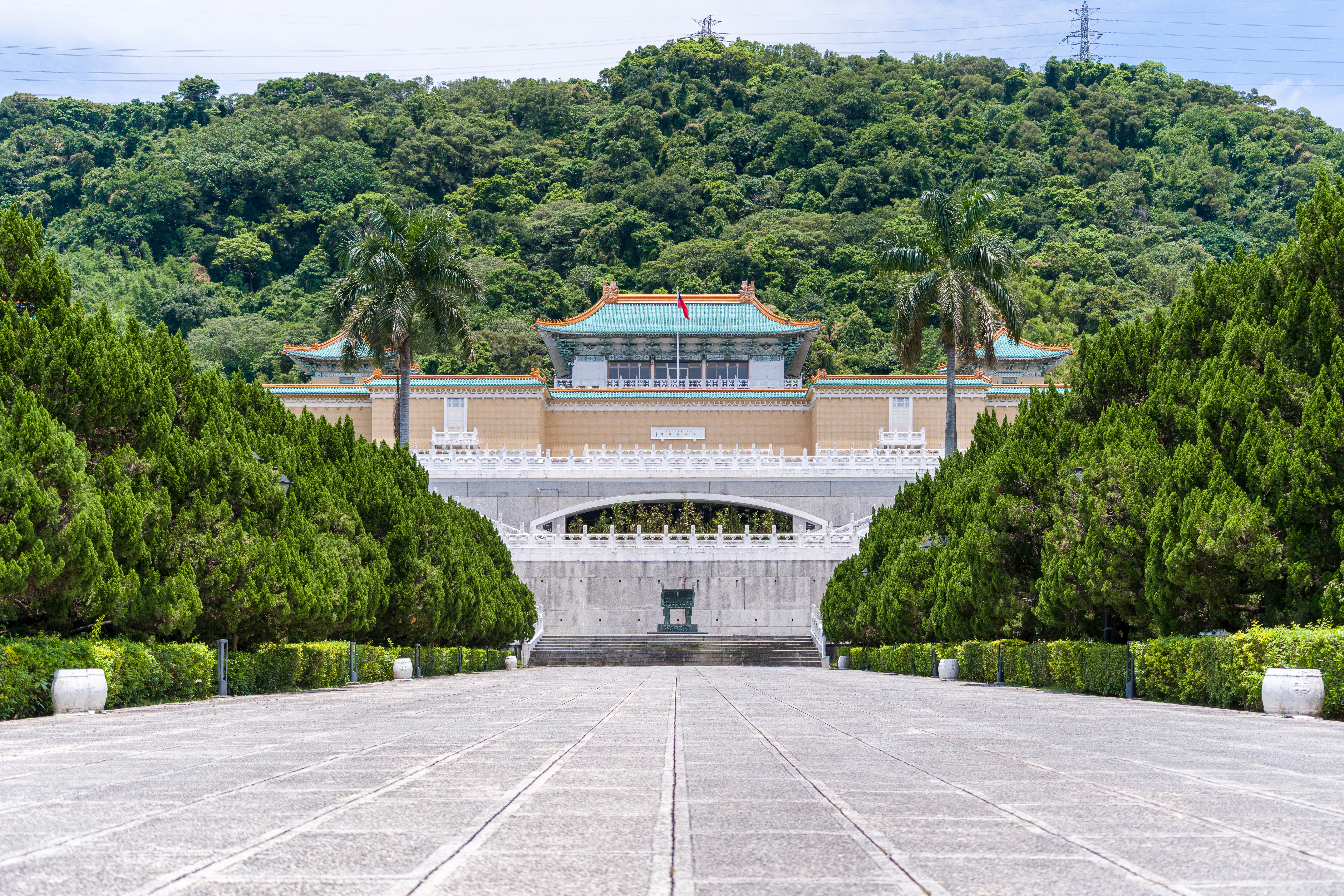
What you actually meet is calmer than the arithmetic suggests. A wide pale forecourt, a memorial arch, a flight of steps up to a building with a green tiled roof grafted onto 1960s concrete. Inside the air is cold and dry — conservation cold — and the loudest sounds are shoe soles on stone and a guide somewhere ahead counting heads in Japanese.
The crowds cluster in predictable places. Two of them, the jadeite carved to follow the stone's own green-and-white flaw and the small piece of banded jasper cut to look like braised pork belly, draw queues that snake around the case. Walk the other way first. The bronzes, the Ru ware, the Song calligraphy — those rooms are frequently near-empty, and they are where the collection's argument is really made.
Getting here is a small commitment from central Taipei: MRT to Shilin, then a bus up Zhishan Road, and the museum sits far enough uphill that the city noise drops away. Give it a half day minimum. Give it a full one if you intend to include the gardens, and eat before you arrive rather than after.
Taipei Travel Guide 2026 | 25 Best Things to Do in Taiwan's Capital
Island Hopper TV01 What to see.
The Jadeite Cabbage and the Jade Galleries
Everyone queues for the cabbage, and almost everyone looks at the wrong part of it. The carver took a flawed block of jadeite — one end cloudy white, one end green — and turned the defect into a bok choy with pale stem and leafy top, about the length of a dinner fork. Then look closer at the leaves.
Two insects sit up there, camouflaged in the green, traditionally read as a wish for many descendants. That's the whole object's argument in miniature: nothing here is decoration for its own sake.
Stay on the third floor afterwards, in the jade rooms (306 and 308), where the collection quietly turns into a history of collecting. The museum's own route notes point out a prehistoric jade that the Qianlong emperor had inscribed with his poetry — carved at an orientation that fights the original object's own. An eighteenth-century man writing over something several thousand years older, and getting it slightly wrong.
The Ceramics Rooms on the Second Floor
Song dynasty ceramics reward the kind of looking most museums make impossible, and this is where the crowds thin out. The permanent displays run through galleries 201, 205 and 207, and the pleasure is entirely in surfaces: glaze that pools, thickens, and slides.
The museum's guides point out two details worth hunting. A Ding ware pillow carries "tear marks" — glaze that ran during firing and froze mid-drip. A Ru ware warming bowl shows tiny spur marks on its base, the scars where it sat on supports inside the kiln.
Both are evidence of a kiln that no longer exists and hands that left fingerprints in the wrong way. Ru ware survives in roughly ninety pieces worldwide. Standing in front of one, knowing that, changes the temperature of the room.
A Route That Actually Works: Top Down, Then Outside
Do this backwards from what the signage suggests. Ride straight to the third floor and start with bronzes, inkstones and jades while your eyes are fresh, then work down through ceramics on the second and religious sculpture and Qing court life on the first. The marquee icons pull a crush of tour groups in the morning; the bronze and jade rooms rarely do.
When your concentration goes — and it will, around ninety minutes — stop at Sanxitang on the fourth floor for tea before you're too tired to enjoy it. Then go outside. Both gardens are free and open with the museum.
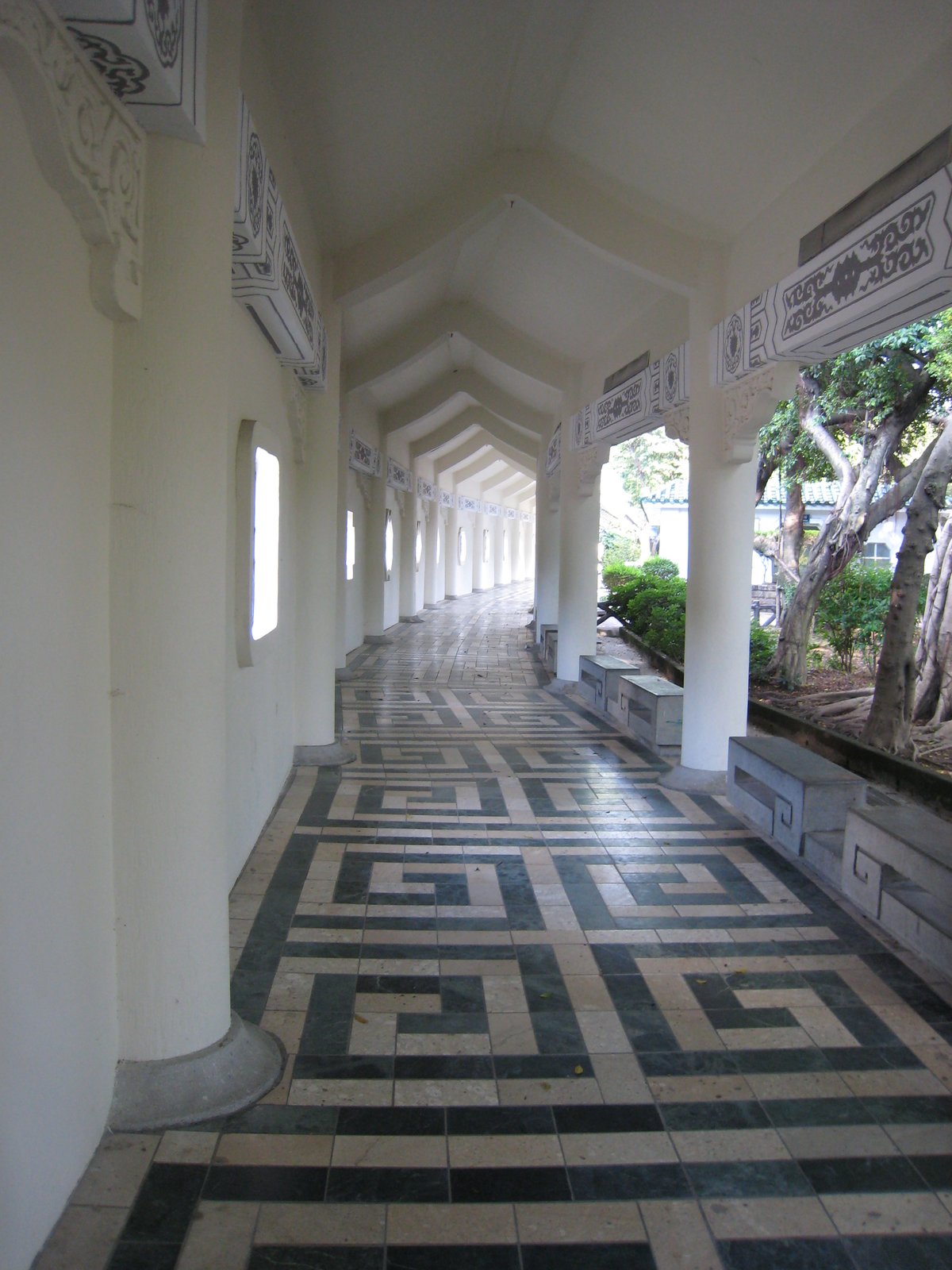
Zhishan Garden, begun in 1984, is the bigger one: ponds, rockwork, bridges, winding paths, and pavilion beams engraved with couplets in the calligraphy of earlier scholars that nearly everyone walks under without glancing up. Zhide Garden is smaller and softer, best in the early morning during lotus and water-lily season. On the way back, take thirty seconds in the forecourt to look at the arrival sequence properly — the six-column memorial archway, the paired huabiao columns, the whole thing staged along one axis so that the building reads like a palace from a distance. It's reinforced concrete and granite, built in 1965. The illusion is deliberate, and it works.
Plan and listen to National Palace Museum with Audiala.
Audio guide in your pocket, itinerary in your browser. Built for the way you actually visit.
03 Visitor logistics.
The practical scaffolding for a good visit — kept short.
Getting There
No MRT reaches the museum — every route ends in a bus. Take the Red Line to Shilin (R16), Exit 1, walk two minutes to the Zhongzheng Rd. stop and catch bus 紅30 (Red 30): NT$15, about 15 minutes, and it terminates inside the compound at the Exhibition Hall I B1 entrance. Buses 小18, 255區, 300, 304 and 815 stop on the road below and leave you an uphill climb; from the Brown Line, Jiannan Rd. (BR15) plus bus 棕20 or 藍7 takes roughly 10 minutes. Walking from Shilin is 2.5 km and ends on a slope — don't.
Opening Hours
Standard 2026 hours are 09:00–17:00 with last tickets at 16:30, closed Mondays apart from a long published list of special Monday openings (8/10, 8/17, 8/24, 8/31, 9/7 among them). A trial running 8 August–13 September 2026 opens Exhibition Hall I daily 09:00–19:00, last ticket 18:30. Hours here change often, so check the official calendar against your date rather than trusting an aggregator.
Time Needed
Ninety minutes to two hours covers the headline objects — bronzes, Song ceramics, whatever star pieces are on rotation. Three hours is the standard visit; half a day if you add lunch and Zhishan Garden. Taipei regulars will tell you two focused hours in one gallery beats a forced march through all four floors, and the museum publishes themed routes for exactly that.
Tickets & Audio Guide
As of 2026, general admission is NT$350, concession NT$150 for ROC ID or ISIC holders, and free for anyone under 18 regardless of nationality. ROC seniors 65+ enter free on weekdays, NT$75 at weekends. The personal audio guide costs NT$200 in thirteen languages plus a sign-language track — the NT$150 figure on English blogs is the Chiayi branch. Free days include 1 January, Lantern Festival, 18 May, 27 September and 10 October, plus a centenary window of 16–18 May 2026.
Accessibility
The ceremonial front approach is a long flight of stairs; ignore it and use the B1 entrance, which is where the low-floor 紅30 bus terminates. Wheelchairs are loaned at the B1 information desk and the 1F cloakroom, strollers at the cloakroom, and lifts run B1↔1F on the west side plus 1F↔4F inside the ticketed zone. Nursing rooms sit on both sides of the B1 entrance hall, and 3 of the 88 car spaces are accessible.
04 Tips for visitors.
Small things that change the day.
Photography Is Allowed Now
The decades-long camera ban ended on 1 September 2016, so phone shots of bronzes, jades and porcelains are fine — no flash, no tripod, no selfie stick, no group shots over nine people. Signed rooms, especially light-sensitive painting and calligraphy and any loan-in special exhibition, are still strictly enforced, and staff will stop you in the gift shop.
Anything Bigger Than A3
Backpacks, suitcases and umbrellas larger than an A3 sheet go into the Hall I cloakroom on the first floor. Storage is free and the lockers take a coin you get back. Past the doors, bottled water is the only drink permitted and food is not.
The Bronze Cauldron Beef Noodle
Silks Palace on the compound serves its beef noodle in a bowl copying the Mao Gong Ding — upright handles, three hoof feet, ring decor — and it's the one museum restaurant Taipei locals genuinely recommend. Splurge, closed Mondays, dinner 17:00–20:30 so it works after closing. Cheaper on site: 三希堂 tea house on 4F for gold-leaf honey cake and valley views (two-hour seating limit at weekends), or the 閒居賦 café on 1F.
The Cabbage Might Be In Chiayi
The Jadeite Cabbage and Meat-shaped Stone rotate between the Taipei and southern branches — the cabbage was announced as returning north in February 2026, but check the current-exhibitions page before promising anyone. Locals nickname the pair 酸菜白肉鍋, pickled-cabbage-and-pork hotpot, because together they make a meal. Connoisseurs will tell you the calligraphy and Song ceramics are the real reason to come.
Arrive At Nine Or After Four
Coach tours own the building from mid-morning to early afternoon; the queue at 09:00 and the rooms after 16:30 are a different museum entirely. While the 19:00 trial runs to 13 September 2026, the 17:00–19:00 block is the emptiest slot of the year. Galleries are chilled hard for conservation, so carry a layer even in an August that's 34°C outside.
The Real Risk Is Downhill
Nothing here threatens you — the danger is Shilin Night Market, 15 minutes away by the same bus. Pickpockets work the Friday and Saturday crush and deliberately pick foreign tourists who won't file a report; Shilin police logged 16 theft cases around Dadong and Danan Roads between January and July 2026. Cut-fruit and dice-beef stalls are the classic gouge: if no price is posted, walk away, and if they weigh by 兩, get the total in NT$ before anyone starts cutting.
Cross The Road Afterwards
The Shung Ye Museum of Formosan Aborigines sits directly opposite on Zhishan Rd. and gets skipped by nearly every guidebook — the indigenous half of Taiwan's story, twenty minutes' walk from the imperial half. Zhishan Garden inside the precinct is free with your museum ticket (NT$20 without) and the best place on the hill to sit down.
Read The Lintel
Carved above the front door is 中山博物院 — Sun Yat-sen Museum — with the 故宮 plaque hung off to one side like a sub-tenant, because the 1965 building was named for the scenario where the treasures eventually went back to Beijing. That expectation of departure is why the halls feel cramped for 700,000 objects. Renovation continues through 2026 and the main hall's heritage plan was rejected by the city in mid-2025, so expect scaffolding, closed sections and diverted routes.
05 An Empire, Inventoried
Most museums acquire. This one was created by an act of confiscation, and the paperwork survives. The Palace Museum in Beijing opened on 10 October 1925 — a date the museum's own records confirm — in rooms an emperor had been living in eleven months earlier.
Everything that came afterwards, including the long wartime displacement and the crates that reached Taiwan in 1948 and 1949, follows from that founding decision: that a dynasty's private possessions were now public property, and that somebody had to write them all down.
Out by Nightfall: Puyi, 5 November 1924
The story visitors usually carry up the steps is a simple one about a civil war. Chiang Kai-shek's side lost the mainland, took the treasure, and shipped it here. Neat, and roughly a quarter true.
But the museum existed before any of that, and it was not founded by the Nationalists at all. Museum accounts place the beginning in a Beijing coup in late October 1924, when the warlord Feng Yuxiang seized the capital — though the precise chronology of those weeks rests largely on a single institutional history, so treat the individual dates as provisional.
Then came the part nobody planned as culture. On 4 November 1924 the regent premier Huang Fu forced through revised terms stripping Puyi of his imperial status; the next day officials including Lu Zhonglin and Zhang Bi walked into the Forbidden City to tell an eighteen-year-old former emperor that the only home he had ever known was no longer his. He had hours, not weeks. On 6 November the state stood up a Committee for the Disposition of the Qing Imperial Possessions, and clerks began counting bronzes, scrolls, jades and enamels that had never once been listed as objects rather than as belongings. When the National Government took over in June 1928 and appointed Yi Peiji as director, the counting simply continued under a new flag.
So look again at the small inventory numbers and old inked labels where they are still visible. They are not curatorial housekeeping. They are the residue of the week an empire became a catalogue, written by people who did not know yet whether their work would be protected or looted — and who, according to the museum's own account, needed figures like Zhuang Yunkuan and Chen Yuan to shield the place from the warlord factions circling it.
The Long Displacement
Whose Palace Museum?
Listen to the full story in the app
The whole National Palace Museum,
told well.
Audio guides for 1,100+ cities across 96 countries. History, stories, and local insight — offline ready.
06 Frequently asked.
The questions travellers send us most about National Palace Museum.
Is the National Palace Museum worth visiting?
Yes, and not only for the jade. The collection runs to roughly 700,000 objects drawn from the Qing court in Beijing and from the Republic's Central Museum in Nanjing, hauled west, then south, then across the strait — so what you're looking at is also an argument about who inherits Chinese civilisation. Go knowing that and the bronzes stop being pretty metal.
How long do you need at the National Palace Museum?
Three hours is the honest number for a standard visit. You can do the headline objects and a sweep of bronzes and ceramics in 90 minutes to two hours; add Zhishan Garden and a meal and you've spent half a day. Locals will tell you two focused hours on one floor beats a forced march through all four.
How do I get to the National Palace Museum from Taipei city centre?
Take the MRT Red Line to Shilin (R16), leave by Exit 1, then catch a bus from Zhongzheng Road — about 15 minutes. Bus 紅30 is the one you want: it's low-floor and terminates at the B1 entrance of Exhibition Hall I, inside the compound, while routes 小18, 255區, 300, 304 and 815 drop you on the road below with an uphill walk left. The fare is NT$15 by cash or EasyCard. No MRT station serves the museum directly, whatever old blogs claim.
How much does it cost to visit the National Palace Museum?
General admission is NT$350. Under-18s of any nationality get in free, as do disabled visitors plus one companion; ROC ID and ISIC holders pay NT$150. Free days come round on 1 January, Lantern Festival, 18 May, 27 September and 10 October — and the museum ran a free window across 16-18 May 2026 for its centenary-plus-one programme.
What is the best time to visit the National Palace Museum?
Arrive at 09:00 opening or come after 16:00, and pick a weekday. Coach groups land mid-morning and stay through early afternoon, which is when the queue past the star objects turns into a one-way conveyor with no stopping. Between 8 August and 13 September 2026 the museum is trialling daily opening until 19:00 with discounted entry after 16:30, so that last two-hour block is the emptiest the galleries get all year.
Can you take photos in the National Palace Museum?
Yes, in most galleries — the decades-long ban was lifted on 1 September 2016. No flash, no tripods, no selfie sticks, no extra lighting, and no group shots of more than nine people. Painting and calligraphy rooms and loan-in special exhibitions are often signed no-photography and staff enforce it; during the August-September 2026 extended hours, Galleries 103-104 are off limits to cameras entirely.
Is the Jadeite Cabbage at the National Palace Museum in Taipei?
Sometimes — it rotates between the Taipei and Chiayi branches, and it was announced as returning to Taipei in February 2026. Check the current-exhibition page before you build a day around it. When you do find it, look past the cabbage at the two insects on the leaves, a katydid and a locust, carved as a wish for many descendants.
What should I not miss at the National Palace Museum?
The third floor, which is where the slow looking pays off: bronzes in 305 and 307, jades in 306 and 308, inkstones in 303. Look for the prehistoric jade that Qianlong had a poem carved onto centuries later, the inscription running against the object's own orientation — a collector overwriting the thing he collected. Then walk out to Zhishan Garden, free with your ticket, and read the couplets carved into the pavilion beams that everyone photographing the pond walks straight under.
What is there to eat at the National Palace Museum?
Silks Palace on the compound is the one museum restaurant Taipei locals actually recommend, run by the Regent group and famous for serving beef noodle soup in a bowl shaped like the Mao Gong Ding bronze cauldron, handles and hoof feet included. Inside Exhibition Hall I, Sanxitang on the fourth floor does Taiwanese tea and a gold-leaf honey cake with a view over the hills, 09:00-17:00 with last orders at 16:00. Both close Mondays. Silks Palace serves dinner until 20:30, well past museum closing.
Is the National Palace Museum accessible for wheelchair users?
Yes, though you must use the B1 entrance rather than the ceremonial front stairs. That's where bus 紅30 terminates and where two accessible lifts run up to 1F; a third lift inside the ticketed zone covers 1F to 4F, so every gallery is reachable. Wheelchairs are loaned free from the B1 information desk and the 1F cloakroom, strollers from the cloakroom, and three accessible parking spaces sit in the car park.
Verified, and shown.
Researched and written by the Audiala editorial team from historical records, architectural archives, and local expertise.
Opening hours, the 8 August-13 September 2026 daily extended-opening trial to 19:00, Chang Dai-chien Residence and garden access.
NT$350 general admission, concession and free-entry categories, annual free-admission days including 18 May and 10 October.
Bag check-in rules for items larger than A3, photography restrictions, prohibited items, online booking and hotline details.
MRT Shilin R16 and Jiannan Rd BR15 routes, bus numbers including 紅30 terminating at the Exhibition Hall I B1 entrance.
Wheelchair and stroller loan points, accessible lift locations in Exhibition Halls I and II, nursing rooms, accessible parking.
NT$200 adult multimedia guide rental, NT$150 children's guide, full language list including sign language and audio description.
Route notes on the Jadeite Cabbage insects, Ding ware glaze tear marks, Ru ware spur marks, and the Qianlong poem carved onto a prehistoric jade.
Third-floor gallery layout: bronzes in 305/307, jades in 306/308, inkstones in 303, rococo crafts in 300-301.
Zhishan Garden and Zhide Garden layout, the Tianxiaweigong archway and huabiao forecourt, seasonal flowering.
1965 Taipei opening, later expansions, Zhishan Garden construction from 1984, pavilion couplet inscriptions.
Official notice of the 8 August-13 September 2026 daily 19:00 closing trial, discounted entry after 16:30, and the no-photography rule in Galleries 103-104.
Sanxitang tea house on 4F and the 1F café: hours, last orders, Monday closure, weekend seating limits.
Restaurant hours including dinner service past museum closing, and the replica-artefact signature dishes.
The 1 September 2016 policy change, the permanent bans on flash, tripods and selfie sticks, and the nine-person group photo limit.
The Central Museum origin of much of the collection, the 中山博物院 lintel inscription, and the museum as a legitimacy claim.
Confirmation that the star objects rotate between the northern and southern branches.
Ongoing construction, the barrier-free Zhishan Road passage, and the stalled main-hall heritage restoration plan.
Free admission at both branches 16-18 May 2026.
Recommended visit durations and crowd timing advice.
88 car spaces including 3 accessible, coach and scooter provision, weekday and weekend rates.
Researched from Wikidata, Wikipedia & official sources · fact-checked · How we make our guides →