
An introduction.
Researched by the Audiala editorial team from historical records, architectural archives, and local expertise.
OOne of the grandest Gothic cathedrals ever built in East Asia no longer exists — but the congregation that lost it to American bombs in 1945 rebuilt on the same ground, and the Immaculate Conception Cathedral still stands on Minsheng West Road in Taipei, Taiwan. It's quieter than you'd expect from the seat of an archdiocese, more modest than its predecessor by a wide margin, and precisely for those reasons, it tells a story most churches can't.
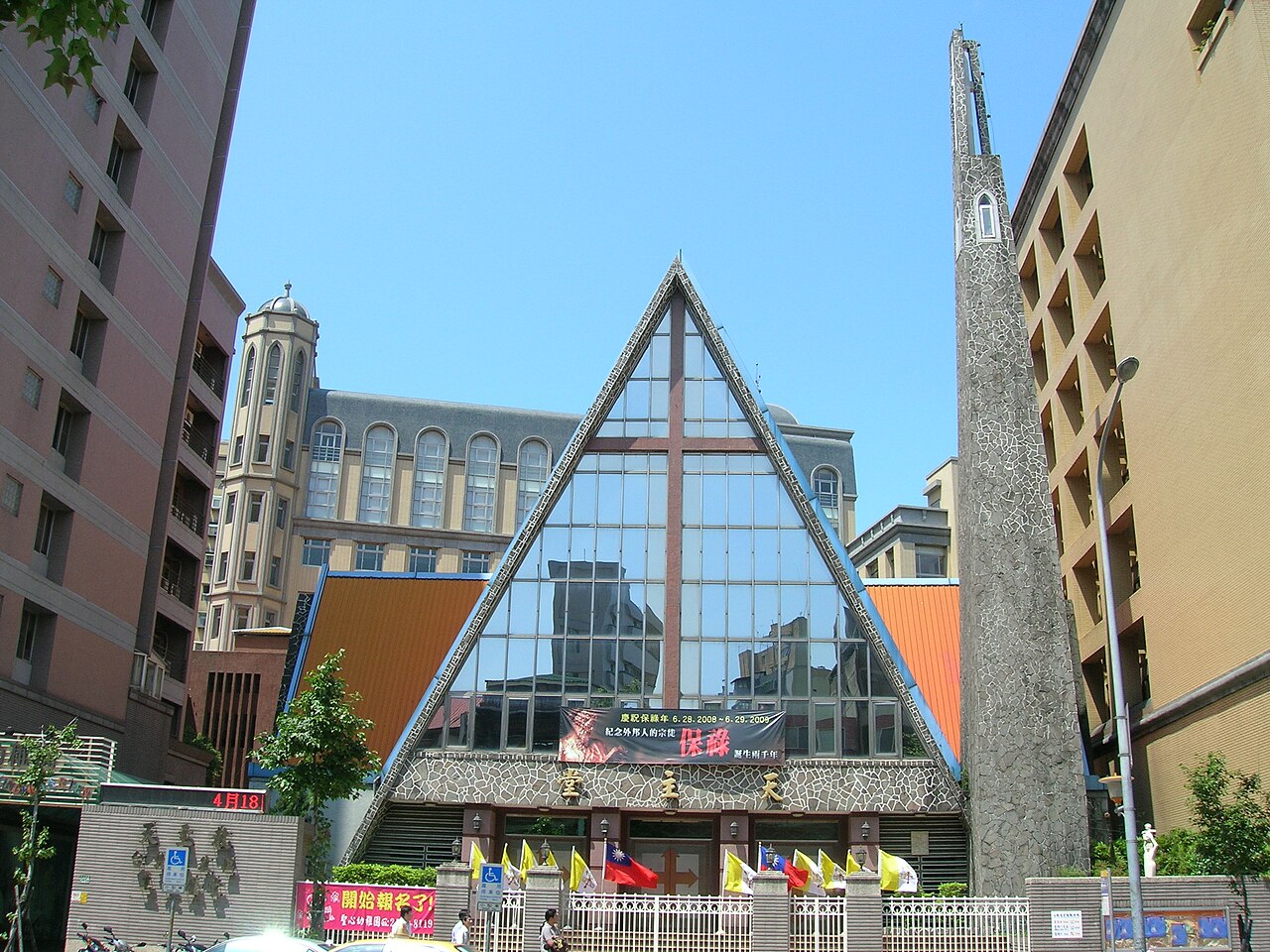
The current building, completed in 1961, sits in Datong District — a neighborhood that was once the commercial heart of Japanese-era Taipei. Walk past the entrance on a Tuesday afternoon and you might not give it a second look. The facade is plain, almost bureaucratic. But step inside and the pointed arches overhead betray the building's ambition: this is a cathedral that remembers what it used to be.
What draws visitors here isn't spectacle. It's the weight of continuity. The same patch of earth has served Catholic worship since 1914, through colonial rule, aerial bombardment, political upheaval, and reconstruction. The light inside is cool and even, filtered through windows that replaced ones shattered by 3,800 bombs dropped in a single afternoon. Silence here feels earned, not designed.
For travelers exploring Taipei, this cathedral offers something the city's temples and night markets don't: a place where 20th-century history left visible scars and then quietly healed them.
01 What to see.
The Main Sanctuary
The Side Chapel
A Walk Through Datong: Cathedral to Neighborhood
02 In pictures.




Plan and listen to Immaculate Conception Cathedral, Taipei with Audiala.
Audio guide in your pocket, itinerary in your browser. Built for the way you actually visit.
03 Visitor logistics.
The practical scaffolding for a good visit — kept short.
Getting There
Take the MRT Red Line to Shuanglian Station (exits 1 or 2) or the Orange Line to Daqiaotou Station (exits 2 or 3) — either is a flat 10–15 minute walk. Bus route 518 drops you at the Jingxiu Girls' High School stop, practically at the front door. Skip driving: there's no dedicated parking, and street spots in Datong District vanish faster than free samples at Ningxia Night Market.
Opening Hours
As of 2026, the cathedral is generally open daily from around 7:30 AM to 4:00–6:00 PM, though hours flex around parish activities. Weekday Mass runs at 7:30 AM, Saturday vigil at 5:00 PM, and Sunday Mass at 9:00 AM. During services, access is reserved for worshippers — plan around those windows if you're visiting purely to see the building.
Time Needed
A focused look at the interior and courtyard takes 15–20 minutes. If you want to sit with the silence, read the historical markers, and absorb the pointed arches overhead, allow 45 minutes. This isn't a place that rewards rushing — the scale is modest, but the atmosphere earns its time.
Cost
Entry is free. No tickets, no audio guides, no booking system. If a third-party travel site tries to sell you a "skip-the-line" pass for this cathedral, that's money you should spend on oyster omelets instead.
Accessibility
The surrounding terrain is flat urban sidewalk, and the main entrance is generally wheelchair accessible. Interior facilities in this 1961 building may have limitations — call the parish office at 02-2557-4874 ahead of your visit if you need specific assistance.
05 Tips for visitors.
Small things that change the day.
Dress Respectfully
Cover shoulders and knees before entering — this is an active parish, not a museum. Staff won't turn you away for shorts, but you'll feel the quiet judgment of a dozen grandmothers at Tuesday evening Legion of Mary meetings.
Photography Etiquette
Discreet photos are fine in the courtyard and nave when no service is underway. Flash is unwelcome, and photographing parishioners at prayer crosses a line. Drones are illegal in Taipei City without a permit — don't even think about it.
Eat at Ningxia After
Ningxia Night Market is a five-minute walk south and one of Taipei's best food streets. Budget picks: oyster omelets, pork liver soup at Rong Zai (榮仔), and fried taro balls at Liu Yu Zi. For a splurge, Le Palais at the Palais de Chine Hotel holds Michelin stars and is ten minutes on foot.
Visit Mid-Morning
Arrive between 10:00 and 11:30 AM — after weekday Mass clears out but before the midday heat makes the walk from the MRT unpleasant. The interior light is best in the morning, and you'll likely have the nave to yourself.
Working Church First
Some guidebooks frame this as an architectural curiosity. It isn't — it's the seat of the Archdiocese of Taipei, rebuilt by its congregation after Allied bombs leveled the original in 1945. If Mass is in session, either join quietly or come back later.
Night Market Awareness
The Datong District is very safe by any global standard, but Ningxia Night Market draws crowds — keep your phone in a front pocket and your bag zipped. No specific scams target the cathedral area.
Where to Eat
Don't Leave Without Trying
Dining Tips
- check Ningxia Night Market is the premier food destination in the Datong district, famous for high concentration of traditional Taiwanese snacks and within walking distance of the Cathedral.
- check Many local bakeries and quick-bite spots operate extended evening hours—perfect for late-night snacking after exploring the neighborhood.
- check When visiting the Cathedral, verify Mass times directly with the parish office upon arrival, as online information can be outdated.
- check Cash is still widely accepted at local eateries; have small bills ready for street food vendors and bakeries.
Restaurant data powered by Google
04 A history of reinvention.
Twice Built, Once Destroyed
Catholic roots in northern Taiwan stretch back to 1626, when Spanish Dominicans established a mission near Keelung. But the story of this particular site begins around 1905, when a Spanish priest named Lin Mao-cai reportedly acquired the land in what was then the Penglaicho neighborhood of Japanese-ruled Taipei. Construction of a full-scale cathedral started in 1911 and was completed in 1914 — a Gothic structure so imposing that contemporary accounts describe it as one of the most magnificent buildings in the colonial capital.
That building survived three decades of Japanese rule. It did not survive the war that ended it.
Cardinal Tien and the Cathedral That Rose from Rubble
On May 31, 1945, 117 American B-24 Liberators appeared over Taipei. They dropped roughly 3,800 bombs — enough to level entire city blocks and kill over 3,000 civilians in a single afternoon. The Penglaicho Cathedral, with its soaring Gothic arches and bell tower, was among the casualties. What remained was a shell, gutted by fire and shrapnel.
For fourteen years, the ruins stood as a kind of open wound. The congregation worshipped in temporary spaces while Taiwan itself transformed — the Japanese departed, the Republic of China government arrived from the mainland, and in 1952, Pope Pius XII elevated Taipei to an archdiocese. The cathedral's ruins were now, officially, the seat of something that demanded a building. But money was scarce and the island was consumed with Cold War survival.
The turning point came with Cardinal Thomas Tien Ken-sin, appointed Acting Archbishop in 1959. Tien — the first Chinese cardinal in Catholic history — had fled mainland China after the Communist revolution. He understood what it meant to rebuild from nothing. Under his direction, reconstruction began that same year. By May 1961, the new cathedral was complete: simpler, smaller, stripped of Gothic grandeur but structurally sound. Tien had traded spectacle for permanence. The congregation, many of them mainland refugees themselves, finally had a home again.
The Ghost of the Gothic Original
From Prefecture to Archdiocese
Listen to the full story in the app
The whole Immaculate Conception Cathedral, Taipei,
told well.
Audio guides for 1,100+ cities across 96 countries. History, stories, and local insight — offline ready.

06 Frequently asked.
The questions travellers send us most about Immaculate Conception Cathedral, Taipei.
Is Immaculate Conception Cathedral Taipei worth visiting?
Yes, but adjust your expectations — this isn't a soaring European Gothic cathedral. The current 1961 building is modest and modern, rebuilt after Allied bombers leveled the original 1914 structure on May 31, 1945. What makes it worth your time is the quiet weight of that story: you're standing on the exact foundations where one of Japanese-era Taipei's grandest buildings once stood, in a neighborhood that still carries the scars and energy of old Datong District. Pair it with a walk to the Ningxia Night Market a few minutes away and you have a genuinely layered afternoon.
Can you visit Immaculate Conception Cathedral Taipei for free?
Entry is completely free. The cathedral is a working parish, not a ticketed attraction. Ignore any third-party travel sites offering "skip-the-line" passes — there is no line, and there is no ticket.
How do I get to Immaculate Conception Cathedral from Taipei city center?
Take the MRT Red Line to Shuanglian Station and use Exit 1 or 2, then walk west for about 10–15 minutes along Minsheng West Road. You can also reach it from Daqiaotou Station on the Orange Line via Exit 2 or 3, roughly the same distance. Bus route 518 stops at Jingxiu Girls' High School, which is right next door. Don't drive — street parking in Datong District is a headache not worth earning.
What is the best time to visit Immaculate Conception Cathedral Taipei?
Mid-week mornings offer the deepest quiet, especially right after the 7:30 AM weekday Mass clears out. Sunday at 9:00 AM is when the parish comes alive with its full congregation — a different experience, more communal, but not ideal for wandering the interior at your own pace. If you want to see the exterior at its most striking, come after dark when the façade is lit against the dense urban backdrop of Minsheng West Road.
How long do you need at Immaculate Conception Cathedral Taipei?
A focused visit takes 15–20 minutes. If you linger in the small side chapel, read the historical markers, and take in the grounds near the adjacent Jingxiu Girls' High School campus, budget closer to 45 minutes. The cathedral rewards a slower pace more than a longer one.
What should I not miss at Immaculate Conception Cathedral Taipei?
Look for the historical markers near the entrance that acknowledge the 1945 bombing — most visitors walk right past them. The small side chapel is quieter and more meditative than the main nave. And before you leave, stand across Minsheng West Road and consider what you're actually looking at: a community that rebuilt its spiritual center from rubble, twice choosing faith over the easier option of walking away.
What is the dress code for Immaculate Conception Cathedral Taipei?
Cover your shoulders and knees — standard respectful attire for a functioning Catholic church. This isn't enforced with bouncers at the door, but you'll feel out of place in beachwear or tank tops. Photography is allowed if you're discreet, but skip the flash entirely, especially during prayer or Mass.
Is Immaculate Conception Cathedral the oldest church in Taipei?
The site has hosted a Catholic parish since 1914, making it the oldest Catholic parish location in Taipei — but the building you see today dates to 1961. The original Gothic cathedral, completed in 1914 and once considered one of the most striking structures in the city, was destroyed by Allied bombing on May 31, 1945. Some guidebooks blur this distinction, so don't arrive expecting centuries-old stonework.
Verified, and shown.
Researched and written by the Audiala editorial team from historical records, architectural archives, and local expertise.
Official parish information including Mass schedule, history, leadership changes, and founding dates (1905 land acquisition, 1911 construction start, 1914 completion, 1945 bombing, 1961 reconstruction).
Cathedral chronicle confirming key historical dates including the 1914 completion and 1961 consecration on May 30.
Historical overview of the cathedral including Fr. Lin Mao-cai's role, the 1905 land acquisition, and details of the 1945 bombing destruction.
General overview of the cathedral's history, 1959 reconstruction start date, and MRT access information.
Chinese-language article with details on the original Gothic structure, its significance during the Japanese colonial era, and the 1914 dedication to St. Peter and St. Paul.
Details of the May 31, 1945 Allied bombing of Taipei, including the 117 B-24 Liberators and approximately 3,800 bombs dropped.
Historical photos and reporting on the 1945 destruction and subsequent reconstruction of the cathedral.
Feature story on the destroyed 1914 cathedral with archival photographs and descriptions of the post-war community's determination to rebuild.
Visitor information confirming free admission and general opening hours.
Aggregated visitor reviews describing the atmosphere, welcoming parish priests, and sensory experience of the cathedral interior.
Local and visitor reviews describing the cathedral's peaceful atmosphere and neighborhood context.
Encyclopedic reference confirming the 1626 Dominican missions, 1911 construction start, 1952 archdiocesan elevation, and 1961 reconstruction completion.
Last reviewed
Researched from Wikidata, Wikipedia & official sources · fact-checked · How we make our guides →


