Type 2+ letters to search all countries, cities, and places
/Ctrl KEsc
travel_explore
Type 2+ letters to search all countries, cities, and places
Press Enter to open the top result
Immaculate Conception Cathedral, Taipei
Taipei·Taiwan·25° N · 121° E·Updated Apr 2026
Bombed to rubble in 1945 and rebuilt by hand, Taipei's oldest Catholic cathedral stands steps from a night market, free to enter, and almost always quiet.
One of the grandest Gothic cathedrals ever built in East Asia no longer exists — but the congregation that lost it to American bombs in 1945 rebuilt on the same ground, and the Immaculate Conception Cathedral still stands on Minsheng West Road in Taipei, Taiwan. It's quieter than you'd expect from the seat of an archdiocese, more modest than its predecessor by a wide margin, and precisely for those reasons, it tells a story most churches can't.
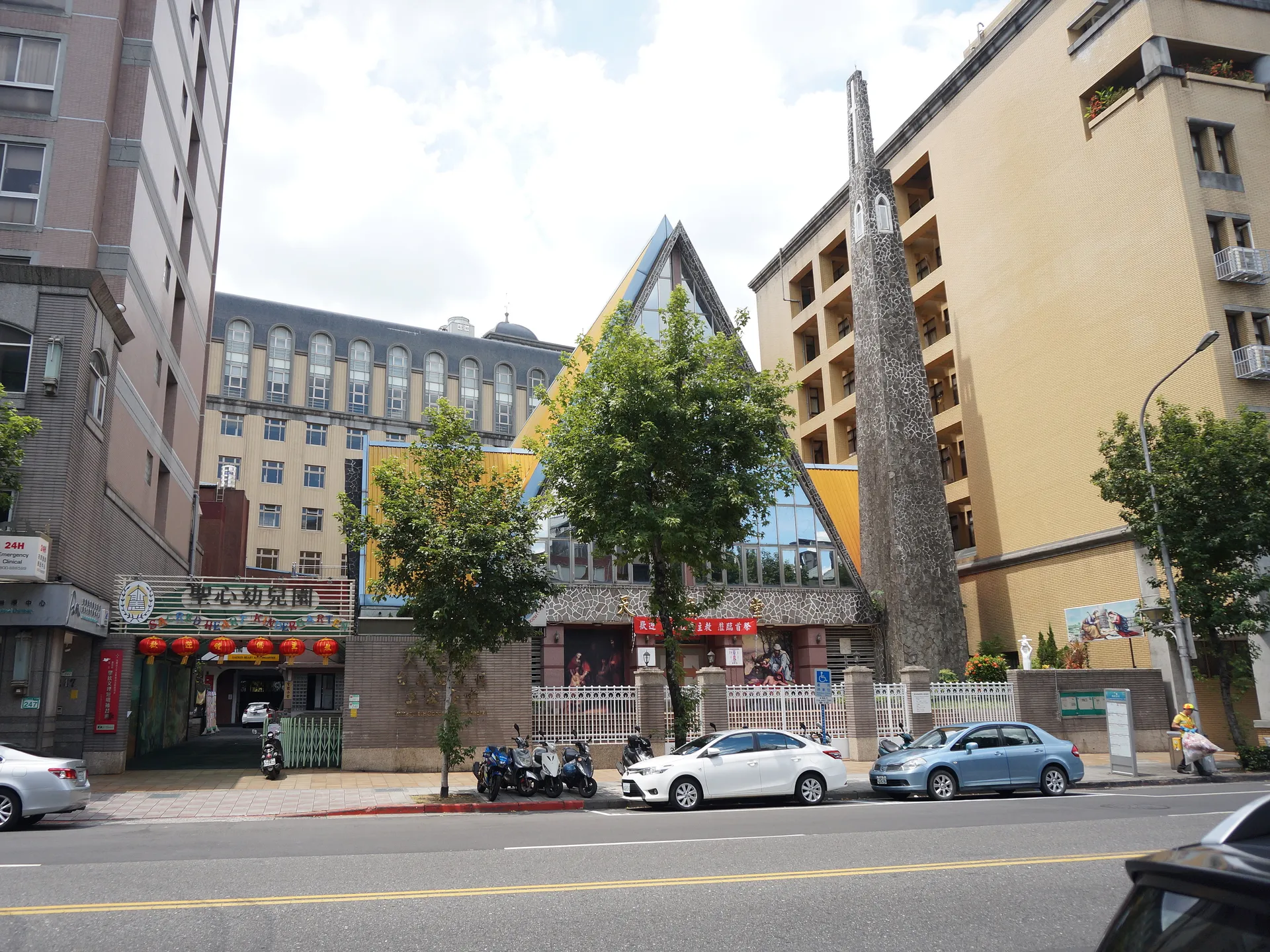
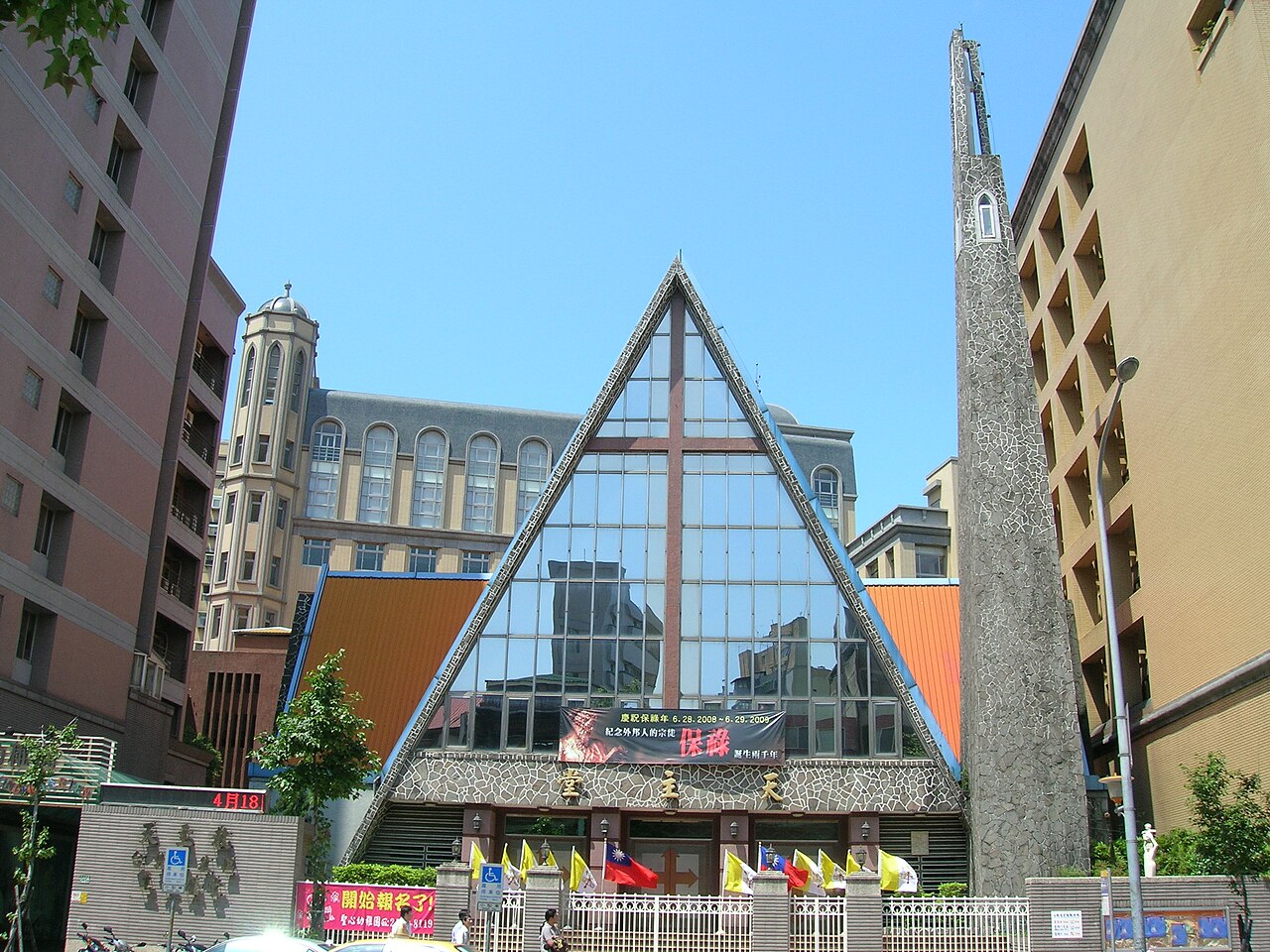
The current building, completed in 1961, sits in Datong District — a neighborhood that was once the commercial heart of Japanese-era Taipei. Walk past the entrance on a Tuesday afternoon and you might not give it a second look. The facade is plain, almost bureaucratic. But step inside and the pointed arches overhead betray the building's ambition: this is a cathedral that remembers what it used to be.
What draws visitors here isn't spectacle. It's the weight of continuity. The same patch of earth has served Catholic worship since 1914, through colonial rule, aerial bombardment, political upheaval, and reconstruction. The light inside is cool and even, filtered through windows that replaced ones shattered by 3,800 bombs dropped in a single afternoon. Silence here feels earned, not designed.
For travelers exploring Taipei, this cathedral offers something the city's temples and night markets don't: a place where 20th-century history left visible scars and then quietly healed them.
Researched by the Audiala editorial team from historical records, architectural archives, and local expertise.
What to see
The Main Sanctuary
The nave of the Immaculate Conception Cathedral confesses something quietly devastating: it is not the building that was supposed to be here. The original 1914 Penglaicho Cathedral — a soaring Gothic structure with spires and vaults, once considered among the finest buildings in colonial-era Taipei — was leveled by Allied bombing on May 31, 1945. What rose in its place by 1961 is deliberately modest, built from post-war concrete and mid-century pragmatism rather than ornate stone. The pointed arches in the ceiling are the only architectural echo of the Gothic predecessor, like a ghost's fingerprint on a new wall. Step inside on a weekday morning and the silence is almost physical, broken only by the occasional shuffle of shoes on tile. Light falls in clean, unadorned planes. There is no gilded excess here, no competition with European grandeur — just a room that chose honesty over spectacle, and is more affecting for it.
The Side Chapel
Most visitors who wander in from Minsheng West Road stay in the main nave for a few minutes and leave. They miss the smaller side chapel entirely. This is where the cathedral actually breathes. Daily services happen here — often led by Malaysian or Filipino clergy, a reminder that Catholicism in Taipei is genuinely international, not just inherited from the Spanish Dominicans who first arrived in Keelung in 1626. The scale is intimate, roughly the size of a large living room, and the atmosphere shifts from reverent formality to something warmer. Parish priests have been known to offer small tokens of welcome to visitors who sit quietly. If you want to understand this cathedral as a living community rather than a historical footnote, this is the room that tells the truth.
A Walk Through Datong: Cathedral to Neighborhood
Start at Shuanglian MRT Station (Red Line, Exit 2) and walk west along Minsheng West Road for about ten minutes. The cathedral at No. 245 appears without fanfare — no plaza, no grand approach, just a concrete façade set among the dense urban fabric of Datong District. This is part of its character. After visiting, cross the street and look back: the building reads differently from a distance, especially after dark when exterior lighting picks it out from the shopfronts and apartment blocks. Then walk south toward the old neighborhood streets around Jingxiu Girls' High School, founded by Dominicans in 1916 and historically tied to the cathedral's mission. The whole loop takes under an hour and gives you something a cathedral visit alone cannot — the context of a Catholic parish that has survived colonial rule, wartime destruction, and reconstruction, all within a few blocks of Taipei's oldest commercial district.
Plan your visit
Getting There
Take the MRT Red Line to Shuanglian Station (exits 1 or 2) or the Orange Line to Daqiaotou Station (exits 2 or 3) — either is a flat 10–15 minute walk. Bus route 518 drops you at the Jingxiu Girls' High School stop, practically at the front door. Skip driving: there's no dedicated parking, and street spots in Datong District vanish faster than free samples at Ningxia Night Market.
Opening Hours
As of 2026, the cathedral is generally open daily from around 7:30 AM to 4:00–6:00 PM, though hours flex around parish activities. Weekday Mass runs at 7:30 AM, Saturday vigil at 5:00 PM, and Sunday Mass at 9:00 AM. During services, access is reserved for worshippers — plan around those windows if you're visiting purely to see the building.
Time Needed
A focused look at the interior and courtyard takes 15–20 minutes. If you want to sit with the silence, read the historical markers, and absorb the pointed arches overhead, allow 45 minutes. This isn't a place that rewards rushing — the scale is modest, but the atmosphere earns its time.
Cost
Entry is free. No tickets, no audio guides, no booking system. If a third-party travel site tries to sell you a "skip-the-line" pass for this cathedral, that's money you should spend on oyster omelets instead.
Accessibility
The surrounding terrain is flat urban sidewalk, and the main entrance is generally wheelchair accessible. Interior facilities in this 1961 building may have limitations — call the parish office at 02-2557-4874 ahead of your visit if you need specific assistance.
Photo Gallery
The illuminated facade of the Immaculate Conception Cathedral stands out against the night sky in Taipei, Taiwan, as a police vehicle patrols the street. · 玄史生A wide-angle view of the interior of the Immaculate Conception Cathedral in Taipei, Taiwan, capturing a religious service in progress. · 總統府The distinctive triangular facade of the Immaculate Conception Cathedral in Taipei, Taiwan, displays a vibrant message of love and community. · lienyuan leeThe soaring, vaulted ceiling and modern lighting of the Immaculate Conception Cathedral in Taipei create a serene and spiritual atmosphere. · lienyuan leeThe striking A-frame design of the Immaculate Conception Cathedral in Taipei, Taiwan, stands out amidst the surrounding urban architecture. · BigmorrA historical view of the original Immaculate Conception Cathedral in Taipei, showcasing its distinct Gothic architecture and colonial-era design. · 台灣寫真帖 第2卷 第1集,1915年The unique A-frame design of the Immaculate Conception Cathedral in Taipei stands out with its blend of modern glass and traditional stone masonry. · 陳文振
History
Twice Built, Once Destroyed
Catholic roots in northern Taiwan stretch back to 1626, when Spanish Dominicans established a mission near Keelung. But the story of this particular site begins around 1905, when a Spanish priest named Lin Mao-cai reportedly acquired the land in what was then the Penglaicho neighborhood of Japanese-ruled Taipei. Construction of a full-scale cathedral started in 1911 and was completed in 1914 — a Gothic structure so imposing that contemporary accounts describe it as one of the most magnificent buildings in the colonial capital.
That building survived three decades of Japanese rule. It did not survive the war that ended it.
The turning point
Cardinal Tien and the Cathedral That Rose from Rubble
On May 31, 1945, 117 American B-24 Liberators appeared over Taipei. They dropped roughly 3,800 bombs — enough to level entire city blocks and kill over 3,000 civilians in a single afternoon. The Penglaicho Cathedral, with its soaring Gothic arches and bell tower, was among the casualties. What remained was a shell, gutted by fire and shrapnel.
For fourteen years, the ruins stood as a kind of open wound. The congregation worshipped in temporary spaces while Taiwan itself transformed — the Japanese departed, the Republic of China government arrived from the mainland, and in 1952, Pope Pius XII elevated Taipei to an archdiocese. The cathedral's ruins were now, officially, the seat of something that demanded a building. But money was scarce and the island was consumed with Cold War survival.
The turning point came with Cardinal Thomas Tien Ken-sin, appointed Acting Archbishop in 1959. Tien — the first Chinese cardinal in Catholic history — had fled mainland China after the Communist revolution. He understood what it meant to rebuild from nothing. Under his direction, reconstruction began that same year. By May 1961, the new cathedral was complete: simpler, smaller, stripped of Gothic grandeur but structurally sound. Tien had traded spectacle for permanence. The congregation, many of them mainland refugees themselves, finally had a home again.
The Ghost of the Gothic Original
Old photographs of the 1914 cathedral show a building that would look at home in provincial France — pointed spires, ornate stonework, a bell tower visible across the low rooftops of colonial Taipei. During the Japanese era, it was considered one of the city's architectural landmarks, originally dedicated to Saints Peter and Paul. The 1961 replacement kept the pointed ceiling arches as a nod to its predecessor, but the scale is dramatically reduced. Where the original occupied the visual imagination of an entire district, the current structure blends into a streetscape of mid-century apartment blocks and shop fronts. What was lost in 1945 was not just a church but an entire architectural vocabulary.
From Prefecture to Archdiocese
The administrative elevation of Taipei's Catholic community happened in the gap between destruction and reconstruction. On August 7, 1952, Pope Pius XII issued the apostolic constitution Gravia illa Christi, formally establishing the Archdiocese of Taipei. The first Archbishop, Guo Ruo-shi, inherited a flock swollen by mainland Chinese clergy and laity fleeing Communist rule — but no cathedral to seat them in. For seven years, the archdiocese existed as an institution without a physical center, a strange inversion that speaks to the chaos of post-war Taiwan. The completion of the new building in 1961 finally gave the title a home.
Tips for visitors
Dress Respectfully
Cover shoulders and knees before entering — this is an active parish, not a museum. Staff won't turn you away for shorts, but you'll feel the quiet judgment of a dozen grandmothers at Tuesday evening Legion of Mary meetings.
Photography Etiquette
Discreet photos are fine in the courtyard and nave when no service is underway. Flash is unwelcome, and photographing parishioners at prayer crosses a line. Drones are illegal in Taipei City without a permit — don't even think about it.
Eat at Ningxia After
Ningxia Night Market is a five-minute walk south and one of Taipei's best food streets. Budget picks: oyster omelets, pork liver soup at Rong Zai (榮仔), and fried taro balls at Liu Yu Zi. For a splurge, Le Palais at the Palais de Chine Hotel holds Michelin stars and is ten minutes on foot.
Visit Mid-Morning
Arrive between 10:00 and 11:30 AM — after weekday Mass clears out but before the midday heat makes the walk from the MRT unpleasant. The interior light is best in the morning, and you'll likely have the nave to yourself.
Working Church First
Some guidebooks frame this as an architectural curiosity. It isn't — it's the seat of the Archdiocese of Taipei, rebuilt by its congregation after Allied bombs leveled the original in 1945. If Mass is in session, either join quietly or come back later.
Night Market Awareness
The Datong District is very safe by any global standard, but Ningxia Night Market draws crowds — keep your phone in a front pocket and your bag zipped. No specific scams target the cathedral area.
Where to Eat
local_dining
Don't Leave Without Trying
Lu Rou Fan (Braised Pork Rice) — minced pork belly braised in soy sauce, served over steamed riceOyster Omelet — a savory omelet mixed with fresh oysters, leafy greens, and sweet-spicy red sauceBeef Noodle Soup — tender beef, hearty broth, and chewy wheat noodlesFried Taro Balls — a sweet or savory snack popular in night marketsSoy Milk & Fried Dough Sticks — traditional breakfast staplesPineapple Cake (鳳梨酥) — buttery pastry with tangy pineapple fillingOyster Vermicelli — traditional oyster noodle soupEgg Cakes (雞蛋糕) — warm, fluffy, slightly sweet cakes
福田一方鳳梨酥
quick bite
Bakery€star4.8(762)
Order: The pineapple cakes are the real deal—buttery, flaky pastry with tangy pineapple filling. Locals buy them by the box as gifts.
A beloved neighborhood bakery that's been perfecting the Taiwanese pineapple cake since forever. This is where real Taipei residents go, not tourists.
Order: The egg cakes (雞蛋糕) are warm, fluffy, and slightly sweet—grab a few while they're fresh from the pan. A quintessential late-night snack.
This is the spot locals hit up after dinner or a night out in Ningxia. Hidden inside a building near the night market, it's beloved for its authentic, no-frills charm.
Order: The fresh milk crispy donuts are addictively light and airy with a delicate glaze. Come early—they sell out fast.
A specialty donut shop that's earned a cult following for its quality ingredients and perfect texture. It's the kind of place you'll find yourself craving days later.
Order: Ask the bartenders for a signature cocktail—they specialize in bespoke drinks tailored to your taste. Their craft is impeccable.
A hidden gem run by passionate mixologists who treat cocktail-making as an art form. Perfect for an evening drink after exploring the Cathedral and Ningxia area.
checkNingxia Night Market is the premier food destination in the Datong district, famous for high concentration of traditional Taiwanese snacks and within walking distance of the Cathedral.
checkMany local bakeries and quick-bite spots operate extended evening hours—perfect for late-night snacking after exploring the neighborhood.
checkWhen visiting the Cathedral, verify Mass times directly with the parish office upon arrival, as online information can be outdated.
checkCash is still widely accepted at local eateries; have small bills ready for street food vendors and bakeries.
Food districts:Ningxia Night Market area — premier food destination with traditional Taiwanese snacks and street foodChongqing North Road — home to established bakeries and local favorites near the CathedralMinsheng West Road — emerging food corridor with quality cafes and specialty shops
Restaurant data powered by Google
Frequently asked
Is Immaculate Conception Cathedral Taipei worth visiting?
Yes, but adjust your expectations — this isn't a soaring European Gothic cathedral. The current 1961 building is modest and modern, rebuilt after Allied bombers leveled the original 1914 structure on May 31, 1945. What makes it worth your time is the quiet weight of that story: you're standing on the exact foundations where one of Japanese-era Taipei's grandest buildings once stood, in a neighborhood that still carries the scars and energy of old Datong District. Pair it with a walk to the Ningxia Night Market a few minutes away and you have a genuinely layered afternoon.
Can you visit Immaculate Conception Cathedral Taipei for free?
Entry is completely free. The cathedral is a working parish, not a ticketed attraction. Ignore any third-party travel sites offering "skip-the-line" passes — there is no line, and there is no ticket.
How do I get to Immaculate Conception Cathedral from Taipei city center?
Take the MRT Red Line to Shuanglian Station and use Exit 1 or 2, then walk west for about 10–15 minutes along Minsheng West Road. You can also reach it from Daqiaotou Station on the Orange Line via Exit 2 or 3, roughly the same distance. Bus route 518 stops at Jingxiu Girls' High School, which is right next door. Don't drive — street parking in Datong District is a headache not worth earning.
What is the best time to visit Immaculate Conception Cathedral Taipei?
Mid-week mornings offer the deepest quiet, especially right after the 7:30 AM weekday Mass clears out. Sunday at 9:00 AM is when the parish comes alive with its full congregation — a different experience, more communal, but not ideal for wandering the interior at your own pace. If you want to see the exterior at its most striking, come after dark when the façade is lit against the dense urban backdrop of Minsheng West Road.
How long do you need at Immaculate Conception Cathedral Taipei?
A focused visit takes 15–20 minutes. If you linger in the small side chapel, read the historical markers, and take in the grounds near the adjacent Jingxiu Girls' High School campus, budget closer to 45 minutes. The cathedral rewards a slower pace more than a longer one.
What should I not miss at Immaculate Conception Cathedral Taipei?
Look for the historical markers near the entrance that acknowledge the 1945 bombing — most visitors walk right past them. The small side chapel is quieter and more meditative than the main nave. And before you leave, stand across Minsheng West Road and consider what you're actually looking at: a community that rebuilt its spiritual center from rubble, twice choosing faith over the easier option of walking away.
What is the dress code for Immaculate Conception Cathedral Taipei?
Cover your shoulders and knees — standard respectful attire for a functioning Catholic church. This isn't enforced with bouncers at the door, but you'll feel out of place in beachwear or tank tops. Photography is allowed if you're discreet, but skip the flash entirely, especially during prayer or Mass.
Is Immaculate Conception Cathedral the oldest church in Taipei?
The site has hosted a Catholic parish since 1914, making it the oldest Catholic parish location in Taipei — but the building you see today dates to 1961. The original Gothic cathedral, completed in 1914 and once considered one of the most striking structures in the city, was destroyed by Allied bombing on May 31, 1945. Some guidebooks blur this distinction, so don't arrive expecting centuries-old stonework.
Sources & attribution12
Researched and written by the Audiala editorial team from historical records, architectural archives, and local expertise. Last updated April 2026.
Archdiocese of Taipei Official Site — Official parish information including Mass schedule, history, leadership changes, and founding dates (1905 land acquisition, 1911 construction start, 1914 completion, 1945 bombing, 1961 reconstruction).
Verbiest Foundation — Historical overview of the cathedral including Fr. Lin Mao-cai's role, the 1905 land acquisition, and details of the 1945 bombing destruction.
Central News Agency (CNA) Taiwan — Historical photos and reporting on the 1945 destruction and subsequent reconstruction of the cathedral.
Yahoo News Taiwan — Feature story on the destroyed 1914 cathedral with archival photographs and descriptions of the post-war community's determination to rebuild.
迪化街逛舊街辦年貨 - panoramio - Tianmu peter (76) — Tianmu peter — CC BY 3.0 (https://creativecommons.org/licenses/by/3.0/) — Source: https://commons.wikimedia.org/wiki/File:迪化街逛舊街辦年貨_-_panoramio_-_Tianmu_peter_(76).jpg
迪化街逛舊街辦年貨 - panoramio - Tianmu peter (80) — Tianmu peter — CC BY 3.0 (https://creativecommons.org/licenses/by/3.0/) — Source: https://commons.wikimedia.org/wiki/File:迪化街逛舊街辦年貨_-_panoramio_-_Tianmu_peter_(80).jpg
迪化街逛舊街辦年貨 - panoramio - Tianmu peter (78) — Tianmu peter — CC BY 3.0 (https://creativecommons.org/licenses/by/3.0/) — Source: https://commons.wikimedia.org/wiki/File:迪化街逛舊街辦年貨_-_panoramio_-_Tianmu_peter_(78).jpg
台北主教座堂 Taipei Cathedral - panoramio — lienyuan lee — CC BY 3.0 (https://creativecommons.org/licenses/by/3.0/) — Source: https://commons.wikimedia.org/wiki/File:台北主教座堂_Taipei_Cathedral_-_panoramio.jpg
Strictly necessary cookies keep the site working. Analytics (PostHog, Google Analytics) measures how each visitor uses our pages. Marketing loads YouTube videos and walking-route maps without a tap and lets Google Analytics set advertising cookies. We never sell your data. You can change this any time from the footer.
Privacy
Cookie preferences
Pick what you're okay with. You can change this any time from the footer.
Strictly necessary
Always on
Sign-in, language, navigation. Always on.
Product analytics
PostHog (EU) and Google Analytics record which pages you view and how you use them, under a random identifier stored in your browser. Helps us see which pages work and which need fixing. Google's ad personalisation stays off. No selling.
Marketing
Loads YouTube videos and the walking-route maps (OpenFreeMap) without a tap; without it, they load only when you tap them. If analytics is also on, Google Analytics may set advertising cookies. Ad personalisation stays off.