Caesarea Philippi
BaniasSyria 33° N · 35° E Updated Aug 2026
Caesarea Philippi preserves the Grotto of Pan and Roman city remains at Banias in the Israeli-occupied Syrian Golan; check current travel warnings.
- Time needed
- 2-3 hours
- Access
- Partial access only; archaeological and waterfall trails include steps
Caesarea Philippi, also known as Paneas or Banias, combines the Grotto of Pan, a Roman city, Christian tradition, and the headwaters landscape below Mount Hermon. The site is in Syrian territory occupied and administered by Israel since 1967. Israel's Nature and Parks Authority currently operates it as part of the Hermon Stream (Banias) Nature Reserve.
The legal and practical descriptions are different and both matter. UN Security Council Resolution 497 treats the Golan as occupied Syrian territory and says Israel's imposition of its laws and administration there has no international legal effect. Visitors who can safely travel to the site currently approach it through Israeli-controlled roads and the Israeli park system, not through Syria.
At the cliff, the cave and rock-cut niches preserve the sanctuary of Pan. Below them are remains associated with the Herodian and Roman city, while marked trails continue through the stream reserve toward the waterfall. Read the archaeology, biblical associations, natural landscape, and modern displacement together rather than treating any one tradition as the site's only story.
What to see
-
The Grotto of Pan and the Cultic Cliff Terrace
Stand below the 40-metre cliff and the cave opens like a missing tooth—20 metres wide and 15 metres tall, roughly two city buses parked nose to tail. In February, Hermon snowmelt fattens the springs and your voice rimshots off the limestone so sharply you'll grasp why Greeks placed Echo here. The carved niches still hold an inscription from 148 CE: 'The priest Victor, son of Lysimachos, dedicated this goddess to the god Pan, lover of Echo.' Herod's Augusteum stood directly before the cave from around 20 BCE. Search the bedrock for square mortise holes where his builders anchored white marble with bronze dowels. -
Palace of Agrippa II and the Roman Baths
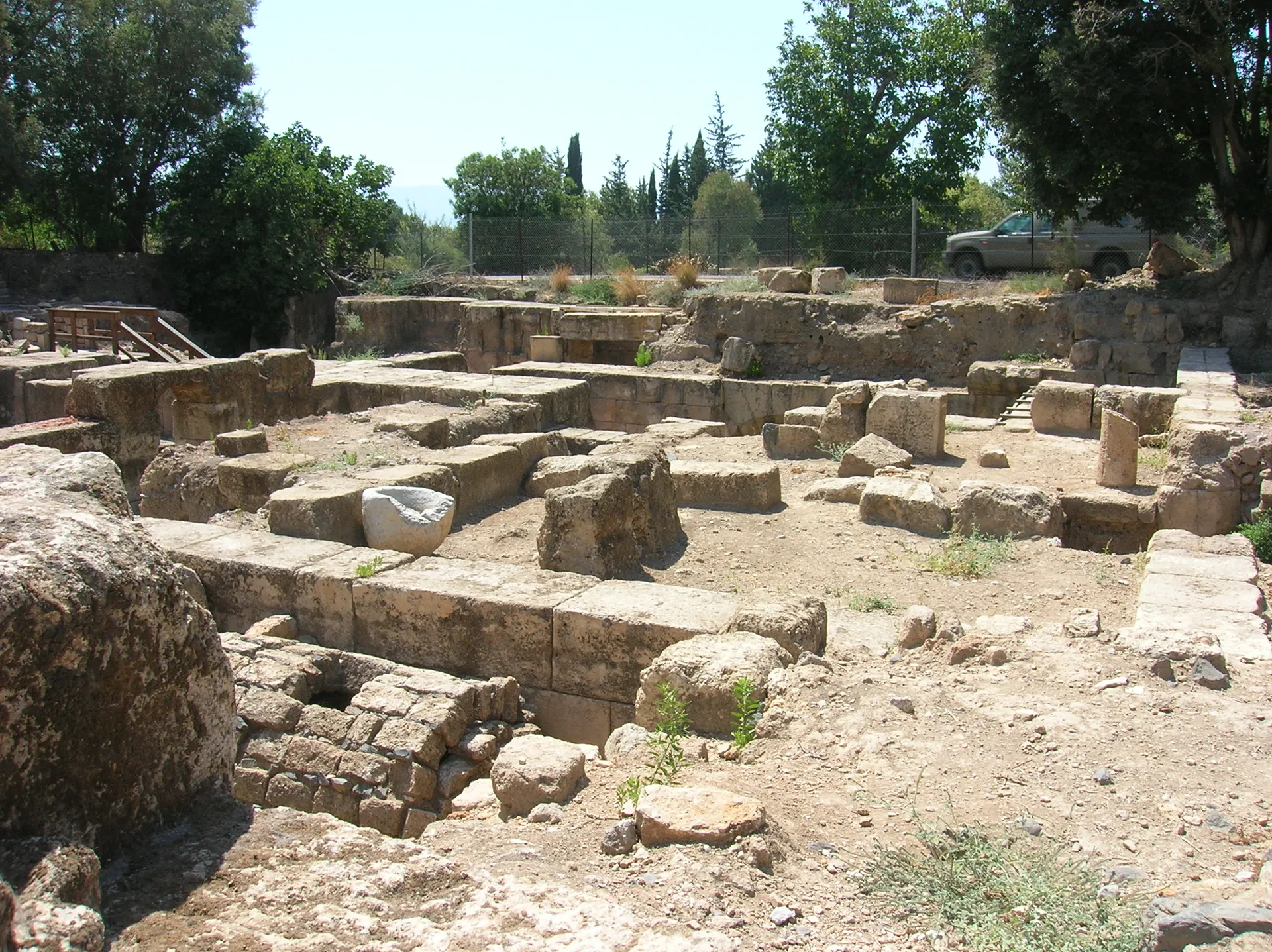
A 2,000-square-metre palace-bath complex lies southwest across the stream, built for King Agrippa II and later converted into a Roman bathhouse with underfloor heating. Pause in the vaulted cellars and look for round terracotta pipes still set into the walls—they once pushed mountain spring water into the hot rooms. Cold water, warm steam. On a summer afternoon, the shade here feels ten degrees cooler than the plateau and the stone smells of damp basalt. The scale is easy to misread until you notice the brick hypocaust pillars, each the size of a small log, that once held the floors above. -
The Gorge Trail: Boardwalk to the Banias Waterfall
Skip the second parking lot and walk the 3.5-kilometre connector trail instead. It drops you into a canyon where plane trees and wild figs canopy the path, and the river churns through black basalt boulders just below a 100-metre boardwalk bolted to the cliff—roughly the length of a football pitch. At the end, the Banias waterfall plunges 10 metres, about three storeys, into a milky-green pool; in winter, spray slicks the wooden platforms and the thunder bounces off Hermon's flanks. Go early, before the Druze pita stalls open, and the only voices you'll hear will be bulbuls and your own boots on wet timber.
Plan your visit
- Getting There
- The reserve is currently approached through Israeli-controlled roads, with the springs and waterfall entrances reached from Route 99. Do not attempt to enter the occupied Golan through Syria. Check current government travel advice, road status, security instructions, and the park's operating notice before departure.
- Opening Hours
- The park authority currently lists 08:00 opening. Summer closing is 17:00 Sunday–Thursday and Saturday, 16:00 Friday and holiday eves; winter closing is 16:00 and 15:00 respectively. Entry closes one hour before the listed closing time. Security, weather, and holiday conditions can override the schedule, so verify it that day.
- Time Needed
- Budget 45–60 minutes for the springs and Pan's Grotto alone. The full experience—archaeological terraces, the 2 km stream trail, suspended boardwalk, and waterfall—needs 3–4 hours. The two entrances sit roughly 2 km apart, so factor in either a car shuttle or a 90-minute hike between them.
- Accessibility
- Accessibility is partial. Some visitor facilities and the springs area are easier to reach, but archaeological terraces, the connecting trail, waterfall route, and suspended walkway include uneven ground and steps. Confirm the current accessible route with the park before booking.
- Cost & Tickets
- The park authority's 2026 price list gives Banias admission as ₪31 for adults and ₪16 for children, with separate concession categories. Prices, reservation rules, and access can change; use the official park channel for the visit date.
Photo Gallery


History
The Cave That Got the Wrong Label
Long before the Gospels reached this hillside, Paneas was a Hellenistic sanctuary where priests lobbed offerings into a black pool inside the cave. Josephus and other ancient sources describe the test: if the water swallowed the victim, Pan accepted it; if blood bloomed in the spring below, he did not. The name Paneas stuck for centuries—what never stuck is the label 'Gates of Hades,' which appears in no ancient text.
Herod the Great changed the equation around 20 BCE, building a white marble temple to Augustus in front of the cave. His son Philip then refounded the settlement as Caesarea Philippi in 3–2 BCE, using his own name to separate it from the coastal Caesarea. What rises here is a city built on imperial gratitude, dynastic vanity, and very old fear.
The turning point
The King Who Supplied the Arena
To most visitors, the broad terrace below the cave looks like an empty civic plaza—eroded foundations, a few column stubs, picnic light. The surface story is easy: this was a prosperous Herodian capital, home to the last Jewish king, Herod Agrippa II, who filled it with marble halls and water gardens.
But Agrippa was a king without a kingdom. Raised in the court of Claudius, he spent his reign balancing Jewish identity against Roman demands. In 66 CE he begged Jerusalem's rebels to stand down and failed. Four years later, after the Temple burned, the Roman general Titus arrived at Caesarea Philippi as Agrippa's guest.
What happened next is recorded by Josephus in The Jewish War. Agrippa opened his city for games celebrating the fall of Jerusalem, and in this plaza more than 2,500 Jewish prisoners were killed in staged combat or thrown to animals. The man who called himself king of the Jews supplied the stage for the empire to mutilate his people. For Agrippa, hospitality to Rome was the price of keeping his crown—and it worked, for a while.
Look at the flagstones again. The flat ground becomes an arena floor, the cedar shade a gallery. Agrippa II died childless around 93 CE, and with him the Herodian line ended. That is what sits beneath your feet at Caesarea Philippi.
The Battle of Panium
Crusader Banias
Tips for visitors
Current travel warning
As of 30 August 2026, UK FCDO advice is against all travel to the area north of Route 91 across the occupied Golan, which includes Banias, and warns against approaching through Syria. Consult your own government's advice and local closure instructions; never cross fences or leave marked paths because minefields and military areas remain in the wider region.The cave is dry
Josephus described water gushing from the grotto, but the 1837 Galilee earthquake rerouted the springs underground. Water now bubbles from the scree at the cliff base, leaving the cave floor dry. Don't expect the dramatic cascade ancient pilgrims saw.No wading, ever
Rangers strictly prohibit entering any water in the reserve—springs, stream channels, waterfall pool included. Those social media photos of people in the falls? Rule-breakers. Fines apply.Cover up at shrines
The white-domed shrine of al-Khadr above the grotto is revered by Muslims, Christians, and Druze. Covered shoulders and knees show respect when approaching it or visiting nearby Druze villages. Hiking attire works for the ruins themselves.Leave the drone home
Recreational drones are prohibited across all INPA nature reserves without prior written permits from civil aviation and wildlife authorities. Handheld photography is fine everywhere—heavy tripods blocking walkways need management approval.Pair with Nimrod Fortress
Nimrod Fortress, the massive Ayyubid stronghold, perches on the ridge directly above Banias. Tell Dan Reserve sits 4 km west on Route 99. One day can cover all three if you start early.Morning light, fewer crowds
Arrive at the 08:00 opening for the grotto's best light and quietest trails. Summer afternoons get hot and crowded; winter brings flash-flood closures after heavy rain. Check weather warnings before driving up.
Frequently asked
Is Caesarea Philippi worth visiting?
Yes, if you want a place where a clifftop pagan sanctuary, a Herodian palace, and one of the Jordan's headwaters all share one compact valley. You can stand in front of the Cave of Pan, see rock-cut niches that once held statues of Pan and Echo, then walk a short distance to Agrippa II's palace ruins. The Banias waterfall and suspended boardwalk add a cool, green counterpoint to the archaeology.
How long do you need at Caesarea Philippi?
Budget 3 to 4 hours if you want both the archaeological zone and the waterfall trail. A quick visit to the springs and Pan's grotto alone takes 45 to 60 minutes. The two entrances sit about 2 km apart, so either drive between them or hike the connecting trail along the stream.
How do I get to Caesarea Philippi from Kiryat Shmona?
The archaeological site is part of the Banias reserve and is currently reached through Israeli-controlled Route 99 and the park's springs entrance. Do not approach through Syria. Check government travel advice, road status, and the park's same-day operating notice before any journey.
What is the best time to visit Caesarea Philippi?
Spring, from March to May, is the best time: wildflowers and clear water with temperatures around 18°C to 24°C. Summer works because the gorge stays cooler than the plateau, but weekends draw heavy family and school groups. Winter brings the most violent waterfall flow from Mount Hermon snowmelt, though the boardwalk can get slick.
Can you visit Caesarea Philippi for free?
Standard admission is charged. The park authority's 2026 list gives ₪31 for adults and ₪16 for children, with concession categories. Verify the current price and reservation requirement on the official park site.
What should I not miss at Caesarea Philippi?
Start with the Cave of Pan and the rock-cut niches beside it. Walk about 50 meters east to the Temple of the Sacred Goats and Nemesis terrace; most groups turn back before this quieter corner. Look for the Greek inscription chiseled by the priest Victor, son of Lysimachos, on the cliff face.
Is Banias the same as Caesarea Philippi?
Yes. Banias is the modern Arabic name of the site that Greeks called Paneas and Herod Philip renamed Caesarea Philippi in 3–2 BCE. The name Banias comes from Paneas, because Arabic has no native 'p' sound. Agrippa II briefly renamed the city Neronias in the mid-1st century.
Sources & attribution 15
- Israel Nature and Parks Authority – Hermon Stream (Banias) Nature Reserve — Official park data for opening hours, admission fees, dual-entrance ticketing, and site regulations.
- LaidBack Trip – Hermon Stream (Banias) Nature Reserve Israel — Time estimates, parking notes, and trail difficulty for the springs and waterfall sections.
- BibleWalks – Banias — Site layout, historical periods, and nearby landmarks such as Nimrod Fortress and Tell Dan.
- Generation Word – Caesarea Philippi — Chronology of the Battle of Panium, Herod's Augusteum, and the founding of Caesarea Philippi.
- ANE Today – The Pan Grotto at Paneas — Rock-cut niches, Greek inscriptions, and the scholarly debate over the Augusteum's location.
- Religion Unplugged – St. Peter and Pan Grotto and Spring in the Golan Heights — Banias/Paneas name history, Jewish blessing tradition, and multi-faith significance.
- Hike Israel – Banias — Seasonal water conditions, trail logistics, and summer crowd patterns.
- BiblePlaces – Caesarea Philippi (Banias) — Visual and historical overview of the sanctuary, cave, and Banias waterfall.
- Show Caves – Panias Spring — Geological explanation for how earthquakes shifted the spring outflow from the cave.
- Biblical Archaeology Society – Ruins at Banias: King Herod's Palace Identified at Caesarea Philippi — Archaeological identification of Agrippa II's palace and the Roman bath complex.
- BibleWalks – Banias Crusaders' City — Medieval phases and fortification details for the Crusader and Ayyubid city of Banias.
- Jewish Virtual Library – Banias Nature Reserve — Nomenclature, Jordan River headwaters context, and local cultural background.
- UN Security Council Resolution 497 (1981) — Legal status of the occupied Syrian Golan.
- UK FCDO Israel travel advice — Current 2026 warning for northern Israel and the occupied Golan Heights.
- Israel Nature and Parks Authority 2026 price list — Current Banias admission categories and prices.
Built from cited sources · see the method · How we make our guides →
Pick up where you left off
Saved and recently read places — kept on this device only.
Photo credits (12)
- 0052מקדש לאל פאן במפלי הבניאס שברמת הגולן — עמוס גל — CC BY-SA 4.0 (https://creativecommons.org/licenses/by-sa/4.0/) — Source: https://commons.wikimedia.org/wiki/File:0052מקדש_לאל_פאן_במפלי_הבניאס_שברמת_הגולן.jpg
- 145945 archaeological site in banias PikiWiki Israel — רוני קניגסברג — CC BY 2.5 (https://creativecommons.org/licenses/by/2.5/) — Source: https://commons.wikimedia.org/wiki/File:145945_archaeological_site_in_banias_PikiWiki_Israel.jpg
- 145948 archaeological site in banias PikiWiki Israel — רוני קניגסברג — CC BY 2.5 (https://creativecommons.org/licenses/by/2.5/) — Source: https://commons.wikimedia.org/wiki/File:145948_archaeological_site_in_banias_PikiWiki_Israel.jpg
- 145949 archaeological site in banias PikiWiki Israel — רוני קניגסברג — CC BY 2.5 (https://creativecommons.org/licenses/by/2.5/) — Source: https://commons.wikimedia.org/wiki/File:145949_archaeological_site_in_banias_PikiWiki_Israel.jpg
- 145974 archaeological site in banias PikiWiki Israel — Unknown authorUnknown author — CC BY 2.5 (https://creativecommons.org/licenses/by/2.5/) — Source: https://commons.wikimedia.org/wiki/File:145974_archaeological_site_in_banias_PikiWiki_Israel.png
- 145946 archaeological site in banias PikiWiki Israel — רוני קניגסברג — CC BY 2.5 (https://creativecommons.org/licenses/by/2.5/) — Source: https://commons.wikimedia.org/wiki/File:145946_archaeological_site_in_banias_PikiWiki_Israel.jpg
- 20110222 0151 Banias Springs (5540435622) — Dan Lundberg — CC BY-SA 2.0 (https://creativecommons.org/licenses/by-sa/2.0/) — Source: https://commons.wikimedia.org/wiki/File:20110222_0151_Banias_Springs_(5540435622).jpg
- 145947 archaeological site in banias PikiWiki Israel — רוני קניגסברג — CC BY 2.5 (https://creativecommons.org/licenses/by/2.5/) — Source: https://commons.wikimedia.org/wiki/File:145947_archaeological_site_in_banias_PikiWiki_Israel.jpg
- Ancient roman columns in Cesarea Philippi — Alejandrofsc — CC BY-SA 4.0 (https://creativecommons.org/licenses/by-sa/4.0/) — Source: https://commons.wikimedia.org/wiki/File:Ancient_roman_columns_in_Cesarea_Philippi.jpg
- Banias (4) — עומר מרקובסקי — CC BY-SA 4.0 (https://creativecommons.org/licenses/by-sa/4.0/) — Source: https://commons.wikimedia.org/wiki/File:Banias_(4).jpg
- Banias (2) — עומר מרקובסקי — CC BY-SA 4.0 (https://creativecommons.org/licenses/by-sa/4.0/) — Source: https://commons.wikimedia.org/wiki/File:Banias_(2).jpg
- Banias (40) — עומר מרקובסקי — CC BY-SA 4.0 (https://creativecommons.org/licenses/by-sa/4.0/) — Source: https://commons.wikimedia.org/wiki/File:Banias_(40).jpg
Photos may have been resized or cropped.