Château De La Bâtie
VinzelSwitzerland 46° N · 6° E Updated Aug 2026
Mussolini laid drains here in 1903, and six generations of women have owned this Swiss wine estate—with a Cedar of Lebanon from a botanist's gift in the courtyard.
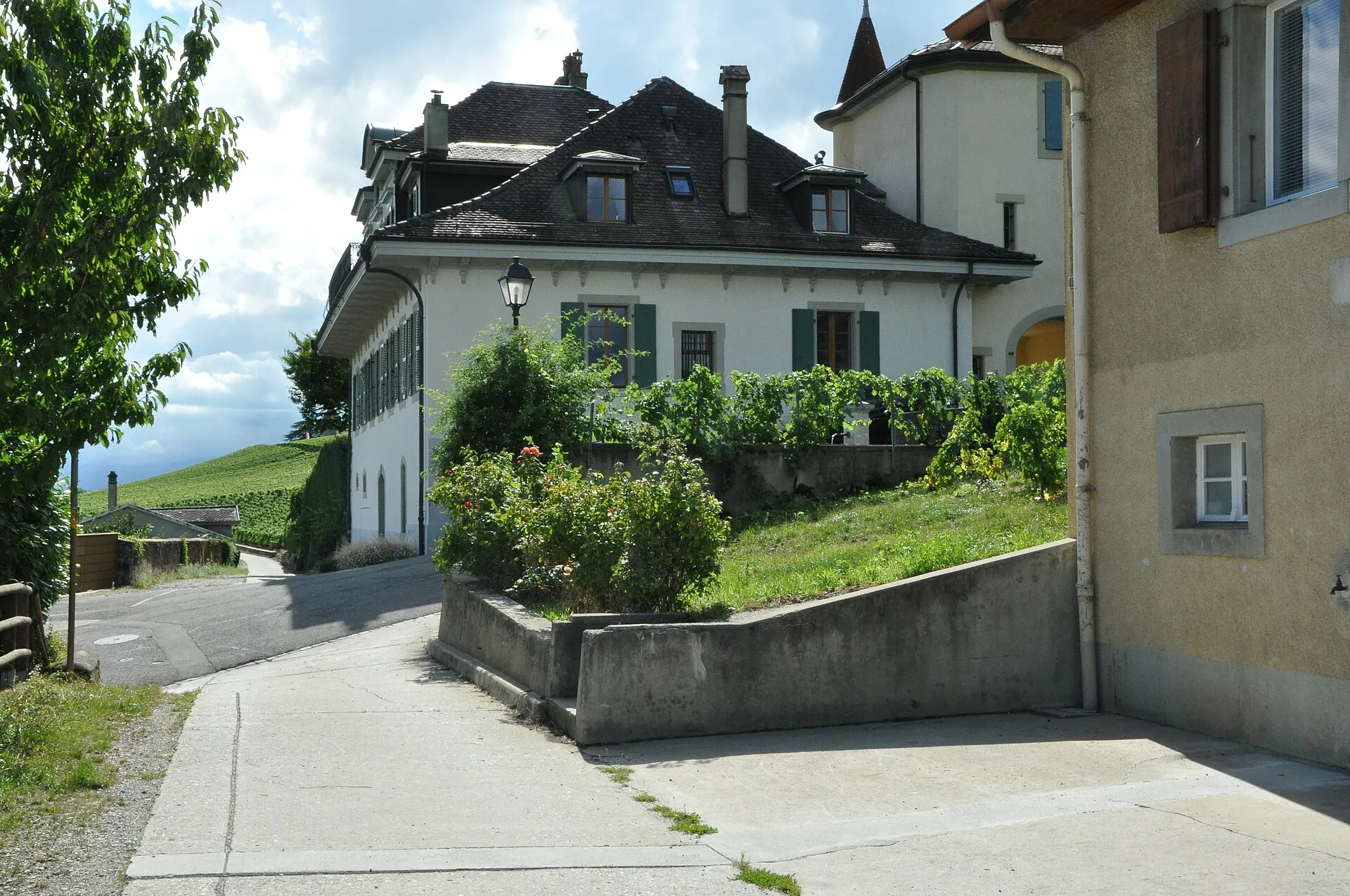 Photo: Herbert wie · CC BY-SA 4.0
- Time needed
- 1-2 hours
For six generations, Château de La Bâtie in Vinzel, Switzerland, passed from mother to daughter without a single male heir breaking the chain. That fact alone is rare enough to make the owners themselves pause. You come for the wine — a Chasselas Premier Grand Cru the Vaud State Council chose as its official wine. You stay for the cedar of Lebanon, the vaulted cellars, and a story involving a future dictator digging drains.
Vinzel takes its name from the Latin vinicella, a small vineyard, and the château still lives inside that name. The manor you see, with its double staircase and roses, is an 18th-century face. Under it, a stocky medieval fortified house and deep vaulted cellars hold the older memory of watching over nearby villages.
Walk the courtyard and you meet the real elder: a cedar of Lebanon grown from a seedling that Geneva botanist Auguste-Pyrame de Candolle carried back from Lebanon. It has outlived every owner who stood beneath it, and it is now classified, like the château itself, as a historical monument. Beneath your feet, the old vaulted cellars have been receiving the grape harvest for centuries.
Don't expect a museum. La Bâtie remains a working wine estate, about ten hectares of Chasselas on a south-facing slope above Lake Geneva. The current vigneron works with the lake shimmering and Mont Blanc keeping its silence. And that future dictator? Around 1903, a young Benito Mussolini laid drains here; in 1927, Josip Broz — later Marshal Tito — worked at the tile factory down in Vinzel.
What to see
-
The Cedar of Lebanon and the Rose-Flanked Staircase
Step into the courtyard and the first thing you notice is the smell—warm resin from a Cedar of Lebanon that has no business being this far from the Beqaa Valley. Geneva botanist Auguste-Pyrame de Candolle brought back five seedlings for the five de Saugy family domains; this one, planted at La Bâtie, still stands solid and is classified as a historical monument. The double staircase flanking the façade drips with roses in June, and the boxwood parterres frame the tree like a green geometry lesson. Two centuries of shade. You realize the tree is not decoration—it's a family handshake, the reason all those châteaux between Rolle and Dully call each other cousins. -
The Vaulted Cellars Beneath the Château
You'll feel the temperature drop before your eyes adjust—the cellars beneath La Bâtie hold at around 12°C even when the vineyard above is baking. The air is heavy. Two vaulted rooms, among the largest in the canton, have received every harvest from the surrounding vines since the 1722 rebuilding absorbed the medieval tower. Run your hand along the cool limestone, breathe in old oak and the faint sweetness of past vintages, and listen to your footsteps die in the dark. A handshake in 2002 sealed the partnership with Cave de La Côte. The caveau claims the 2014 Premier Grand Cru became the Vaud State Council's official wine. -
A Matrilineal Walk: Six Women, One Slope, Two Dictators
Walk this estate slowly and you'll trace a story most Swiss wine domains can't tell: six generations of women passed La Bâtie from mother to daughter, from Adélaïde de Reding to Laura de Cormis-Chiesa. Six women. One estate. Start at the cedar, then follow the tight vine rows downhill—the 20% slope faces south and the lake flashes between the leaves—and end at the Caveau de Vinzel on Route de Bugnaux 6, where the Chasselas tastes of the same limestone you just walked on. Along the way, glance back at the château and remember that around 1903 a young Benito Mussolini laid drains here as a mason; twenty-four years later, Josip Broz worked the tile factory down the road. The place doesn't just grow wine—it collects the strangest footnotes.
Plan your visit
- Getting There
- Set your map for Rue du Collège 23, 1184 Vinzel. By car, leave the A1 at Rolle and climb roughly 3 km through the vines; by rail, Rolle and Bursinel stations sit on the Geneva–Lausanne line, leaving a short taxi or PostBus ride up to the village. Coming from the lower Château de Vinzel, it's a 50–100 m stroll along the same street.
- Opening Hours
- There are no regular public hours — Château de La Bâtie is a private working wine estate. As of 2026, visits run by appointment only through Cave de La Côte at +41 21 804 54 64. No seasonal closures are published, but September–October harvest work can limit access, so confirm by phone.
- Time Needed
- Plan 15–20 minutes if you're only picking up a bottle. A booked tasting with a short cellar look takes 45–60 minutes; allow 1.5–2 hours to add a vineyard walk and unhurried conversation. Since visits are private, agree on the pace when you call.
- Accessibility
- This is a private 18th-century manor with vaulted stone cellars and vineyard paths on slopes up to 20%. There is no visitor infrastructure or elevator, and cellar access involves stone steps and uneven floors. Wheelchair users should call ahead to see what's feasible.
- Cost & Tickets
- There's no general admission fee or ticket booth. Visits are free by appointment but centered on wine; as of 2026, the Grand Cru sells for around CHF 13.90 a bottle and the Premier Grand Cru around CHF 17.95. Ask whether a tasting fee applies or is waived with bottle purchase.
Photo Gallery


History
A Fortress Rebuilt, a Chain Unbroken
La Bâtie resists the usual Swiss castle story. No siege, no fire, no celebrated battle. Instead, you get an old fortified house absorbed into an 18th-century manor, then held together by six generations of women who treated the estate as a chain rather than a crown.
According to estate tradition, the château has watched over Vinzel since 1245, but the earliest written mention local heritage sources treat as firm appears only in 1580. The name comes from bastide, a fortified house — and for most of its history, La Bâtie was the only château in the village, with today's Château de Vinzel merely its dependency.
The turning point
Nicolas Jenner's 28,000-Florin Bet
On 12 May 1669, Jean-François Baddel, lord of Bassins, sold the old fortified house of La Bâtie to Nicolas Jenner of Bern for 28,000 florins. The exact figure survives through a single account repeated in Swiss castle histories, but the direction is plain: Vaud's old seigneurial order was yielding to Bernese money and power. For Jenner, this was not just a vineyard purchase. The estate was a physical claim to belonging among the Protestant patricians now running the region.
Then came the turning point. The Jenner family held the property for nearly a century, and around 1722 — some regional sources say 1725 — they hired the French architect Joseph Abeille to replace the squat medieval stronghold with an elegant manor. Abeille folded the old tower and the deep vaulted cellars into the new design, hiding the defensive past behind a double staircase that would later flower with roses. The working farmyard survived. The fortress did not.
A Cedar from Lebanon
The Burckhardts' Village Kindness
Tips for visitors
Call the cellar first
Don't roll up expecting a front desk. Phone Cave de La Côte at +41 21 804 54 64 and ask for a tasting appointment at Château La Bâtie; French gets the warmest response.Closed-toe shoes, no perfume
The vaulted cellar has stone floors and twilight lighting, and the vines climb a 20% slope. Skip strong perfume or cologne — it will flatten the Chasselas aromas you came to taste.Ask before you shoot
This is a family home and working domaine, not a film set. Ask permission before photographing the cellars, courtyard, or rows of vines; drones need explicit landowner approval under Swiss law.Pair with the lower château
Château de Vinzel, just 50–100 m down Rue du Collège, runs its own tastings with a literary angle. Book both domains for one afternoon and compare two very different Chasselas estates.Aim for early autumn
May to October gives the best vineyard light, with Lake Geneva and Mont Blanc beyond the rows. September–October is harvest time — atmospheric and busy, so call at least a week ahead.Don't chase the Geneva festival
Typing 'La Bâtie' into a search can surface the unrelated performing-arts festival in Geneva. If you're buying festival tickets, you're in the wrong place — this is a wine estate in Vinzel, canton of Vaud.
Frequently asked
Is Château de La Bâtie worth visiting?
Yes, if you care about wine and family history more than turrets and gift shops. This is a working Chasselas estate, not a museum — the payoff is a tasting of Premier Grand Cru in vaulted cellars that rank among the largest in the canton, plus the story of six generations of women who've run the place in direct mother-to-daughter line. Skip it if you want a roped-off monument with an audio guide.
Can you visit Château de La Bâtie?
Yes, but only by appointment — it's a private residence and working domaine, not a public attraction. Call +41 21 804 54 64 to arrange a tasting through Cave de La Côte. Don't show up expecting a ticket booth; there isn't one.
How do I get to Château de La Bâtie from Geneva?
Take the train to Rolle, about 25 minutes from Geneva, then a short taxi or PostBus ride up to Vinzel. The château sits at Rue du Collège 23, dominating the village. By car, exit the A1 at Rolle and follow signs to Vinzel.
What is the best time to visit Château de La Bâtie?
September and October, when the harvest fills the cellars with the smell of fermenting Chasselas and the vines turn gold. Spring offers fresh green rows and clear lake views. Winter is quiet — bare vines, low sun, and the most atmospheric cellar tastings.
What wine does Château de La Bâtie produce?
Chasselas, the classic Swiss white grape, in two tiers: Grand Cru and Premier Grand Cru Vinzel. The 2014 Premier Grand Cru was selected as the official wine of the Vaud State Council, according to the Caveau Luins-Vinzel. Expect pale yellow with silver reflections, citrus, white peach, and a saline mineral edge.
Who owns Château de La Bâtie?
Laura de Cormis-Chiesa, the sixth generation of women to own the estate in direct mother-to-daughter succession. Her ancestor Elisabeth Burckhardt described it as "a chain of which I feel myself one of the links." The chain started with Adélaïde de Reding, who ran the domaine for nearly fifty years.
Is Château de La Bâtie the same as Château de Vinzel?
No — they're two separate estates on the same street in Vinzel. La Bâtie (Rue du Collège 23) is the older, upper château; Château de Vinzel (Rue du Collège 19C) was historically just a dependency of La Bâtie. The two only became distinct domains after World War I.
Did Mussolini work at Château de La Bâtie?
Yes, around 1903, the future dictator worked as a mason laying drains at the La Bâtie estate. A quarter-century later, in 1927, another future dictator — Josip Broz, later Marshal Tito — worked at the Keusen tile factory in the same village. Vinzel has a strange knack for hosting history's villains before they were famous.
Sources & attribution 8
- Château La Bâtie — Official Site — Primary source for the six-generation matrilineal succession, cedar of Lebanon story, 1722 construction date, Simon Gay quotes, and the 2002 handshake anecdote with Cave de La Côte.
- Swiss Castles (swisscastles.ch) — Richest source for Burckhardt receptions, village generosity (two buses to Expo 64), Franz de Reding's character, sale prices, Elisabeth Burckhardt's full quotes, and the five cedar domains story.
- Caveau Luins-Vinzel — Historical owner archetypes, Elisabeth's "chain" quote, 2012/2014 wine honors, and the estate's by-appointment visitation policy.
- La Côte Tourism — Confirms the tower and vaulted cellar integration, 1580 first written mention, and the 1725 construction date (conflicting with 1722).
- Maison des Vins — Confirms current ownership (Laura de Cormis-Chiesa), Rodrigo Banto/Simon Gay collaboration, and the 1245 existence claim.
- Vaud Vins — Sensory wine description: pale yellow with silver reflections, citrus, white peach, saline mineral edge.
- Château de Vinzel — Parallel story of the lower château, "Gallimard des chasselas" nickname, and the distinction between the two Vinzel estates.
- Falstaff — Independent wine critic's tasting notes for the Château La Bâtie Premier Grand Cru.
Built from cited sources · see the method · How we make our guides →
Pick up where you left off
Saved and recently read places — kept on this device only.
Photo credits (2)
- Château de Vinzel Vaud Schweiz — Herbert wie — CC BY-SA 4.0 (https://creativecommons.org/licenses/by-sa/4.0/) — Source: https://commons.wikimedia.org/wiki/File:Château_de_Vinzel_Vaud_Schweiz.JPG
- Château de Vinzel Vinzel Schweiz — Herbert wie — CC BY-SA 4.0 (https://creativecommons.org/licenses/by-sa/4.0/) — Source: https://commons.wikimedia.org/wiki/File:Château_de_Vinzel_Vinzel_Schweiz.JPG
Photos may have been resized or cropped.