Schaffhausen

Switzerland

Schaffhausen

Schaffhausen packs 171 ornate bay windows into a compact old town, with Munot above the Rhine and Rhine Falls 10 minutes away.

location_on 12 attractions
calendar_month May-June and September-October
schedule 2-3 days

Introduction

Church bells still cut through Schaffhausen at nine each evening, and a few minutes later the Rhine slides past the old town with that cold blue-green light Alpine rivers keep long after sunset. Schaffhausen, Switzerland, feels stranger than its postcard image suggests: a medieval city north of the Rhine, hemmed in by Germany on three sides, crowned by a round fortress that looks less Swiss than stubbornly self-invented. Then you notice the windows. All 171 of those carved bay windows seem to lean out and inspect you back.

Schaffhausen's old town works because stone never gets left alone here. Facades are painted, fountains carry guild memory, and Haus zum Ritter wears Renaissance frescoes with the confidence of a merchant who wanted his neighbors to look up in 1566 and feel slightly outdone. Cars mostly stay out, so what fills the streets instead are footsteps, café spoons, market chatter, and the brief hollow echo under archways.

The city has a double life. One face belongs to Munot, the circular fortress built between 1564 and 1589 above the vineyards; the other belongs to the river, where Lindli and Freier Platz soften the mood into apéro territory, swimming steps, and long views toward Neuhausen. Ten minutes away waits the Rhine Falls, loud enough to rearrange your thoughts, but Schaffhausen itself is quieter and more interesting.

Wine explains more of the place than first-time visitors expect. This is Blauburgunderland, Pinot Noir country, and the local rhythm makes sense once you follow it: market in the morning, coffee on Vordergasse, a glass by the Rhine toward evening, then maybe a concert in a former factory at Kammgarn. Schaffhausen isn't trying to impress you every second. That's exactly why it does.

Places to Visit

The Most Interesting Places in Schaffhausen

What Makes This City Special

Munot Above the Vines

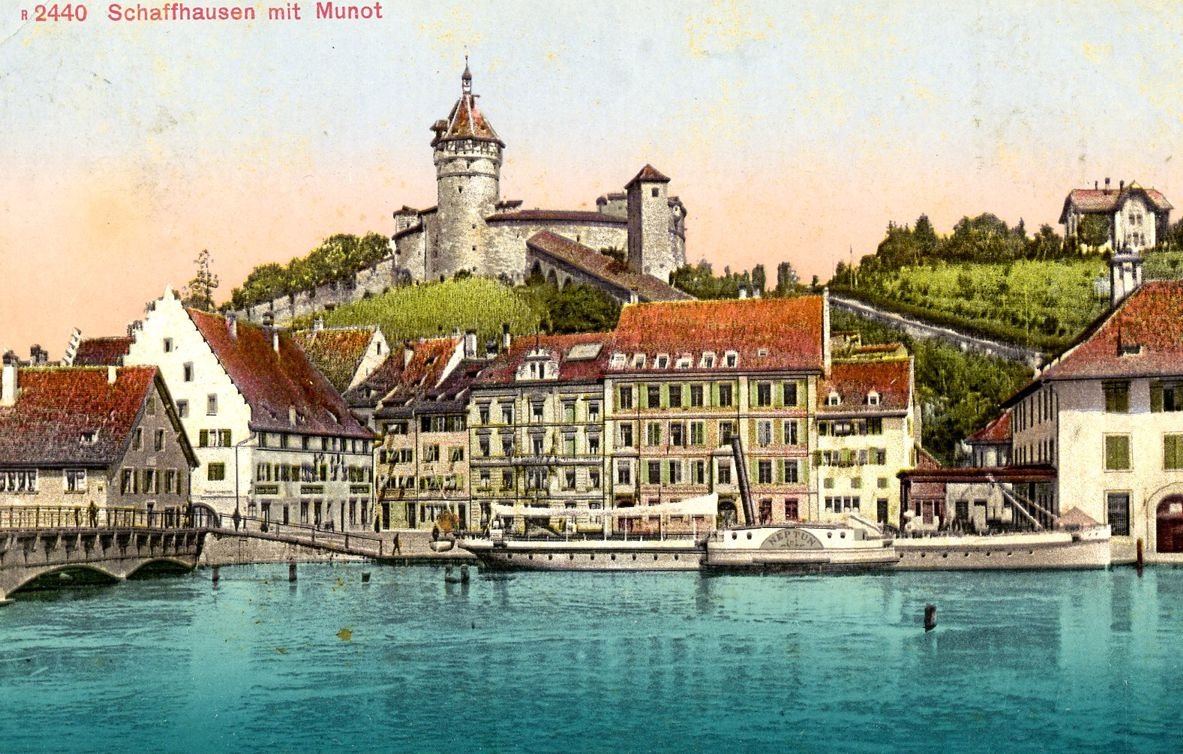
Munot has watched the Rhine since 1589, a circular fortress built to shrug off cannon fire with thick sloping walls and a roofline that still feels military, not decorative. Climb through the vineyards at dusk and the whole city opens beneath you: bay windows, red tiles, river light, and deer moving quietly in the dry moat.

A Town of Bay Windows

Schaffhausen's old town carries 171 ornate Erker, those projecting bay windows merchants once used as status symbols in stone and glass. Walk along Vordergasse to Fronwagplatz and you'll keep looking up, because the facades are painted, carved, and a little competitive about it.

Abbey Quiet and Civic Memory

The Museum zu Allerheiligen occupies a former Benedictine abbey with Switzerland's largest accessible Romanesque-Gothic cloister, and the silence still clings to the stone. A few streets away, Haus zum Ritter turns Renaissance civic pride into theater, its facade frescoes showing exactly how seriously this small city once took itself.

Rhine Power, Ten Minutes Away

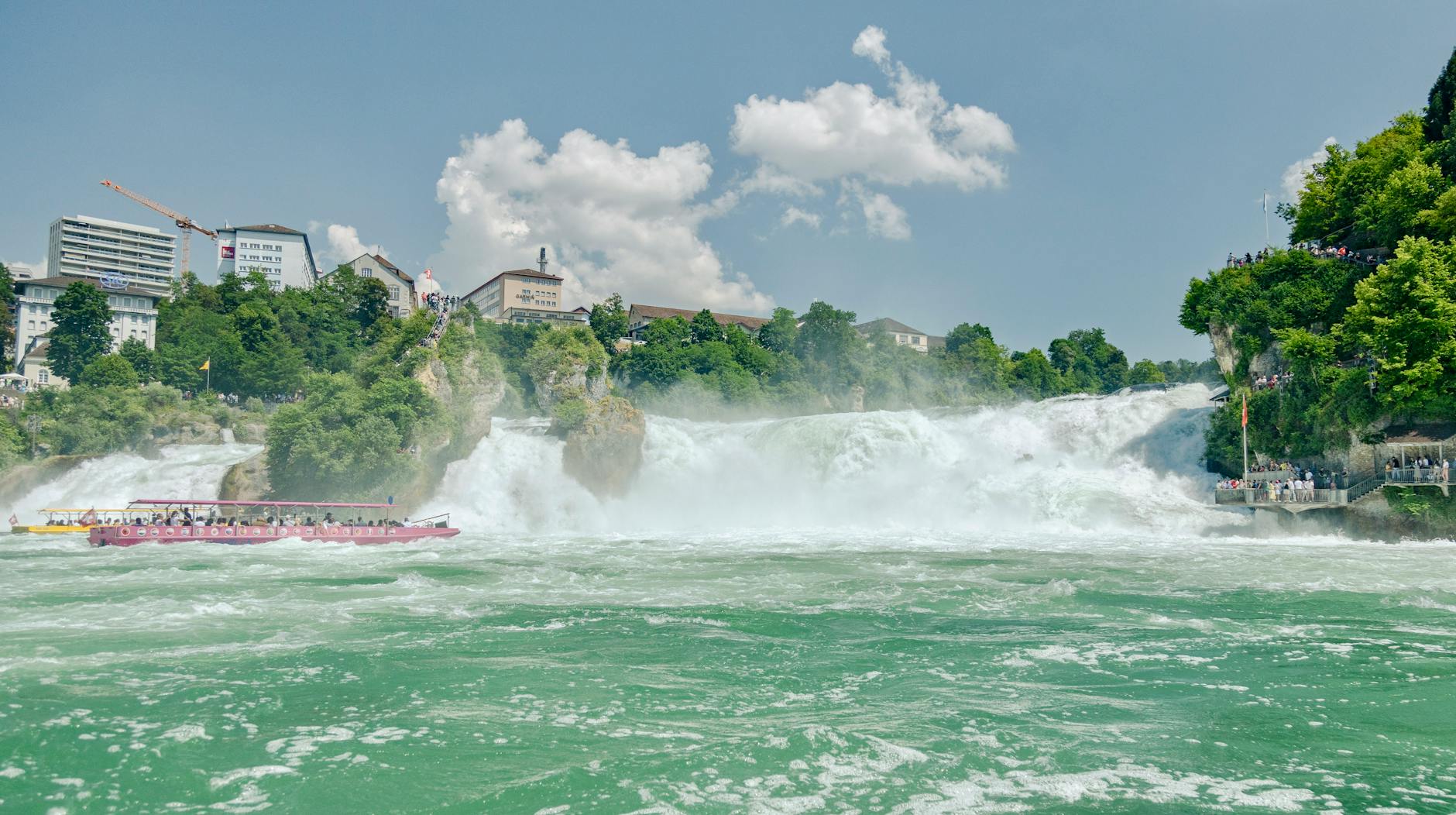
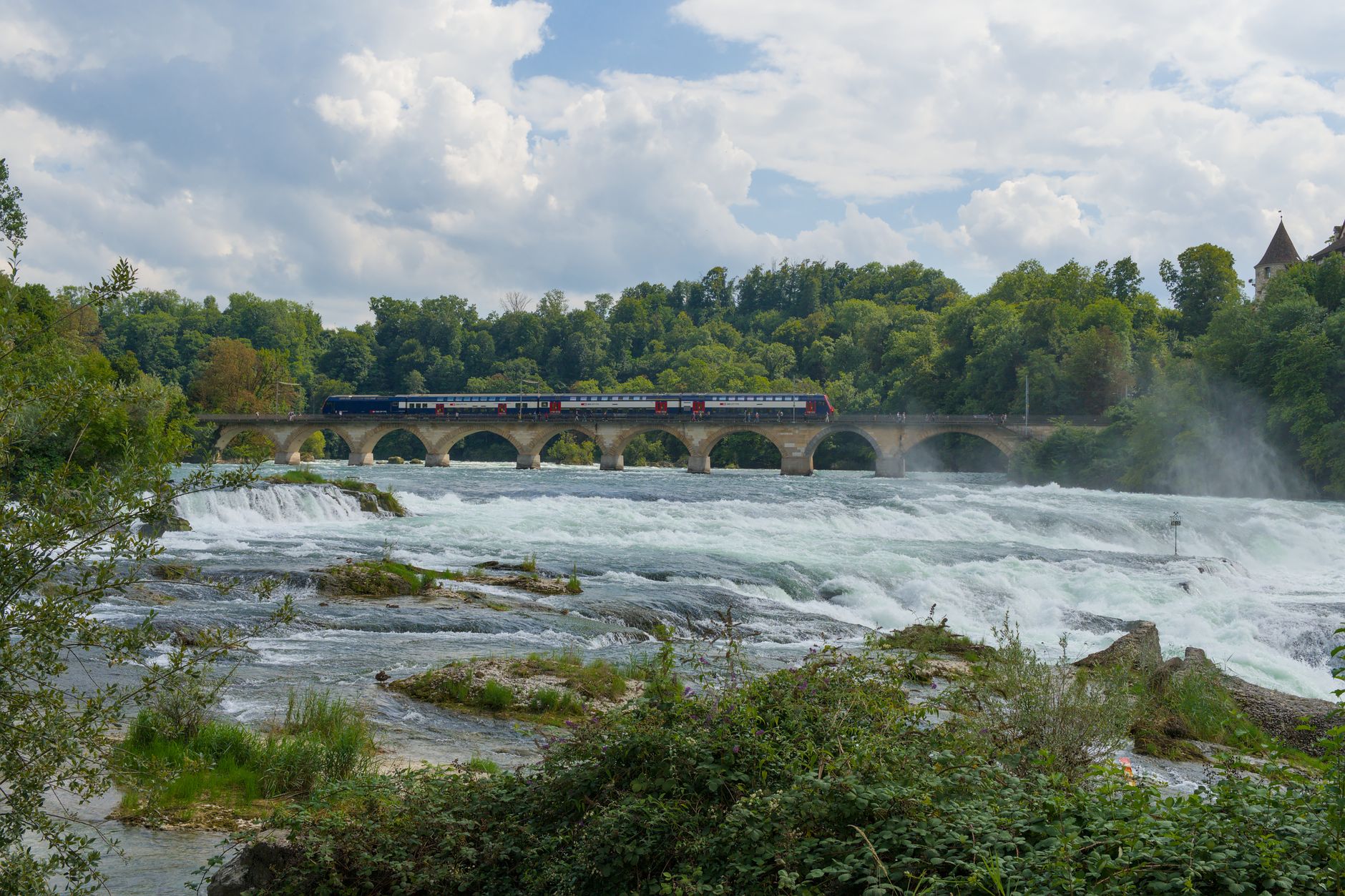
Rhine Falls sits close enough to Schaffhausen that you can hear the city in your head and the water in your chest at the same time. The drop is only 23 meters, but the river spreads 150 meters across and can hurl around 600,000 liters per second in summer, which is why the spray feels less picturesque than physical.

Historical Timeline

A Rhine Town Built by Monks, Merchants, and Misfires

From Celtic river crossings to the 1944 bombing and the watchmakers who remade the city

public
c. 1000 BCE

First Settlers Above the Rhine

Most scholars date the earliest settled landscape around Schaffhausen to the Late Bronze Age, when small farming communities took hold above the Rhine. The river already did what rivers do best: carried goods, marked routes, and forced people to pay attention.

gavel
58 BCE

Rome Reaches the River

After Julius Caesar's campaigns, the Rhine corridor around modern Schaffhausen fell within Rome's orbit. No Roman city rose here, but roads, trade stops, and military movement left the region smelling less of isolation and more of empire.

gavel
1045

Scaphusia Enters the Record

A royal charter first names the place as Scaphusia in 1045. That single line matters because towns often exist long before parchment notices them; this is the moment Schaffhausen steps out of mud and rumor into documented history.

church
1049

All Saints Abbey Founded

Count Eberhard VI von Nellenburg founded Allerheiligen Abbey, and the city grew in its shadow. Bells, prayer, landholding, and traffic belonged together here; the abbey was a spiritual house, a property machine, and the hinge of urban growth.

gavel
1218

Imperial City Rights Granted

Emperor Frederick II granted Schaffhausen city rights, turning a monastic settlement into a place with legal muscle. Markets thickened, walls mattered more, and civic ambition began to rival clerical authority.

local_fire_department
1349

Plague Empties Streets

The Black Death struck the region between 1348 and 1350, and Schaffhausen did not escape the fear that rolled through every Rhine town. Trade slowed, households vanished, and the silence in churchyards would have said enough.

swords
1499

War With the Habsburg World

During the Swabian War, Schaffhausen aligned with the Old Swiss Confederacy against Habsburg power. Border towns feel these choices in their bones: garrisons, taxes, and the question of who gets to command the bridge.

gavel
1501

Schaffhausen Joins the Confederacy

Schaffhausen entered the Swiss Confederacy as a full member in 1501, alongside Basel. The move pulled the city more firmly away from Habsburg control and tied its fate to a confederation that was still inventing itself.

church
1529

The City Turns Protestant

Schaffhausen adopted the Reformation in 1529 along a Zwinglian line, and the change bit deep. Monastic property was dissolved, worship changed its sound, and church interiors across the city lost much of their medieval visual noise.

palette
1539

Tobias Stimmer Is Born

Tobias Stimmer was born in Schaffhausen in 1539 and gave the city its sharpest Renaissance face. His painted architecture on Haus zum Ritter still alters the street's temperature; stone seems to argue with pigment, and pigment wins.

person
1548

Rüeger Begins His City's Memory

Johann Jakob Rüeger, born in 1548, would become Schaffhausen's great early chronicler and a pastor at St. Johann. Cities need witnesses as much as walls, and his writing fixed local events before they could blur into legend.

castle
1564

Munot Rises Above the Vineyards

Construction of the Munot fortress began in 1564 on the hill above town and continued until 1589. Its circular form was built for the age of cannon, with thick sloped walls meant to glance off shot; even now the masonry feels stubborn.

palette
1568

Haus zum Ritter Gets Its Skin

Around 1568, Tobias Stimmer painted the facade of Haus zum Ritter, producing the city's most dazzling act of public self-confidence. The house stands on Vordergasse like a lesson in civic vanity, which in this case is fully justified.

public
1648

Swiss Independence Confirmed

The Peace of Westphalia formally recognized the Swiss Confederation's independence from the Holy Roman Empire. For Schaffhausen, a border city long pressed by larger powers, this was less abstract diplomacy than a new political weather.

person
1752

Johannes von Müller Is Born

Born in Schaffhausen in 1752, Johannes von Müller became one of Switzerland's defining historians. The city's clerical schools and republican habits shaped his eye; he learned early that local history is never just local.

factory
1773

Fischer Forges an Industrial Future

Johann Conrad Fischer was born in Schaffhausen in 1773 and later built the foundry that became Georg Fischer AG. Heat, iron, and experiment changed the city's smell from wood smoke and wine casks to metal and oil.

swords
1798

French Troops End the Old Order

The French invasion of 1798 swept away Schaffhausen's old city-state structure and folded it into the Helvetic Republic. Guild habits and patrician control did not vanish overnight, but the political grammar had changed.

person
1805

Heinrich Moser Is Born

Heinrich Moser was born in Schaffhausen in 1805 and later returned with watchmaking wealth and industrial ambition. His investments on the Rhine helped turn moving water into power, which is how many 19th-century cities learned to speak faster.

factory
1813

Machines Enter the Textile Trade

A mechanical cotton-spinning mill opened in Schaffhausen in 1813, tying the city to the wider industrial shift remaking Europe. Workshops that once ran on hand skill alone now answered to shafts, belts, and regular noise.

gavel
1831

A Liberal Canton Takes Shape

The liberal constitution of 1831 helped define the modern Canton of Schaffhausen inside the Swiss Confederation. Government became more structured, more public, and less beholden to the old urban elite.

science
1868

IWC Brings Precision to Town

Florentine Ariosto Jones founded the International Watch Company in Schaffhausen in 1868, betting that Swiss craft and Rhine-side industry belonged together. It was an American idea with Swiss discipline, and the city kept the better half of the bargain.

swords
1914

Neutral, But Not Untouched

When World War I began, Switzerland stayed neutral and Schaffhausen stayed anxious. Border trade tightened, prices rose, and the city felt what neutral countries always feel in wartime: hunger without glory.

local_fire_department
1944

Bombs Fall by Mistake

On 1 April 1944, American bombers mistakenly dropped roughly 400 bombs on Schaffhausen in about 40 seconds while aiming for targets in Germany. Forty people died, about 100 were injured, and whole blocks near the station were torn open; the city learned the sound of world war despite Swiss neutrality.

gavel
1971

Women Enter Federal Politics

Swiss women won the federal vote in 1971, and Schaffhausen moved with the country into a democracy that had arrived embarrassingly late. Old town facades can make a place look ancient in the wrong way; this was one of those moments.

public
2002

Switzerland Joins the United Nations

Switzerland entered the United Nations in 2002 after a national referendum, and Schaffhausen's border identity gained a new frame. A city hemmed in by Germany on three sides has always understood that local life depends on international arrangements.

schedule
Present Day

Notable Figures

Johannes von Müller

1752–1809 · Historian
Born here

Johannes von Müller was born in Schaffhausen, then spent his life turning Swiss history into something grand enough to shape a nation. He'd still recognize the city's stern Protestant bones, though he might be startled by how calmly people now drink Pinot Noir under them.

Tobias Stimmer

1539–1584 · Renaissance painter and engraver
Born here

Tobias Stimmer gave Schaffhausen one of its lasting visual shocks: the frescoes of Haus zum Ritter, painted around 1568 to 1570. Even in copied form on the facade, his work makes the street feel theatrical, as if the building has decided plain stone is beneath it.

Heinrich Moser

1805–1874 · Watchmaker and industrialist
Born here and returned in 1848

Heinrich Moser made money in imperial Russia, came home, and helped push Schaffhausen into the industrial age with the Moserdamm on the Rhine. He would probably admire the city's neat calm today, then ask why nobody is using the river for something more ambitious.

Johann Conrad Fischer

1773–1854 · Metallurgist and industrial pioneer
Born here

Johann Conrad Fischer founded the foundry that became Georg Fischer AG, and with it helped turn Schaffhausen from a handsome town into a working one. His story sits behind the facades: painted windows in front, iron and invention just out of sight.

Johann Jakob Rüeger

1548–1606 · Theologian and chronicler
Lived and worked here

Rüeger served as pastor at St. Johann and wrote one of the great early chronicles of Schaffhausen. He preserved the city's memory in ink long before guidebooks arrived, which feels fitting in a place where so many walls still look as if they have something to tell you.

Roberto Di Matteo

born 1970 · Footballer and manager
Born here

Roberto Di Matteo was born in Schaffhausen before going on to win the UEFA Champions League as Chelsea manager in 2012. His story adds a small modern twist to the city: beneath the medieval roofs, people still leave and return with stranger ambitions than the skyline suggests.

Practical Information

flight

Getting There

Zurich Airport (ZRH) is the practical gateway in 2026, with direct SBB S24 trains from Zürich Flughafen to Schaffhausen in about 47 to 49 minutes; by car, the A4 makes the run in roughly 35 minutes. Schaffhausen Hauptbahnhof is the main rail station, with links to Zürich HB, Winterthur, Basel, St. Gallen, Singen and Stuttgart, while secondary airport options include EuroAirport Basel-Mulhouse-Freiburg (BSL/MLH) and Stuttgart Airport (STR).

directions_transit

Getting Around

Schaffhausen has no metro or tram in 2026; the city runs on the vbsh bus network, regional trains, and your own feet, which is often the smartest choice in an old town you can cross in 15 to 20 minutes. PubliBike stations near the Hauptbahnhof and Freier Platz cover short rides, Schaffhausen sits on Switzerland's Rhine Route No. 2 cycle corridor, and standard local fares have been around CHF 2.60 for a Zone 1 single ticket and CHF 6.20 for a day pass; the Swiss Travel Pass covers city buses, regional rail, and URh boats.

thermostat

Climate & Best Time

Spring usually runs around 10 to 18 C, summer 22 to 25 C, autumn 8 to 20 C, and winter about -2 to 5 C, with the wettest stretch in late spring and summer when thunderstorms can roll over the Rhine. July and August bring the heaviest visitor traffic, while May to June and September to October are the sweet spot in 2026: mild air, vineyard color, and enough daylight to linger by the river without fighting peak-season crowds.

translate

Language & Currency

German is the official language, but daily speech is Swiss German, which can sound like a different instrument entirely; most hotel, museum, and restaurant staff speak solid English. Switzerland uses the Swiss franc (CHF), cards are widely accepted in 2026, and euros are sometimes taken in tourist-facing places, though the exchange rate is usually bad and your change comes back in francs.

shield

Safety

Schaffhausen is one of those places where caution is mostly about surfaces, not crime: station areas and Rhine Falls draw the usual petty-theft risk, but serious safety issues are rare by European standards. Watch your footing on wet platforms at Rhine Falls and on the steep path to Munot after rain or in winter; emergency numbers are 112, police 117, fire 118, and ambulance 144.

Where to Eat

local_dining

Don't Leave Without Trying

Schaffhauser Blauburgunder (Pinot Noir) from the Schaffhauser Blauburgunderland wine region Schaffhauserzungen confection Swiss seasonal dishes made with regional products Bread and pastry culture from local bakeries and cafes Fresh regional produce and farm specialties from the Schaffhausen weekly market

D'Chuchi

fine dining
Seasonal Swiss cuisine €€ star 5.0 (216)

Order: Order the venison plate if it's on the menu, or the house Cordon Bleu, which regulars describe as the best they've had.

This is the kind of tiny old-town dining room locals keep to themselves: intimate, precise, and a little theatrical in the best way. Reviews keep coming back to the personal service, the chef's surprise extras, and food that feels polished without losing its warmth.

schedule

Opening Hours

D'Chuchi

Monday Closed
Tuesday 6:00 – 11:30 PM
Wednesday 6:00 – 11:30 PM
map Maps language Web

Thai Isaan Restaurant Schaffhausen

local favorite
Family-run Thai restaurant €€ star 4.9 (134)

Order: Go for the duck curry, or the red and green curries, which reviewers single out again and again.

The hidden courtyard matters here. People mention it because it turns a central Schaffhausen meal into something unexpectedly calm, while the food gets described as careful, generous, and far better than a routine Thai stop.

schedule

Opening Hours

Thai Isaan Restaurant Schaffhausen

Monday 11:30 AM – 1:30 PM
Tuesday 11:30 AM – 1:30 PM, 5:30 – 10:00 PM
Wednesday 11:30 AM – 1:30 PM, 5:30 – 10:00 PM
map Maps

Gasthof Ziegelhütte

local favorite
Traditional Swiss inn cooking €€ star 4.8 (929)

Order: Order the Cordon Bleu. Multiple reviewers call it the dish to come for.

If you want the hearty Swiss side of Schaffhausen rather than a polished tasting-room version of it, start here. Nearly a thousand reviews and a steady drumbeat for the same dish usually tell you something useful.

schedule

Opening Hours

Gasthof Ziegelhütte

Monday 9:00 AM – 11:00 PM
Tuesday 9:00 AM – 11:00 PM
Wednesday 9:00 AM – 11:00 PM
map Maps language Web

Beckenburg das Restaurant

local favorite
Swiss seasonal restaurant with game and burgers €€ star 4.8 (504)

Order: Try one of the seasonal soups or the boar burger; both come up in reviews for a reason.

Beckenburg sits in that sweet spot between formal and relaxed: carved wood, trained service, and a menu that still lets itself have some fun. It feels rooted in town rather than staged for visitors.

schedule

Opening Hours

Beckenburg das Restaurant

Monday Closed
Tuesday 11:30 AM – 2:00 PM, 6:00 – 11:00 PM
Wednesday 11:30 AM – 2:00 PM, 6:00 – 11:00 PM
map Maps language Web

Wirtschaft zum Frieden

fine dining
Seasonal Swiss restaurant €€ star 4.8 (200)

Order: If the daily special looks good, trust it; reviewers praise dishes like pumpkin soup, steak, veal cheek, and carefully built starters.

A building with 1445 carved above the entrance could coast on atmosphere alone, but this one earns the room. The service gets described as warm and unhurried, and the kitchen sounds precise without turning stiff.

schedule

Opening Hours

Wirtschaft zum Frieden

Monday Closed
Tuesday 11:30 AM – 2:30 PM, 5:00 – 11:30 PM
Wednesday 11:30 AM – 2:30 PM, 5:00 – 11:30 PM
map Maps language Web

Focaccia Puglia

quick bite
Southern Italian focacceria and bistro €€ star 4.9 (126)

Order: Order a focaccia sandwich with sliced-to-order meats and cheeses, and don't miss the gluten-free rosemary focaccia if that's relevant to you.

This place sounds like a small obsession run by people who care about bread texture, espresso, and the details that usually get skipped. Schaffhausen has good traditional dining, but this is where you go when you want lunch with real personality.

schedule

Opening Hours

Focaccia Puglia

Monday 8:00 AM – 6:00 PM
Tuesday 8:00 AM – 6:00 PM
Wednesday 8:00 AM – 8:00 PM
map Maps language Web

Kaffee Kollektiv

cafe
Specialty coffee cafe €€ star 5.0 (63)

Order: Come for the specialty coffee; regulars call it the most balanced cup in town, and one reviewer raved about the mocca.

Schaffhausen does not need ten serious coffee spots. It needs one this good. The praise is unusually consistent: balanced coffee, friendly staff, cozy room, no fuss.

schedule

Opening Hours

Kaffee Kollektiv

Monday Closed
Tuesday Closed
Wednesday Closed
map Maps language Web

Willis Brotladen, Madleina Bührer

market
Artisan bakery €€ star 5.0 (42)

Order: Buy the bread. Reviews are blunt about it: this is the loaf that makes home baking feel unnecessary.

A bakery with tiny review volume and perfect affection is usually a better sign than a flashy concept. This reads like a bread shop for people who already know where good bread lives.

schedule

Opening Hours

Willis Brotladen, Madleina Bührer

Monday Closed
Tuesday Closed
Wednesday Closed
map Maps
info

Dining Tips

  • check Check Monday first before you plan a meal out. Research suggests it is the most common closing day for sit-down restaurants in Schaffhausen.
  • check Sunday evening can be thinner for dining options, especially at more traditional or evening-focused places.
  • check Lunch is usually served between 12:00 and 2:00 PM, and dinner from 6:00 to 9:30 PM.
  • check Many local restaurants run split service, often around 11:30 or 12:00 to 14:00 for lunch and 17:30 or 18:00 to 22:00 or later for dinner.
  • check For the most local food angle, focus on regional wine, Swiss seasonal cooking, confectionery, bread and pastries, and market produce rather than hunting for one defining Schaffhausen savory dish.
  • check The weekly market on Vordergasse in the Old Town runs Tuesday from 7:00 AM to 11:00 AM and Saturday from 7:00 AM to 12:00 PM.
  • check The market is the place for fresh fruit and vegetables, regional specialties, seedlings, flowers, and other farm products from the Schaffhausen area.
Food districts: Schaffhausen Old Town Vordergasse market area Schaffhauser Blauburgunderland wine region

Restaurant data powered by Google

Tips for Visitors

train
Use the S24

From Zurich Airport, take the direct S24 to Schaffhausen Hauptbahnhof. It runs about once an hour and takes roughly 47 to 49 minutes, which beats renting a car for a city this compact.

directions_bus
Check Line 6

vbsh Line 6 is disrupted between Finsterwaldstrasse and Wiesenweg from May 7, 2026 to about June 12, 2026 because of construction. Replacement minibuses run between Kantonsspital and Wiesenweg, so check vbsh before heading toward Neuhausen or Rhine Falls.

water
Rhine Falls Shoes

Wear shoes with grip if you're visiting Rhine Falls. The spray reaches the platforms, and the stone paths around the Känzeli viewpoints get slick fast.

payments
Pay in Francs

Use Swiss francs, even if a shop near Rhine Falls accepts euros. Change usually comes back in CHF at a poor rate, while cards and mobile wallets are widely accepted across town.

restaurant
Tip by Rounding

Service is already included in Swiss restaurant bills. Locals usually round up a few francs or add 5 to 10 percent only when the service felt genuinely good.

shopping_basket
Market Morning

For picnic supplies, go to the old-town Wochenmarkt on Tuesday from 07:00 to 11:00 or Saturday from 07:00 to 12:00. You'll get a more local lunch than anything near the station.

wine_bar
Drink Local Pinot

Schaffhausen's real local signature is Blauburgunderland Pinot Noir, not a single headline dish. Order a glass with perch or a tavern plate and the city makes more sense.

Explore the city with a personal guide in your pocket

Your Personal Curator, in Your Pocket.

Audio guides for 1,100+ cities across 96 countries. History, stories, and local insight — offline ready.

smartphone

Audiala App

Available on iOS & Android

download Download Now

Join 50k+ Curators

Frequently Asked

Is Schaffhausen worth visiting? add

Yes, especially if you want a Swiss old town with real texture instead of a polished stage set. The painted facades, 171 bay windows, Munot above the vineyards, and fast access to Rhine Falls give it more character than many larger cities manage.

How many days in Schaffhausen? add

Two days is enough for the old town, Munot, Museum zu Allerheiligen, and Rhine Falls. Stay three if you want time for a boat trip to Stein am Rhein or a detour into the Hallau vineyards.

How do I get from Zurich Airport to Schaffhausen? add

The easiest route is the direct S24 train from Zurich Airport to Schaffhausen Hauptbahnhof. The ride takes about 47 to 49 minutes, and the station sits right beside the edge of the old town.

Can you walk everywhere in Schaffhausen? add

Mostly, yes. The old town is traffic-free and small enough to cross in about 15 to 20 minutes, though the climb to Munot is steep and Rhine Falls is about 4 kilometers away if you go on foot.

Is Schaffhausen expensive for tourists? add

Yes, by most European standards, though you can soften the blow. Free sights like Munot, market breakfasts, SBB saver fares, and city walking keep costs saner than in bigger Swiss hubs.

Is Schaffhausen safe? add

Yes, Schaffhausen is very safe. Use normal station-area caution after dark, watch your footing at Rhine Falls and on the Munot hill in wet weather, and you are dealing with practical risks more than crime.

What is the best time to visit Schaffhausen? add

May to June and September to October are the sweet spots. You get mild weather, fewer crowds than high summer, and in autumn the vineyards around the city finally start showing off.

Sources

Last reviewed:

All Places to Visit

6 places to discover

Museum of All Saints

Museum of All Saints

Song of the Bell

Song of the Bell

Munot

Munot

photo_camera

Iwc Museum

photo_camera

Stemmler Museum

photo_camera

Vebikus Kunsthalle Schaffhausen