Type 2+ letters to search all countries, cities, and places
/Ctrl KEsc
travel_explore
Type 2+ letters to search all countries, cities, and places
Press Enter to open the top result
Vufflens Castle
Saint-Prex·Switzerland·46° N · 6° E·Updated Mar 2026
A 15th-century Burgundian-Gothic masterpiece with Lombard brick towers rising over Lake Geneva vineyards — entirely private, entirely unmissable from outside.
The most Italian building in Switzerland never crossed the Alps — it was planted here, brick by deliberate brick, on a vineyard terrace above Lake Geneva. The Château de Vufflens rises near Morges in the Canton de Vaud, its warm ochre tower and crenellated battlements so thoroughly Milanese that first-time visitors glance around for olive groves instead of grapevines. This is one of the finest surviving examples of Lombard brick architecture north of the Alps, a fifteenth-century enigma that remains a private residence — admired from the road, never entered by the public, which only deepens its hold on the imagination.
The castle sits in the commune of Vufflens-le-Château, a pocket-sized village of a few hundred souls wedged between Morges and Aubonne. From the lakeside road, you see the keep first: a square tower roughly 60 metres tall — as high as a 20-storey building — punching above the treeline with a confidence that feels almost aggressive for this gentle landscape of Chasselas vines and Sunday sailboats. The brickwork is the giveaway. While nearly every other medieval castle in the region was built from local limestone or grey granite, Vufflens opted for fired brick laid in decorative patterns, a technique imported directly from the workshops of northern Italy.
Switzerland designated the castle a cultural property of national importance, Category A — the highest protection tier — and cantonal law adds a further layer of conservation. Yet because it has been continuously inhabited as a private home for centuries, there is no ticket office, no audio guide, no gift shop. You experience Vufflens from the village lanes and the surrounding vineyard paths, where the castle asserts itself against the sky with the quiet authority of something that has outlasted every government that ever claimed to own it.
If you are visiting Morges and its lakeside Château de Morges, the short drive or cycle west to Vufflens-le-Château rewards you with one of the most unexpected silhouettes in the Swiss landscape — a piece of Lombardy misplaced among the Vaudois hills, still guarding secrets it has never been obliged to share.
Researched by the Audiala editorial team from historical records, architectural archives, and local expertise.
What to see
The Great Tower and Five-Tower Silhouette
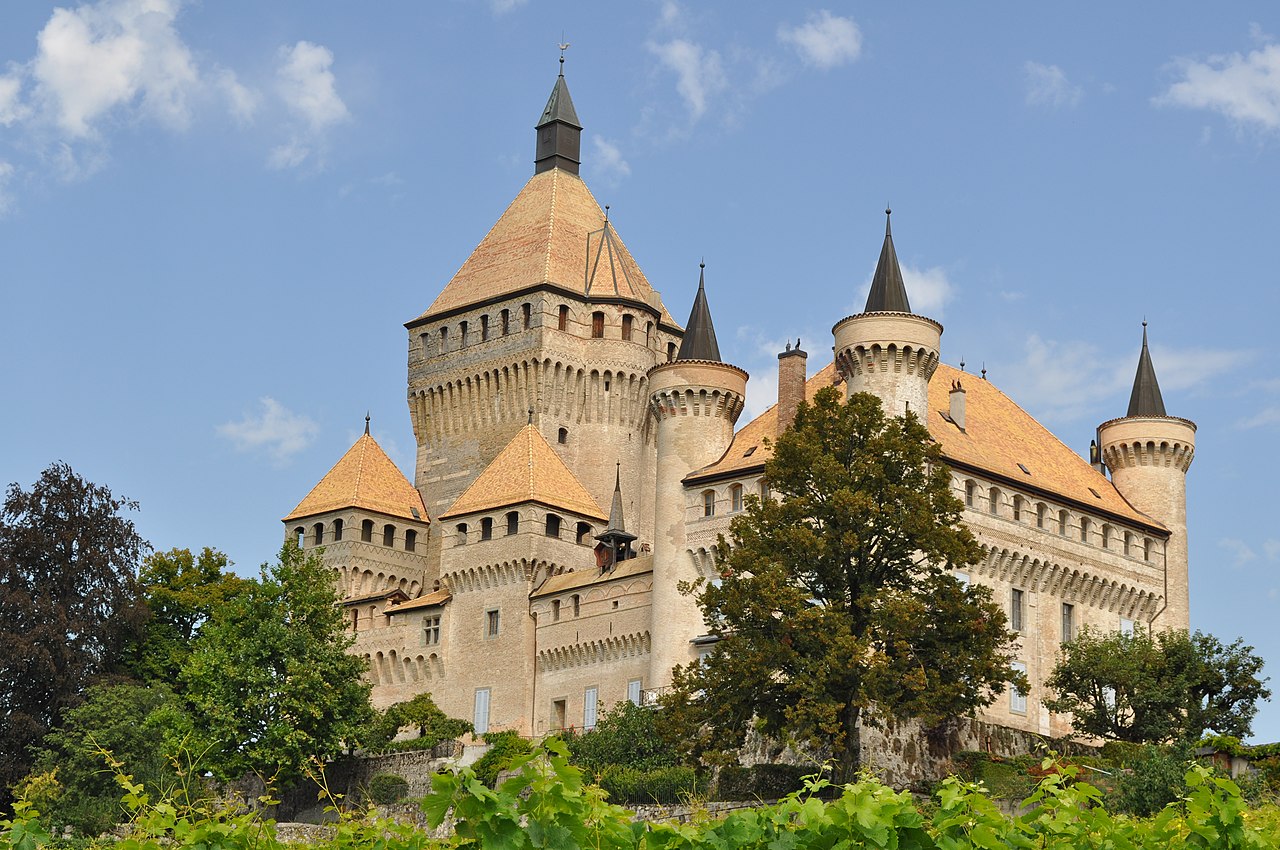
Here is a confession that photographs cannot make: this castle is enormous. The central keep rises roughly 36 metres — taller than a ten-storey building — and when you stand in the village below and tilt your head back, the sheer brick face fills your entire field of view in a way that no wide-angle lens has ever honestly conveyed. Built around 1415–1430 by Henri de Colombier, a powerful counsellor to the Duke of Savoy, the château is that rare thing north of the Alps — a castle made almost entirely of fired red brick, in the Lombard Gothic style imported from the Duchy of Milan. Four corner towers flank the central donjon, and together they compose a five-tower skyline that has no equivalent in Switzerland. The brick itself is the first surprise: hand-pressed six centuries ago, each block carries the fingerprints and slight warping of the craftsman who shaped it, with colour banding from uneven kiln-firing that shifts from burnt sienna to pale terracotta across a single face. Against this deep red, white limestone dressings mark every structural transition — quoins, window surrounds, string courses — so that the builder essentially drew the skeleton of the building in two colours. The castle is privately owned and generally closed to the public, which only sharpens the experience of standing outside it: you are looking at one of the most ambitious pieces of medieval architecture in the country, and it belongs to someone's daily life.
Lombard Decorative Brickwork
Most visitors snap a photo from the road and move on. Stop instead at the base of the nearest tower and look closely. Running across the upper walls is a series of blind arcades — shallow decorative arches pressed into the brick surface — that belong not to Swiss building tradition but to the churches and palazzi of Lombardy, 200 kilometres to the south. Count them as you walk the perimeter: the rhythm changes from side to side, as if the master mason were composing variations on a theme. Above, corbel tables — rows of small stone brackets supporting the parapet — cast a pronounced shadow-line that shifts through the day, sharpest and most dramatic in the low afternoon light. Look for the paired Gothic windows (biforae) in the residential wings: two lancet arches set beneath a single relieving arch, a hallmark of high-status Savoyard domestic architecture that links this Vaudois hilltop directly to the courts of Turin and Milan. The red-and-white colour logic is not decoration for its own sake — it is a political statement. Henri de Colombier was advertising, in brick and limestone, that his cultural horizons extended far beyond the local stone-and-timber vernacular. Six hundred years later, the message still reads clearly.
The Vineyard Walk: Castle, Vines, and Lake Geneva
The real reward at Vufflens is not a single monument but a 30-minute loop that most people never take. From the village square, follow the vineyard paths east and slightly uphill until you are level with the castle's upper walls. Turn south. Suddenly the full sweep of Lac Léman opens before you — the same panorama Henri de Colombier surveyed from his keep, the view that made this promontory worth fortifying in the first place. On a clear day, Mont Blanc floats above the Savoy shore like a rumour of altitude. In autumn, during the vendange, the air smells of fermenting Chasselas grapes and turned earth, and the vine rows blaze gold against the red brick behind you — a colour combination so specifically Vaudois it could be the canton's unofficial flag. In winter, the stripped vines expose the castle's full architectural mass against grey sky, the best season for understanding its scale without leafy distraction. The surrounding estate operates as a working wine domain, and the nearby town of Morges — a ten-minute drive with its own lakeside castle — makes a natural pairing for the afternoon. But linger here first. The quiet is the point: no audio guides, no ticket queues, just birdsong, wind through the vines, and six centuries of brick catching the light.
Plan your visit
Getting There
From Morges train station, it's a 5 km drive or a 15-minute cycle along vineyard roads to Vufflens-le-Château. By car from Lausanne, take the A1 motorway toward Geneva and exit at Morges-Ouest — the village is signposted from there. Double-check your GPS: you want Vufflens-le-Château, not Vufflens-la-Ville, which is a completely different place 10 km away and the source of countless wrong turns.
Opening Hours
As of 2026, Château de Vufflens is a private residence and is not open to the public — no ticket office, no visitor center, no posted hours. The exterior is visible year-round from public roads and vineyard footpaths through the village. Do not drive up the castle driveway; you will be turned away.
Time Needed
A leisurely walk through the village and along the vineyard paths to admire the castle from its best angles takes 30–45 minutes. Pair it with a half-day exploring the La Côte wine route through Féchy, Vinzel, and Aubonne, and you have one of Vaud's finest afternoon loops.
Accessibility
The public road through Vufflens-le-Château is paved and manageable by wheelchair, offering clear views of the castle towers. However, the vineyard footpaths (chemins viticoles) that provide the best panoramic angles are unpaved, often steep, and muddy after rain — not wheelchair-friendly.
Photo Gallery
Vufflens Castle is a stunning example of medieval military architecture, prominently situated in the Vaud region of Suisse. · [https://www.flickr.com/people/98778315@N00 St�phane Dewarrat] from Morges, SwitzerlandA long, fenced staircase leads up to the imposing medieval stone walls and towers of Vufflens Castle in Vufflens-le-Château, Suisse. · [https://www.flickr.com/people/98778315@N00 St�phane Dewarrat] from Morges, SwitzerlandThe majestic Vufflens Castle stands prominently in Vufflens-le-Château, Suisse, surrounded by scenic vineyards under a clear summer sky. · ManonrothThe imposing medieval architecture of Vufflens Castle stands prominently against the evening sky in Vufflens-le-Château, Suisse. · [https://www.flickr.com/people/98778315@N00 St�phane Dewarrat] from Morges, SwitzerlandThe majestic Vufflens Castle stands prominently in Vufflens-le-Château, Suisse, showcasing its iconic medieval towers and stone architecture against a bright summer sky. · Ben BenderA scenic view of the historic Vufflens Castle in Vufflens-le-Château, Suisse, as a regional train travels through the surrounding vineyards. · Fabien PerissinottoThe majestic Vufflens Castle stands as a prominent medieval landmark in Vufflens-le-Château, Suisse, showcasing its well-preserved brick towers and fortifications. · Manonroth
History
A Lombard Dream on Borrowed Ground
The village name itself carries a faint Roman echo: Vufflens most likely derives from a Gallo-Roman personal name, suggesting an agricultural estate on this terrace long before anyone thought to fortify it. By the twelfth century, a noble family styling themselves 'de Vufflens' held the lordship, though whatever structure they occupied — probably a modest tower house or motte — left no trace in the castle we see today. The story of the current fortress begins around 1415, when a Vaudois nobleman named Henri de Colombier embarked on something no one in the region had attempted: a full-scale castle built not from local stone but from fired brick, in the architectural idiom of the Duchy of Milan.
This was no accident of taste. The early fifteenth century was the zenith of Visconti power in Milan, and their fortified palaces — Pavia, the Castello Sforzesco's predecessors — set the standard for aristocratic ambition across the western Alps. That a Vaudois lord chose this style tells us something about where he looked for cultural gravity. Not toward Bern, not toward the French crown, but south, across the passes, toward a duchy that was then the richest and most architecturally daring state in Europe.
The turning point
Henri de Colombier and the Masons from Milan
Henri de Colombier was not simply wealthy — he was politically exposed. As a vassal operating in the contested borderlands between Savoyard and Bernese spheres of influence, his position depended on projecting strength he did not always possess. Evidence suggests that around 1415, he began recruiting master masons from Lombardy, specialists in the brick construction techniques that were reshaping the skyline of Milan. The undertaking was enormous: every brick had to be fired locally or transported overland, and the decorative banding and corbelled cornices demanded craftsmen who understood an aesthetic vocabulary almost unknown in the Pays de Vaud.
What was at stake for Henri was nothing less than dynastic survival dressed as architecture. The keep he raised — soaring to a height that dwarfed every other private fortification in the region — was a statement legible from the lake, from the road, from any hilltop within a day's ride. According to tradition, construction continued until roughly 1430, consuming the better part of fifteen years and an unknown fortune. Henri de Colombier would not live to see the political landscape he was trying to navigate rendered irrelevant: within a century, Bern would swallow all of Vaud whole.
The turning point came in 1536, when Bernese troops swept through the Pays de Vaud and ended Savoyard sovereignty in a matter of weeks. Vufflens changed hands without a siege — its military purpose was already an anachronism. Under Bernese overlordship, the castle survived as a noble residence rather than a garrison, which may be precisely why it endured. Fortresses that stayed strategically relevant got besieged, damaged, rebuilt, modernised beyond recognition. Vufflens, rendered quietly irrelevant, was left alone — and that neglect became its preservation.
The Brick That Doesn't Belong
Walk the perimeter of any other Vaudois castle — Morges, Rolle, Aigle — and you will find limestone, granite, rubble masonry. Vufflens stands apart because its Lombard brickwork was a conscious import, not a local evolution. The decorative blind arcading on the tower, the herringbone patterns in the curtain walls, and the corbelled machicolations all point to workshop traditions rooted in the Po Valley. Most scholars attribute this to Henri de Colombier's direct recruitment of Italian craftsmen, though no contract or payment record naming specific masons has surfaced. The result is a building that looks transplanted — as if someone lifted a corner of the Castello Visconteo in Pavia and set it down among Chasselas vines.
Six Centuries of Private Hands
After the Colombier line faded, the castle passed through a succession of Vaudois noble families — the Bentinks, the Senarclens, among others — each leaving subtle marks but none fundamentally altering the medieval silhouette. When Napoleon's armies dissolved the old Bernese order in 1798 and the Canton de Vaud gained its independence, Vufflens transitioned smoothly into the new republican era as private property. It has remained a family residence ever since, one of the rare Swiss castles that was never converted into a museum, a hotel, or a cantonal office. This unbroken domestic use explains both its excellent state of preservation and its inaccessibility: the same walls that kept out medieval enemies now keep out modern tourists.
Tips for visitors
Best Photo Angles
The most striking views come from the vineyard paths south and west of the village, where the castle's full silhouette — square keep, four polygonal towers, and one massive round tower — rises above the vines with Lake Geneva behind. Early morning light from the east hits the main façade perfectly.
No Drones Allowed
Swiss aviation rules (OFAC/BAZL) prohibit drone flights over private inhabited buildings without the landowner's explicit permission. Since the castle is a private residence, flying a drone anywhere near it is both illegal and a fast way to make enemies in a village of 750 people.
Drink The View
The castle sits in the heart of AOC La Côte, one of Vaud's finest Chasselas regions. During the annual Caves Ouvertes weekend each May, neighboring wine estates open their cellars — you can taste mineral, low-alcohol whites while the castle towers loom over the vines. Contact the estate in advance if you want to buy their own-label bottles; don't assume walk-in tasting.
Eat In Féchy
There is no café, restaurant, or shop in Vufflens-le-Château itself — zero. Head 5 km west to the Auberge communale de Féchy for village-inn cooking with own-estate Chasselas (CHF 25–45), or south to Morges for filets de perche meunière on the lake promenade.
Visit In May
Late April through May is the sweet spot: the vines are vivid green, the Morges tulip festival draws crowds to the lakefront 5 km away, and the Caves Ouvertes weekend turns the whole La Côte into an open-air wine bar. Arrive early on weekdays to have the vineyard paths to yourself.
Combine With Morges
Pair Vufflens with Château de Morges — a lakeside castle that actually lets you inside. The contrast is striking: Morges is a sturdy Savoyard square fortress built for defense, while Vufflens is a Lombard-Gothic showpiece built to impress. Together they tell the whole story of medieval Vaud.
Where to Eat
local_dining
Don't Leave Without Trying
Papet vaudois (leeks, potatoes and saucisse au chou)Filets de perche meunière (Lake Geneva perch in browned butter)Féra du lac (Lake Geneva char, simply grilled or pan-fried)Fondue vaudoise (Gruyère and Vacherin Fribourgeois blend)Raclette with cornichons and boiled potatoesChasselas white wine (La Côte and Morges appellations)Gâteau du Vully (custard-cream tart from the nearby Vully hills)
Restaurant de l'Hôtel de Ville de Crissier
fine dining
French Haute Cuisine€€€€star4.9directions_walk10 min drive
Order: The seasonal tasting menu — Benoît Viret's multi-course progression through the finest local and French ingredients is the entire reason you make the trip.
One of Switzerland's great three-Michelin-star institutions, this legendary address near Morges has been a pilgrimage for food lovers since the Frédy Girardet era. Now under Benoît Viret, it remains the summit of French haute cuisine in the Vaud.
Order: Papet vaudois — the leek-and-potato gratin with saucisse au chou is the soul of Vaud cooking at its most comforting.
The quintessential Swiss village auberge within walking distance of the château walls, where La Côte winemakers stop for lunch. Honest, unpretentious cooking with a strong local wine list that puts the surrounding vineyards front and centre.
Café-Restaurant du Port
local favorite
Swiss Brasserie / Lake Fish€€directions_walk12 min drive
Order: Filets de perche meunière — lightly floured Lake Geneva perch fillets pan-fried in butter, served with frites and a cold glass of local Chasselas.
Morges' lakefront is the right address for the region's signature dish. This casual portside spot delivers perfectly executed lake perch with views across Lac Léman to the Alps — a combination that never gets old.
Cave de la Couronne — Domaine local
quick bite
Wine Bar / Snacks€directions_walk10 min walk
Order: A glass of estate Chasselas paired with local charcuterie and a hard cheese from the Vaud — the simplest and most honest way to eat in this corner of Switzerland.
The La Côte wine route runs directly through Vufflens, and several domaines open their cave for tastings with simple snacks. Stop at any estate flying an open flag — it's one of the great cheap pleasures of visiting this part of Vaud.
info
Dining Tips
checkSwitzerland is expensive — a casual lunch runs CHF 20–30, fine dining CHF 150+ per person without wine.
checkService is included in every bill; tip by rounding up or leaving 5–10% for genuinely excellent service.
checkCards are widely accepted, but carry Swiss francs for village cave tastings and farm stalls.
checkBook Hôtel de Ville de Crissier weeks or even months ahead — it fills fast.
checkThe lunch menu du jour offers by far the best value: two courses for CHF 18–28 at most restaurants.
checkAsk for a local Chasselas when ordering lake fish — it's the canonical pairing and almost always available by the glass.
Food districts:Vufflens-le-Château village — wine-country auberges and cave tastings within walking distance of the châteauMorges lakefront (Quai du Port) — perch restaurants and brasseries along the waterfront promenadeCrissier — 10 minutes east, home to Hôtel de Ville de Crissier, Switzerland's most celebrated fine dining destinationLa Côte wine route — the vineyard road connecting Morges to Nyon is lined with domaines open for tastings and simple snacks
Restaurant data powered by Google
Frequently asked
Can you visit Château de Vufflens inside?
No — Château de Vufflens is a private residence and is not open to the public. There is no ticket office, no posted hours, and no visitor center. You can freely admire the exterior from the public road through Vufflens-le-Château village and from the vineyard paths (chemins viticoles) surrounding the castle. On rare occasions, the castle may open during the Journées Européennes du Patrimoine (European Heritage Days) in September, but participation varies year to year — check the Patrimoine Suisse website each autumn.
Is Château de Vufflens worth visiting?
Absolutely, even without going inside. This is one of the most visually striking medieval castles in Switzerland — a five-tower silhouette in red Lombard brick rising above Lake Geneva vineyards, unlike anything else north of the Alps. The real experience is the walk through the village and surrounding vine rows, where the castle's scale hits you viscerally: the central keep stands roughly 36 meters tall, about the height of a twelve-story building, towering over low stone village houses. Pair it with a Chasselas tasting at a nearby La Côte wine estate and you have one of the finest half-days in Canton de Vaud.
How do I get to Château de Vufflens from Morges?
Vufflens-le-Château is about 5 km northwest of Morges, reachable in 10 minutes by car via the Route de Vufflens. There is no direct train to the village, but you can cycle from Morges along vineyard roads in about 20 minutes — a pleasant, gently uphill ride through some of Vaud's finest wine country. Be careful not to confuse the destination with Vufflens-la-Ville, a different village roughly 10 km away that GPS devices occasionally mix up.
What is the best time to visit Château de Vufflens?
Autumn — specifically late September through mid-October — is the peak season. The vine leaves turn gold and amber during the vendange (grape harvest), creating a colour palette of golden foliage, red brick, and blue lake that defines the Vaudois landscape. Early morning offers the best light, with the sun from the east illuminating the main tower facade. Spring is a close second, when the vines bud vivid green against the red walls. In winter, stripped-bare vines and occasional snow on the towers make for the purest architectural photography.
Why is Château de Vufflens built in red brick?
Because its builder, Henri de Colombier, was making a political and cultural statement around 1415–1430. As a counselor to the Duke of Savoy, whose court looked toward northern Italy, he imported Lombard master-builders who worked in fired brick rather than the local limestone used by virtually every other Swiss castle. The result is an almost unique building in Switzerland: red hand-made brick with white limestone dressings tracing every structural joint, decorated with blind arcades and corbelled turrets straight from the Milanese architectural vocabulary. Up close, you can still see individual finger marks pressed into the brick surfaces six centuries ago.
How long do you need at Château de Vufflens?
About 30 to 45 minutes for the castle exterior and village walk, or a full half-day if you combine it with the surrounding vineyards and a wine tasting. Since you cannot enter the castle, the visit is a loop through the village streets and along the vineyard paths that offer different angles on the five-tower silhouette. The best approach is to treat it as one stop on the La Côte wine route, pairing it with tastings in Féchy, Vinzel, or Aubonne and a lakeside lunch in Morges.
Can you visit Château de Vufflens for free?
Yes — viewing the castle exterior costs nothing. The public roads through Vufflens-le-Château village and the vineyard footpaths surrounding the promontory are freely accessible year-round. There is no entrance fee because there is no public entrance; the castle is a private home. The only costs you might incur are wine purchases if you contact the estate's domaine viticole, or parking in nearby Morges if you drive.
What should I not miss at Château de Vufflens?
Three things most visitors overlook. First, get close enough to study the brick surfaces — from a distance it looks like any red building, but within arm's reach you see the irregularity of 600-year-old hand-pressing, colour banding from uneven kiln firing, and original lime mortar weathered to creamy grey. Second, follow the white limestone dressings with your eye: they trace the entire structural logic of the building like an architect's drawing in two colours. Third, turn your back on the castle from the vineyard paths and look south — the full Lake Geneva panorama stretching toward Mont Blanc is the view that made Henri de Colombier choose this exact promontory in 1415.
Sources & attribution8
Researched and written by the Audiala editorial team from historical records, architectural archives, and local expertise. Last updated March 2026.
Saved and recently read places — kept on this device only.
Photo credits (11)
Chateau de Vufflens — [https://www.flickr.com/people/98778315@N00 St�phane Dewarrat] from Morges, Switzerland — CC BY-SA 2.0 (https://creativecommons.org/licenses/by-sa/2.0/) — Source: https://commons.wikimedia.org/wiki/File:Chateau_de_Vufflens.jpg
Chateau de Vufflens3 — [https://www.flickr.com/people/98778315@N00 St�phane Dewarrat] from Morges, Switzerland — CC BY-SA 2.0 (https://creativecommons.org/licenses/by-sa/2.0/) — Source: https://commons.wikimedia.org/wiki/File:Chateau_de_Vufflens3.jpg
Chateau de Vufflens2 — [https://www.flickr.com/people/98778315@N00 St�phane Dewarrat] from Morges, Switzerland — CC BY-SA 2.0 (https://creativecommons.org/licenses/by-sa/2.0/) — Source: https://commons.wikimedia.org/wiki/File:Chateau_de_Vufflens2.jpg
1134 Chigny, Switzerland - panoramio — Ben Bender — CC BY-SA 3.0 (https://creativecommons.org/licenses/by-sa/3.0/) — Source: https://commons.wikimedia.org/wiki/File:1134_Chigny,_Switzerland_-_panoramio.jpg
BAM Ge 4-4 22, B62, B61, B63, B73 and B72 — Fabien Perissinotto — CC BY-SA 3.0 (https://creativecommons.org/licenses/by-sa/3.0/) — Source: https://commons.wikimedia.org/wiki/File:BAM_Ge_4-4_22,_B62,_B61,_B63,_B73_and_B72.JPG
Chateau de vufflens 3 — Manonroth — CC BY-SA 3.0 (https://creativecommons.org/licenses/by-sa/3.0/) — Source: https://commons.wikimedia.org/wiki/File:Chateau_de_vufflens_3.jpg
Château de Vufflens et vignes — Christian David — CC BY-SA 4.0 (https://creativecommons.org/licenses/by-sa/4.0/) — Source: https://commons.wikimedia.org/wiki/File:Château_de_Vufflens_et_vignes.jpg
Château de Vufflens 2 — Fanny Schertzer — CC BY-SA 3.0 (https://creativecommons.org/licenses/by-sa/3.0/) — Source: https://commons.wikimedia.org/wiki/File:Château_de_Vufflens_2.jpg
Château de Vufflens et vignes (1) — Christian David — CC BY-SA 4.0 (https://creativecommons.org/licenses/by-sa/4.0/) — Source: https://commons.wikimedia.org/wiki/File:Château_de_Vufflens_et_vignes_(1).jpg
Château de Vufflens — Fanny Schertzer — CC BY-SA 3.0 (https://creativecommons.org/licenses/by-sa/3.0/) — Source: https://commons.wikimedia.org/wiki/File:Château_de_Vufflens.jpg
Strictly necessary cookies keep the site working. Analytics (PostHog, Google Analytics) measures how each visitor uses our pages. Marketing loads YouTube videos and walking-route maps without a tap and lets Google Analytics set advertising cookies. We never sell your data. You can change this any time from the footer.
Privacy
Cookie preferences
Pick what you're okay with. You can change this any time from the footer.
Strictly necessary
Always on
Sign-in, language, navigation. Always on.
Product analytics
PostHog (EU) and Google Analytics record which pages you view and how you use them, under a random identifier stored in your browser. Helps us see which pages work and which need fixing. Google's ad personalisation stays off. No selling.
Marketing
Loads YouTube videos and the walking-route maps (OpenFreeMap) without a tap; without it, they load only when you tap them. If analytics is also on, Google Analytics may set advertising cookies. Ad personalisation stays off.