Rolle Railway Station
RolleSwitzerland 46° N · 6° E Updated Aug 2026
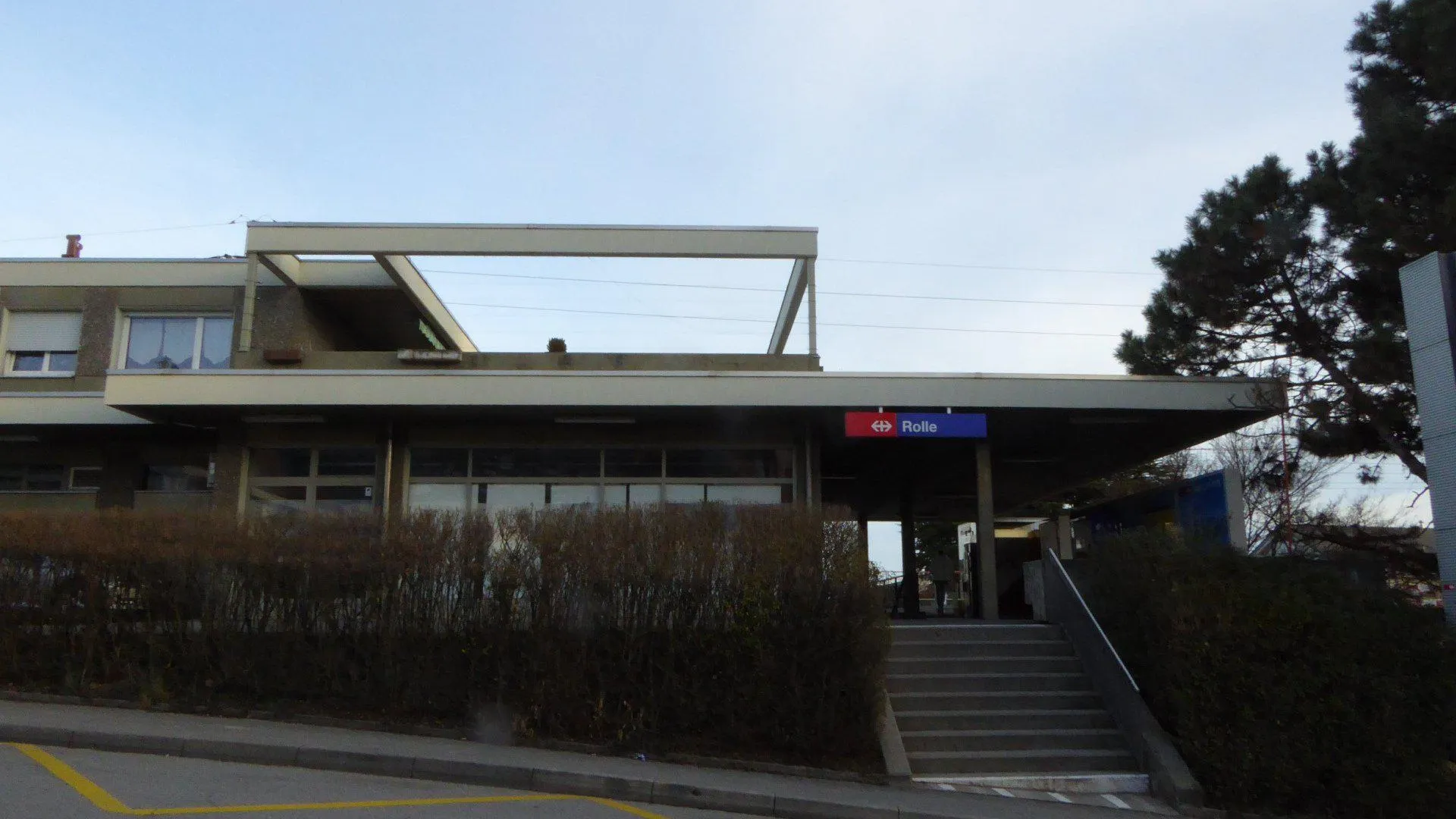
Rolle's station is a gateway to the Pearl of Lake Geneva, where a 30-year-old bistro serves perch fillets and a train once forgot to stop, stranding passengers.
- Time needed
- 1-2 hours
- Entry
- Free
- Access
- Fully accessible with elevator, ramps, and level boarding
- Best season
- Late spring to early autumn
Exactly 5,200 passengers use Rolle Railway Station on an ordinary weekday, and nearly all of them step straight past a passenger building that has stood here since 1858. Rolle, Switzerland, is a Lake Geneva town of 6,500 people, and this modest transport stop is the hinge between the upper town, the medieval castle, and the quays that slope down to the water. You don't come for the station itself; you come because the descent from platform to lake is one of the best short walks on the Swiss Riviera.
Built in 1858, the station was the lever that moved Rolle's economic center away from the lake. The Historical Dictionary of Switzerland puts it bluntly: «La construction de la gare (1858) déplaça le centre économique.» Before the rails, Rolle faced south to the water. After, the town's gravity shifted north toward the tracks.
Post-renovation, the station is fully accessible: an elevator, ramp, and level boarding were added under Switzerland's H55 disability law, with work completed around 2020. But the real architecture worth noticing is older. The original passenger building survives from 1858, one of the rarer early station structures on the Lausanne–Geneva line. Two side platforms, each 320 metres long — about three football pitches — run north–south, and the air smells faintly of lake and hot metal in summer.
Walk out of the station and you start descending. Hard rail infrastructure quickly gives way to old street grain, quays, and open water views as the road drops toward Rolle Castle. Everyone moves the same direction: down, toward the lake. Comfortable shoes matter more than station amenities.
What to see
-
The 1858 building and its buried railway marks
Most people pass through Rolle as a misadventure waiting to happen—a 24 heures story once recounted a train that forgot to stop here, then a second one that carried the stranded passengers all the way to Geneva. Look around anyway. The 1858 station building still stands in grey Vaud limestone, its original wooden canopy on wrought-iron brackets above the main entrance, while new stainless handrails from the 2018–2020 renovation warm in the sun. Crouch near the platform edge and you'll find cast-iron markers stamped 'JS' for the old Jura–Simplon Railway, half buried under pale tactile paving, plus a granite kilometre marker reading 26.66 km from Lausanne. -
The Mont Blanc illusion from platform 2
Stand at the Geneva-bound end of platform 2 and look southwest. On a clear winter day, the Mont Blanc massif seems to detach itself from the earth and float over Lake Geneva, a trick of scale above the water. The 320-metre platforms—roughly three football pitches—mean the view shifts as you move; each step changes the angle. Then an IC1 from Lausanne will hammer through without stopping, a two-second roar that rattles your sternum before the silence returns to that impossible Alpine backdrop. -
Platform to quays: the 800-metre descent
Make the descent the outing. Exit north onto Rue du Léman, then Avenue de Rolle, and the railway quickly gives way to old-street grain, café terraces, and finally the open water of the quays. The drop is only about 800 metres, but it cuts through the seam between Rolle's upper town and its lakefront—wear shoes with some grip. Detour 250 metres northwest first to the 13th-century gatehouse of Rolle Castle, then loop down past the tiny tree-covered Île de la Harpe just offshore. Do this between late spring and early autumn; the station is step-free and open every day, but the sunset from the quay is the moment that justifies the stop.
Plan your visit
- Getting There
- Rolle is a stop on the Lausanne–Geneva line (SBB line 150), about 27 km west of Lausanne and 40 km east of Geneva. Direct regional trains call regularly; use the SBB app to check exact departures to 'Rolle, gare'. Drivers can use the 115-space P+Rail lot (CHF 7/day), and the station has 44 covered bike spaces.
- Opening Hours
- As of 2026, the station has no gated entry and is open daily from early to late—SBB lists no closing hours or seasonal closures. Self-service ticket machines operate around the clock, though staffed help is limited at a station this size. Train frequencies change with the December timetable update.
- Time Needed
- Allow 10–20 minutes for a quick change or a photo of the station square. A proper visit—down the hill to Grand-Rue, Rolle Castle, and the quays—takes 1.5 to 2 hours. If you only have a tight connection, stay near the platforms; the lake views are tempting but the uphill return is slow.
- Accessibility
- After the 2018–2020 H55 renovation, both side platforms have step-free access via a new elevator, ramps, and level boarding. Two disabled parking spaces are available, and SBB publishes a station accessibility map. The surrounding descent to the lake is steep, so wheelchair users may prefer Avenue de la Gare rather than the footpaths.
- Cost & Tickets
- There is no entry fee to the station itself—you only need a ticket to board a train. As of 2026, P+Rail parking costs CHF 7 per day, CHF 70 monthly, or CHF 700 yearly via the SBB app, ticket machines, or sbb.ch. Rolle is in Mobilis fare zone 25, so compare a point-to-point ticket against a day pass if you're making multiple stops.
Photo Gallery


History
The Station That Stole the Town from the Lake
Rolle is six centuries older than its railway station. Pierre II de Savoie raised Rolle Castle in 1264 to protect a lakeside loading point, and Louis II de Savoie granted the town its charter in 1319. By the late 17th century, Huguenot refugees from France were building a merchant class that would later take to rail.
The railway arrived in 1858 with the opening of the Morges–Coppet section of the Lausanne–Geneva line. The Historical Dictionary of Switzerland confirms the effect: the station's construction displaced the town's economic center. Within two years, Switzerland had the densest rail network in Europe.
The turning point
The Man Who Never Boarded This Train
Frédéric-César de La Harpe never stood on Rolle's platform. He died in 1838, two decades before the first steam locomotive rolled through. Yet the station is his monument as much as anyone's.
De La Harpe had spent years in Russia as tutor to the future Tsar Alexander I, then returned to Vaud with one obsession: freeing his homeland from Bernese rule and bringing it into the Swiss Confederation. The personal price was real — his relative Amédée de La Harpe had to flee Rolle in 1791 after a Bastille Day banquet, escaping Bernese authorities. Frédéric-César's campaign was slower, diplomatic, and ultimately triumphant. In 1803 Vaud became a canton and Rolle its district capital.
The turning point came with the Act of Mediation in 1803. Once Vaud was a self-governing canton, it could negotiate, tax, and build like a modern state. The railway arrived fifty-five years later because the legal ground had shifted. When the station opened in 1858, it completed an economic trajectory that de La Harpe's victory had made possible. The lake had ruled Rolle for six centuries; now the rails pulled the town's center uphill.
The Sunday-Best Welcomer, c. 1885
When the Train Forgot Rolle
Tips for visitors
Eat at the station bistro
Restaurant Chemin de Fer sits at the station address itself (Gare 1) and has done traditional Swiss brasserie cooking for 30 years. Locals call it 'très abordable' and the last properly Vaudois spot in the area—go before the announced late-2027 closure.Head downhill first
The station's real reward is the descent: hard rail platforms give way to old-town grain along Grand-Rue, then quays and open water. Comfortable shoes matter more than station amenities here.Pick warm months
Late spring to early autumn is when the station justifies a stop, because the lakefront terraces and vineyard views are at their best. Aim for mid-morning or late afternoon to avoid commuter peaks on the platform and P+Rail lot.Respect the clock
Trains on the Lausanne–Geneva line leave sharp, and with just two side platforms there's no long walk to the train. Be on the platform a minute before departure, not queuing at the ticket machine.Snap, but skip drones
Casual photos of trains and platforms are fine at Rolle, but drones are banned near SBB railway infrastructure and tripods or commercial filming may require permission. Keep flash off when a train is approaching after dark.Lock your bike
The station's 74 bike-parking spaces are a clue: cycling is common, and bike theft is the likelier worry here than pickpockets. Use a sturdy lock and take lights and panniers with you.
Frequently asked
Is Rolle railway station worth visiting?
Not for the station alone — it's a working SBB stop, not a ticketed sight. But the 1858 passenger building still faces the tracks, and the real payoff is what happens after you step off the train: in ten downhill minutes you reach the lake quays. Treat it as the hinge between rail and water, and it earns a deliberate stop.
How long do you need at Rolle railway station?
Ten to twenty minutes for the station itself, enough to cross the platforms and inspect the old clock and stonework. Give yourself 90 minutes to two hours if you walk down to the lake and climb back through the old town to Rolle Castle. The station is small; the town below is what eats your time.
How do I get to Rolle from Lausanne?
Catch any SBB train on the Lausanne–Geneva line heading toward Geneva, Coppet, or Annemasse and alight at Rolle, 26.7 km west of Lausanne. It's a regular intermediate stop with half-hourly RegioExpress service, so you won't wait long. Use the destination 'Rolle, gare' in the SBB timetable for exact departures.
What is the best time to visit Rolle railway station?
Late spring to early autumn, when the platform is merely a starting point and the lakefront, terraces, and vines justify the stop. Clear winter days offer their own reward: bise wind, low sun, and Mont Blanc occasionally visible beyond the water from platform 2. Avoid the thick grey lake-basin fog that parks over Rolle in late autumn.
Can you visit Rolle railway station for free?
Yes. Swiss stations have no entry fee, and Rolle's platforms are open daily; you pay only when you board a train. You can walk from the station square to the lake without spending a franc, though the perch fillets at Le Resto will cost you.
What should I not miss at Rolle railway station?
Look for the 1858 station building, the analog Swiss railway clock, and the platform 2 view toward the lake and Savoy Alps on clear days. Then leave the platform: the 10-minute descent to the quays is the actual experience. Near the platform edges, a few original Jura–Simplon cast-iron markers may still hide under the modern tactile paving.
Is Rolle railway station wheelchair accessible?
Yes. The 2018–2020 modernization added an elevator, ramps, and level boarding, so both 320-metre platforms are now step-free. The H55 upgrade also raised platforms to 55 cm and added tactile paving, shelters, and designated disabled parking.
Sources & attribution 10
- Wikipedia – Rolle railway station — Station facts, platform lengths, passenger numbers, line details, step-free access, and current SBB services.
- SBB – Rolle station page — Official station services, daily opening, shops, parking, and accessibility map.
- Swiss Engineering Group – Rolle railway station completed — Details of H55 disability-access renovation, lift, ramps, raised platforms, and two-year construction period.
- notrehistoire.ch – Rolle, la gare — Circa 1885 photograph of steam train arrival and the station's emotional place in local memory.
- 24 heures – Le train les oublie à Rolle, ils se retrouvent à Genève — News story about a train skipping Rolle and passengers ending up in Geneva.
- Restaurant Chemin de Fer — Station-adjacent traditional Vaudois bistro, evidence of the station's food and social role.
- Le Resto – Rolle — Local restaurant menu highlighting perch fillets and brasserie classics near the station.
- SBB – Rolle P+Rail — Parking spaces, bike parking, and P+Rail pricing for Rolle station.
- Wikipedia – Gare de Rolle (French) — Historic passenger building, service tracks, and local railway context.
- 24 heures – Le Chemin de fer est de retour sur les rails à Rolle — Local coverage of the station bistro's continuation and community regard for it.
Built from cited sources · see the method · How we make our guides →
Next stop
More in Rolle.
18 places to discover — a few worth pairing.





Pick up where you left off
Saved and recently read places — kept on this device only.
Photo credits (5)
- SBB CFF FFS Re 460 020-1 IC 2000 (14491791540) — Markus Eigenheer from Genève — CC BY-SA 2.0 (https://creativecommons.org/licenses/by-sa/2.0/) — Source: https://commons.wikimedia.org/wiki/File:SBB_CFF_FFS_Re_460_020-1_IC_2000_(14491791540).jpg
- SBB Historic - F 122 00867 002 - Rolle Stationsgebaeude Bahnseite — Hans-Rudolf Berner — CC BY-SA 4.0 (https://creativecommons.org/licenses/by-sa/4.0/) — Source: https://commons.wikimedia.org/wiki/File:SBB_Historic_-_F_122_00867_002_-_Rolle_Stationsgebaeude_Bahnseite.jpg
- SBB Historic - F 122 00867 001 - Rolle altes Stationsgebaeude Bahnseite — Hans-Rudolf Berner — CC BY-SA 4.0 (https://creativecommons.org/licenses/by-sa/4.0/) — Source: https://commons.wikimedia.org/wiki/File:SBB_Historic_-_F_122_00867_001_-_Rolle_altes_Stationsgebaeude_Bahnseite.jpg
- SBB Historic - F 122 00867 004 - Rolle Stationsgebaeude Bahnseite — Hans-Rudolf Berner — CC BY-SA 4.0 (https://creativecommons.org/licenses/by-sa/4.0/) — Source: https://commons.wikimedia.org/wiki/File:SBB_Historic_-_F_122_00867_004_-_Rolle_Stationsgebaeude_Bahnseite.jpg
- SBB Historic - F 122 00867 003 - Rolle Stationsgebaeude Bahnseite — Hans-Rudolf Berner — CC BY-SA 4.0 (https://creativecommons.org/licenses/by-sa/4.0/) — Source: https://commons.wikimedia.org/wiki/File:SBB_Historic_-_F_122_00867_003_-_Rolle_Stationsgebaeude_Bahnseite.jpg
Photos may have been resized or cropped.