Île De La Harpe
RolleSwitzerland 46° N · 6° E Updated Aug 2026
A tiny artificial island in Lake Geneva commemorates the Vaudois revolutionary who tutored a Russian tsar, and was once confiscated over a 2-franc tax debt.
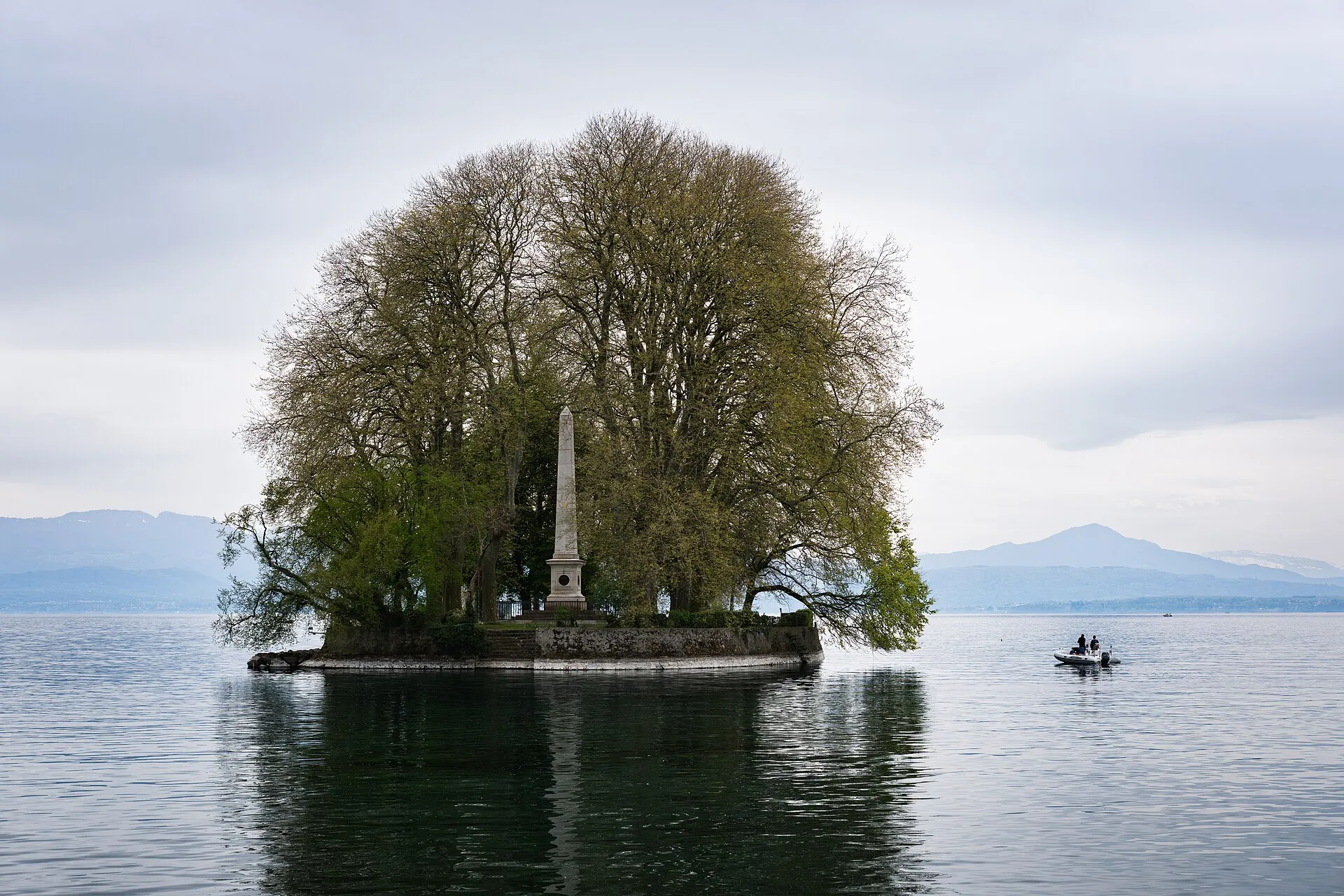 Photo: Christian David · CC BY-SA 4.0
- Time needed
- 30–45 minutes
- Entry
- Free to view from shore
- Best season
- Spring (April–May) or early autumn (September–October)
The most improbable hostage in Swiss history was a tiny island seized over an unpaid bill of 2 francs and 1 centime. That island is Île de la Harpe, a pocket of trees and limestone sitting just 80 metres offshore from Rolle, Switzerland — and it earns a visit because a man who tutored a Russian tsar is remembered here not with a city square, but with his own breakwater on Lake Geneva.
The island covers 2,368 square metres — roughly a third of a football pitch. It's 110 metres long and 30 metres wide at most; a full lap takes less than a minute at a stroll. From the eastern end of the Place de la Harpe and the Lakefront Quay, the sightline frames the obelisk against Rolle Castle and the La Côte vineyard terraces, with Mont Blanc peeking over the Savoyard Alps on clear days.
Mornings are the move. Step onto the island after dawn and the lake surface lies flat as brushed metal, the white limestone obelisk turning faintly pink before the sun clears the hills. You hear the water working the rocks, not much else. By night, tree lighting gives the island a vaguely theatrical presence, as if the monument is about to deliver a soliloquy.
Come in spring or early autumn. April and May give you green vines and calm water; September and October bring harvest light and fewer swimmers. The classic post-island reward is back on shore: a plate of filets de perche and a glass of Chasselas from one of Rolle's lakefront terraces.
What to see
-
The Obelisk and Its Medallions
You'll see it from the promenade before you ever set foot on the island: a pale limestone needle rising through the plane trees, impossibly white against the water. The obelisk went up in 1844, six years after Frédéric-César de La Harpe died, and each face of its base carries a carved medallion by James Pradier — Geneva's finest sculptor of the era, the same man who made the Winged Victory for Napoleon's tomb. Walk around it slowly. The inscriptions appear in all three national languages, a deliberate assertion that this tiny Vaudois town belonged in the Swiss story. Stand with your back to Rolle and face the monument from the island's western tip: the obelisk, the old harbor channel, and the town hall tower align in a single sightline most visitors never notice. -
The Island Itself
The whole thing is 110 meters long and 30 wide — you could walk its perimeter in under a minute. Built in 1835 as a breakwater to shield Rolle's timber port from the bise and joran winds, it sits on a sandy shoal the locals called a ténevière. Here's the strange part: the island was partly constructed using piles and remains from a Late Bronze Age lakeside settlement, so you're standing on buried prehistory. The commune seized it in 1874 over unpaid taxes — a national monument, raised by public subscription, repossessed over a bill. It became communal property the following year and has stayed that way since. In summer, swimmers paddle out from the shore 80 meters away, climb the rope swing, and launch themselves into water that drops to terrifying depths just beyond the shallows. Bring a picnic. There are no facilities, no ferry, no kiosk — just trees, grass, and the sound of water hitting stone. -
The Promenade to the Island
Start at Rolle Castle, the 13th-century Savoyard fortress now stuffed with cantonal paperwork, and follow the lakefront east. The promenade here is one of the least crowded on Lac Léman — plane trees, benches, moored sailing boats, the occasional CGN steamer pulling in during summer. At the eastern end you'll find the classic framing: the island's green hump, the obelisk, and the château stacked behind it like a postcard. Early morning is the move. The lake goes glassy, the Alps of Chablais sharpen against the sky, and on clear days Mont Blanc shows up 80 kilometers to the southeast. Cross to the island by kayak or paddleboard if you can — rental options exist in the port — or just sit on the quai and watch the light change. After dark, tree lighting gives the island a stage-like presence, as if the whole thing were waiting for a performance. In 2012, the Far° theatre company from Nyon obliged, staging a production right on the grass.
Plan your visit
- Getting There
- No bridge reaches the island — you arrive by swimming roughly 80 m from Rolle's lakeshore, by kayak or paddleboard, or by private boat. SBB trains run from Geneva in 25–30 minutes and from Lausanne in about 20; station is a 10–15 minute walk down to the lakefront. CGN steamers call at Rolle's landing stage on summer schedules, but you'll still need a small craft or a swim for the final hop.
- Opening Hours
- As of 2026, Île de la Harpe has no gates, staff, or closing hours — it's an open-air municipal islet you can visit at any time, though daylight is the sane choice. After dark, tree lighting gives it a stage-like glow, but swimming or landing at night is a bad idea.
- Time Needed
- The island is 110 m long and 30 m at its widest — you can walk around the whole thing in a minute or two. Allow 30–60 minutes to swim out, read the obelisk inscriptions, and take in the Mont Blanc panorama. With a picnic and a swim in summer, set aside 1.5–3 hours, mostly because leaving this little patch of grass is hard.
- Accessibility
- The island is not wheelchair accessible: there is no bridge, only boat or swim approach, and no paved paths, toilets, water, or infrastructure of any kind. The Rolle lakeside promenade, by contrast, is pushchair- and wheelchair-friendly and offers clear views across to the islet. Plan a shore-based visit if you need step-free access.
- Cost / Tickets
- Entry costs nothing and there is no ticket office, booking system, or admission control — the island is free public land owned by Rolle commune since 1875. Festival Île de la Harpe events run 3–10 September 2026 (one tourism listing suggests through 11 September) and sell separate tickets via festivaliledelaharpe.com.
Photo Gallery


History
The Tutor, the Tsar, and a Two-Franc Debt
The island began as harbour engineering. Around 1835, according to Rolle's municipal history, local merchants dumped stone and rubble onto a sandbank called a ténevière to shelter the timber boats loading Jura wood for Geneva. Builders later reused or buried the piles of a Late Bronze Age lakeside village beneath the new ground. That means the site is older than its 19th-century surface admits.
Then, in 1838, Frédéric-César de La Harpe died, and the pile of boulders acquired a political soul. A national public subscription paid for a monument, and by the inauguration on 26 September 1844 the island had become a strange cross between naval infrastructure and national shrine.
The turning point
The Tutor Who Cashed In a Tsar's Gratitude
Frédéric-César de La Harpe left Rolle in 1782 for St. Petersburg, where Catherine II installed him as tutor to two imperial grandsons. One was Alexander, the future tsar. La Harpe drilled the boy in Enlightenment ideas — rights, republics, the notion that power should answer to law. He had no title, no army, no fortune; his real asset was access to a future emperor.
When La Harpe returned to Vaud, he found his homeland governed by Bernese bailiffs. In 1798 he petitioned the French Directory for Vaud's independence and helped create the short-lived Helvetic Republic. The personal stakes were blunt: if the bid failed, he faced exile or prison, and Vaud would remain a subject territory. Everything changed in 1815, after Napoleon's fall. La Harpe lobbied his former pupil Alexander I directly at the Congress of Vienna, and the tsar's goodwill helped guarantee Vaud's survival as a sovereign canton inside the Swiss Confederation.
So the island works as a receipt in stone for one of the stranger transactions in Swiss nation-building. A Swiss tutor's decades-old influence with a Russian emperor helped a small canton survive Napoleon's undoing.
The Two-Franc Hostage
Pradier's Cameo at the Base
Tips for visitors
Dawn glass, empty promenade
Come just after dawn in April, May, September, or October — the lake turns glassy, Mont Blanc sharpens across the water, and you'll have the classic east-end view to yourself.East-end framing
Shoot from the eastern end of the promenade, not head-on: that's where the islet lines up with the château behind it, the single best framing. Drone pilots need Swiss FOCA clearance, and sunrise or dusk gives the obelisk a clean, low sun.Perch and Chasselas after
Restaurant du Casino's terrace sits opposite the landing stage with seasonal lake perch and local Chasselas — mid-range to splurge. For something simpler, try Blackbird House or Restaurant Terrasse a short stroll from the waterfront.Swim smart, use the rope
The swim is only about 80 m, but it's open lake water — cold even in summer, and you'll be sharing it with light boat traffic; use the commune's rope to haul yourself onto the island. Never jump from the rocks.Pair with the château
Walk the promenade before or after to Rolle Castle, whose medieval mass anchors the view west of the islet; its courtyard is freely open though interior access is limited. Time a September trip to catch the multidisciplinary festival named after the island.
Frequently asked
Is Île de la Harpe worth visiting?
Yes—if you're already in Rolle or moving between Geneva and Lausanne, a stop here beats a station coffee. The island is 2,368 m², 110 m long and barely 30 m wide, so you can walk round it in about a minute. The payoff is the oddity: a breakwater turned national memorial, built over Bronze Age lake-dwelling piles, with an obelisk carrying four James Pradier medallions. From the shore you also get the classic view of the island, Rolle Castle, and the vineyards of La Côte.
How long do you need at Île de la Harpe?
Budget 30 to 60 minutes if you're swimming or paddling out; allow two to three hours if you want to picnic and stay. The island itself is tiny and has no facilities, so most of the time is spent in the water, reading, or watching the lake light change. From the Rolle promenade, ten minutes is enough to see it and take a photo.
How do I get to Île de la Harpe from Geneva?
Take the SBB train from Geneva to Rolle, about 25–30 minutes, then walk 10–15 minutes down to the lake and swim, kayak, paddleboard, or take a private boat. There is no bridge to the island. The northern tip sits about 80 m from shore, so a confident swimmer can make the crossing; CGN steamers call at Rolle in summer but do not dock at the island.
Can you visit Île de la Harpe for free?
Yes, the island is free and open, with no tickets, gates, or staff. Bring everything you need and take everything back, because there are no toilets, running water, or bins. You'll only pay if you rent a boat or attend a separate festival event.
What is the best time to visit Île de la Harpe?
Early morning in April–May or September–October gives you glassy water and the sharpest Alps. Spring brings green vineyards and a calm lake; autumn has harvest light and often clearer skies. Summer is lively for swimming and the rope swing, but moored boats and daytime glare can flatten your photos.
What should I not miss at Île de la Harpe?
Don't skip the obelisk base: the four bronze medallions by James Pradier are the finest detail most visitors never see up close. Also look for the commemorative inscriptions and the view back toward Rolle's castle and lakefront. If you swim out, the communal rope swing drops you into deep Lake Geneva water—locals use it all summer.
Why is Île de la Harpe famous?
It commemorates Frédéric-César de La Harpe, the Rolle-born lawyer who tutored Tsar Alexander I and helped create the canton of Vaud. The island began around 1835 as a breakwater for Rolle's timber port, then took his name after his death in 1838. Its strangest episode came in 1874, when the canton seized it over an unpaid property tax of 2 francs and 1 centime.
Can you swim to Île de la Harpe?
Yes, swimming out is common in summer, and the commune provides a rope to help you pull yourself onto the rocks. The closest distance from shore is about 70–80 m. Check wind and water temperature before you go, because Lake Geneva gets choppy and cold quickly.
Sources & attribution 7
- Île de la Harpe – Commune de Rolle — Official municipal page for dimensions, breakwater origins, 1844 inauguration, obelisk and Pradier medallions, and monument restoration.
- Île de la Harpe – Wikipédia — French Wikipedia article for construction history, Bronze Age pile-dwelling remains, Belles-Lettres 1846 festival, 1968 classification, and 2012 Far° theatre performance.
- La Côte Tourisme – L'île de la Harpe — Regional tourism page for boat/swim access, breakwater purpose, naming after La Harpe, and night lighting of the island.
- 24 Heures – 150 ans de la restitution de l'île de La Harpe à Rolle — Newspaper article for the 1874 confiscation over a 2-franc tax debt, the later restitution to Rolle, and the monument's restoration.
- Swiss Spectator – Rolle, de La Harpe and the Tsar — Biographical detail on La Harpe tutoring Tsar Alexander I, Vaud independence, Napoleon, and the Congress of Vienna.
- TripAdvisor – Ile de la Harpe reviews — Visitor reports for swimming access, the rope swing, practical access, and the Tsar Alexander I inscription.
- Festival Île de La Harpe – MySwitzerland — Festival dates and contact information for the annual early September cultural events linked to the island.
Built from cited sources · see the method · How we make our guides →
More in Rolle.
18 places to discover — a few worth pairing.



Pick up where you left off
Saved and recently read places — kept on this device only.
Photo credits (14)
- File:Île de la Harpe et Léman, Rolle, Vaud — Christian David — CC BY-SA 4.0 (https://creativecommons.org/licenses/by-sa/4.0/) — Source: https://commons.wikimedia.org/wiki/File:File:Île_de_la_Harpe_et_Léman,_Rolle,_Vaud.jpg
- Île de la Harpe et Léman, Rolle, Vaud — Christian David — CC BY-SA 4.0 (https://creativecommons.org/licenses/by-sa/4.0/) — Source: https://commons.wikimedia.org/wiki/File:Île_de_la_Harpe_et_Léman,_Rolle,_Vaud.jpg
- Harpe-aerial-1 — Alexey M. — CC BY-SA 4.0 (https://creativecommons.org/licenses/by-sa/4.0/) — Source: https://commons.wikimedia.org/wiki/File:Harpe-aerial-1.jpg
- Ile de la Harpe — Thomas Strobel at de.wikipedia — CC BY-SA 3.0 (https://creativecommons.org/licenses/by-sa/3.0/) — Source: https://commons.wikimedia.org/wiki/File:Ile_de_la_Harpe.jpg
- Harpe-aerial-2 — Alexey M. — CC BY-SA 4.0 (https://creativecommons.org/licenses/by-sa/4.0/) — Source: https://commons.wikimedia.org/wiki/File:Harpe-aerial-2.jpg
- Ile de la Harpe Rolle Schweiz — Herbert wie — CC BY-SA 4.0 (https://creativecommons.org/licenses/by-sa/4.0/) — Source: https://commons.wikimedia.org/wiki/File:Ile_de_la_Harpe_Rolle_Schweiz.JPG
- Harpe-aerial-3 — Alexey M. — CC BY-SA 4.0 (https://creativecommons.org/licenses/by-sa/4.0/) — Source: https://commons.wikimedia.org/wiki/File:Harpe-aerial-3.jpg
- IleHarpe — Tania81 — CC BY-SA 3.0 (https://creativecommons.org/licenses/by-sa/3.0/) — Source: https://commons.wikimedia.org/wiki/File:IleHarpe.jpg
- Rolle - Île de la Harpe - Simplon — Pymouss — CC BY-SA 3.0 (https://creativecommons.org/licenses/by-sa/3.0/) — Source: https://commons.wikimedia.org/wiki/File:Rolle_-_Île_de_la_Harpe_-_Simplon.jpg
- St-Prex - Gland (24.12.12) 170 (8306335053) — Alain Rouiller — CC BY-SA 2.0 (https://creativecommons.org/licenses/by-sa/2.0/) — Source: https://commons.wikimedia.org/wiki/File:St-Prex_-_Gland_(24.12.12)_170_(8306335053).jpg
- St-Prex - Gland (24.12.12) 169 (8306334575) — Alain Rouiller — CC BY-SA 2.0 (https://creativecommons.org/licenses/by-sa/2.0/) — Source: https://commons.wikimedia.org/wiki/File:St-Prex_-_Gland_(24.12.12)_169_(8306334575).jpg
- St-Prex - Gland (24.12.12) 177 (8306336773) — Alain Rouiller — CC BY-SA 2.0 (https://creativecommons.org/licenses/by-sa/2.0/) — Source: https://commons.wikimedia.org/wiki/File:St-Prex_-_Gland_(24.12.12)_177_(8306336773).jpg
- St-Prex - Gland (24.12.12) 172 (8306335479) — Alain Rouiller — CC BY-SA 2.0 (https://creativecommons.org/licenses/by-sa/2.0/) — Source: https://commons.wikimedia.org/wiki/File:St-Prex_-_Gland_(24.12.12)_172_(8306335479).jpg
- Île de la Harpe 2020 (2) — Gzzz — CC BY-SA 4.0 (https://creativecommons.org/licenses/by-sa/4.0/) — Source: https://commons.wikimedia.org/wiki/File:Île_de_la_Harpe_2020_(2).jpg
Photos may have been resized or cropped.