House of Allinges
RolleSwitzerland 46° N · 6° E Updated Aug 2026
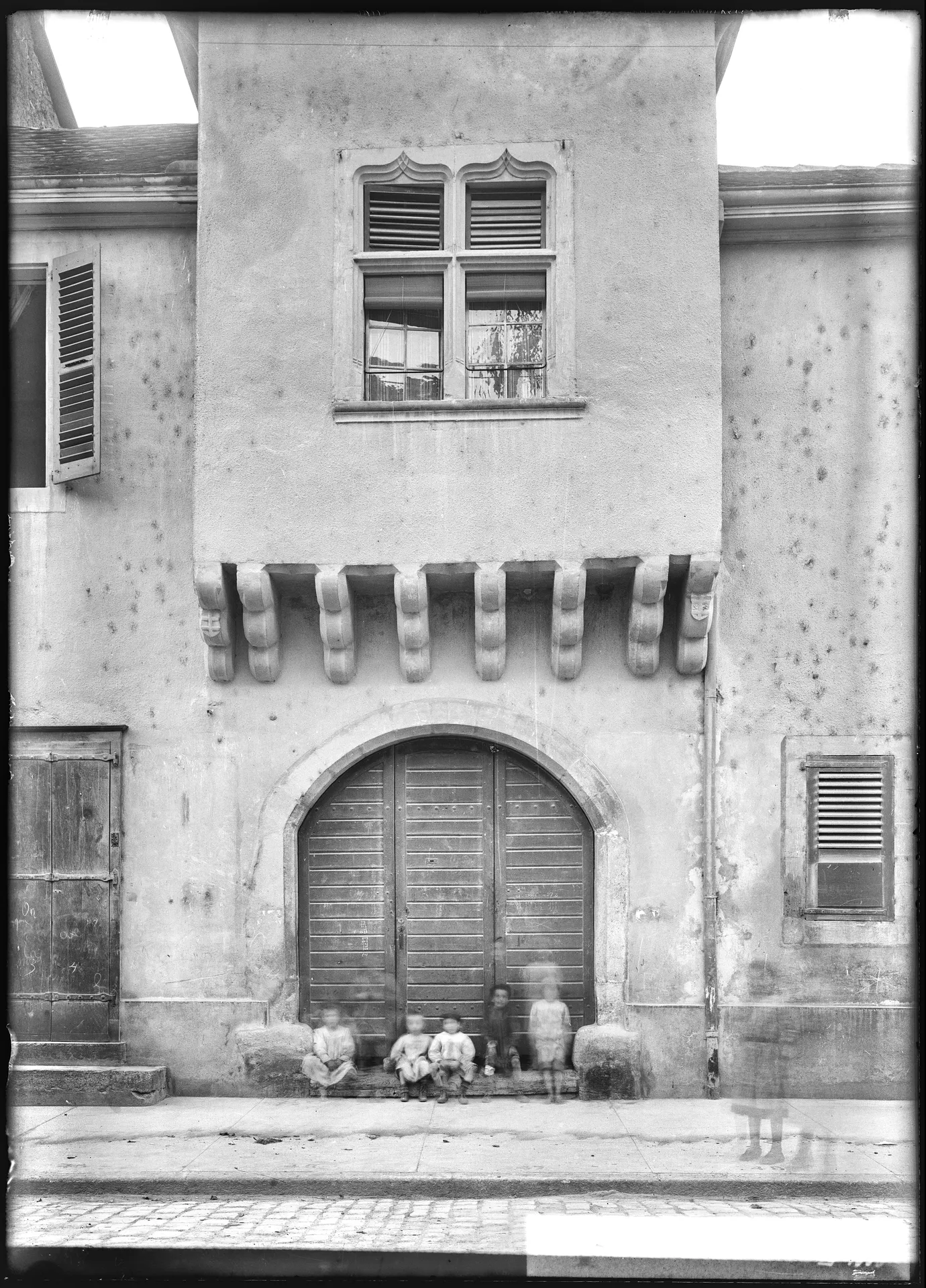
Rolle's most famous medieval house hides a machicolated bretèche above its gate — a private fortress built inside the town walls, not outside them.
- Time needed
- 10-15 minutes
- Entry
- Free (exterior viewing only)
- Access
- Viewable from street level
- Best season
- Year-round
The most heavily defended front door in Rolle, Switzerland doesn't guard a castle — it belongs to a private house on Grand-Rue. The House of Allinges wears its machicolated bretèche over the carriage gate like a stone brow, built for a family who wanted a fortress on the market street, not a country retreat. You come for that contradiction: a late-Gothic fortified townhouse still standing where the town's own walls did not.
Rolle's château leads the skyline, but the House of Allinges holds the corner on Grand-Rue. Pointed arches, stone mullions, and a cross-window under an ogee hood survive from the late Gothic turn toward Renaissance. The machicolated bretèche guarded the carriage gate — a stone shelf built to let defenders drop anything heavy on unwelcome callers.
The building stays private, so this is an exterior read. Interior beams carry torus and listel moldings from the early 16th century; late 18th-century wrought-iron handrails and marble fireplaces in jasper from Truchefardel or black Saint-Triphon stone show the house softened without losing its stare.
Just a few steps from Rolle Castle, the house reveals why it looks so defensive: Rolle's medieval walls were weak, so the family supplied their own. You don't enter. You read the façade.
What to see
-
The Bretèche That Guards Grand-Rue
Look above the carriage gate at Grand-Rue 50 and you'll see the moment this house stops pretending to be polite. A stone box thrusts out from the facade on corbel brackets, its underside studded with slot-like gaps.
Defenders in the 16th century dropped rocks, boiling oil, and worse through those mâchicoulis onto anyone uninvited. Rolle's medieval walls were weak, and this fortified house sat inside the town itself — a private castle on a merchant street.
Stand close and the shadow over the gate feels heavier than it should. You're not just looking at late Gothic architecture; you're standing exactly where the family of Allinges decided the street needed watching.
-
Molasse Windows and Cellar Beams
A slower circuit of the facade rewards nose-to-stone attention. The north side keeps a Gothic window with a molded frame in molasse, that soft local sandstone the color of old honey.
First-floor windows still carry wrought-iron handrails from the late 18th century, thin as calligraphy against all that stone weight. If the door to the vaulted cellar stands ajar, you might catch molded oak beams from the early 1500s, their torus and listel profiles worn glossy by five centuries of hands.
Nobody photographs these details. That's exactly why you should.
-
A Fortified Twenty-Minute Walk Through Rolle
Start under the bretèche, naturally. Then follow Grand-Rue east toward Rolle Castle, the town's other defensive anchor and a reminder that public power in old Rolle was stone, not paper.
Cut down through the old streets to the lake and circle Île de la Harpe, a sliver of planted earth where lake light and shadow move all afternoon. End at Place de la Harpe and the Lakefront Quay; the lake flattens into a mirror and the bretèche's grim warning starts to feel like what it always was — one family's bet that the street could be trusted only at arm's length.
The loop takes twenty unhurried minutes. Do it at ten in the morning, when the bretèche's shadow falls across Grand-Rue like a sundial.
Plan your visit
- Getting There
- Rolle station sits on the SBB main line, 25 minutes from Lausanne and 45 from Geneva. Walk 10 minutes: exit onto Avenue de la Gare, head lakeward, continue onto Rue du Temple, then turn left onto Grand-Rue; No. 50 is on the left. Drivers should use Parking du Château or Parking de la Gare — Grand-Rue is too narrow for casual car touring.
- Opening Hours
- The façade is visible 24/7, every day of the year as of 2026. The interior is a private residence and not open for visits, so there are no seasonal hours, closures, or special openings. If a guidebook lists admission, it means the view from the pavement.
- Time Needed
- Five to ten minutes is enough to study the machicolated bretèche, the cross-window, and the family arms. Pair it with Rolle Castle and the Tower Clock for a 1–2 hour old-town loop. The monuments sit close enough that you'll retrace the same street twice.
- Accessibility
- Grand-Rue is flat and paved, so the building's front is easy to approach by wheelchair or on foot. The private interior has no public access for any visitor, which sidesteps lifts or adapted toilets entirely. Nearest accessible restrooms are at the station and lakefront.
- Cost
- Free — you are looking at a public street, so there is no ticket, booking, or queue. The only paid option for deeper context is the town's guided heritage walk, run April to October for about 1.5–2 hours; the tourist office can confirm current pricing.
History
Five Centuries at the Gate
Rolle's medieval walls were never much. So the family who built here in the 16th century — likely the d'Allinges, a seigneurial line from Chablais — made their own gate. That act of distrust became the building's destiny. What endures is not the defense itself, but the house's refusal to retreat from the street.
The d'Allinges name appears in historical records as early as the 11th century, attached to two castles near Thonon across the lake. In Rolle, the house on Grand-Rue kept the family name and kept its watch. The ground floor may have shifted from storeroom to shop, but the stone above stayed.
The turning point
The Saint and the Stronghold
François de Sales never slept in the Rolle house, as far as any public document shows. But the family whose name it carries kept his memory close: their Château d'Allinges above Thonon was one of his bases during the Catholic mission to reclaim the Chablais after 1594.
For the bishop, the stakes were the religious allegiance of the Lake Geneva shore. Bern had imposed the Reformation on Vaud, including Rolle, after 1536. He walked into the Chablais with little more than a commission and a conviction; by 1598, much of the territory had returned to Rome.
That shift left the Rolle house stranded in a Protestant canton with a Catholic family name. The double name Troillet d'Allinges hints at a marriage or inheritance that pulled a local family into the d'Allinges orbit. Precisely who lived here during that reversal is still an open file.
What Changed
What Endured
Tips for visitors
Shoot from across the street
The bretèche reads best from the opposite pavement, where the machicolated overhang and the hooded cross-window stack in one frame. Morning light angles in from the lake end of the street; late afternoon stipples the corbels with shadow.It's still a private home
No entry and no knocking — behind the late Gothic façade is someone's residence on Rolle's main shopping street. A lingering look is welcome; pressing your phone against a window is not.Eat a few doors east
Hostellerie du Château at Grand-Rue 42, just downhill from the house, serves mid-range plates in a 17th-century setting. For a cheaper espresso or sandwich, try Café de la Place near the center; for lakefront perch fillets, walk five minutes to the quay.Morning beats noon
The molasse stone flattens under midday sun and delivery vans can crowd the street. Come before 11:00 or after 15:00 for deeper corbel shadows and fewer vehicles in the frame.Pair it with the Tower Clock
The Tour de l'Horloge at Grand-Rue 58 stands two doors away, its 1545 base a natural next stop. This compact run gives the best medieval-to-18th-century snapshot in Rolle.Mind the delivery carts
Grand-Rue is a working shopping street, so step backward for a photo with caution — bicycles and delivery vans use the same cobbles. Rolle has no tourist-scam reputation; the real hazard is standing in a shop doorway during morning deliveries.
Frequently asked
Is Maison d'Allinges worth visiting?
Yes, but only as a 10-minute street stop. You cannot go inside, so set expectations: stand on Grand-Rue, tip your head back, and let the machicolated bretèche do its work. If you are already in Rolle, it is worth the detour; I would not cross Lake Geneva solely for it.
How long do you need at Maison d'Allinges?
Five to ten minutes. The house is a private facade on Grand-Rue, not a museum. Pair it with Rolle Castle and the lakefront, and you have a comfortable two-hour wander.
How do I get to Maison d'Allinges from Geneva?
Take a train from Geneva to Rolle station, about 45 minutes. Then walk 10 to 12 minutes downhill toward the lake: left on Grand-Rue, number 50, where the fortified facade and carriage gate sit. From Lausanne the train is about 25 minutes.
Can you visit Maison d'Allinges for free?
Yes. The only way to visit is free because this is a private residence with no public interior. You photograph from the street, all year, 24 hours a day. No tickets, no hours, no queue.
What should I not miss at Maison d'Allinges?
Look above the carriage gate. The machicolated bretèche, a stone box with gaps in its floor for dropping unpleasant things on unwanted visitors, is the reason this house matters. Also check the cross-window above it, with its ogee hood mould; records suggest the owners wanted ceremony as much as defense.
What is Maison d'Allinges?
It is a 16th-century fortified townhouse at Grand-Rue 50 in Rolle, Switzerland, also called Maison Troillet d'Allinges. Its late Gothic stonework and machicolated bretèche make it the most famous medieval building in Rolle after the castle. It was fortified despite standing inside the town, because Rolle's own walls were weak.
Is Maison d'Allinges open to the public?
No, not the interior. You stand on the public street and look up; the building remains privately owned. No tours, no audio guide, no restrooms. The exterior paradox: it is free and always open, but only from the pavement.
Sources & attribution 5
- La Côte Tourisme – Maison d'Allinges — Confirms 16th-century late Gothic dating, fortified house status inside the town, machicolated bretèche defending the gate, and prominence after Rolle Castle.
- Commune de Rolle – Monuments — Official municipal description; gives full name Maison Troillet d'Allinges, 16th-century stylistic dating, architectural features, and local prominence.
- Tripadvisor – Maison d'Allinges — Visitor perspective confirming the house is a late Gothic exterior landmark with no public interior access.
- Rolle Tourist Guide — Practical visitor information: location on Grand-Rue, walking route from the station, free exterior viewing, and combining with other monuments.
- Historical Dictionary of Switzerland – d'Allinges — Family history context: d'Allinges origins in Chablais, first attested in the 11th century, service to the Counts of Savoy.
Built from cited sources · see the method · How we make our guides →
More in Rolle.
18 places to discover — a few worth pairing.


Pick up where you left off
Saved and recently read places — kept on this device only.