2nd Maison De Ville
RolleSwitzerland 46° N · 6° E Updated Aug 2026
This town hall began as a medieval hospital. Seized at the Reformation, it held revolutionary power — and still hides an 18th-century stone fireplace.
- Time needed
- 30-45 minutes
- Entry
- Free (exterior and courtyard)
- Best season
- Spring to autumn (April-October)
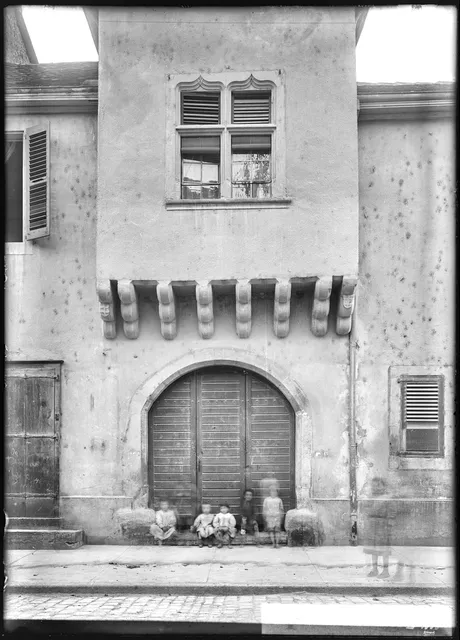
A hospital for the dying became a room for tax collectors, and the 2nd Maison de Ville in Rolle, Switzerland, still stands on that pivot. You come not for a fortress but for the rare civic building that has been sickhouse, town hall, revolutionary office, and school — all on the same Grand-Rue plot. The change is written in its walls.
Don't confuse it with the more conspicuous Rolle Castle on the lakefront. This is the smaller civic survivor at Grand-Rue 11, the town's second seat of administration, set back from the water but still in the same lake air.
The facade rewards slow looking. Later masons filled in arcades on the courtyard side, wide windows replaced older openings, and the whole street-side face now reads as a palimpsest.
When the commune opens the building for exhibitions, the interior's centerpiece is an 18th-century molasse kitchen fireplace with curved console supports. In 1718 the council chamber displayed twelve printed portraits of Roman emperors and the four continents; carpenter Jean-Charles Clert painted its woodwork pale straw with azure mouldings. It's a building that has never stopped announcing who it thinks it is.
What to see
-
The Second Maison de Ville
Rolle's second town hall at Grand-Rue 11 keeps a stranger résumé than most civic buildings. Before it governed, it healed: the medieval hospital on this footprint tended the sick until the Reformation handed the walls over to administrators. Documents first call it the maison de ville in 1550, and in 1751 the commune painted the shutters with its colors as a small act of swagger. Run a hand over the cool stone doorway and think of the last rites and tax disputes these walls have absorbed. -
Rolle Castle
At Rolle Castle, four towers stand guard — and none of them match. The Savoyards built the fortress between roughly 1250 and 1275, decades before the town itself, on a trapezoidal plan that shrugs off the tidy square of Morges. By 1558, Jean de Steiger's coat of arms had been fixed to the courtyard facade; on the lake side, later owners carved wide windows through the old arrow slits. Trace the original narrow openings in the stone around the glass. Afternoon light slants low across the lake, and swans drift almost within reach of the walls. The Salle des Chevaliers opens for exhibitions and weddings; the lakeside lawn never closes. -
A Grand-Rue Loop to the Île de la Harpe
Begin at Grand-Rue 11, then walk east past the Tower Clock on Grand-Rue 58, which has been keeping time since 1545 and was raised in 1727. The street has hosted a weekly market since 1425, so the morning air can still smell of bread and local cheese. At the bottom, turn onto Place de la Harpe and the Lakefront Quay, where the Promenade des Amoureux angles west toward Rolle Castle. Pause at the Île de la Harpe, an 1835 artificial island that has gone from timber loading to a place where someone might play trumpet at dusk. The whole loop takes under an hour at a strolling pace. That's not a suggestion; it's the zoning law of this town.
Plan your visit
- Getting There
- Grand-Rue 11 sits a 7-minute downhill walk from Rolle Railway Station. Trains run roughly twice hourly from Geneva (25 min) and Lausanne (20 min). By car, take A1 exit Rolle, drop toward the lake, and use the 24/7 Parking du Château (69 spaces).
- Opening Hours
- As of 2026, the interior of the Ancienne Maison de Ville is not a walk-in site. It opens only for municipal exhibitions, receptions, or rare heritage-day tours, so check the noticeboard by the lakefront or call Rolle's mairie at +41 (0)21 825 15 35 before expecting to step inside. The Grand-Rue facade is always visible.
- Time Needed
- Ten minutes buys you a good look at the facade and its 1751 shutters. Allow 45–60 minutes to add the lakefront, Château de Rolle, and Île de la Harpe. There is no full interior visit to stretch it.
- Accessibility
- Grand-Rue is flat but the pedestrian pavement is narrow, with delivery vans regularly squeezing past, so wheelchair users may prefer the wide, flat lakeside promenade one block down. The building's upper floors have no public elevator access confirmed.
- Cost & Tickets
- Seeing the exterior is free and there is no ticket desk. Occasional exhibitions inside are typically free, though a municipal reception may require advance registration through the mairie.
History
The Sickhouse That Learned to Govern
Before it was a seat of local power, this was the medieval hospital of Rolle — a place where the sick came to be tended and the dying came for a last bed. At the Reformation the commune seized the premises, and by 1550 a 'maison de ville' appears in surviving documents.
Each century then left a seam: Renaissance adaptations, 18th-century civic decoration, revolutionary panic and archive burnings, a 19th-century school, and finally the municipal administration. The building did not so much change use as absorb every use around it.
The turning point
The Banquet That Cost a Baron His Home
On 14 July 1790, a year after the Bastille fell, citizens of Rolle set long tables under the linden trees. They repeated the celebration in 1791, this time under the presidency of Amédée de La Harpe, seigneur of Yens and des Uttins. Just steps away stood the Maison de Ville — the local authority through which Bernese overlords expected obedience.
For Amédée, the stakes were personal. His family held land, title, and standing under Bern; to preside over a revolutionary banquet was to gamble all of it. According to the town's official history, he had to flee Rolle precipitously to escape 'Leurs Excellences de Berne.' The turning point came not in the flight alone, but in what it made of him: he later rose to general under Napoleon and was killed during the Italian campaign, becoming a martyr of the cause he had toasted under the lindens.
The facade gives no sign of the wine smells, the songs, the nervous glances toward the road. Yet this is where local risk lived — a reminder that grand events often pivot on a few tables set in the shade outside a town hall.
From Sickbeds to Civic Power
Huguenot Refugees and the French Purse
Tips for visitors
Shoot the shutters
The five windows per floor still carry the 1751 shutters painted in communal colors. Stand across Grand-Rue for a full-facade shot, but keep an ear out for buses coming through the narrow street.Sandwich at Shatri
Skip a sit-down lunch and grab a legendary sandwich at Boulangerie Shatri on Grand-Rue. Eat it on the lakefront 100m downhill, with the Alps across the water and the castle walls behind you.Late-afternoon light
The pale molasse stone and azure-blue woodwork look far more expressive in low afternoon light than under midday glare. Aim for after 16:00 in summer, when the facade warms up.Five-minute loop
This old town hall sits about 200m from Château de Rolle, Île de la Harpe, and the lakeside quay. Do them in one short loop, then walk back toward the station.Park smart
Blue-zone spaces near the old town require a Swiss parking disc and often cap stays at 1–2 hours. The 24/7 Parking du Château charges roughly 1 CHF/hour and is free on Sundays.Ring for events
The interior opens only for exhibitions, ceremonies, or rare heritage-day tours. Check the noticeboard near the lakefront — Rolle still announces civic events the analog way.
Frequently asked
Is the 2nd Maison de Ville in Rolle worth visiting?
Yes, if you realize this label usually means the Château de Rolle's working civic face rather than a conventional museum. The reward is a lakefront medieval pile with four mismatched corner towers, a grassy picnic strip, and almost no ticket-tourist crowds. Go for the exterior, the silence under the plane trees, and the way the light hits the lake-facing stone in late afternoon.
What is the 2nd Maison de Ville in Rolle?
It's a confusing map or database label rather than a name locals use. You're almost certainly looking for Rolle Castle, the 13th-century fortress that now houses municipal offices. Some records point to the old Maison de Ville on Grand-Rue 11, but Rolle has no officially named 'second town hall'.
How long do you need at Château de Rolle?
Give it about 45 minutes for the castle exterior and courtyard, then add another hour for the lakeside walk to Île De La Harpe. Thirty minutes feels rushed if you pause to trace the blocked arcades and the arrow slits buried in later window frames. A slow picnic on the grass easily stretches the stop to two hours.
How do I get to Château de Rolle from Lausanne?
Take the SBB train to Rolle station, roughly 20 minutes from Lausanne, then walk downhill toward the lake for about five minutes. From Geneva, the train ride is similar at 20 to 25 minutes. If you drive, leave the A1 at the Rolle exit and use the Parking du Château lot beside the castle.
Can you visit Château de Rolle for free?
Yes, the lakeside grounds, park, and courtyard are free and generally accessible all day. The office interior is not open for casual visits, except during municipal exhibitions, receptions, or a civil ceremony. Check the noticeboard near the castle or chateauderolle.ch for event openings.
What is the best time to visit Château de Rolle?
Late afternoon, when the lake-facing facade glows and the small beach and promenade have emptied of lunch crowds. Spring and summer give you picnics, open-air events, and lake swimming; autumn brings the La Côte grape harvest. Winter is quiet and sharp, with clear Alpine views but little shelter from the bise.
What should I not miss at Château de Rolle?
Start with the four differently shaped corner towers — round, square, and two semi-ovals — all visible from outside. Then find the wide windows cut into old arrow slits on the lake facade, and the filled-in arcade arches in the courtyard. Jean de Steiger's 1558 coat of arms still presides over the courtyard wall.
Sources & attribution 9
- La Côte - Nyon Région Tourisme, The Rolle Castle — Describes the castle's towers, courtyard, and event uses.
- MySwitzerland, Château de Rolle — Confirms the lakeside location, medieval origin, and working municipal role.
- Official Rolle municipality, Monuments — Documented the Steiger coat of arms and the castle's architectural features.
- Official Rolle municipality, History — Provided the 1558 Steiger purchase, Bourla Papey archive burning, and civic history.
- TripAdvisor, Château de Rolle — Visitor observations on free access, picnics, quiet corners, and the long-drop loo.
- Dwight Peck, Views of Rolle, Switzerland, 2013 — Local texture on the castle, lakeside promenade, Isle de la Harpe, and Rolle's character.
- Parking.ch, Parking du Château — Parking details: 69 spaces, 24/7 access beside Rolle Castle.
- Baby Steps, Rolle — Practical train and accessibility notes for visiting Rolle and the lakefront.
- Wikipedia FR, Château de Rolle — Historical timeline for the castle, including the 1264 construction date and Steiger tenure.
Built from cited sources · see the method · How we make our guides →
Next stop
More in Rolle.
18 places to discover — a few worth pairing.




Pick up where you left off
Saved and recently read places — kept on this device only.
Photo credits (2)
- Île de la Harpe — Stéphane Dewarrat — CC BY-SA 2.0 (https://creativecommons.org/licenses/by-sa/2.0/) — Source: https://commons.wikimedia.org/wiki/File:Île_de_la_Harpe.jpg
- Port de Rolle — Erikacourant — CC BY-SA 3.0 (https://creativecommons.org/licenses/by-sa/3.0/) — Source: https://commons.wikimedia.org/wiki/File:Port_de_Rolle.jpg
Photos may have been resized or cropped.