Perroy Priory
PerroySwitzerland 46° N · 6° E Updated Aug 2026
The priory's written history was erased in an 1802 archive fire—today it's a village school, communal vineyard, and terrace over Lake Geneva.
- Time needed
- 30 min–1 hr
- Entry
- Free
- Best season
- Late Aug–Sept (harvest & festivals)
The wine in your glass from Lake Geneva's La Côte may trace its roots to a terrace where monks bent over vines long before the Reformation. That terrace belongs to Perroy Priory in Perroy, Switzerland. Come for the lake view, the old bell, and the wine—the priory is still a working vineyard, a church, and a school.
From the priory's stone terrace, Lake Geneva opens below and the Savoy mountains turn blue as the light goes. Monks from Saint-Philibert-de-Tournus are said to have settled here around the 11th century, and they did more than pray. They planted. Perroy still works 129 hectares of vines—nearly half the commune's land.
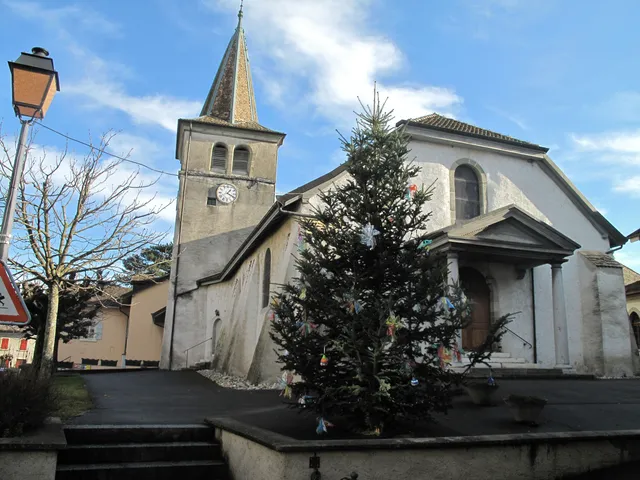
A bell cast in 1526 still hangs in the church, but the Latin chant is gone. The old priory buildings now hold a school. Walk through and you'll hear children's voices where monks once recited the hours, with the same lake wind moving through the vines outside.
What to see
-
Church of Notre-Dame
The church of Notre-Dame has stood here since at least 1130, but its written history is a wound. In 1802, the Bourla-Papey burned the priory's archives — every charter, every account, every name of the monks who prayed here for four centuries, gone in an afternoon. What survives is fragmentary. A bell from 1526, cast by Rolet Bollo, still rings in the tower. The fireplace mantelpiece carved with small columns survived the 1824 renovation, was photographed in 1914, then vanished. And beneath the floor, the 15th-century cloister holds the bones of monks and local notables, buried side by side. After the Reformation of 1536, the church became Protestant, and the interior has kept that sober character ever since. Step inside and the stone is cool, mineral, almost silent. You're standing in a building that has forgotten more than it remembers. -
The Terrace and the Millennial Vineyard
The monks who settled here in the 10th century were not hermits. They were vintners. The vineyard wrapping the priory is the oldest in Perroy — locals call it le vignoble millénaire — and it still produces Chasselas and Pinot Noir from the same terraced slopes the brothers worked a thousand years ago. Today the commune owns 3.6 hectares, tended by three taskworker vintners, and the wine they pour is bien charpenté, élégant et fruité. The terrace above the lake is where the village gathers: weddings, tastings, summer evenings that stretch until the light fails. In 1914, the commune bought the priory outright — a village taking ownership of its own history. Stand here at dusk and the lake turns silver, then violet. The mountains of Savoy go blue in the distance. This is the view the monks saw, unchanged except for the absence of their prayers. -
A Walk Through Nine Centuries
Walk downhill from the church and the village unfolds in layers. The old stone houses cling to the slope, their gardens terraced with vines. In autumn, the smell of fermenting must seeps from the cellar vents — the priory's winemaking tradition is still alive. The priory buildings now house a school, and on weekday mornings children's voices echo where monks once chanted. Continue to the lake shore, then loop back up through the vineyard. The whole circuit takes about an hour. September and October are the months to do it, when the harvest fills the air with crushed grapes and the press runs late into the evening. You'll cross nine centuries of history without leaving the village.
Plan your visit
- Getting There
- Perroy sits on the SBB Lausanne–Genève line, one stop from Rolle. From the station, it's a 5–10 minute uphill walk to Le Prieuré 5 — the village climbs the slope above Lake Geneva, so you'll feel it in your calves. Driving means street parking only; nothing dedicated, and spaces are scarce in the old centre.
- Opening Hours
- The priory itself has no published hours — it's a working village building, not a museum, though the church opens for worship and sometimes daytime visits. As of 2026, the tea-room Le Prieuré (Roberto Uzzo) keeps reliable hours: Tue–Fri 06:00–12:30 and 14:30–18:00, Sat 06:00–12:30, Sun 06:30–12:30, closed Monday. Come 15–17 August 2026 and the quadrennial Abbaye festival changes everything — expect crowds and altered access.
- Time Needed
- Fifteen minutes gets you the exterior, the church, and a look at the terrace. Give it 1–2 hours to wander the village lanes, walk down toward the lake, and trace the vineyard paths. A half-day works if you add lunch in Rolle or a slow walk through the La Côte vines — the priory rewards lingering, not checklisting.
- Accessibility
- The priory is medieval stone on a hillside — expect steps, uneven floors, and narrow passages. No elevator exists, and the walk up from the lakefront is a genuine climb. If mobility is a concern, approach from the village side rather than the beach, and call the commune (021 825 38 45) to ask about current access.
- Cost & Tickets
- Entry is free — there's no ticket booth, no queue, no audio guide. The priory is commune property, open as public space. The only money you might spend is on wine: Domaine du Prieuré bottles sell at festivals for CHF 22–25, which is fair for quality Swiss Chasselas or Pinot Noir.
Photo Gallery


History
A Thousand Years in the Vines
Perroy Priory was never a powerhouse. Documents place a Benedictine house here between 1132 and 1172, though the Historical Dictionary of Switzerland suggests it may have succeeded an earlier chapel dedicated to Saint Symphorian, cited in 1013–1014.
The monks' real estate was the terraced slope. A community from Saint-Philibert-de-Tournus settled in the village and planted vines above Lake Geneva. That vineyard became the priory's purpose and its afterlife: Perroy still counts 129 hectares under vine, nearly half the commune.
The turning point
A Bell for the Coming Storm
Rolet Bollo was a bell founder, and in 1526 he cast a bell for the priory church at Perroy. Ten years later, Bernese forces dissolved the monastery and assigned the church to Reformed worship. Bollo's bell was made for a Catholic liturgy that was about to end.
What was at stake for Bollo was craft and survival. A bell that called monks to prayer could easily be melted for scrap once the old order collapsed. Yet the 1526 bell survived the rupture. Records still attribute it to him—one of the few individual names to escape the priory's erased archive.
The turning point came in 1536, when the church lost its images but kept its bell. It still hangs, its sound now summoning schoolchildren and villagers instead of monks.
The Reformation Rupture
The Bourla-Papey Bonfire
Tips for visitors
Dress & Greetings
Cover your shoulders if you step into the church — it's still a working Reformed parish, not a ruin. And say 'bonjour' when you enter the bakery or any shop; skipping the greeting marks you as a tourist faster than a camera around your neck.Photography Rules
No flash during services, no tripods without asking, and absolutely no drones — Swiss regulations require permits near buildings and people. For serious photography, contact the commune in advance; casual phone shots are fine if you're discreet.Eat Like a Local
Boulangerie Le Prieuré Roberto Uzzo on Grand-Rue 21 is where locals buy bread — grab a CHF 5.90 surprise bag via Too Good To Go if you're lucky. For a real meal, book La Petite Table de Montelly, a monthly community table d'hôte at CHF 15; it's home cooking with village residents, and it's the best deal in the region.Festival Timing
Come for the Abbaye de Perroy festival, 15–17 August 2026 — it happens once every four years, with traditional flower-making and the commune's own wine. Avoid Mondays, when the tea-room closes and the village goes quiet; late afternoon light on the terrace is the best you'll see all day.Buying the Wine
Don't expect a tasting room — the Domaine communal du Prieuré sells its wine at festivals and local channels, not over a counter. If you want to taste, time your visit for Festi'Grape in late August or the Abbaye festival, where bottles go for CHF 22–25.Combine Nearby
Pair the priory with Château de Prangins, a Swiss National Museum site 15 minutes away — open Tue–Sun, 10:00–17:00 in winter. Or walk the vineyard paths toward Rolle, whose medieval castle and lakeside promenade make a natural half-day loop.Not a Museum
This is not a museum, and treating it like one will confuse everyone — the priory houses a school, a church, and communal offices, so respect that people work here. Don't expect guided tours, gift shops, or visitor infrastructure; the reward is seeing a village that actually uses its thousand-year-old stones.
Frequently asked
Is Perroy Priory worth visiting?
Yes, if you want a working wine village with a 12th-century church rather than a ticketed monument. The commune bought the priory in 1914, so it now holds the church, a school, and a tea-room at Le Prieuré 5. You won't find a museum or guided tour, but you get a real slice of La Côte life, with 129 hectares of vines covering nearly half the commune.
How long do you need at Perroy Priory?
Half an hour covers the church exterior and the terrace; allow 1–2 hours to walk the lanes and vineyard paths. The priory itself is small, with no visitor infrastructure, so the time depends on whether you stop for a glass of Chasselas or wander down toward Plage de Perroy.
How do I get to Perroy Priory from Geneva?
Take a regional SBB train from Geneva toward Lausanne and get off at Perroy; the priory is a 5–10 minute uphill walk from the station. Perroy sits on the Lausanne–Genève line between Rolle and Allaman, so trains are frequent. From the station, head toward the village centre and Le Prieuré 5.
What is the best time to visit Perroy Priory?
September to early October, during the grape harvest, when the air smells of pressed grapes and the lake light turns gold. If you want a festival, aim for the quadrennial Abbaye de Perroy on 15–17 August 2026, or Festi'Grape in late August. Summer evenings on the terrace are warm, but harvest season is when the village feels most like itself.
Can you visit Perroy Priory for free?
Yes, the priory is not a ticketed attraction; the church and public exterior areas are free. No official visitor hours exist, because this is a functioning parish church and a school, so check locally before entering. The tea-room Le Prieuré keeps its own hours, closed Mondays, if you want to sit inside.
What should I not miss at Perroy Priory?
Don't miss the church of Notre-Dame, the terrace over Lake Geneva, and a bottle of the commune's own Chasselas. Inside the church, records attribute a 1526 bell to Rolet Bollo, and remember the priory's archives were burned in 1802, so much of its written history is gone. The 3.6-hectare Domaine communal du Prieuré is cultivated by three vignerons-tâcherons.
Sources & attribution 9
- Commune de Perroy — Histoire — Official communal history for the 910 charter, 1914 purchase, vineyard area, and priory ownership.
- Dictionnaire historique de la Suisse — Perroy — Church of Notre-Dame first mentioned in 1132, possible Saint-Symphorian predecessor, and Reformation context.
- FAOVD — Alphabet des communes vaudoises: Perroy — Benedictine priory established around 1010, 1238 communal oven gift, and late 14th-century religious life.
- Maison des Vins — Domaine communal du Prieuré — 3.6 hectares of communal vines, Chasselas and Pinot Noir, and three vignerons-tâcherons.
- NotreHistoire.ch — Eglise de Perroy — Church attested 1130–1143 and assigned to Reformed worship in 1536.
- Enfance-Jeunesse.ch — UAPE Le Prieuré — After-school care operating in the priory, with weekday opening days.
- Local.ch — Tea-room Le Prieuré Roberto Uzzo — Café hours in the priory building, closed Mondays.
- Commune de Perroy — Abbaye de Perroy 2026 — Quadrennial festival dates 15–17 August 2026 and festival wine prices.
- Outdooractive — Perroy Travel Guide — Rail access context for Perroy on the Lausanne–Genève line.
Built from cited sources · see the method · How we make our guides →
More in Perroy.
2 places to discover — a few worth pairing.

Pick up where you left off
Saved and recently read places — kept on this device only.
Photo credits (1)
- Perroy, Ancien Prieuré — Leemburg-CH — CC BY-SA 4.0 (https://creativecommons.org/licenses/by-sa/4.0/) — Source: https://commons.wikimedia.org/wiki/File:Perroy,_Ancien_Prieuré.jpg
Photos may have been resized or cropped.