Church of Notre-Dame, Perroy
PerroySwitzerland 46° N · 6° E Updated Aug 2026
A 12th-century Benedictine priory church, Reformed since 1536, is now a Swiss national heritage temple anchoring Perroy's vineyards above Lake Geneva.
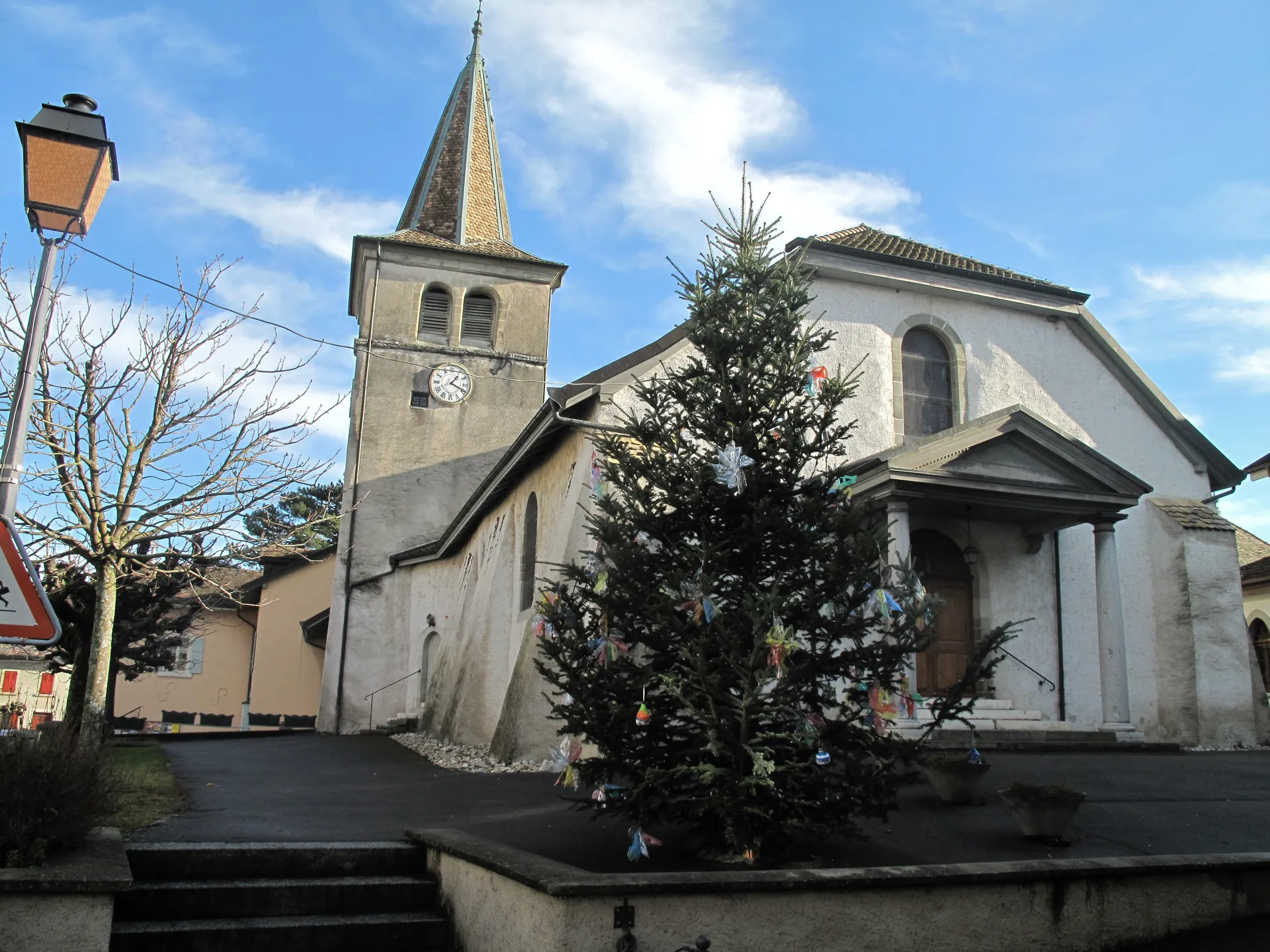 Photo: Alain Rouiller · CC BY-SA 2.0
- Time needed
- 30-45 minutes
- Entry
- Free
- Best season
- Spring to autumn (April-October)
A church named for the Virgin Mary has not heard a Catholic Mass since 1536. The Église Notre-Dame in Perroy, Switzerland, kept its Marian name through nearly five centuries of Reformed worship — a small act of linguistic stubbornness that tells you everything about how history actually works in this lakeside wine village.
Before it was a parish church, Notre-Dame was the sanctuary of a Benedictine priory, attested between 1130 and 1143. A handful of black-robed monks lived here on a narrow shelf of land between Lake Geneva and the vine-terraced slopes of La Côte. They sang the Divine Office through the night. They worked the same south-facing vineyards that still produce Perroy's wines. They buried the village dead in the shadow of the bell tower.
Then came 1536. Bernese armies conquered Vaud from the Dukes of Savoy, and the church was assigned to the Reformed cult by decree. The statues came down. The altar was stripped. The monks dispersed. A church dedicated to the Virgin became a preaching hall where her intercession was explicitly denied — yet the name Notre-Dame stuck.
Today the church is a Swiss cultural property of national importance, listed under number PBC 14721. It sits above the village of Perroy, its molasse sandstone tower visible from the lake and the Lausanne–Geneva railway line. Inside, the silence is radical — whitewashed walls, wooden benches, a pulpit as the focal point. Outside, the vineyard hums with wind and birds. That contrast is the Reformed experience made physical.
What to see
-
The Bell Tower
The tower went up in 1487, and it still commands the village the way its builders intended — visible from the lake, from the train line, from every row of vines on the terraced slopes. Square, massive, built from local molasse sandstone that glows honey-gold in late afternoon, it looks less like decoration than fortification. And that's the point. Before 1536, this was the church of a Benedictine priory, and a tower like this announced both God's presence and the monks' claim on the landscape. Climb the lane behind the church and look up at the northeast corner — some Vaud towers have a small protruding stone box up there, a watchman's latrine, a tiny detail that says we watched over this valley. The bells inside have rung for monks, for Reformed pastors, for every birth and burial in Perroy since before the village had a proper name. Stand in the square at noon and let them ring. No neighbors to complain here — just vines, water, and the echo carrying across the lake. -
The Reformed Interior
Step inside and the first thing you notice is what's missing. No statues. No candles. No gilded anything. In 1536, Bern's armies swept through Vaud and this church changed hands overnight — the priory dissolved, the Virgin's images pulled down, the walls whitewashed. What remains is a space built for the human voice. The pulpit, dark wood and probably 17th-century, sits where the altar once dominated. The acoustics are startling — clap your hands and the sound comes back at you fast and close, a room designed for psalm-singing rather than incense. Look down at the threshold stone as you enter: centuries of feet have worn it concave, a smooth hollow polished like marble. That's 900 years of Perroy — monks, then pastors, then winegrowers — all walking through the same door. The silence inside is the real monument. Outside, the vineyards hum with wind and tractors. Inside, nothing. That contrast is the Reformed experience. -
The Churchyard and the Six-Foot Rule
Walk the perimeter of the church and you'll notice something odd: no graves. The cemetery used to wrap around the building, the way it does in every medieval village. Then in 1810, a cantonal law moved it to the northeast edge of the village — a sanitary measure, a statement about the living and the dead no longer sharing the same square. But before that, around 1770, the authorities had already issued a stranger order: graves must be dug to a depth of six feet, exactly 180 centimeters. Not for drainage. Not for frost. The official reason was to prevent the living from being disturbed by the smell of the dead. Stand in the grassy churchyard now and imagine it: centuries of Perroy's dead beneath your feet, moved only by decree. The view from the south wall is the real reward — the lake sudden and bright between the houses, the Savoy Alps rising on the far shore. Monks chose this spot deliberately, orienting the choir toward the water. The view hasn't changed in 900 years. For the full context of Perroy's wine landscape, walk the vineyard paths below the church toward Malessert — the same slopes the monks first planted. See the full picture on the Perroy city page.
Plan your visit
- Getting There
- Perroy sits between Rolle and Nyon on the Lausanne–Geneva rail line; the nearest SBB stations are Rolle or Allaman, a short PostBus ride or taxi from the village. By car, park at Place du Centenaire right by the church, or at the Route Suisse lot (60 spaces) about 18 minutes' walk away. The church anchors the village core, so once you're in Perroy, everything is on foot.
- Opening Hours
- As of 2026, no published opening hours exist for this working Reformed parish church. Swiss village churches of this type are typically open during daylight hours, but the door may be locked outside service times. Contact the Paroisse du Cœur de La Côte (via perroy.ch) or email [email protected] to confirm before making a special trip.
- Time Needed
- A focused visit inside takes 15–20 minutes — this is a modest village church, not a cathedral. Allow 30–45 minutes to include the exterior, the old village core, and the view back up from the vineyards. If you're walking down to the lake afterward, budget a full hour for the whole loop.
- Accessibility
- As a 12th-century Romanesque building, expect stone steps at the entrance and uneven thresholds — no ramp or lift information exists for this specific church. The surrounding village streets are narrow and cobbled in places. Visitors with limited mobility should contact the parish ahead to check current access arrangements.
- Cost & Tickets
- Entry is free — this is an active Reformed parish church, not a ticketed monument. No booking, queue, or audio guide infrastructure exists. If you want a guided visit, the parish or commune can arrange one through the rental contact on perroy.ch.
Photo Gallery


History
A Name That Outlived Its Faith
The story of Notre-Dame de Perroy spans nearly a millennium — and possibly longer. The Historical Dictionary of Switzerland records the church's first mention in 1132 as a Marienkirche, the church of a Benedictine priory. But the same source hints at something older: a sacred building attested in 1013 or 1014, dedicated to Saint Simphorianus, possibly standing on this very spot.
What is certain is this: for roughly four centuries, monks lived and prayed here. Then the Reformation arrived with soldiers, and everything changed — except the name.
The turning point
The Uncle and the Nephew
Records show Nicod Benoît served as prior of Perroy from 1450 to 1482. During his tenure, the church took much of its current form — the nave, the choir, the bones of the building that still stand above the village. He died before seeing the bell tower finished.
His nephew Rodolphe Benoît picked up where his uncle left off. The historical record names Rodolphe as prior from 1483 until his death in 1526 or 1529. The bell tower was completed in 1487, five years after Nicod's death — Rodolphe saw it through.
What was at stake for the Benoît family was simple: legacy. Two successive priors from one family had shaped this church. The bells they hung would ring for Catholic offices, for the Divine Office, for the monks' prayers through the night. They had no reason to imagine any of it ending.
Rodolphe died in the late 1520s. Within a decade, Bernese troops arrived in Vaud. The priory was dissolved, the church stripped of its Catholic furnishings, and the Benoît name faded from the records. The building they built survived. The institution they led did not.
The Rupture of 1536
The Building Kept Changing
Tips for visitors
Call It the Temple
Locals say 'le temple' or 'l'église de Perroy' — never 'Notre-Dame de Perroy' with cathedral expectations. The medieval name stuck, but this has been Protestant since 1536. Saying 'the temple' instantly marks you as someone who did the reading.Photography Is Fine
Personal photos without flash are generally acceptable, but keep the camera down during services, weddings, or funerals. Tripods and drones need prior permission — this is a KGS-listed national heritage site, so treat it with extra care.Drink the Chasselas
The monks who built this church almost certainly planted the first vines on these slopes. Walk down through the terraces to the lake, then find a caveau or wine stand in the village for a glass of La Côte Chasselas — crisp, young, and best with the tower in view. Rolle (3 km away) has more options, including the Malakoff fried cheese patty the region is known for.Go Late Afternoon
The molasse sandstone turns golden in low light — late afternoon is when the tower glows against the vineyard slopes. Morning light is flatter and the church can feel cold and shadowed inside. If you want the interior to yourself, a weekday is quieter than Sunday, when the parish gathers.Walk Down to the Lake
The postcard angle is from below: walk the vineyard path from the church down toward Lake Geneva, then turn around. The tower rising above the vines and rooftops is the image that appears in every heritage photograph. The loop takes 30 minutes and costs nothing.Listen for the Silence
Reformed churches stripped their interiors bare — no statues, no frescoes, just whitewashed walls and a pulpit. The contrast between the vineyard noise outside and the radical quiet inside is the whole Protestant experience made physical. Sit in a pew for five minutes and let it settle.
Frequently asked
Is the Church of Notre-Dame in Perroy worth visiting?
Yes, if you like small, layered village churches with a view over Lake Geneva. It's a Reformed temple disguised behind a medieval Catholic name — Benedictine monks prayed here from the early 12th century, and Bernese reformers stripped it in 1536. You get Romanesque stone, a bell tower finished by 1487, and vineyard views without crowds.
How long do you need at the Church of Notre-Dame in Perroy?
15 to 45 minutes. The interior is small: one nave, a pulpit, a few heritage details. Allow 30 minutes to walk the exterior, find the worn threshold, and take in the lake view from the churchyard, then a little longer if you walk down through the vines.
How do I get to the Church of Notre-Dame in Perroy from Geneva?
Take a train from Geneva toward Lausanne and get off at Rolle, then a short bus or taxi into Perroy. The church sits at Le Prieuré 5, in the old village centre. Allaman station works too, but Rolle offers more connections.
What is the best time to visit the Church of Notre-Dame in Perroy?
Late afternoon in spring or autumn. Low light pulls the texture out of the molasse stone, and autumn turns the surrounding vineyards gold. Summer mornings are cool inside; winter feels stark and silent, which suits this Reformed interior.
Can you visit the Church of Notre-Dame in Perroy for free?
Yes, entry is free. This is an active Reformed parish church, not a ticketed attraction. Opening hours are not posted online, so call the commune at +41 21 825 38 45 or check the church door before you go.
What should I not miss at the Church of Notre-Dame in Perroy?
Look for Hans Ludwig Steiger's marble tomb inside, the bell tower finished by 1487, and the worn sandstone threshold at the entrance. Steiger became lord of Mont-le-Grand through his niece Marguerite, and his tomb is one of the few personal monuments left in the stripped interior. Then walk the churchyard's south edge for the lake-and-Alps panorama past the old priory walls.
Why is the church in Perroy called Notre-Dame if it is Protestant?
The name is a fossil from its Catholic past. This began as a Benedictine priory church dedicated to the Virgin Mary, attested between 1130 and 1143. Bern imposed the Reformation on Vaud in 1536, but the old name stuck — a Protestant temple still carrying its Catholic dedication.
Is there parking near the Church of Notre-Dame in Perroy?
Yes, Place du Centenaire is a small parking area near the church. If it's full, Route Suisse offers 60 spaces about 18 minutes away on foot. The village core is compact, so you won't need the car once you're parked.
Sources & attribution 8
- Historical Dictionary of Switzerland (HLS) – Perroy — Confirmed first mention in 1132 and a possible earlier sacred building attested in 1013/14.
- notrehistoire.ch – Eglise de Perroy — Confirmed Benedictine priory attested 1130–1143, Reformed worship from 1536, and 1915 restoration.
- Commune de Perroy – Eglise — Confirmed current Reformed parish use and local contact for visits or rentals.
- Wikimedia Commons – Perroy, église réformée Notre-Dame — Confirmed Swiss cultural property of national importance (KGS 14721).
- Canton de Vaud architectural database (Davel) — Recorded 1553 transformations and 1828 neo-classical renovation.
- Mapcarta – Place du Centenaire — Confirmed Place du Centenaire parking near the church.
- Parkopedia – Route Suisse, Perroy — Confirmed Route Suisse parking with 60 spaces, about 18 minutes' walk from the church.
- Knowledge Base – Church of Notre-Dame, Perroy — Biographical facts for priors Nicod and Rodolphe Benoît, bell tower completion in 1487, Hans Ludwig Steiger's tomb, and cemetery regulations.
Built from cited sources · see the method · How we make our guides →
More in Perroy.
2 places to discover — a few worth pairing.


Pick up where you left off
Saved and recently read places — kept on this device only.
Photo credits (6)
- St-Prex - Gland (24.12.12) 137 (8307616344) — Alain Rouiller — CC BY-SA 2.0 (https://creativecommons.org/licenses/by-sa/2.0/) — Source: https://commons.wikimedia.org/wiki/File:St-Prex_-_Gland_(24.12.12)_137_(8307616344).jpg
- Perroy, église réformée Notre-Dame 02 — Leemburg-CH — CC BY-SA 4.0 (https://creativecommons.org/licenses/by-sa/4.0/) — Source: https://commons.wikimedia.org/wiki/File:Perroy,_église_réformée_Notre-Dame_02.jpg
- Perroy, église réformée Notre-Dame 01 — Leemburg-CH — CC BY-SA 4.0 (https://creativecommons.org/licenses/by-sa/4.0/) — Source: https://commons.wikimedia.org/wiki/File:Perroy,_église_réformée_Notre-Dame_01.jpg
- Grand-Rue de Perroy (VD) 2 — Jérémy Toma — CC BY-SA 4.0 (https://creativecommons.org/licenses/by-sa/4.0/) — Source: https://commons.wikimedia.org/wiki/File:Grand-Rue_de_Perroy_(VD)_2.jpg
- St-Prex - Gland (24.12.12) 140 (8306571045) — Alain Rouiller — CC BY-SA 2.0 (https://creativecommons.org/licenses/by-sa/2.0/) — Source: https://commons.wikimedia.org/wiki/File:St-Prex_-_Gland_(24.12.12)_140_(8306571045).jpg
- Grand-Rue de Perroy (VD) 1 — Jérémy Toma — CC BY-SA 4.0 (https://creativecommons.org/licenses/by-sa/4.0/) — Source: https://commons.wikimedia.org/wiki/File:Grand-Rue_de_Perroy_(VD)_1.jpg
Photos may have been resized or cropped.