Origins and Early Development
Neuchâtel’s origins date to April 1011, when King Rodolphe III of Burgundy granted the royal residence "Novum castellum" to his wife, Ermengarde. The city’s name, evolving over centuries, reflects its dynamic heritage (Neuchâtelville). The settlement clustered around the castle, with the Old Town’s medieval crossroads and early civic landmarks forming the nucleus of the city.
Political and Dynastic History
The city’s political trajectory is marked by its passage through the hands of Burgundy, German noble houses, and the French d’Orléans-Longueville dynasty, which elevated Neuchâtel to a principality in 1504 (Swiss Spectator). Notably, Neuchâtel retained a monarch until 1857, leaving a lasting imprint on its architecture and local identity.
Urban and Socioeconomic Transformation
Philanthropist David de Pury and industrialists like those behind Suchard chocolate played pivotal roles in the city’s 18th and 19th-century growth. Neuchâtel became a hub for watchmaking, precision engineering, and innovation, with urban expansion shaping new neighborhoods and infrastructure (Swiss Spectator).
Role and Significance of the Galeries
The Galeries De L'Histoire serve as a vital cultural repository, displaying scale models, archival documents, and interpretive materials to illustrate the city’s evolution. Highlights include models of Neuchâtel circa 1400, explorations of heraldry, and exhibits on urban transformation (mahn.ch; myswitzerland.com).
Architectural and Cultural Context
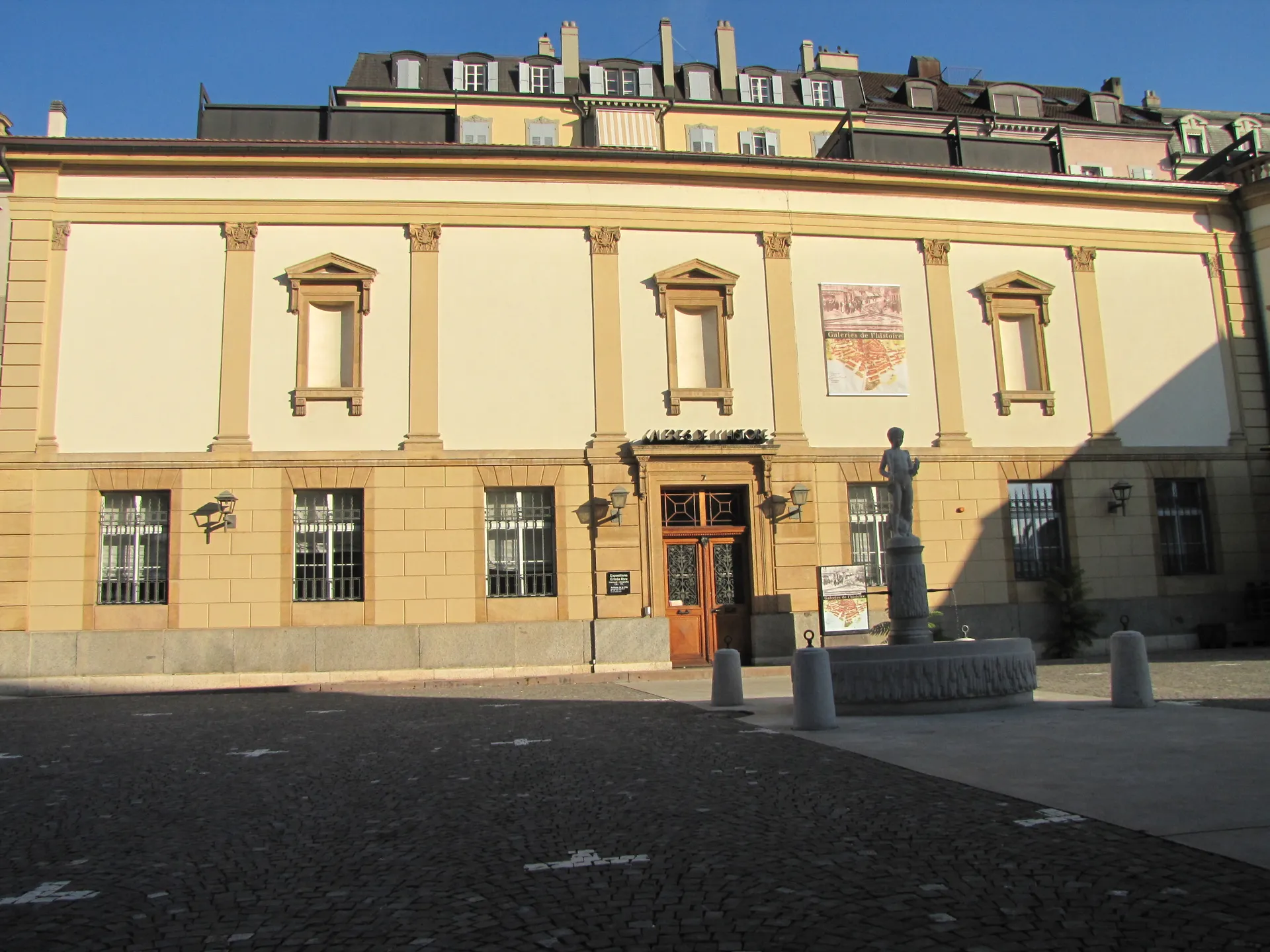
Occupying the north courtyard of the Hôtel DuPeyrou, the Galeries’ building was constructed in the 1860s and expanded in the 1890s, reflecting Neuchâtel’s commitment to cultural preservation (mahn.ch). The site’s adaptive reuse as a museum and archive underscores its ongoing relevance, and its central location places visitors close to other architectural landmarks and public gardens.
Permanent Exhibition: The Seven Models
The centerpiece is a series of seven chronological models charting Neuchâtel’s development from the year 1000 to 2000:
- Neuchâtel circa 1000 Fortified residence origins
- Medieval Expansion (12th–15th centuries) Growth of fortifications and neighborhoods
- Renaissance and Early Modern Architectural influences and civic development
- 18th Century Enlightenment Public spaces and education
- Industrial Revolution Railway and industry
- Early 20th Century Modernization and cultural institutions
- Contemporary Neuchâtel Integration of heritage and modernity
Interpretive panels and multimedia contextualize each phase (mahn.ch).
Thematic Exhibitions and Multimedia
- Daily Life Artifacts and photos
- Historical Events Reformation, Swiss Confederation, migration
- Industrial Heritage Watchmaking and microtechnology
- Civic Life Documents and multimedia presentations
Temporary Exhibitions
Special displays focus on urban planning, migration, and innovation. For example, “Le don de Berthe” (Oct 2024–Jun 2025) and “Livres d'or” (Jun 2025–Feb 2026) offer additional perspectives (neuchatelville.ch).
Visitor Information
Opening Hours
- Wednesday & Thursday 09:00–12:00, 13:30–17:00
- Saturday & Sunday 14:00–17:00
- Closed Monday, Tuesday, and Friday
- Appointments Visits outside regular hours by arrangement (neuchatelville.ch)
Admission and Booking
- Admission Free of charge for permanent exhibitions (mahn.ch)
- Temporary Exhibitions CHF 4 entrance fee (torpille.ch)
- Group Visits & Guided Tours Booking recommended for groups and schools
- Email: [email protected]
- Phone: +41 (0)32 889 68 90
- myswitzerland.com
Guided Tours
Guided and thematic tours can be arranged in advance, available in French and other languages upon request. Educational workshops are also offered for school groups.
Accessibility
The museum is wheelchair accessible, with adapted facilities. Contact ahead for specific requirements (museums.ch).
Getting There
- Address Avenue Du Peyrou 7, 2000 Neuchâtel, Switzerland
- Public Transport Near bus and tram stops; 15-minute walk from the main train station
- Parking Limited; public transport is advised during busy periods (myswitzerland.com)
Travel Tips and Nearby Attractions
- Best Time Weekday mornings or early afternoons for a quieter visit
- Duration 45–60 minutes recommended for a full tour
- Family-Friendly Educational materials and interactive exhibits available
- Nearby Sites Collégiale (Collegiate Church), Château de Neuchâtel, lakeside promenade, Art and History Museum (j3l.ch)
- Neuchâtel Tourist Card Free public transport and attraction discounts for overnight visitors (j3l.ch)
FAQs
Q: What are the Galeries De L'Histoire opening hours?
A: Wednesday and Thursday 09:00–12:00 & 13:30–17:00; Saturday and Sunday 14:00–17:00; closed Monday, Tuesday, Friday.
Q: Is admission free?
A: Yes, permanent exhibitions are free; temporary exhibitions may have a CHF 4 fee.
Q: Are guided tours available?
A: Yes, with advance booking; available in multiple languages.
Q: Is the venue accessible?
A: Yes, fully wheelchair accessible; contact for specific needs.
Q: Can I take photos?
A: Non-flash photography is permitted except during certain temporary exhibitions.


