Type 2+ letters to search all countries, cities, and places
/Ctrl KEsc
travel_explore
Type 2+ letters to search all countries, cities, and places
Press Enter to open the top result
Temple De Morges
Morges·Switzerland·46° N · 6° E·Updated Mar 2026
Morges' most grandiose Reformed temple hides a local twist: the famous front facade is rarely the entry. Go for the baroque interior and 2022 Ahrend organ.
One Roman numeral above the west door, MDCCLXXII, turns Temple De Morges into a puzzle you can read in stone. In Morges, Switzerland, Temple De Morges is worth visiting because you can see a public engineering failure, a redesign, and a civic comeback in one building. Records show worship on this site by 1306, but the temple in front of you is an 18th-century reinvention, not a medieval survivor.
Inside, the light feels measured and calm, and the sound hangs in the air with unusual clarity. The 2022 Ahrend organ arrived roughly 250 years after the inscription date, about the age of the United States, reconnecting the church to a long musical tradition without pretending the timeline is simple.
The temple also works as a key stop in Morges’s historic circuit: you can pair it with Château de Morges, the civic center around Hôtel De Ville, Morges, and the broader town context on the Morges page.
Researched by the Audiala editorial team from historical records, architectural archives, and local expertise.
What to see
The Nave’s Quiet Drama
Enter from the west and the building confesses its trick: first a tight rib-vaulted vestibule, then a sudden release into a pale, late-Baroque hall that feels more like a civic theater than a stern Reformed church. The main floor holds 327 seats and the galleries another 100, roughly the load of six city buses, so even a half-full service has a human hum before a single note is played. Stand under the west gallery when the organ is being tested and you can hear how delicately the room carries sound; in 2022 the city restricted activity during voicing because tiny noises mattered. Before you leave, walk behind the pulpit and find Samuel Düntz’s funerary slab in the floor, a Saint-Triphon stone once flipped upside down and only rediscovered in 1958. It is the kind of detail that turns a pretty interior into a lived biography.
The Facade and the 1772 Clue
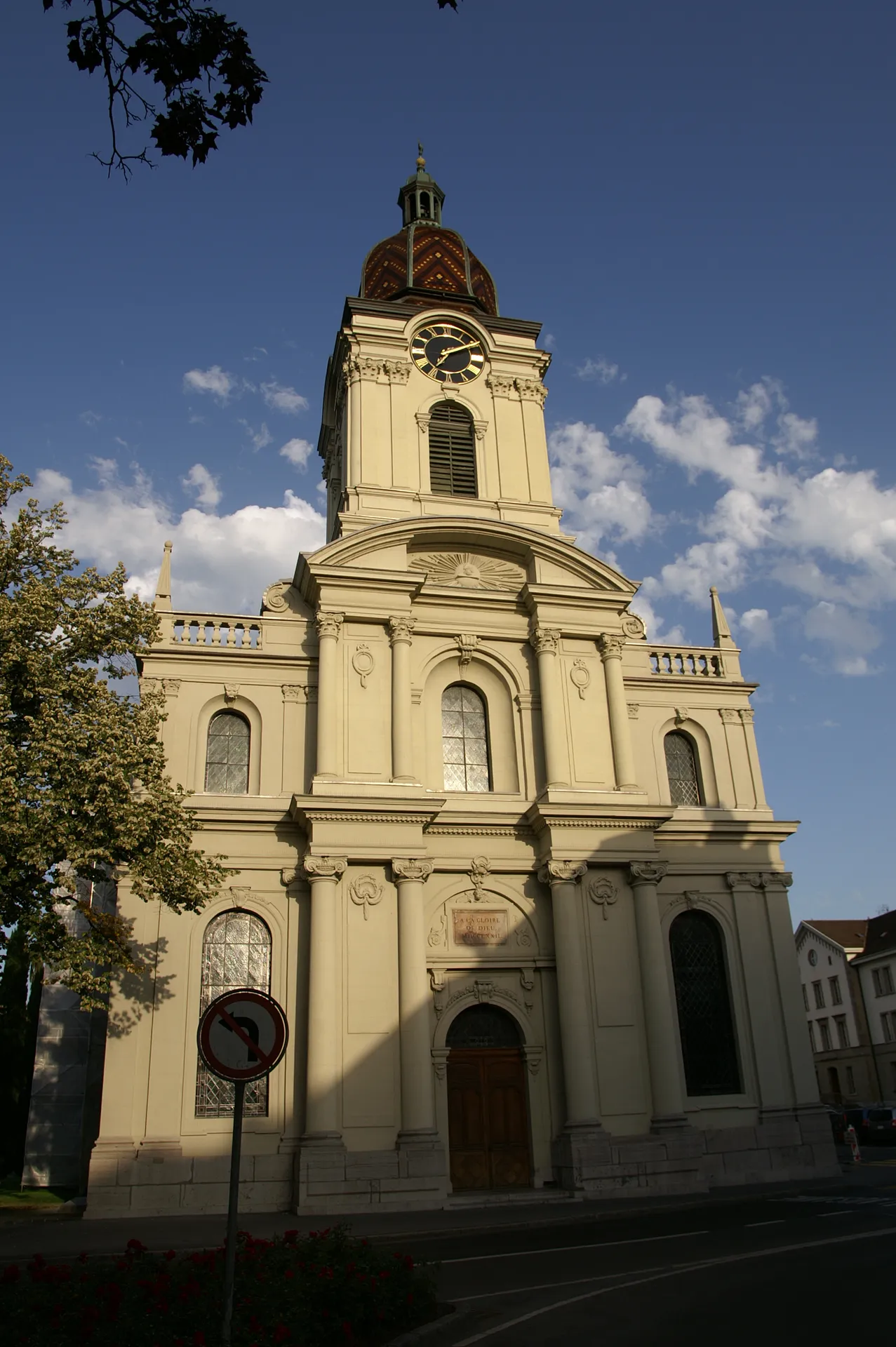
Outside, skip the front-on postcard angle and stand slightly off-axis on Place de l’Église: the facade starts reading like stage scenery, with stacked classical orders, a compact tower, and that unusual divine eye in the pediment. Over the portal, the red Yvorne-marble inscription dated 1772 is the building’s bluntest clue, now 254 years old as of 31 March 2026, and four years older than the United States. This is where Morges’s Protestant restraint softens into ornament: shell motifs, colored roof tiles on the tower, and a dome that seems to float above the stone. If you are coming from Hôtel De Ville, Morges, approach through the north end of Grand-Rue and watch the temple appear at the street’s vanishing point; that reveal is part of the architecture, not just the walk.
Old Town to Lakeshore Soundwalk
Start at Morges Railway Station and walk about 600 meters to the temple, roughly six football pitches laid end to end; late afternoon is best, when the west front warms and interior light turns honey-colored. After the temple, continue to Château de Morges, then drift toward Musée Forel and Casino De Morges by the lake. The full loop is around 1.8 kilometers, about four and a half track laps, short enough to do slowly with pauses for organ-rehearsal overtones, bell echoes between facades, and the smell of lake air replacing old stone. Taken together, the route changes the temple from an isolated monument into what it really is: the acoustic heart of the town.
Plan your visit
Getting There
Temple de Morges is at Place de l’Église 2, about a 5-7 minute walk from Morges Railway Station, roughly one song and a half through the old town. Closest bus stops are Morges, Poste (701, 702, 703, 704, 724) and Morges, Casino (706). By car, use central lots like Centre-Ville Charpentiers or Parc des Sports; since December 1, 2025, the first hour at Parc des Sports is free, about the length of a quick temple stop.
Opening Hours
As of 2026, the temple does not publish fixed museum-style daily visiting hours; access usually follows worship and event schedules. Regular Sunday services are listed at 10:00, and parish secretariat hours are Tuesday and Friday 08:30-11:30 (except school holidays), a window about as short as a long coffee break. Check the live EERV calendar before coming, because independent interior access is not guaranteed.
Time Needed
Plan 10-15 minutes for an exterior look, about the time to finish an espresso on Grand-Rue. If the interior is open, 20-30 minutes gives a satisfying visit; 45-90 minutes works best if you stay for music, prayer, or a slow old-town detour. Official tourism guidance also frames 1 hour as a solid average.
Accessibility
As of 2026, official listings describe the temple as partially wheelchair-accessible, with nearby accessible parking spaces. Approaches through central Morges are generally easy and mostly flat, but no public elevator information is provided. Because access is marked partial, contact the parish in advance if you need full step-free certainty.
Cost & Tickets
As of 2026, there is no published standard admission fee for ordinary sightseeing, and regular services are generally free. Concerts vary: some are free with donation, while paid programs have been around CHF 30 standard and CHF 20 reduced, roughly the jump from a quick lunch to a full dinner. There is no general skip-the-line system; tickets are handled per event.
Photo Gallery
The historic Temple De Morges stands proudly at the end of a charming, sun-drenched cobblestone street in the heart of Morges, Switzerland. · SlatinA detailed historical floor plan illustrating the interior seating arrangement and architectural layout of the Temple De Morges in Switzerland. · Jean-Jacques BergerThe historic Temple De Morges stands proudly under a clear blue sky in the heart of Morges, Switzerland. · Tansu OzcelebiThe historic Temple De Morges stands in silhouette against a breathtaking sunset over Lake Geneva in Morges, Switzerland. · Sarah3319The historic Temple De Morges stands proudly in Morges, Switzerland, showcasing elegant neoclassical architecture and a prominent clock tower. · PymoussA serene sunset view of the Temple De Morges across the water, featuring silhouetted figures strolling along the rocky lakefront. · Sarah3319The historic Temple De Morges stands as a beautiful example of Neoclassical architecture in the heart of Morges, Switzerland. · Henk Monster
History
A Church That Had to Be Rebuilt Twice
Documented records show a church here by 1306, tied to Savoy’s planned town. Evidence suggests the current temple was shifted to the nearby Pré de l’Étang after demolition of the older structure in 1769, so this is continuity of place more than continuity of walls.
That distinction is the building’s real confession. Temple De Morges preserves not a seamless past, but a moment when an ambitious Reformed town built beyond its ground conditions and had to recover in full public view.
The turning point
Erasme Ritter’s Setback, Léonard Roux’s Rescue
Erasme Ritter, the Bernese architect, had personal stakes that were unmistakable: this commission could secure his reputation in Vaud. Documented sources show rapid progress from 1769, then a turning point in 1771 when the nearly completed west front and tower subsided after the tower rose beyond the original plan.
What changed next was authorship itself. Records show works resumed under Rodolphe de Crousaz with Léonard Roux involved from 1772, turning a near-disaster into a controlled redesign. Documented sources date the solemn dedication to 4 August 1776, when the town reopened the building as both temple and public vindication.
1306 Is Real, but Easy to Misread
Records show worship at this spot in 1306, and local accounts describe a medieval church near the old town wall. The present structure is later: documented demolition in 1769 and reconstruction nearby. Evidence suggests most confusion comes from merging the age of the sacred site with the age of the current building.
Sound, Glass, and Layered Memory
Documented sources place the first organ in the late 1770s, but the exact year remains uncertain, with credible accounts split between 1777 and 1778. The later organ history, including the 1896 Kuhn phase and a 2022 inauguration cycle, shows a long technical afterlife, while 1891 choir glass by Karl Wehrli adds color to an otherwise disciplined Protestant interior.
Tips for visitors
Quiet Temple Etiquette
No strict dress code is publicly posted, but this is an active parish church, so neat clothing and calm behavior matter more than style. During services or concerts, keep your voice low and avoid moving around until a natural pause.
Photos Without Friction
General tourist photography appears acceptable outside active worship, but avoid flash and do not assume tripod use is fine without permission. For drones, follow Swiss FOCA rules and check official flight-restriction maps before launching.
Parking QR Alert
Local safety messaging in Morges focuses on scams more than street crime, especially fake police and fraudulent QR codes on parking machines. Pay only through trusted channels and inspect parking meters before scanning anything.
Eat Nearby Smart
For Vaud classics, Restaurant de l’Union on Grand-Rue is a dependable mid-range choice; Confiserie Fornerod and La Boîte à Thé are easier budget-to-mid tea-room stops. If you want lake views and a longer meal, the restaurant at Casino De Morges is the splurge option.
Best Light Window
Go early for quieter streets, or late afternoon when lake-reflected light warms the stone and the façade looks almost theatrical. Spring and early autumn usually give the most comfortable walking weather, jacket-light rather than heavy-coat cold.
Plan B Loop
If the temple door is closed, pivot fast: walk to Morges Castle, then Musée Forel, and finish on the quays, a loop that feels shorter than a single podcast episode. Save money by targeting free or donation-based organ events, and bring small cash for easy giving.
Where to Eat
local_dining
Don't Leave Without Trying
Filets de perche — lightly pan-fried Lake Geneva perch with fries, the defining dish of this stretch of the Swiss RivieraFera — a more delicate local lake fish, less well-known than perch but worth seeking outBacalhau — salt cod cooked Portuguese-style, a Morges specialty thanks to the town's strong Portuguese communityChasselas — the local white wine from Vaud vineyards just above Morges, the natural pairing for lake fishFondue — Swiss classic available at several restaurants, best ordered in cooler monthsRösti — crispy Swiss potato cake, often finished with melted cheese or bacon
Pepper Jack
quick bite
Takeaway / Burgers€€star4.6(1116)directions_walk3 min walk
Order: Whatever's on the daily special — with over 1,100 reviews and a 4.6 rating, the crowd has done the vetting for you
The most-reviewed spot in Morges by a wide margin, right on the pedestrian Grand-Rue. Numbers don't lie — locals come back again and again, and the rating only climbs.
Portuguese / Lake Fish€€star4.5(492)directions_walk4 min walk
Order: Perch fillets from Lake Geneva with fries — the definitive local dish at around 22–29 CHF for a lunch menu. If you want something more Portuguese, the Bacalhau cooked several ways and the Monkfish & Seafood Cataplana are both exceptional.
Morges has a strong Portuguese community, and Le Gallion is where that heritage meets the lake. Fresh local perch and authentic salt cod under one roof is a rare combination — and the staff make you feel like a regular from the first visit.
British Pub / Bar€star4.4(945)directions_walk5 min walk
Order: A cold pint and whatever's on the pub menu — this is your go-to for a relaxed drink after the Temple and the old town
Close to 1,000 reviews and a 4.4 rating says everything. The White Horse is where Morges genuinely unwinds — open from morning until 1 AM and welcoming the whole way through.
Spanish Tapas / Bar€€star4.3(412)directions_walk3 min walk
Order: Go for tapas to share — the format is made for a long, unhurried lunch on Grand-Rue, picking your way through plates with a glass of something cold
Spanish tapas on the pedestrian main street of a Swiss lake town works better than it sounds. A lively spot for apero or a leisurely meal, right in the heart of the old town — open from 9 AM on Wednesdays if you want a slow start.
Swiss Brasserie€€star4.2(421)directions_walk2 min walk
Order: Fondue in cooler months, rösti with melted cheese, or steak tartare — the Swiss classics done properly in a room that feels like it belongs here
The closest thing to a proper Swiss brasserie on Grand-Rue — attached to the Hotel Savoie and open every day of the week. When you want the real local experience without fuss, this is the default.
Café / Brasserie€€star4.2(658)directions_walk4 min walk
Order: The lunch menu is the sweet spot — good value for a proper sit-down meal steps from the lake, with evening service running until 11 PM if you want to linger
A reliable all-day brasserie with 658 reviews backing it up, on the same street as Le Gallion. Solid for when you want a proper table and a full meal without any ceremony.
checkMany restaurants close on Mondays — Le Gallion, Metropolis, and Fu-Yiu all shut that day; Brasserie de l'Union is your safest bet if you're visiting on a Monday
checkLe Gallion is effectively a lunch restaurant — if you want the perch, arrive before 2:30 PM
checkThe Wednesday and Saturday morning market on Grand-Rue is one of Switzerland's best weekly markets — local cheeses, charcuterie, and Vaud farm produce, two minutes from the Temple
checkOrder a glass of Chasselas with lake fish — the local Vaud white wine is made for exactly this pairing
checkGrand-Rue and Rue Louis de Savoie are the two main dining streets; nearly everything worth eating is within a five-minute walk of the Temple
Food districts:Grand-Rue — the pedestrian main street, lined with cafes, bars, takeaways, and the twice-weekly marketRue Louis de Savoie — the parallel street with the best sit-down restaurants, including Le Gallion and MetropolisLakefront promenade — the natural setting for a post-meal stroll, steps from every restaurant on this list
Restaurant data powered by Google
Frequently asked
Is Temple de Morges worth visiting?
Yes, Temple de Morges is worth visiting, especially if you like places that look calm but hide a structural drama. The present temple rose between 1769 and 1776 after part of its first tower-front subsided in 1771, so the building you see is literally a recovered project. Inside, the light is pale and wide, and when the organ sounds, the echo hangs in the room like a long breath.
How long do you need at Temple de Morges?
You need about 45 to 60 minutes if the interior is open, roughly the length of a relaxed lunch by the lake. An exterior-only stop takes about 10 to 15 minutes, about as long as one espresso and a short old-town loop. If you pair it with Morges Castle or Musée Forel, plan 90 minutes total, about one full podcast episode.
How do I get to Temple de Morges from Morges?
From Morges Railway Station, the easiest route is a 5 to 7 minute walk through the old town to Place de l’Église, about the time of one song and a chorus. If you are using local buses, stops like Morges Poste put you very close. From Château de Morges, it is about 3 minutes on foot, basically one short city block sequence.
What is the best time to visit Temple de Morges?
The best time is during a concert or service window, because this church reveals itself through sound as much as architecture. Spring is especially good when Morges is in bloom and the old town feels lively on the approach, while Advent often brings strong organ programming. If you want the quietest atmosphere and softest light, aim for weekday mornings outside event rush.
Can you visit Temple de Morges for free?
Yes, you can usually visit Temple de Morges for free when it is open for worship or public access. Many events are free with donations, while some concerts are ticketed, with examples around CHF 30, roughly the price of two generous lakeside drinks in Switzerland. There is no standard museum-style admission system for routine sightseeing.
What should I not miss at Temple de Morges?
Do not miss the funerary slab behind the pulpit, the 1772 portal inscription (MDCCLXXII), and the historic organ case now housing the 2022 Ahrend instrument. Those three details explain the temple’s whole personality: medieval memory, interrupted construction, and living music culture. Afterward, continue toward Hôtel De Ville, Morges and Casino De Morges to see how the building sits inside the city’s civic spine.
Sources & attribution79
Researched and written by the Audiala editorial team from historical records, architectural archives, and local expertise. Last updated March 2026.
Grande Rue de Morges — Slatin — CC BY-SA 3.0 (https://creativecommons.org/licenses/by-sa/3.0/) — Source: https://commons.wikimedia.org/wiki/File:Grande_Rue_de_Morges.jpg
Morges, Switzerland - panoramio (136) — Tansu Ozcelebi — CC BY 3.0 (https://creativecommons.org/licenses/by/3.0/) — Source: https://commons.wikimedia.org/wiki/File:Morges,_Switzerland_-_panoramio_(136).jpg
Church of Morges as seen from the South - panoramio — Henk Monster — CC BY 3.0 (https://creativecommons.org/licenses/by/3.0/) — Source: https://commons.wikimedia.org/wiki/File:Church_of_Morges_as_seen_from_the_South_-_panoramio.jpg
Strictly necessary cookies keep the site working. Analytics (PostHog, Google Analytics) measures how each visitor uses our pages. Marketing loads YouTube videos and walking-route maps without a tap and lets Google Analytics set advertising cookies. We never sell your data. You can change this any time from the footer.
Analytics and marketing cookies are optional and only load if you agree. Details under Customize.
Privacy
Cookie preferences
Pick what you're okay with. You can change this any time from the footer.
Strictly necessary
Always on
Sign-in, language, navigation. Always on.
Product analytics
PostHog (EU) and Google Analytics record which pages you view and how you use them, under a random identifier stored in your browser. Helps us see which pages work and which need fixing. Google's ad personalisation stays off. No selling.
Marketing
Loads YouTube videos and the walking-route maps (OpenFreeMap) without a tap; without it, they load only when you tap them. If analytics is also on, Google Analytics may set advertising cookies. Ad personalisation stays off.