Type 2+ letters to search all countries, cities, and places
/Ctrl KEsc
travel_explore
Type 2+ letters to search all countries, cities, and places
Press Enter to open the top result
Morges Castle
Morges·Switzerland·46° N · 6° E·Updated Mar 2026
Founded in 1285 to control Lake Geneva's trade routes, Morges Castle birthed an entire town — and still houses one of Switzerland's finest military museums.
Seven centuries of continuous military purpose and not a single siege to show for it — Morges Castle on the shores of Lac Léman in Switzerland has stored weapons, quartered soldiers, and guarded a general's legacy, all without ever needing to defend itself. Standing at the water's edge in the quiet town of Morges, its four round towers project a confidence that history never tested. Come for the architecture that connects this lakeside fortress to some of the most consequential castle-building of the medieval world; stay for the tin soldiers — thousands of them — and the story of a man who saved Switzerland by refusing to fight.
The castle's silhouette — a near-perfect square with four projecting corner towers — looks like a textbook illustration of medieval military design, and that is no accident. Evidence suggests it belongs to the same Savoyard architectural tradition that produced the great castles of the late 13th century, a tradition whose master builders also shaped Edward I's famous Welsh fortresses at Harlech and Beaumaris. What reads from across the lake as a charming Swiss castle is, architecturally, a node in a military design network that once stretched from the Alps to the Irish Sea.
Today the castle houses the Musée Militaire Vaudois, one of Switzerland's most distinctive military collections. Alongside centuries of Vaudois regimental history, it holds the personal effects of General Henri Guisan — the Swiss commander-in-chief during the Second World War — and one of the country's largest collections of painted tin soldiers, thousands of miniature figures cataloguing European military uniforms across centuries. The building has never stopped being about the military. Only the weapons got smaller.
Morges itself is a town that was literally built around this castle. When Louis de Savoie commissioned the fortress around 1285, he laid out the town's grid street plan at the same time — castle and settlement conceived as a single act of will. Walk through Morges today and the medieval geometry is still legible beneath the café awnings and lakeside promenades.
Researched by the Audiala editorial team from historical records, architectural archives, and local expertise.
What to see
The Savoyard Fortress and Vaud Military Museum
Louis I of Savoy began building Morges Castle in 1285, and the design he chose tells you everything about his priorities: four cylindrical corner towers, curtain walls thick enough to park a car inside, and a courtyard so compact it feels less like a residence than a clenched fist. The honey-gold molasse sandstone — the same sedimentary rock that built Lausanne Cathedral — glows warm in afternoon light but turns austere and grey under cloud, as if the building changes mood with the weather. Step through the entrance and the town noise vanishes. Inside, the Vaud Military Museum fills room after room with the physical evidence of Swiss martial history: halberds taller than a person, lined up in ranks that still look menacing after five centuries; suits of plate armor with visible battle dents and repaired sword cuts; Napoleonic-era uniforms whose blues and reds remain startlingly vivid behind glass. The rooms smell faintly of old metal and preservation wax, lit by spotlights that pick out the articulation of an armored glove or the foundry mark on a bronze cannon barrel. But the real revelation is architectural — find the deep window embrasures in the tower rooms, where you step through a meter and a half of solid wall into a private alcove, and suddenly you're looking at Lac Léman and the Alps through a frame that hasn't changed since the thirteenth century.
Musée de la Figurine Historique
Most visitors come for the castle and the weapons. The ones who linger longest came for those too, then stumbled into the Historical Figurine Museum and lost an hour they hadn't planned on. Tens of thousands of hand-painted tin and lead soldiers — some barely fifteen millimeters tall — are arranged in dioramas depicting battles from Roman antiquity through the twentieth century. The effect is disorienting: you lean in close, and a Napoleonic cavalry charge materializes in miniature, each rider's face individually painted, each horse caught mid-stride, shadows falling across modeled terrain in warm directional light that makes the scene look almost cinematic at the right angle. A Waterloo diorama might contain more individual figures than the room has square meters. This is one of Europe's finest collections of its kind, and it sits inside a thirteenth-century castle where most people never look past the swords. Give yourself at least thirty minutes here. The pleasure is cumulative — the longer you look, the more you notice: a drummer boy's expression, the highlight on a cannon wheel, a fallen standard in the mud of a battlefield no bigger than a dining table.
The Guisan Museum and Swiss Wartime Memory
In a quieter wing of the castle, a smaller museum holds the personal effects of General Henri Guisan, commander-in-chief of the Swiss Army during World War II and arguably the most important Swiss figure of the twentieth century. On July 25, 1940 — weeks after France fell — Guisan summoned his entire officer corps to the Rütli meadow above Lake Lucerne and told them Switzerland would fight. The Rütlirapport, as the Swiss call it, became the defining act of national identity under existential threat. Here you'll find his actual uniforms, his command maps, the desk where decisions were written, the walking stick he carried. The tone shifts from the martial grandeur of the main museum to something more intimate and unsettling: not weapons of war but the personal objects of a man who had to decide what his country was willing to die for. For Swiss visitors, this room carries a weight that's hard to explain to outsiders. For everyone else, it's a window into a version of WWII neutrality that was anything but passive — a country that spent six years armed to the teeth, staring across its borders, waiting.
The Lakeside Walk: Castle, Tulips, and Alps in One Frame
The best way to understand Morges Castle is to see it from where Louis of Savoy's enemies would have: the water. Walk south from the castle entrance to the Quai Igor Stravinsky and turn back to face the four towers rising above the rooftops. On clear days — especially winter mornings and spring afternoons — the entire chain of the Savoy Alps unfolds across the lake behind you, Mont Blanc visible at the far western edge. From April through mid-May, the Parc de l'Indépendance next door erupts with some 120,000 tulips during the Fête de la Tulipe, and the contrast is almost absurd: medieval military stone meets saturated bands of red, yellow, and violet at ground level. The walk from the railway station along the waterfront to the castle takes ten minutes, passes outdoor café terraces and the old harbor, and delivers you to the entrance having already understood the thing that photographs can't convey — that this fortress wasn't built to dominate a hilltop but to command a lake, and that seven centuries later, the lake is still the reason to come.
Plan your visit
Getting There
From Lausanne, take a CFF train to Morges — just 10 minutes, with departures every 15–20 minutes. From the station, walk south toward the lake along Rue Louis-de-Savoie; you'll see the castle's square towers in about 8 minutes. CGN lake steamers also dock at Morges pier, practically at the castle's feet — a far more dramatic arrival if you're coming from Geneva, Nyon, or Lausanne-Ouchy.
Opening Hours
As of 2026, the castle museums are generally open Tuesday through Sunday, 10:00–17:00 during the main season (April–October), with reduced afternoon-only hours in winter. Closed Mondays year-round. Verify exact dates on the official site before visiting, as the castle may close for several weeks in January–February.
Time Needed
The castle houses four separate museums under one roof — military history, decorative arts, firefighting, and artillery. A focused visit to one or two collections takes about an hour; seeing everything properly requires 2.5 to 3.5 hours. If the tulip festival is running in the adjacent park, add at least another 45 minutes for the flower displays.
Tickets
Expect adult admission around CHF 8–10, with reduced rates for students and seniors. Children under 16 typically enter free or at reduced cost. The Swiss Museum Pass is accepted — if you're hitting multiple museums on your Swiss trip, the pass pays for itself quickly. The Swiss Travel Pass likely covers entry as well.
Accessibility
This is a 13th-century fortress, and it shows: uneven stone floors, narrow staircases to upper levels, and no elevator. The courtyard and ground-floor galleries are reachable by wheelchair, but the tower rooms and upper collections are stairs-only. Contact the museum in advance for specific accommodations.
Photo Gallery
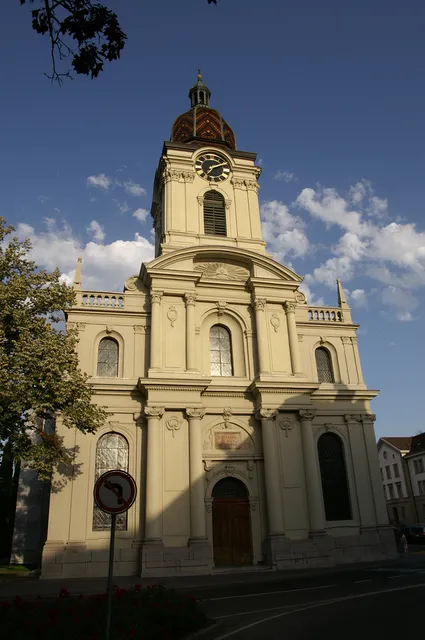
A view of Morges Castle, モルジュ, スイス. · Pierre Bona
History
Seven Hundred Years Under Arms
Most castles change purpose with the centuries — fortress becomes palace, palace becomes ruin, ruin becomes museum. Morges Castle skipped the middle steps. From the day its first garrison took position behind freshly mortared walls around 1286, through 250 years as a Savoyard stronghold, 262 years as a Bernese arsenal, and into its present life as a military museum, the building has served the same essential function: storing the instruments of organized violence and the people trained to use them. The weapons evolved from halberds to rifles to painted tin figurines, but the purpose never wavered.
What visitors walk through today is not a castle repurposed but a castle perfected — centuries of military occupants refining, reinforcing, and restocking the same stone envelope that Louis de Savoie raised beside the lake. The walls are thick enough to park a car inside — roughly two and a half meters in places — and the layout still follows the defensive logic of the 1280s, even as the threat it was designed to meet vanished centuries ago.
The turning point
The General Who Won by Refusing to Fight
On July 25, 1940, six weeks after France fell and Switzerland found itself completely encircled by Axis powers, General Henri Guisan summoned every senior officer in the Swiss Army to the Rütli meadow — the legendary birthplace of the Swiss Confederation. What was at stake was nothing less than Swiss sovereignty. A genuine faction within the Swiss military and political establishment, the so-called Fronten movement, favored accommodation with the Third Reich. Guisan, a French-speaking Vaudois commanding a predominantly German-speaking army in a country where cultural sympathy with Germany ran deep, was personally and politically exposed.
He chose defiance. His Rütli address laid out the Réduit strategy: retreat to the Alpine fortress, mine every bridge and tunnel, make invasion so costly that Hitler would look elsewhere. No surrender. No negotiation. No accommodation. It worked — not through combat but through the credible promise of unbearable cost. Switzerland was never invaded. Guisan became the most revered Swiss figure of the 20th century, and after his death in 1960, his personal collection — wartime maps, operational documents, the memorabilia of a career defined by restraint — came to rest here, in the castle at Morges that had been storing military materiel since before his ancestors were born.
The continuity is almost too neat: a building commissioned in the 1280s to project military strength on behalf of a lord who never lived here, now preserving the legacy of a general whose greatest military achievement was making sure nobody had to fight at all.
What Changed: Masters and Flags
The heraldry above the gate has been rewritten three times. Savoyard crosses gave way to the Bernese bear in February 1536, when Berne's army swept through the entire Vaud in weeks and the castellan opened the gates without resistance — the very fortress Louis de Savoie built to project Savoyard power became the instrument of Savoyard erasure. The bear flew for 262 years until the Vaudois revolution of January 1798, when patriots inspired by the French Revolution expelled the Bernese bailiffs and briefly proclaimed the République lémanique. Then came Napoleon's Act of Mediation in 1803, and the castle passed to the newly created Canton of Vaud. Three sovereigns, three flags, three entirely different political orders — and through it all, the same four towers kept watch over the same stretch of lake.
What Endured: The Arsenal Within
Beneath the changing flags, the building's daily reality barely shifted. Savoyard castellans inventoried weapons and counted garrison provisions. Bernese bailiffs stored ammunition and maintained the armory. Cantonal authorities kept it as a federal military depot through the 19th century. When the museum finally opened, its founding collection was not acquired — it was already there, accumulated across centuries of continuous military storage. The tin soldiers arrived later, but they fit the logic of the place: even the miniatures are dressed for war. Today's museum guards walk the same stone corridors that Savoyard sentries patrolled, checking on the same essential category of objects. The job description has not fundamentally changed in over seven centuries.
Tips for visitors
Photography Rules
Exterior shots are unrestricted, but inside the military museum, skip the flash — the centuries-old uniforms, silk battle flags, and campaign maps are light-sensitive. Tripods likely require staff permission. Drones are a no-go over the lakefront under Swiss BAZL regulations without a permit.
Eat Lake Fish
The lakefront brasseries within 200 meters of the castle serve filets de perche — pan-fried Lake Geneva perch that's the regional obsession. Pair it with a glass of local Chasselas white from the La Côte vineyards that carpet the hillsides behind town. Expect CHF 25–45 for a main course — Swiss prices, but the fish swam past the castle this morning.
Tulip Festival Timing
The Fête de la Tulipe (late April–early May) fills the park beside the castle with over 120,000 tulips and considerably more visitors. Come on a Tuesday or Wednesday morning for elbow room; Sunday afternoons are shoulder-to-shoulder, and parking becomes genuinely painful.
Combine With the Lakefront
After the castle, walk east along the lake promenade to the Parc de l'Indépendance — the tulip park is lovely even outside festival season. On clear days, Mont Blanc appears above the French shore across the water, best lit in morning light. The old town arcades behind the castle hide excellent wine shops stocking hyper-local La Côte bottles you won't find elsewhere.
Stay for Evening
Most visitors treat Morges as a quick Geneva day-trip and leave by mid-afternoon. The evening light on the lake from the castle esplanade — golden hour turning the water pink against the Alpine silhouette — is one of the finest views in the Léman Arc, and you'll have it nearly to yourself.
Drink Local Chasselas
Morges sits at the heart of the La Côte AOC wine region. Ordering anything other than the local Chasselas white is a minor social faux pas — this is where the grape reaches its most precise expression. The old town wine shops on the streets behind the castle offer tastings and bottles starting around CHF 12.
Where to Eat
local_dining
Don't Leave Without Trying
Filets de perche (Lake Geneva perch fillets)Féra du LémanSoupe de poisson du lacPapet vaudois (leek-potato stew)Saucisson vaudoisMalakoffs (fried cheese fritters)Fondue moitié-moitiéRösti
Restaurant du Club Nautique
local favorite
Swiss-French lakeside seafood€€star4.3(847)directions_walk4 min walk from Morges Castle
Order: Go straight for lake fish: fera, fish soup, then perch fillets.
This is the classic lakeside table near the castle, and one of the strongest choices for local fish in Morges. It is where you come when you want a proper Léman-focused meal, not just a quick bite.
Italian-Mediterranean, wood-oven pizza€€star4.3(1110)directions_walk3 min walk from Morges Castle
Order: Order a wood-oven pizza (La Rive or Tartufata) or the risotto ai frutti di mare if you want seafood.
Reliable, lively, and very close to the castle, this is the easiest crowd-pleaser in the area. Big menu, fast rhythm, and consistently solid pizzas make it a safe bet.
Neapolitan Italian pizza and pasta€€star4.5(224)directions_walk7 min walk from Morges Castle
Order: Get a classic Neapolitan pizza with a soft, blistered crust; if you stay longer, add a pasta course.
One of the better-rated Italian addresses in central Morges, with a more dinner-focused feel than a grab-and-go pizzeria. Great pick when you want a relaxed evening meal in the old-town axis.
Japanese ramen€€star4.4(251)directions_walk9 min walk from Morges Castle
Order: Order a full ramen bowl for dinner service; add gyoza if you are hungry.
When you need a break from brasserie and lake fish, this is the warm, satisfying alternative near the station. It is one of the better comfort-food options in town.
Traditional Swiss-Vaud bistro€€star4.4(213)directions_walk6 min walk from Morges Castle
Order: Pick classic Swiss bistro plates; in colder months, go for hearty regional specials.
This is the cozy old-town bistro mood many travelers miss if they only eat on the waterfront. Good choice for a more local, less tourist-facing dinner pace.
Specialty coffee, cafe plates, pastries€€star4.9(147)directions_walk7 min walk from Morges Castle
Order: Go for coffee and a pastry in the morning, or a light lunch plate in the afternoon.
This is the stylish pause button in central Morges: high ratings, calm vibe, and a better-than-average coffee stop. Ideal between castle visit and lakeside stroll.
checkService is included in Switzerland; tip by rounding up or leaving around 5-10% for great service.
checkCards are widely accepted, but keep some CHF cash for small cafes and split bills.
checkReserve ahead for Friday-Sunday dinner, especially on the lakeside.
checkMany kitchens slow down between 14:00 and 18:00, so check service windows before walking in.
checkDinner starts earlier than in southern Europe; 19:00-20:30 is prime time.
checkMonday and Sunday closures are common in the region, so always verify opening days.
checkIf you want tap water, ask clearly for 'une carafe d’eau'; bottled water is otherwise standard.
Food districts:Vieille Ville / Grand-Rue (old-town bistros, cafes, Italian spots)Les Rives-de-la-Morges (waterfront terraces and easy casual dining)Place de la Navigation (lakeside seafood focus)Rue de la Gare (quick eats and international options)
Restaurant data powered by Google
Watch & Explore Morges Castle.
Explore Morges
Morges, Switzerland | Spring 2021【4K】
WALKS WITH WILL15 min8K
Explore Morges
AUDREY HEPBURN - her Grave and her House in Switzerland
L T Jones10 min193K
Frequently asked
Is Morges Castle worth visiting?
Yes — it's one of the best-preserved Savoyard fortresses on Lake Geneva and holds four distinct museums under one roof. The Vaud Military Museum has an unexpectedly strong collection of medieval halberds, Napoleonic uniforms, and WWII memorabilia from General Guisan, while the Historical Figurine Museum — housing tens of thousands of hand-painted tin soldiers in elaborate battle dioramas — is a genuine hidden gem that most visitors don't expect. If you visit during the April–May tulip festival, the castle's honey-gold towers rising above 120,000 tulips with the Alps behind is one of the finest compositions on the Swiss Riviera.
How long do you need at Morges Castle?
Plan 45 minutes for a quick walk through the courtyard and one museum, or 2.5 to 3.5 hours to properly explore all four collections. The figurine museum alone can absorb an hour if you lean in close enough to notice individual painted faces on the thousands of miniature soldiers. Add another 30 minutes to walk the lakefront promenade and take in the castle's four-tower silhouette from the water side, which is the best external view.
How do I get to Morges Castle from Lausanne?
Take a direct SBB train from Lausanne to Morges — it's only about 10 minutes. From Morges Railway Station, walk south toward the lake along Rue Louis-de-Savoie for roughly 8 to 10 minutes until you reach Place du Château. You can also arrive by CGN lake boat, which docks at Morges pier practically at the castle's feet.
What is the best time to visit Morges Castle?
Late April to early May, during the Fête de la Tulipe, is the standout season — the tulip festival in the adjacent Parc de l'Indépendance puts 120,000 blooms at the castle's doorstep, and spring light keeps the Alps razor-sharp across the lake. Go on a weekday morning to avoid the weekend crush. For quieter museum visits, autumn offers emptier galleries and warm foliage against the molasse stone walls, while clear winter mornings deliver the best Mont Blanc views from the quai.
Can you visit Morges Castle for free?
The castle exterior and courtyard may be accessible without a ticket, but the four museums inside require paid admission — typically around CHF 8 to 10 for adults. Holders of a Swiss Museum Pass or Swiss Travel Pass are almost certainly covered, as the castle belongs to the Canton Vaud museum network. Check the official site at chateau-morges.ch for current prices, possible free-entry days, and any children's discounts.
What should I not miss at Morges Castle?
Don't skip the Historical Figurine Museum — it's easily overlooked but holds one of Europe's finest collections of hand-painted military miniatures, with intricate battle dioramas that reward close inspection at about 20 centimeters. Step into the deep window embrasures in the tower rooms, where walls thicker than a car is wide frame sudden, intimate views of Lac Léman and the Alps. The General Guisan room is also worth lingering in: his personal uniform, command maps, and documents from the 1940 Rütli address carry real emotional weight, especially once you understand that Switzerland's refusal to capitulate was not a foregone conclusion.
What museums are inside Morges Castle?
The castle houses four separate collections: the Musée Militaire Vaudois, covering arms and uniforms from the 14th century through WWII; the Musée de la Figurine Historique, with thousands of painted tin soldiers in battle dioramas; the Musée du Général Henri Guisan, dedicated to Switzerland's WWII commander-in-chief; and a smaller collection on artillery and firefighting history. Together they take 2.5 to 3.5 hours to explore properly, though many visitors underestimate the figurine museum and wish they'd budgeted more time for it.
Who built Morges Castle and when?
Louis I of Savoy, lord of Vaud, commissioned the castle around 1285–1286 — making it roughly as old as the English Parliament. He didn't just build a fortress; he laid out the entire town of Morges simultaneously, designing a grid street plan that still defines the old town today. The castle's square plan with four cylindrical corner towers is a Savoyard architectural signature shared with other Lake Geneva fortresses, and may be linked to the same military design network that produced Edward I's famous castles in Wales.
Sources & attribution9
Researched and written by the Audiala editorial team from historical records, architectural archives, and local expertise. Last updated March 2026.
Saved and recently read places — kept on this device only.
Photo credits (1)
Morges château — Pierre Bona — CC BY-SA 3.0 (https://creativecommons.org/licenses/by-sa/3.0/) — Source: https://commons.wikimedia.org/wiki/File:Morges_château.jpg
Strictly necessary cookies keep the site working. Analytics (PostHog, Google Analytics) measures how each visitor uses our pages. Marketing loads YouTube videos and walking-route maps without a tap and lets Google Analytics set advertising cookies. We never sell your data. You can change this any time from the footer.
Analytics and marketing cookies are optional and only load if you agree. Details under Customize.
Privacy
Cookie preferences
Pick what you're okay with. You can change this any time from the footer.
Strictly necessary
Always on
Sign-in, language, navigation. Always on.
Product analytics
PostHog (EU) and Google Analytics record which pages you view and how you use them, under a random identifier stored in your browser. Helps us see which pages work and which need fixing. Google's ad personalisation stays off. No selling.
Marketing
Loads YouTube videos and the walking-route maps (OpenFreeMap) without a tap; without it, they load only when you tap them. If analytics is also on, Google Analytics may set advertising cookies. Ad personalisation stays off.