"La Grande Cité"
MorgesSwitzerland 46° N · 6° E Updated Mar 2026
A UNESCO Bronze Age settlement lies hidden beneath postcard quays; stroll the flower-lined promenade knowing the real landmark is underwater and unseen.
 Photo: Slatin · CC BY-SA 3.0
- Time needed
- 45-90 minutes
- Entry
- Free
- Access
- Mostly flat, paved lakefront promenade
- Best season
- Spring to early autumn (March-September)
How can La Grande Cité be one of the most important places in Morges when you cannot see it at all? On the quays of Morges, Switzerland, gulls cut across the light, rigging taps against sailboat masts, and the lake looks calm enough to hide every secret. Visit La Grande Cité for that paradox itself: a serene waterfront above a submerged UNESCO prehistoric settlement that changes how you read the city.
La Grande Cité is the main southwestern sector of Morges–Stations De Morges, not a standing ruin with walls and gates. Most scholars date its occupation to the Late Bronze Age, long before the medieval skyline of Château de Morges, so the bay's story begins deeper in time than most first-time visitors expect.
What survives is mostly underwater: piles, pile-blocking elements, and floor traces in lakebed sediment. That invisibility is why interpretation matters so much today, from local guided walks to museum context at Musée Forel, where discovery stories make the hidden site legible.
What to see
-
La Grande Cité from the Quays
What surprises first is that the star attraction is almost entirely invisible. On the waterfront by Morges–Stations De Morges, you look over ordinary blue water while a Late Bronze Age village lies preserved beneath it: piles, timber shoes, fragments of floors, the bones of houses without walls. On 24 August 1854, Adolphe Morlot descended here with a rough iron diving helmet that sounded more like factory gear than modern dive kit, and Swiss underwater archaeology suddenly became real. Stand still long enough and the promenade changes character: gulls, mast lines, café chatter, and then the uncanny thought that families cooked, repaired nets, and argued in this same bay more than three millennia ago. Keep Château de Morges in your peripheral vision; stone on shore, timber under water, two different ideas of permanence in one glance. -
Parc de l’Indépendance and the Bay Light
La Grande Cité makes the most sense from the softness of Parc de l’Indépendance, where wind through old trees and the smell of wet grass slow your pace enough to notice the bay as a shelter, not just a view. In spring 2026, the Tulip Festival brings about 140,000 blooms, roughly the population of a mid-sized city, across around 350 varieties, more kinds of tulip than most people can name colors. At dusk, the light flattens the water into brushed metal and Mont Blanc appears between Mont Ouzon and Mont Billiat like a stage reveal. If you hear the bell and chatter of the Petit Train touristique de Morges, let it pass and stay on foot; this is a place where stillness teaches more than movement. -
Combined Experience: Read the Waterfront, Then Chase the Missing Objects
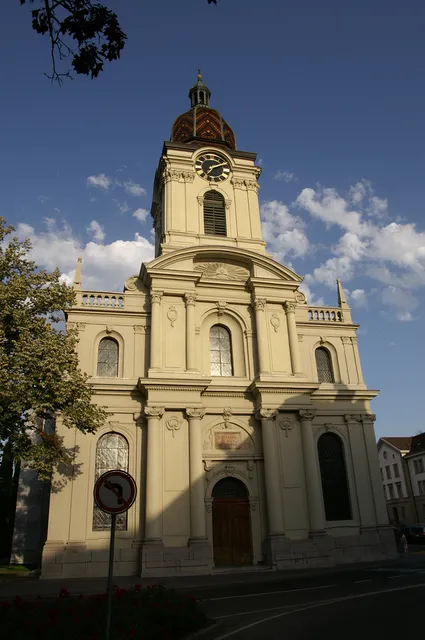
Start in town at Morges Railway Station, walk down past the old center and Temple De Morges, and finish on the quays beside Morges Castle. Do the shoreline first, before any museum labels, so your imagination has room to work. Then go see the evidence: the excavated materials in Lausanne and the famous oak dugout canoe now in Geneva, dated to spring 1326 BCE, centuries older than the Roman Republic. That sequence changes the place completely. You stop treating La Grande Cité as a pretty lakeside backdrop and start reading it as a submerged neighborhood that never entirely left.
Plan your visit
- Getting There
- From Morges Railway Station, walk about 8 minutes to Morges Castle, then follow the quays another 10 minutes toward Quai Igor-Strawinsky; the full approach feels like a coffee break that accidentally became a lakeside stroll. Buses 701 and 702 stop at "Morges, Casino" beside Casino De Morges, and 701 also serves Blancherie near the site zone. If you drive, Quai Igor-Strawinsky parking has 48 spaces, roughly the audience of a small neighborhood cinema.
- Opening Hours
- As of 2026, La Grande Cite has no gate and no ticketed timetable because it sits in a public lakeside promenade. It is effectively open year-round, with seasonal mood shifts rather than formal opening/closing hours. Before visiting, check City of Morges updates on quai works, since infrastructure projects can reroute pedestrians even when access remains open.
- Time Needed
- Quick look: 10-20 minutes, about the length of waiting out one delayed regional train. Most visitors spend 45-90 minutes when they pair the archaeological waterfront with the park and harbor, roughly one unhurried golden-hour walk. For deeper context, use the accessible littoral route: about 1 h 30 over 6 km (around 3.7 miles), roughly seven laps of a standard athletics track.
- Accessibility
- The quays are officially flagged wheelchair-accessible, with accessible toilets and facilities for visitors with visual impairments. The signed accessible lakeside route covers about 6 km in 1 h 30 with only around 36 m of elevation change, gentler than climbing a typical ten-story building, and it links the waterfront with Morges Castle. Confirmed nearby accessible toilets include Casino De Morges and the Petit-Bois harbor area, about 200 m away, roughly two city blocks.
- Cost/Tickets
- As of 2026, visiting La Grande Cite is free: no ticket desk, no timed entry, and no skip-the-line product. Think of it as the open-air edge of Morges–Stations De Morges, where your budget goes to transport, food, or nearby museums. If you want paid indoor context, combine the free shoreline with Morges Castle or Musée Forel.
History
The Day the Lake Gave Up Its Secret
Records show that the bay of Morges carried human life millennia before the modern town grid. La Grande Cité belongs to that earlier shoreline world, where timber engineering and shallow-water settlement turned mud, reeds, and shifting water into habitable ground.
The surface looks effortless today, but the archive is dramatic: damaged recoveries, lawsuits, rival museums, and risky dives. This is history without a façade, where the key evidence lies under water and the shoreline keeps the memory alive.
The turning point
Morlot's Descent and the Myth of the Floating Village
At first glance, the old postcard version seems true: a neat prehistoric village perched over open water. But evidence suggests that image is too tidy; across Alpine pile-dwelling sites, building forms varied, and the romantic stilt-house picture was partly a nineteenth-century simplification.
Records show that the turning point came on 24 August 1854, when Karl Adolf (Adolphe) von Morlot descended here in a rudimentary iron diving helmet. For him, the stake was personal as well as scientific: real bodily danger in cold, opaque water and the risk that lake-dwelling archaeology would be dismissed as fantasy if he found nothing convincing in situ.
The revelation was not a stage-set village but a complex submerged settlement whose traces could be studied, protected, and argued over. Once you know that, the promenade changes: you stop scanning for picturesque huts and start seeing an underwater field archive beneath your feet.
The Canoe That Became a Court Case
Living Heritage Above an Invisible Site
Tips for visitors
Expect The Invisible
La Grande Cite is a hidden layer under the water, not a reconstructed stilt-village you can walk through. Go for the bay, the quays, and the story beneath your feet, and avoid judging the site by what is visibly built above the lake.Shoot, Don't Sprawl
Personal photos are generally fine on the promenade, but larger shoots that occupy public space may require city authorization. For drones, check Swiss FOCA restriction maps before every flight and avoid flying over festival crowds.Crowds, Not Scams
The common issue here is crowd density during festivals, not organized tourist-scam pressure. Keep bags zipped, do not leave phones on terrace tables, and treat busy waterfront evenings as you would a packed commuter platform.Eat The Lake
Budget: Confiserie Christian Boillat for coffee and pastry. Mid-range: Restaurant de l'Union or Le Leman for Vaud classics like perch and fera. Splurge: reserve Casino De Morges or Le Pavois for a terrace meal with lake light.Chase Soft Light
Early morning gives calmer paths and metallic silver water; late afternoon warms the Alps and facades. Spring tulip weeks and summer-to-autumn dahlia season are visually richer but busier, so bring a windproof outer layer for fast-changing lakeside breeze.Build One Loop
Link Morges Railway Station, Morges Castle, Musée Forel, and Temple De Morges in one continuous waterfront walk. It is the cheapest way to stack layers of the city, and it avoids the stress and cost of lakeside parking.
Frequently asked
Is La Grande Cité worth visiting?
Yes, especially if you enjoy places where the real story is hidden in plain sight. This is the submerged heart of the UNESCO Morges–Stations De Morges, so you stand on a peaceful quay while Bronze Age remains sit under the waterline. The thrill is mental: a waterfront promenade that looks modern but holds settlement traces from over 3,000 years ago, like walking above a time capsule older than the Roman Republic.
How long do you need at La Grande Cité?
You need about 20 minutes for a focused stop, or 60 to 90 minutes if you combine it with nearby lakefront landmarks. A quick visit lets you read the landscape and understand where the submerged site lies; a longer one can include the quays, Morges Castle, and Casino De Morges. If you continue onto the accessible 6 km shoreline route, that is roughly the length of about 65 soccer pitches laid end to end.
How do I get to La Grande Cité from Morges?
From central Morges, the simplest route is a short walk to the lakeside quays around Quai Igor-Strawinsky. From Morges Railway Station, it is roughly a 10 to 15 minute walk, about the time it takes to drink a takeaway coffee, passing toward the lakefront near Château de Morges. If you prefer transit, local buses serving the Casino stop place you close to the waterfront zone.
What is the best time to visit La Grande Cité?
Late March to early May is the most atmospheric season for most travelers. During the Tulip Festival (March 27 to May 10, 2026), the park-and-quay setting becomes a color field of around 140,000 blooms, while summer-to-autumn adds the Dahlia promenade (July 1 to October 31, 2026). Winter is quieter and clearer for reflection, when the invisible archaeology feels even more haunting because the shoreline is less crowded.
Can you visit La Grande Cité for free?
Yes, visiting La Grande Cité from the public quays is free. There is no dedicated ticket office, timed entry gate, or standard skip-the-line system because this is an open-air archaeological zone rather than a conventional museum building. Paid costs usually come from extras like restaurants, boat rides, or museum add-ons elsewhere.
What should I not miss at La Grande Cité?
Do not miss the paradox: almost everything important is underwater and mostly invisible. Stand on the quay and picture Morlot’s 24 August 1854 helmet dive, then pair the shoreline with nearby urban anchors like Temple De Morges or a loop on the Petit Train touristique de Morges to read the bay as layered time, not just scenery. If you want objects rather than imagination, follow up in regional museums that display pile-dwelling evidence.
Is La Grande Cité a visible stilt-house village?
No, that is the biggest misconception. You are visiting the setting of a submerged archaeological site, not a reconstructed village with houses standing over open water. The old postcard image of alpine lake dwellers on dramatic platforms is now treated as an oversimplification by current research.
Sources & attribution 104
- UNESCO World Heritage Centre – Prehistoric Pile Dwellings around the Alps — Official UNESCO listing, chronology range, and significance of the transnational pile-dwelling property.
- UNESCO Monitoring Document 192715 — Monitoring and conservation context, including ongoing site-risk considerations.
- Historical Dictionary of Switzerland (FR) – Morges/Grande-Cité entry — Core archaeological history, site phases, key people, canoe episode, and 1854 dive narrative.
- Historical Dictionary of Switzerland (FR) – Morges commune entry — Broader local historical context and role of Morges in regional archaeology.
- Historical Dictionary of Switzerland (DE) – Grande-Cité entry — German-language corroboration of chronology and archaeological framing.
- Historical Dictionary of Switzerland (IT) – Morges commune entry — Italian-language corroboration of Morges historical context.
- Palafittes.org – Morges station page (EN) — UNESCO component context, underwater remains, and site summary.
- Palafittes.org – Morges station page (FR) — French-language archaeological details for Grande-Cité and nearby sectors.
- Palafittes.org – FAQ (FR) — Clarifies misconceptions around romanticized stilt-house imagery.
- Palafittes.org – FAQ — General interpretation guidance on pile dwellings and settlement forms.
- Palafittes.org – Protecting pile dwellings — Conservation threats and vulnerability of submerged archaeological remains.
- Palafittes.org – Museums and Exhibition Rooms — Museum mediation network for otherwise invisible pile-dwelling sites.
- Palafittes.org – Museums (FR page with Morges canoe mention) — Museum references including the Morges dugout canoe in Geneva.
- Palafittes.org – Museums (DE) — German-language museum corroboration for associated finds.
- Palafittes.org – Publications and downloads — Additional multilingual heritage documentation resources.
- UNIGE Archive Ouverte – Morlot/underwater archaeology paper record — Academic reference supporting the historical significance of the 1854 underwater exploration.
- Musée d’Archéologie nationale – Underwater archaeology article — Contextual evidence for early underwater archaeological practice.
- Vaud Canton – Archaeology milestones — Regional archaeological historiography and methodological development.
- Vaud Canton – Visible and invisible archaeological sites — Explains why key sites, including lacustrine remains, are often not visibly monumental.
- Musée d’art et d’histoire Genève – Pirogue monoxyle record — Detailed provenance and legal-history timeline for the Morges dugout canoe.
- University of Geneva – François-Alphonse Forel historical page — Biographical context for a key figure linked to Morges and Lake Geneva science.
- Morges Tourisme – Palafittes UNESCO page — Local visitor-facing summary of the UNESCO pile-dwelling designation.
- Morges Tourisme – Palafittes UNESCO (generic page) — Additional local tourism framing of UNESCO palafitte heritage.
- Morges Tourisme (DE) – UNESCO Pfahlbauten — German-language local tourism framing of the same UNESCO topic.
- Morges Tourisme – The quays of Morges — Primary practical context for visitor experience on the public lakeside.
- Morges Tourisme – Tulip Festival 2026 — Confirmed 2026 seasonal dates and programming details.
- Morges Tourisme – Dahlia Festival 2026 — Confirmed 2026 dahlia-season dates and lakeside programming.
- Morges Tourisme – Dahlia Festival (event index page) — Additional festival visitor details and promotional framing.
- City of Morges – Voie verte / Quai Igor-Strawinsky FAQ — Infrastructure and works context potentially affecting shoreline conditions.
- CGN – Port of Morges — Waterfront access and port-location reference points.
- City of Morges – CFF station services — Station facilities, including luggage locker information.
- Morges Tourisme – Château de Morges access page — Walking-distance reference from station to key waterfront landmarks.
- Morges Tourisme – Casino Belle Epoque hall — Distance marker and local orientation near lakeside zone.
- CGN – Contact and access — Public transport and stop references near Morges lakefront.
- MBC Bus Line 701 — Line-stop verification for reaching lakeside area.
- MBC Bus Line 702 — Line-stop verification for reaching lakeside area.
- MBC Bus Line 704 — Checked for line-stop discrepancy versus other transport pages.
- Parking.ch – Quai Igor-Strawinsky parking — Parking capacity and facility details close to the quays.
- City of Morges – Real-time parking availability — Official parking availability resource for visitors arriving by car.
- Morges Tourisme – Wheelchair-accessible lakeside route — Accessibility, route length, elevation, and practical timing.
- Morges Tourisme – Lake stroll Morges–Lausanne — Terrain and lakeside walking character.
- Morges Tourisme – Morges Casino restaurant — Food option, opening hours, and accessible-toilet reference.
- Morges Tourisme – Morges Casino restaurant (full slug) — Duplicate-access URL used for dining and accessibility corroboration.
- Morges Tourisme – Accessibility page — Accessible services and nearby facilities in Morges.
- Morges Tourisme – Restaurant La Maison d’Igor — Nearby dining with transit and accessibility details.
- Morges Tourisme – Independence Park — Lakeside park context and visitor atmosphere.
- Morges Tourisme – Photo Spot Grand Tour de Suisse (FR) — Evidence of photo-friendly policy and promoted viewpoints.
- Hôtel Mont-Blanc au Lac – Inspiration article — Recent non-official corroboration of waterfront visitor pattern.
- Freizeit.ch – Dahlienfest Morges listing — Recent third-party event corroboration.
- Frame Zone – Morges travel article — Recent non-official description of promenade appeal.
- Visorando – Morges lakeside walk — Recent route corroboration for practical walking experience.
- Morges Tourisme – View of Mont Blanc — Best-viewpoint guidance from the quays and jetties.
- Musée cantonal d’archéologie et d’histoire (MCAH) — Regional museum context for seeing archaeological evidence tied to Morges.
- Morges Tourisme – Superb view of the lake and Morges — Elevated viewpoint context including mention of submerged heritage.
- Morges Tourisme – Viewpoint page (short URL) — Alternate URL used for the same viewpoint context.
- Switzerland Tourism – Pile dwellings around the Alps — Tourism-level interpretation and mention of audio-guide app.
- Swiss Federal News – Palafittes guide app release — Federal communication about app-based interpretation tool.
- Morges Tourisme – Guided tours — Current tour formats available in Morges.
- Hôtel Mont-Blanc – Activities page — Tourist train mention and lakeside activity context.
- Morges Tourisme – Paillote Festival — Seasonal cultural-life context near the quays.
- City of Morges – Les quais — Municipal framing of quays as civic social space.
- La Côte – Quays traffic debate article — Local controversy around vehicles versus pedestrian use of quays.
- Morges Tourisme – Restaurant de l’Union — Local-food references and city-identity wording.
- City of Morges – Summer 2025 quay closure notice — Evidence of recurring temporary traffic restrictions.
- Morges Tourisme – Le Livre sur les quais festival — Major recurring cultural event linked to waterfront identity.
- City of Morges – Le Livre sur les quais 2023 note — Municipal support and programming context.
- City of Morges – Convention renewed 2025-2028 — Longer-term municipal commitment to cultural programming.
- City of Morges – Dahlia festival announcement — Municipal event framing of lakefront floral culture.
- City of Morges – Tulip festival 2026 announcement — Municipal confirmation of 2026 tulip-program return.
- City of Morges – Parc de l’Indépendance official page — Local historical and civic role of the park by the quays.
- Morges Tourisme – Préverenges — Quieter nearby lakeside area context.
- Morges Tourisme – Morges overview — City-level tourism context and regional identity framing.
- City of Morges – Parc de Vertou — Nearby public-space facilities and neighborhood context.
- City of Morges – Police Région Morges — General local public-safety framing.
- Police Région Morges – Pickpocket advice — Practical risk-prevention guidance for crowded settings.
- Morges Tourisme – Le Léman restaurant — Regional fish specialties and waterfront dining context.
- Morges Tourisme – Au XXème siècle — Traditional local cuisine references.
- Morges Tourisme – La Côte AOC — Wine-terroir identity tied to Morges region.
- Morges Tourisme – Mr Dufaux’s local products — Regional products and culinary-identity context.
- Morges Tourisme – Sévery Oil Mill — Nearby terroir product traditions.
- Morges Tourisme – History of Morges (EN) — City historical storyline linking medieval and deeper-time identity.
- Morges Tourisme – History of Morges (FR) — French-language version of city historical narrative.
- City of Morges – Voie verte technical report PDF (2024) — Engineering background on embankment reinforcement concerns.
- City of Morges – Council commission report (2023) on quai reinforcement — Project-planning and policy context for lakeside infrastructure works.
- City of Morges – Public-domain authorization page — Rules for occupying public space, relevant to shoots/events.
- City of Morges – Organizing events — Municipal procedure context for public-event permissions.
- FOCA/BAZL – Drone flight rules (EN) — Swiss federal drone regulations for visitor compliance.
- FOCA/BAZL – Geographical flight restrictions (EN) — Required pre-flight map checks and restricted zones.
- FOCA/BAZL – Drone rules (IT) — Italian-language cross-check of federal drone guidance.
- FOCA/BAZL – Drone overview (DE) — German-language cross-check of federal drone guidance.
- Morges Tourisme – Confectionery Christian Boillat — Budget-friendly local snack and pastry option.
- Morges Tourisme – Lykke — Coffee/snack option in city center context.
- Morges Tourisme – La Boîte à Thé — Tea-room option for nearby breaks.
- Morges Tourisme – Restaurant Le Pavois — Upscale waterfront dining reference.
- Morges Tourisme – La Table du Petit Manoir — Higher-end dining recommendation in Morges.
- Morges Tourisme – European Heritage Days — Annual civic-memory programming and heritage interpretation.
- Morges Tourisme – Fête de la Musique de Morges — Annual city cultural calendar context around the same waterfront.
- ASM Morges – Groupe des guides — Volunteer-guiding practice as living heritage transmission.
- City of Morges – Espace 81 — Local exhibition venue supporting civic memory and heritage interpretation.
- ASM Morges – Espace 81 exhibitions — Association-level continuity of heritage programming.
- Lausanne Tourisme – Atelier famille destination archéologie — Family archaeology programming tied to regional museum mediation.
- ASM Morges – New guides (2025) — Evidence of ongoing renewal in local interpretation community.
- ASM Morges – Heritage advocacy page — Context for local heritage activism and civic engagement.
- City of Morges – Expert commission call — Contemporary municipal heritage-governance context.
Built from cited sources · see the method · How we make our guides →
More in Morges.
12 places to discover — a few worth pairing.


Pick up where you left off
Saved and recently read places — kept on this device only.
Photo credits (7)
- Château de Morges depuis le vieux port — Slatin — CC BY-SA 3.0 (https://creativecommons.org/licenses/by-sa/3.0/) — Source: https://commons.wikimedia.org/wiki/File:Château_de_Morges_depuis_le_vieux_port.jpg
- Palafitte Morges Les Roseaux 5 1 — Stedewa — CC BY-SA 3.0 (https://creativecommons.org/licenses/by-sa/3.0/) — Source: https://commons.wikimedia.org/wiki/File:Palafitte_Morges_Les_Roseaux_5_1.jpg
- Pilotis de palaffite - Maison de la Rivière — Gzzz — CC BY-SA 4.0 (https://creativecommons.org/licenses/by-sa/4.0/) — Source: https://commons.wikimedia.org/wiki/File:Pilotis_de_palaffite_-_Maison_de_la_Rivière.jpg
- Château de Morges — Slatin — CC BY-SA 3.0 (https://creativecommons.org/licenses/by-sa/3.0/) — Source: https://commons.wikimedia.org/wiki/File:Château_de_Morges.jpg
- Morges-Passe du port — Pierre Bona — CC BY-SA 3.0 (https://creativecommons.org/licenses/by-sa/3.0/) — Source: https://commons.wikimedia.org/wiki/File:Morges-Passe_du_port.jpg
- Grande Rue de Morges — Slatin — CC BY-SA 3.0 (https://creativecommons.org/licenses/by-sa/3.0/) — Source: https://commons.wikimedia.org/wiki/File:Grande_Rue_de_Morges.jpg
- P1280113 - Morges — Esby (talk) 21:02, 13 April 2010 (UTC) — CC BY-SA 3.0 (https://creativecommons.org/licenses/by-sa/3.0/) — Source: https://commons.wikimedia.org/wiki/File:P1280113_-_Morges.JPG
Photos may have been resized or cropped.