Type 2+ letters to search all countries, cities, and places
/Ctrl KEsc
travel_explore
Type 2+ letters to search all countries, cities, and places
Press Enter to open the top result
Hôtel De Ville, Morges
Morges·Switzerland·46° N · 6° E·Updated Mar 2026
Built around 1682 under Bernese rule, Morges's town hall has served five political regimes and still hosts the weekly market. Free to visit, best in September.
Free (exterior); guided town walks ~CHF 5–15 via Morges Tourisme
Access
Cobblestone square; exterior fully accessible; interior access limited to special events
Best season
Year-round; September for Heritage Days interior access; Saturday mornings for market
On market mornings, the smell of Chasselas grapes and fresh bread drifts across a cobblestone square in Morges, Switzerland, pooling against the pale limestone façade of a building that has quietly governed this lakeside town for over three centuries. The Hôtel de Ville de Morges isn't the kind of monument that demands your attention — it earns it, the way a well-told story earns its silence at the end.
Morges sits on the north shore of Lake Geneva, roughly halfway between Lausanne and Geneva, in the French-speaking canton of Vaud. Its town hall anchors the Place de l'Hôtel-de-Ville at the heart of the old town — a grid of streets laid out in 1286 that has barely shifted since. The building dates to 1682, erected under Bernese rule in a style that splits the difference between Bernese civic formality and Romand elegance. Its square clock tower rises just high enough above the roofline to be spotted from the approaching streets, a quiet assertion of municipal pride rather than imperial ambition.
What makes this town hall worth a detour isn't grandeur — it's proportion. Where Lausanne and Fribourg built their hôtels de ville to impress, Morges built one to fit. The scale matches the town: a prosperous wine-trading port of a few thousand souls, not a cantonal capital. That restraint is precisely what gives the building its character. Stand in the square on a Wednesday morning, surrounded by market stalls selling Vaudois sausage and lake fish, and you'll understand what Swiss civic life looks like when nobody is performing it for tourists.
The Château de Morges looms a few hundred metres to the west, the Temple de Morges rises to the east, and Morges Railway Station sits a five-minute walk downhill — but the Hôtel de Ville holds the centre, as it has through five different political regimes, from Savoyard dukes to the modern Swiss Confederation.
Researched by the Audiala editorial team from historical records, architectural archives, and local expertise.
What to see
The Clock Tower and Façade
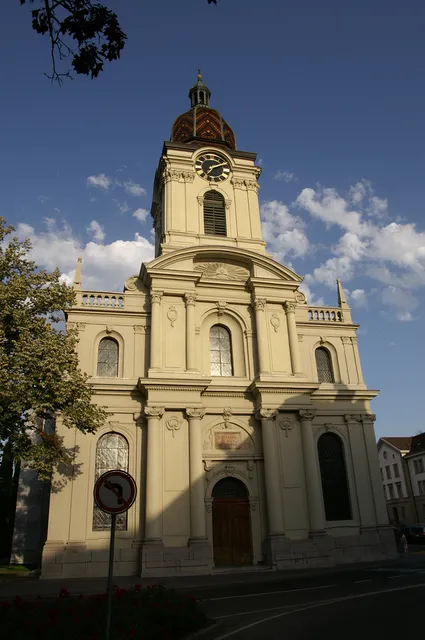
The Hôtel de Ville's defining feature is its square clock tower, which rises above the roofline of the Place de l'Hôtel-de-Ville like a raised hand calling a meeting to order. The façade is pale regional limestone — the same stone used across Vaud's lakeside towns — arranged in a symmetrical composition with a central projecting bay and an arched main portal. Morning light hits the east-facing stone best, warming it from grey to gold between about 8 and 10 a.m. The tower is visible from most approaches through the old town's medieval grid, and its proportions reward comparison with the nearby Château de Morges: where the castle asserts power through sheer mass — walls roughly as thick as a car is long — the town hall persuades through balance. Stand at the south end of the square and you'll see how the tower, the roofline, and the arched entrance align into a composition that's almost musical in its symmetry.
Place de l'Hôtel-de-Ville on Market Day
The cobblestone square that the town hall closes at one end is a working civic space, not a monument — and it's at its best on Wednesday and Saturday mornings, when market stalls fill the area with Vaudois sausages, lake fish from Léman, wheels of Gruyère, and bottles of local Chasselas. The square has hosted markets since the medieval period, and the continuity is not abstract: the same grid of streets Louis of Savoy laid out in 1286 channels foot traffic past the same building façades, into the same open space. Arrive early enough and you'll catch stallholders setting up in the half-light, their breath visible in the cool air off the lake, the clock tower above them marking the hour as it has since the 17th century. It's a scene that earns the word 'timeless' honestly, by simply never having stopped.
European Heritage Days: Your Chance Inside
The Hôtel de Ville is a working municipal building, not a museum, so the interior — including the wood-panelled Salle du Conseil where the town council still meets — is normally closed to casual visitors. The exception is the annual Journées européennes du Patrimoine (European Heritage Days), held each September across Switzerland. During this weekend, the council chamber, historic archives, and administrative rooms open to the public, often with guided commentary from local historians. If your timing doesn't align with Heritage Days, Morges Tourisme offers guided walking tours of the old town that pause at the Hôtel de Ville and explain what you're looking at from the outside — check morges-tourisme.ch for the current schedule. Either way, the exterior and the square are freely accessible at all hours and, frankly, that's where most of the building's story is told.
Plan your visit
Getting There
Morges sits on the main Lausanne–Geneva rail line, with trains every 15–30 minutes from either city — about 10 minutes from Lausanne, 35 from Geneva. From the station, walk uphill through the old town grid for roughly five minutes; the clock tower marks your destination before you reach the square. If arriving by lake, CGN boats dock at the Morges pier in summer, putting you a pleasant 300-meter stroll from the building.
Opening Hours
The exterior and Place de l'Hôtel-de-Ville are freely accessible around the clock — no ticket, no barrier, no closing time. Interior access is limited: as of 2026, the building remains an active municipal office, so your best chance to step inside is during the Journées européennes du Patrimoine in September or via a guided town walk booked through Morges Tourisme. Check morges-tourisme.ch for current guided walk schedules.
Time Needed
The exterior and square reward about 15–20 minutes of unhurried looking — enough to study the façade, photograph the clock tower, and absorb the proportions of the square. If you time your visit with a guided old-town walk (typically 60–90 minutes), the Hôtel de Ville becomes one stop in a circuit that includes the nearby Château de Morges and the Temple de Morges.
Cost
Viewing the exterior costs nothing. Guided town walks through Morges Tourisme typically run CHF 5–15 per person as of 2026 — verify current pricing at morges-tourisme.ch. The September Heritage Days events are traditionally free of charge.
Photo Gallery
A view of Hôtel De Ville, Morges, Morges, Schweiz. · SissssouThe elegant stone architecture of the Hôtel De Ville in Morges, Schweiz, stands out with its classic octagonal tower and vibrant floral window boxes. · SissssouThe historic Hôtel De Ville in Morges, Switzerland, illuminated at night, showcasing its traditional stone architecture and charming corner tower. · StedewaThe elegant Hôtel De Ville in Morges, Switzerland, showcases classic neoclassical architecture with its distinctive arched arcade and charming blue shutters. · Peb45
History
Five Flags Over One Square
The Hôtel de Ville de Morges has outlasted every government that has claimed authority over it. Built in 1682, when Bern ruled Vaud as a subject territory, it has since served the Helvetic Republic, Napoleon's satellite state, the restored Confederation, and the modern federal democracy — all without changing its address. Few buildings in Switzerland can claim such an unbroken record of civic use across such turbulent political ground.
But the building's story is inseparable from the town's. Morges existed for nearly four centuries before its town hall was erected, and the forces that shaped one shaped the other: Savoyard ambition, Bernese conquest, the wine trade that made the town rich, and the revolution that made the canton free.
The turning point
Louis of Savoy's Gamble on the Lake
In 1286, Louis I of Savoy did something calculated and slightly reckless: he founded a brand-new town on the north shore of Lake Geneva, barely 10 kilometres from Lausanne, which was controlled by its own bishop and owed no loyalty to Savoy. The town was Morges, and it was designed from the first surveyor's stake as a commercial and military counterweight — a planned grid of streets with its main axis, Rue Louis-de-Savoie, running from a fortified castle to the lake. The layout still survives, virtually unchanged, making the old town of Morges one of the most intact medieval villes neuves in the Swiss federal inventory of heritage settlements.
Louis's bet paid off for two and a half centuries. Morges became a prosperous wine-export port — barrels of Chasselas and Pinot were loaded onto flat-bottomed boats bound for Geneva and beyond, and the town's guild records and trade regulations, many of them stored in the Hôtel de Ville's archives, document a lakeside economy that hummed with commercial energy. But in 1536, Bern swept south and seized all of Vaud. The Savoyard era ended overnight, and for the next 262 years, Morges answered to Bernese bailiffs who imposed their own civic conventions — including the architectural language that would eventually produce the current town hall.
When the building finally went up in 1682, it was simultaneously a symbol of Bernese administrative control and a statement of local identity — designed by Bernese standards, but built with local stone, for local purposes, on a square that had been the heart of communal life since Louis of Savoy drew his grid four centuries earlier.
The Night Vaud Broke Free
On 14 April 1798, the Canton of Vaud declared independence from Bern — a seismic break after 262 years of subject status, triggered by the approaching armies of Revolutionary France. The Hôtel de Ville stood at the centre of this upheaval, as it stood at the centre of everything in Morges. Overnight, the building stopped being an instrument of Bernese administration and became the seat of a newly sovereign municipality. No stone was moved, no façade was altered, but the meaning of the building changed completely. The Bernese coat of arms was replaced; the council chamber, where bailiffs had once presided, now hosted elected Vaudois officials. It's the kind of transformation that leaves no visible trace — which is exactly what makes it worth knowing about.
A Wine Port's Quiet Wealth
Morges never minted coins or commanded armies, but for centuries it controlled something arguably more valuable: a lakeside quay where Vaudois wine met Geneva's thirst. The town hall's archives document generations of wine-trade regulation — barrel sizes, quality inspections, export duties — that reveal how thoroughly commerce saturated municipal governance. The wealth generated by this trade funded the civic buildings around the square, including the Hôtel de Ville itself. By the 19th century, railways replaced lake boats and the port's commercial dominance faded, but the town hall endured as a physical record of the era when Morges punched well above its weight, exporting wine across Lake Geneva — a body of water roughly the size of metropolitan London — to markets that couldn't get enough of it.
Tips for visitors
Morning Light Works Best
The main façade faces east, so morning sun picks out the pale limestone detailing and the clock tower at its sharpest. By afternoon the square falls into shadow and the stone flattens to grey.
Come on Market Day
Wednesday and Saturday mornings fill the square with market stalls — fruit, cheese, flowers, local wines. You get the building as a backdrop to actual civic life rather than an empty stage, and Morges's history as a wine-trade port suddenly makes tangible sense.
Heritage Days in September
The Journées européennes du Patrimoine (usually the second weekend of September) are the one reliable window to see the wood-paneled Salle du Conseil inside. Mark the date — interior access outside this event requires an appointment with the municipality.
Combine with the Castle
The Château de Morges is barely 200 meters downhill — an easy pairing that traces Morges's story from medieval fortress to Bernese-era civic pride. Add the Temple de Morges and you've covered three centuries of architecture in a 20-minute walking loop.
Eat on the Square
Cafés line the edges of Place de l'Hôtel-de-Ville — grab a table facing the clock tower for a mid-range lunch (expect CHF 20–35 for a plat du jour). For something more indulgent, the lakefront restaurants a three-minute walk south serve perch fillets fresh from Léman, the local signature dish.
Best Photo Angle
Stand at the far end of the square to frame the clock tower against the rooftops with a clean sightline. For a wider context shot, walk 50 meters east along Rue Louis-de-Savoie — the original Savoyard main axis — and shoot back toward the tower rising above the medieval grid.
Where to Eat
local_dining
Don't Leave Without Trying
Papet vaudois (leeks and potatoes with Vaud sausage)Malakoffs (fried cheese fritters, a Vaud classic)Filets de perche (perch fillets, often from the lake region)Fera du Leman (Lake Geneva whitefish)Fondue moitie-moitieRosti in brasserie styleSwiss charcuterie with local Vaud cheeses
Restaurant Il Bivio
local favorite
Italian trattoria€€star4.5(550)directions_walk6 min walk from Hôtel de Ville
Order: Order a classic pasta plus one of the rotating daily specials; this is the kind of place where the handwritten suggestion board is usually the right move.
This is one of central Morges' most reliable sit-down picks when you want a proper meal, not just a snack. Locals use it for both business lunches and relaxed evening dinners, which is always a good sign.
Pub fare and bar classics€star4.4(945)directions_walk5 min walk from Hôtel de Ville
Order: Go for a burger with fries and a local beer; if you want comfort food after a lake walk, this is the easiest win.
Big local following, long opening hours, and a lively atmosphere make it the fallback that rarely disappoints. It works for anything from an early drink to a late casual meal.
Lakefront Swiss-French brasserie€€star4.4(796)directions_walk8 min walk from Hôtel de Ville
Order: Choose lake fish when available, especially perch-style preparations, with a glass of Vaud white wine.
You come here for the setting as much as the plate: classic Morges lakefront energy with room to linger. It is a strong choice when you want a more scenic meal without leaving town center.
Hotel restaurant with Swiss and seasonal lake dishes€€star4.3(858)directions_walk7 min walk from Hôtel de Ville
Order: Prioritize the fish dishes and seasonal regional plates, ideally with Chasselas from Vaud.
This is one of the best addresses near the harbor when you want a polished meal with views. The location gives you that classic Morges postcard backdrop without feeling formal or stiff.
Cafe and light bistro€€star4.4(558)directions_walk4 min walk from Hôtel de Ville
Order: Order a proper coffee with one pastry, then add a savory lunch plate if you are staying through midday.
A dependable daytime stop in the old-town flow, good for a calm breakfast or a working coffee break. It has that lived-in local feel rather than a quick tourist turnover.
Traditional Swiss confiserie and bakery€€star4.3(607)directions_walk2 min walk from Hôtel de Ville
Order: Pick a butter croissant in the morning or a house pastry in the afternoon; pair it with espresso and keep it simple.
Right on Grand-Rue, this is an easy old-town ritual stop and one of the most practical places for quality sweets and bakery staples. If you are building a picnic for the lakeside, start here.
checkService is included in Switzerland; tip by rounding up or leaving around 5-10% for great service.
checkCards are widely accepted, but carry a little cash (CHF) for bakeries, kiosks, and small add-ons.
checkBook ahead for Friday-Saturday dinner, especially lakefront tables.
checkLunch is typically 12:00-14:00 and many kitchens pause after; dinner service often starts around 18:30-19:00.
checkSunday and Monday closures are common, so always check same-day opening hours.
checkIf you want tap water, ask explicitly; some places may default to bottled water.
Food districts:Grand-Rue (old town): cafes, bakeries, and casual spots closest to Hôtel de VilleRue Louis de Savoie: daytime cafe culture and quick lunch optionsPlace du Casino and the harbor edge: scenic lakefront diningRue des Alpes waterfront strip: hotel restaurants and terrace meals
Restaurant data powered by Google
Frequently asked
Is Hôtel de Ville Morges worth visiting?
Yes, especially if you're already exploring Morges's old town — the square in front of it is one of the most characterful public spaces on the north shore of Lake Geneva. The building itself is an active town hall rather than a museum, so the experience is about atmosphere and architecture rather than exhibits: the clock tower, the cobblestones, and the sense of a civic space that has been continuously used for over three centuries.
Can you go inside Hôtel de Ville Morges?
Interior access is limited because the building is a working municipal hall, not a public attraction. The best opportunity is the European Heritage Days (Journées européennes du Patrimoine) held each September, when historic buildings across Switzerland open their doors for free. Guided walking tours through Morges Tourisme may also include a stop at the building; check morges-tourisme.ch for current schedules.
How long do you need at Hôtel de Ville Morges?
Allow 15–20 minutes to appreciate the square and exterior properly. If you're combining it with a wander through the old town — Rue Louis-de-Savoie, the lakefront, and the nearby Château de Morges — budget 2–3 hours for the whole area.
What is the history of Hôtel de Ville de Morges?
The current building dates to around 1682, constructed during the period of Bernese rule over Vaud (1536–1798). Morges itself was founded in 1286 by Louis I of Savoy — making the town older than the Swiss Confederation — and the town hall has served through five distinct political regimes, from Savoyard duchy to the modern Swiss federal system. When Vaud declared independence from Bern on 14 April 1798, this building was at the center of that transition.
Is there a market at Place de l'Hôtel-de-Ville in Morges?
Yes — the square and surrounding streets host a traditional market on Wednesday and Saturday mornings. It's one of the more authentic weekly markets in the Vaud region, drawing local producers from the surrounding wine country. The combination of the historic façade and market stalls makes Saturday morning one of the best times to visit.
How do I get to Hôtel de Ville Morges from Lausanne or Geneva?
Morges station sits on the main Lausanne–Geneva rail line (CFF/SBB), with trains every 15–30 minutes; the journey is about 10 minutes from Lausanne and 25 minutes from Geneva. From the station, it's a five-minute walk uphill through the old town. In summer, the CGN lake boat from Geneva or Lausanne is a scenic alternative, arriving at the lakefront roughly 300 metres from the square.
What architectural style is Hôtel de Ville de Morges?
The building is in the Late Baroque / Classical Vaudois style — the dominant idiom for civic architecture in 17th- and 18th-century Vaud. Compared to grander Swiss town halls like those in Lausanne or Fribourg, Morges's is deliberately restrained: pale regional limestone, a symmetrical façade, an arched portal, and a square clock tower that rises just enough to mark the building's civic purpose without competing with the sky.
Sources & attribution6
Researched and written by the Audiala editorial team from historical records, architectural archives, and local expertise. Last updated March 2026.
Saved and recently read places — kept on this device only.
Photo credits (3)
Hôtel de ville Morges — Sissssou — CC BY 3.0 (https://creativecommons.org/licenses/by/3.0/) — Source: https://commons.wikimedia.org/wiki/File:Hôtel_de_ville_Morges.JPG
Morges, Hôtel de Ville, HDR — Stedewa — CC BY-SA 3.0 (https://creativecommons.org/licenses/by-sa/3.0/) — Source: https://commons.wikimedia.org/wiki/File:Morges,_Hôtel_de_Ville,_HDR.jpg
Strictly necessary cookies keep the site working. Analytics (PostHog, Google Analytics) measures how each visitor uses our pages. Marketing loads YouTube videos and walking-route maps without a tap and lets Google Analytics set advertising cookies. We never sell your data. You can change this any time from the footer.
Privacy
Cookie preferences
Pick what you're okay with. You can change this any time from the footer.
Strictly necessary
Always on
Sign-in, language, navigation. Always on.
Product analytics
PostHog (EU) and Google Analytics record which pages you view and how you use them, under a random identifier stored in your browser. Helps us see which pages work and which need fixing. Google's ad personalisation stays off. No selling.
Marketing
Loads YouTube videos and the walking-route maps (OpenFreeMap) without a tap; without it, they load only when you tap them. If analytics is also on, Google Analytics may set advertising cookies. Ad personalisation stays off.