Germagny
Mont-Sur-RolleSwitzerland 46° N · 6° E Updated Aug 2026
A 1679 wine estate in Mont-sur-Rolle likely traces its name to the monks of Cluny, farms its Grand Cru Chasselas organically, and opens only by appointment.
The oldest door in Germagny still hangs on nails hammered before the Protestant Reformation divided Switzerland. It belongs to a working wine estate, not a museum — a four-hectare domaine pressed into the base of the slope at Mont-sur-Rolle, in Canton Vaud, where a 1679 house, a medieval cellar, and three historic wine presses share space with barrels of Chasselas. You come here to drink a grape local tradition ties to monks from near Cluny; you stay because the past is still nailed into place.
Most people drive the Route de Germagny without noticing the name is a fossil. In 1405, records suggest Mont, Germagny, and Haute-Cour formed three separate territorial entities; they merged into a single commune only in the 16th century. A hamlet once distinct enough to be sold as freehold now hides inside a wine label and a quiet road.
The domaine sits low, facing south-southwest, sheltered from northern frosts. That microclimate matters as much as any wall. Henri Bercher farms about three of the estate's four hectares organically and was among the first in the region to adopt the mi-haute vine-training system, which keeps yields modest and the Chasselas sharp. In the house, a cast-iron hearth plate dated 1793 still hangs above the fire.
What to see
-
Domaine de Germagny
You come for a glass of Chasselas and end up standing in front of a cellar door that hasn't changed since the Late Middle Ages. The chamfered oak frame still holds its original panel, pinned with large-headed nails, and the air that rolls out smells of old stone and fermenting fruit. The current buildings date to 1679, but three wine presses once worked these four hectares—roughly six football pitches of south-southwest slope at the base of the Côte.
Call Ludmila Bercher at +41 21 825 20 88 to book a tasting, then ask to see the 1793 cast-iron hearth plate still hanging above the kitchen fireplace. Henri and Ludmila farm three of those hectares organically and were among the first in the region to adopt the mid-high vine training system, which sounds technical until you taste the result: a traditional Chasselas with the estate's old stones in its bones.
-
The gatepost chapel
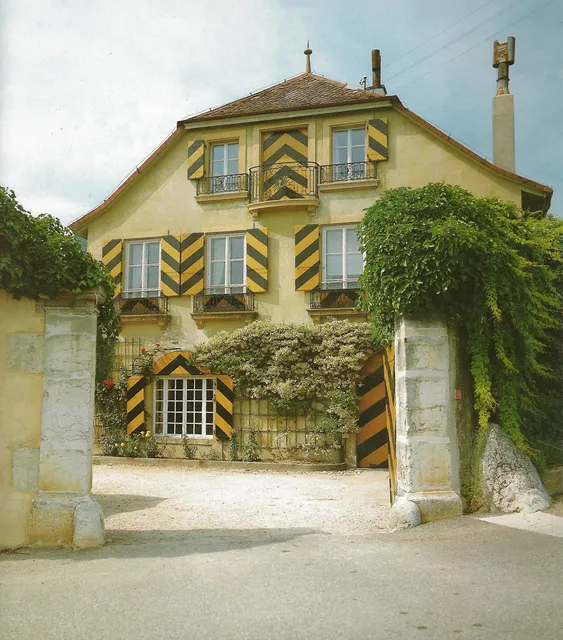
Most people walk straight past the best picture in Germagny. Stand between the two weathered stone gateposts on the edge of the hamlet and look through: an aged chapel with a conical roof, ivy spilling over its eaves, sits perfectly framed at the end of the sightline. A photograph in the notrehistoire.ch archive preserves the composition, but no sign marks it and no museum claims it. That's the point. Come in late afternoon, when the ivy throws moving shadows across the stone, and you'll understand why this tiny vignette has outlived every renovation around it. -
A slow loop through the vines
Start at the domaine with a bottle in your bag and follow the field paths uphill through the organic parcels. You'll cross the Vy de l'Etraz, an ancient road that likely predates the Romans and once linked Lyon, Geneva, and Basel—most walkers never notice the alignment under their feet. On a clear day the slope opens south-southwest toward Lake Geneva, the French Alps, and the spa town of Évian-les-Bains across the water. In autumn the rows smell of ripeness and cellar work; in winter the bare canes reveal the bones of the hill. Keep the loop under an hour and end back at Route de Germagny 7, where a glass of their Chasselas tastes like the walk itself.
Plan your visit
- Getting There
- Take the Lausanne–Geneva main line to Rolle, then PostAuto bus 840 or 842 climbs 9 minutes to Mont-sur-Rolle. By car, set Route de Germagny 7, 1185 Mont-sur-Rolle. The 3 km walk up from Rolle station threads through the Chasselas terraces.
- Opening Hours
- As of 2026, the published reception window is 10:00–18:00. Tastings are strictly by appointment: call +41 21 825 20 88 or email [email protected] before arriving. No seasonal or weekly closures are listed, though Sunday/Monday hours remain unconfirmed.
- Time Needed
- A focused tasting and purchase takes 30–45 minutes. Add a wander through the vines or a cellar conversation inside the 1679 buildings and plan 1–1.5 hours. Combine with the village or the Winegrower's Museum for 2–3 hours total.
- Accessibility
- The winery buildings sit at the foot of the slope, but the wider vineyard terrain is steep and uneven. No step-free access details are published; call ahead to confirm the tasting room and any wheelchair route.
History
The Donzel Who Signed Away a Village
Long before Mont-sur-Rolle became a single municipality, Germagny stood apart. It was part of the seigneurie of Mont-le-Grand, one of the oldest and most powerful baronies in the Pays de Vaud, according to the commune's own history. The lords' castle sat on the Molard hill with a chapel and a small settlement called Bourg Sainte-Marie. Meanwhile, monks worked the slopes below.
The monasteries of Romainmôtier and Bonmont owned substantial property here. Local wine tradition goes further, linking the name Germagny to a small village near Cluny in Burgundy — a story of monks who cleared the slopes and kept the name of home. Whether or not the etymology holds, the monastic imprint on this wine estate is older than the 1679 staircase.
The turning point
The 1284 Sale
A single surviving document, partially cut off, names a young nobleman — Jean, donzel de Mont — who sold Germagny in 1284 as an alleu, a rare form of freehold land, to a convent. The receiving house is missing from the fragment. Most likely it was Romainmôtier or Bonmont; both held property across these slopes.
What was at stake for Jean was more than acreage. An alleu was the one kind of land a noble family owned outright, without owing feudal service to a higher lord. By signing it over to the Church, he was wiping out his family's most direct claim to Germagny. Maybe it cleared a debt, maybe it purchased prayers, maybe it was capitulation. The deed does not say.
The turning point came the moment the seal was pressed. Germagny had been a distinct territorial entity; now its economic center moved decisively into monastic hands. Lay lords kept titles, but the vines, barns, and presses increasingly answered to abbots. One signature, and the hamlet changed landlords for centuries.
Monks, Vines, and a Name from Cluny
A 1679 Staircase and a Circle of Painters
Tips for visitors
Call Ahead, Always
Tastings run by appointment only—no walk-in pours. Phone Henri Bercher on +41 21 825 20 88 or write to [email protected] before you make the climb.Ask Before You Shoot
No published photo ban exists, but this is a working family estate. Ask at the tasting before photographing the 1679 cellar or the 1793 cast-iron hearth plate.Eat at Auberge de Mont
Auberge de Mont (Tue–Sat) serves seasonal bistro cooking a short drive below; expect CHF 25–45 main courses. La Grande Vigne does planchettes for CHF 20 large or CHF 10 small.Come on a Clear Winter Weekday
Cold, clear weekdays bring the sharpest view across Lake Geneva and fewer tasting-room interruptions. Avoid hot July afternoons when the south-southwest slope turns fierce.Pair the Vigneron Museum
After the estate, walk the Parcours des cépages or book the Musée du Vigneron in the Château de Mont-sur-Rolle cellars. Rolle's lakeside castle sits just 3 km downhill.Buy at the Cellar Door
No tasting fee is published, but buying a bottle—especially the Clos de Germagny Grand Cru—is the expected gesture. Cellar-door prices are kinder than restaurant markups.
Frequently asked
Is Germagny worth visiting?
Yes, if you want a working 17th-century wine estate instead of a museum. The buildings date to 1679 and the domaine covers just 4 hectares — 3 farmed organically — so a visit feels like dropping in on a neighbor with very old walls. Book ahead, because this is a private family estate, not an open attraction.
How long do you need at Germagny?
30 to 45 minutes if you are just tasting and buying a bottle. Give it 90 minutes if you also walk the organic vineyard rows and talk cellar with Henri or Ludmila Bercher. Combine it with the village of Mont-sur-Rolle and nearby Rolle for a 2 to 3 hour morning.
How do I get to Germagny from Geneva?
Take the train from Geneva to Rolle, then PostBus line 840 or 842 up to Mont-sur-Rolle in about 9 minutes. A taxi from Rolle station costs CHF 16–20. The estate is at Route de Germagny 7, 1185 Mont-sur-Rolle.
What is the best time to visit Domaine de Germagny?
Autumn, during harvest, when the cellar works hardest and the vines shift colour. Tastings are by appointment year-round, with standard reception hours of 10:00 to 18:00. Call +41 21 825 20 88 to confirm winter opening and to arrange a visit.
Can you visit Germagny for free?
Probably — there is no published tasting fee. You cannot just turn up though: tastings are by appointment only. Call +41 21 825 20 88 or email [email protected] and ask about the fee while booking.
What should I not miss at Germagny?
The stone gateposts framing the ivy-covered chapel with its conical roof — it is the single most atmospheric view in the hamlet. Also look for the medieval cellar entrance with the chamfered-frame door and the 1793 cast-iron hearth plate still hanging in the kitchen. Both are quiet domestic details most visitors walk past.
What wine is Domaine de Germagny known for?
Chasselas. The Clos de Germagny, an AOC Mont-sur-Rolle Grand Cru, is vinified without malolactic fermentation, which leaves a slight residual sugar and a livelier profile. Serve it at 10–11°C with sweet-and-sour dishes or curries. It drinks well for 3 to 5 years.
Sources & attribution 14
- Wikipedia – Mont-sur-Rolle — Confirmed first mention of Monte around 994–1021, modern name adoption, ancient Vy de l'Etraz road, prehistoric and early medieval finds.
- Commune de Mont-sur-Rolle – Histoire — Official local history with the 996 Amalric charter claim, Mont-le-Grand as one of the oldest baronies in the Pays de Vaud, and the 1346/1349 will of Richard.
- notrehistoire.ch – Document Germagny — Source for the 1284 sale of Germagny as an alleu, the archival photo of stone gateposts framing an ivy-covered chapel with conical roof, and Germagny as centre of a territory.
- Dictionnaire historique de la Suisse – Mont-sur-Rolle — Confirms monasteries Romainmôtier and Bonmont held land, and Mont, Germagny and Haute-Cour likely formed three separate territorial entities in 1405.
- Maison des Vins – Domaine de Germagny — Confirms 1679 building configuration, 4 hectares total, 3 hectares organic, traditional Chasselas and location at the foot of the hillside.
- Vins Mont-sur-Rolle – Profil Henri Bercher — Confirms Henri Bercher as owner, estate size, organic farming and pioneer role in adopting culture mi-haute in the region.
- Lacôte Tourisme – Domaine de Germagny — Visitor listing confirming address, appointment-only tastings, and estate identity.
- Office des Vins Vaudois – Domaine de Germagny — Contact details, standard 10:00–18:00 reception hours, and appointment-only tasting policy for the estate.
- Domaine Maison Blanche – Clos de Germagny — Wine profile of the Clos de Germagny Grand Cru, including German-method winemaking, residual sugar, serving temperature and pairings.
- Komoot – Mont-sur-Rolle attractions — Hiking loops, village attractions and regional vineyard walking context around Mont-sur-Rolle.
- Djurdjevic Architectes – Mont-sur-Rolle — Notes that renovations masked original ceilings and solid wood beams in Mont-sur-Rolle.
- Auberge de Mont — Local restaurant hub in Mont-sur-Rolle, known as Auberge de Mont, with opening hours and seasonal cuisine.
- LocalCities – Balade Gourmande Mont-sur-Rolle — Signature 5 km gourmet vineyard walk with 8 tasting stations and lake views.
- Rome2Rio – Mont-sur-Rolle to Rolle — Bus route 840 fare, frequency and taxi fare between Mont-sur-Rolle and Rolle.
Built from cited sources · see the method · How we make our guides →
More in Mont-Sur-Rolle.
2 places to discover — a few worth pairing.

Pick up where you left off
Saved and recently read places — kept on this device only.
Photo credits (1)
- File:Belletruche — Funck77 — CC BY-SA 3.0 (https://creativecommons.org/licenses/by-sa/3.0/) — Source: https://commons.wikimedia.org/wiki/File:File:Belletruche.jpg
Photos may have been resized or cropped.