Belletruche
Mont-Sur-RolleSwitzerland 46° N · 6° E Updated Aug 2026
A wine estate where Belletruche takes its name from a house in Vevey, not its own land—and a vanished Cistercian monastery lingers in crusader vineyard names.
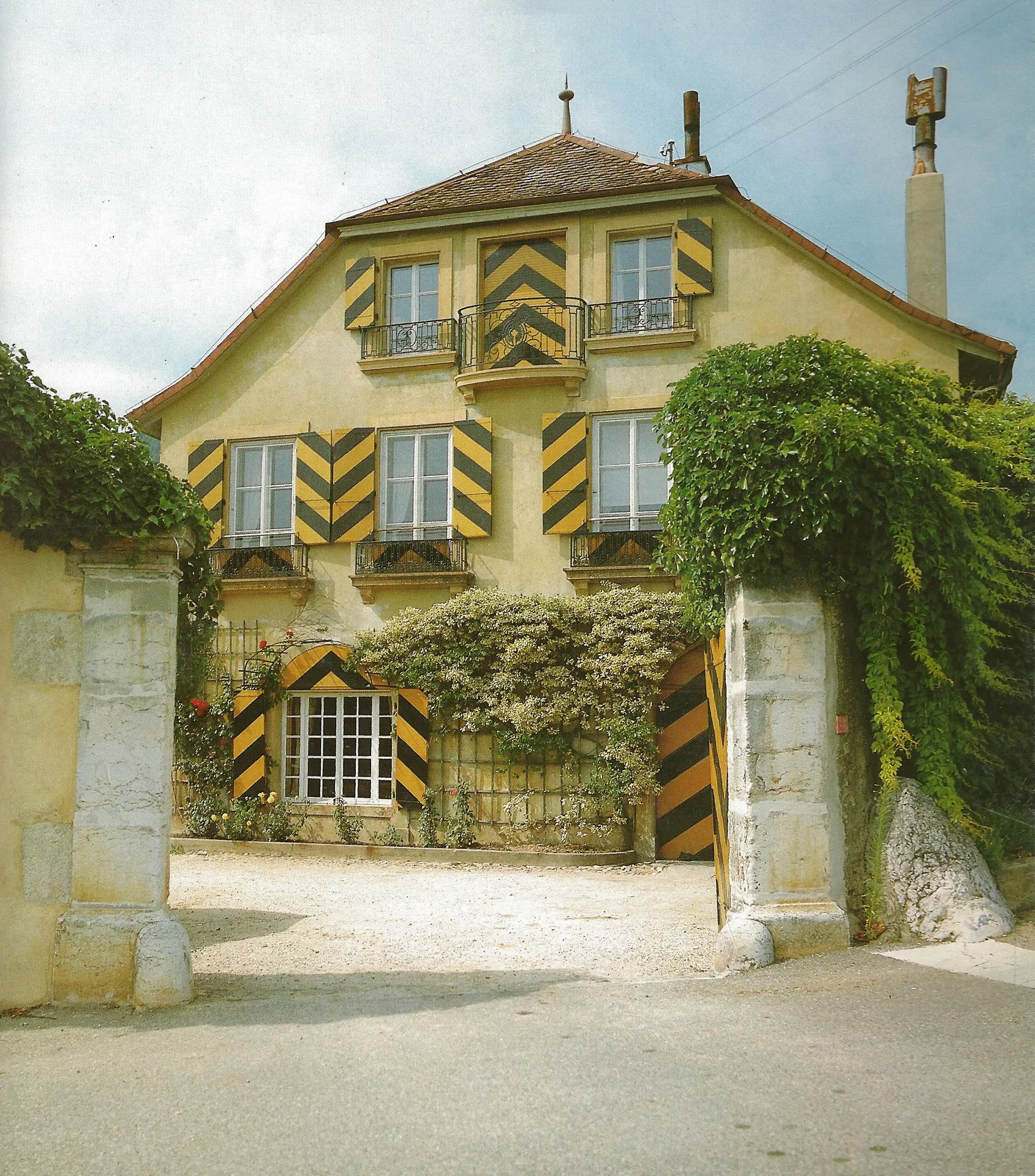 Photo: Funck77 · CC BY-SA 3.0
- Best season
- September (grape harvest)
Six thousand Bernese soldiers marched through this valley in 1536. Their commander liked what he saw. Nearly five centuries later, his direct descendants still pour the wine at Belletruche, the estate above Mont-sur-Rolle, Switzerland, where a military conquest quietly became a family business.
The estate's 4.5 hectares of Chasselas vines sit on the middle slope of La Côte, a position wine merchants compare to the grands crus of Burgundy's Côte d'Or. Sunlight bounces off Lake Geneva onto the vines, while a forested ridge blocks the north wind. The result is a white wine with a spicy nose and a firm, direct palate — what one Bernese dealer calls würzig and kernig.
The manor house rewards a closer look. A salon stove by the ceramicist Perier, nearly two meters tall, shows La Fontaine's fables alongside Juno with her peacock and Apollo in his celestial chariot. The dining room glows with diamond-patterned parquet and three rows of wood paneling. And the garden is listed in the ICOMOS inventory of historic gardens in Switzerland — not a farm, but a composed landscape.
Few wine estates in the Vaud can claim what Belletruche can: unbroken Bernese ownership since the conquest. The names on the deeds read like a roll call of Bern's ruling class — von Graffenried, von Luternau, Nägeli, von May, von Hallwyl, von Mülinen, von Erlach. For generations, Bernese tavern-goers didn't order a half Mont. They ordered a half Belletruche.
What to see
-
The Manor House
The salon stove stops you cold. Blue decoration spirals across its tiles — Juno with her peacock, Apollo driving his celestial chariot, Neptune rising from the waves — all by the ceramicist Perier, alongside scenes from La Fontaine's fables rendered in cobalt. You're looking at a 192-centimeter-tall piece of Bernese patrician taste from the late 18th century, and it still heats the room it was built for.
Around it, the house layers itself like sediment. The dining room wears parquet in diamond patterns and wood paneling in three neat rows. The partisseur chamber — named for the sharecropping agreements once signed there — keeps its fluted and beaded fireplace columns. On the lake side, two barrel-vaulted coach doors in molasse stone still gape wide enough for a carriage.
But here's the detail that lingers: the name. Belletruche first appears in a purchase deed in 1754, and it doesn't describe this house at all. It commemorates Belle-Truche, a house in Vevey that belonged to the de Cerjat family. Ursule de Cerjat brought the memory with her when she assembled this property in the late 1600s. The estate is named after a house that isn't here — a private tribute carried across the lake and pinned to these walls.
-
The Vineyard & Clos de Jérusalem
The monks vanished. Cistercians from the abbeys of Romainmôtier, Bonmont, and Joux cleared these slopes in the 12th and 13th centuries, built a monastery, planted vines — and left not one stone above ground. What remains is a map whispered in field names: Montbenoît, L'Abbaye, En Couvent, Joux. And one name that still appears on a wine label today: Clos de Jérusalem.
That walled parcel — a clos in the old sense, enclosed by stone — may be the direct descendant of monastic plantings. The estate still bottles a Chasselas from it, aged sur lie, carrying the Crusader echo of the Holy City into the glass.
The vineyard itself occupies 4.5 hectares of mid-slope ground, between 400 and 600 meters, almost entirely Chasselas. Forest shields it from north winds; Lake Geneva throws sunlight back up the slope, adding heat that pushes the grapes toward ripeness. Wine merchants compare this position to the Côte d'Or in Burgundy — the privileged middle band where drainage and exposure balance perfectly.
The result is a wine you could recognize blindfolded: spicy on the nose, firm and direct on the palate, with a richness that unfolds slowly. The 2022 vintage earned Grand Cru status. Pour it and think of the monks who cleared this ground eight centuries ago. They'd recognize the slope. Only the labels have changed.
-
A Walk Through Germagny
Start at the estate gates on Route de Germagny and walk the old field names. The route through Germagny traces a medieval map still legible in the landscape — each parcel name a fossil of monastic landholding: Montbenoît, L'Abbaye, En Couvent. The Cistercians who first cleared these slopes are gone, but their cartography survives in the stone walls and vineyard rows.
Continue to the Musée du Vigneron, where the tools and rhythms of Vaudois winegrowing come alive, then end at the Maison des Vins de La Côte. There, among bottles from the region's twelve wine-growing areas, you can taste Belletruche alongside its neighbors and understand what the mid-slope gives you: a spiciness on the nose, a directness on the palate, a richness that lingers.
And if you find yourself in Bern, ask about the old Belletruche-Keller. The novelist Rudolf von Tavel mentioned it in his books before World War I — a cellar where Bernese patricians drank the wine of their Vaud cousins. The estate's reach once stretched across the linguistic border. A glass of Chasselas could cross it again.
Plan your visit
- Getting There
- Mont-sur-Rolle station sits on the SBB line between Lausanne and Geneva, roughly 25 minutes from either city. From the platform, the estate at Route de Germagny 2 is a 10-minute uphill walk through the vineyards of Germagny. Driving means following the Route du Vignoble signs — but the parking is a private courtyard, not a public lot, so arrange ahead.
- Opening Hours
- Belletruche has no public opening hours. As of 2026, this private manor and working winery operates by appointment only. Call Jean-Jacques von Erlach at +41 21 825 16 55 or email [email protected] to arrange a visit. Show up unannounced and you'll be looking at a closed gate.
- Time Needed
- A quick wine purchase takes 15–30 minutes, assuming someone's around. A tasting with a walk around the buildings: 30–60 minutes. A proper visit with a vineyard walk and some history: 1.5–2 hours. The real variable is the owner's generosity — some visitors get a full tour of the 18th-century salons, others just the cellar.
- Accessibility
- The estate sits on a mid-slope vineyard position, so expect uneven, sloped terrain everywhere. The historic manor house has no documented ramps or elevators — 18th-century staircases and gravel paths are the norm. Wheelchair users should call ahead to discuss what's feasible. Vineyard paths are working tractor roads, not paved walkways.
- Cost & Tickets
- No entry fee, no tickets, no booking system. Belletruche is a private residence, not a paid attraction. The only cost is wine: bottles of Domaine de Belletruche Chasselas and Clos de Jérusalem have been available through Riem Daep wine merchants since 2023. A tasting, if offered, usually accompanies a purchase.
Photo Gallery

History
The Conqueror's Vineyard
The story of Belletruche begins not with wine but with war. In January 1536, Hans Franz Nägeli led 6,000 Bernese troops into the Pays de Vaud, breaking the Savoyard siege of Geneva and annexing the region to Bern. According to tradition, the campaign also brought him to this hillside above Rolle — and he liked what he saw.
Records show Nägeli became the estate's original proprietor. His younger daughter Magdalena carried it as a dowry to Hans Steiger, baron of Rolle, around 1550. From that moment, Belletruche passed through the marriage networks of Bern's patriciate for nearly five centuries.
The turning point
The Soldier Who Found a Vineyard
At stake for Hans Franz Nägeli in 1536 was everything — his career, his city's ambitions, and the fate of Geneva itself. The city had just expelled its bishop and embraced the Reformation, and Savoyard forces had responded with a siege. Starvation was setting in. Contemporary accounts describe what happened next not as conquest but as rescue: the starving population welcomed the Bernese army enthusiastically.
The turning point came on this hillside. According to tradition, Nägeli — surveying the slopes above Lake Geneva during the campaign — recognized the spot's potential and later purchased the estate. A military commander became a winegrower's ancestor. His direct descendants, through an unbroken chain of inheritance via the von Wattenwyl, von Wurstemberger, von May, von Hallwyl, von Mülinen, and von Erlach families, still own Belletruche today.
That's the quiet irony of this place. The man who conquered Vaud for Bern is remembered here not as a warrior but as the founder of a wine estate. The conquest that redrew the map of western Switzerland became, in this one spot, a family business.
The Widow's Estate
The Vanished Monastery
Tips for visitors
Call Before You Go
This is not a drop-in place. No public hours, no visitor infrastructure. Phone the owner at +41 21 825 16 55 or email [email protected] at least a few days ahead. A cold knock gets you a polite refusal.Taste It in Bern
Can't arrange a visit? Riem Daep wine merchants in Bern have stocked Belletruche since 2023. The connection runs deep — Rudolf von Tavel's novels mention a 'Belletruche-Keller' in Bern where the city's patricians drank this Vaudois wine a century ago.The Balade Gourmande
Saturday, September 5, 2026 is the best day to taste Belletruche without a private invitation. This village-wide gourmet walk pairs La Côte wines with local food through the vineyards. Locals call it 'extremely gourmet' — book early.Eat at the Auberge
The Auberge de Mont-sur-Rolle is where vineyard workers eat lunch — hearty plat du jour, mid-range prices, open Tuesday–Saturday. Order filet de perche with a glass of local Chasselas. It's the terroir on a plate.Photography Rules
Private residence, listed monument. Drone photography is almost certainly prohibited without authorization — Swiss aviation rules plus privacy laws. Ask before photographing the house or courtyard. The vineyard views of Lake Geneva are public and better anyway.Don't Drink and Drive
Local police are strict about drink-driving, especially during wine events. Take the train to Mont-sur-Rolle — the station is a 10-minute walk from the estate. A taxi from Rolle or Nyon works too. Vineyard paths are tractor roads, not pedestrian shortcuts.The Monks' Clos
Walk the Clos de Jérusalem parcel if you can. The name dates to the 13th century, when Cistercian monks from Bonmont Abbey cleared this slope and planted vines. That walled plot still produces the estate's sur-lie Chasselas. Eight centuries of continuous cultivation.Start at the Maison des Vins
The Maison des Vins de La Côte in Mont-sur-Rolle holds the region's largest wine collection and welcomes walk-ins, unlike the private estate. Orient yourself there, taste a range of La Côte wines, and ask about Belletruche — the staff can often help arrange a visit.
Frequently asked
Is Belletruche worth visiting?
Yes, if you're interested in Swiss wine history and Bernese patrician lineage, but it's a private working estate, not a public attraction. You won't find ticket booths or opening hours; you'll find a 4.5-hectare Chasselas vineyard, a manor house with barrel-vaulted coach doors, and a family line stretching back to the 1536 Bernese conquest. Call ahead or buy the wine through merchants like Riem Daepp instead.
How long do you need at Belletruche?
Realistically, 15 to 30 minutes if you're just stopping to look and buy wine; up to two hours if you've arranged a tasting or want to walk the vineyard edges. The estate has no public tour route, so time depends entirely on whether Jean-Jacques von Erlach or winemaker Laurent Chevalley invites you in.
How do I get to Belletruche from Geneva?
Take a train from Geneva to Mont-sur-Rolle, then walk or take a short taxi up Route de Germagny to number 2. The estate sits on the mid-slope above Lake Geneva, about 400 to 600 meters elevation; no specific bus line to the door is documented, so check SBB for current connections.
What is the best time to visit Belletruche?
Autumn, especially September, when the Chasselas harvest approaches and the Balade Gourmande walks through the vines of Mont-sur-Rolle. Spring and summer show the lake reflection effect that ripens the grapes, but the estate is a working farm year-round, so expect tractors and pruning rather than a manicured tourist site.
Can you visit Belletruche for free?
You can see the exterior and vineyard from the public road for free, but the manor house is a private residence with no public entry. No tickets exist because the estate offers no regular public tour; tastings or visits require prior contact with the owners or winemaker.
What should I not miss at Belletruche?
Don't miss the Clos de Jérusalem wine if you can find it—it's a Chasselas named after a monastic vineyard parcel that echoes the Cistercian monks who cleared these slopes. Also look for the barrel-vaulted coach doors in molasse stone on the lake-side facade and the historic garden listed in the ICOMOS inventory.
Who owns Belletruche?
Burkhart and Jean-Jacques von Erlach own Belletruche, with winemaker Laurent Chevalley managing production. The von Erlach family line goes back to Hans Franz Nägeli, the Bernese commander who conquered Vaud in 1536.
Sources & attribution 9
- Belletruche – Wikipedia — Property history, ownership chain, wine range, heritage status, and first use of the name Belletruche in 1754.
- Domaine de Belletruche – Riem Daepp — Nägeli's 1536 conquest connection, Bernese cellar tradition, wine sensory notes, and the estate's Bernese ownership.
- Domaine de Belletruche – Vins Mont-sur-Rolle — Current owners Burkhart and Jean-Jacques von Erlach and winemaker Laurent Chevalley.
- Domaine de Belletruche – Office des Vins Vaudois — Contact details, address Route de Germagny 2, phone, and email for visit enquiries.
- Domaine de Belletruche Grand Cru 2022 – Terravin — Professional tasting notes for the 2022 Grand Cru Chasselas.
- Domaine de Belletruche vineyard area – Riem Daepp Facebook — Vineyard area of approximately 4.5 hectares and nearly 100% Chasselas planting.
- Mont-sur-Rolle Wines – La Côte Tourism — Mid-slope position, elevation 400–600 m, lake reflection effect, and forest shelter for the vineyard.
- Événements – Vins Mont-sur-Rolle — Date of the Balade Gourmande in September 2026 and other local wine events.
- Maison des Vins de La Côte — Regional wine center in Mont-sur-Rolle for tastings and local wine collection.
Built from cited sources · see the method · How we make our guides →
More in Mont-Sur-Rolle.
2 places to discover — a few worth pairing.


Pick up where you left off
Saved and recently read places — kept on this device only.
Photo credits (1)
- Belletruche — Funck77 — CC BY-SA 3.0 (https://creativecommons.org/licenses/by-sa/3.0/) — Source: https://commons.wikimedia.org/wiki/File:Belletruche.jpg
Photos may have been resized or cropped.