Luins Church
LuinsSwitzerland 46° N · 6° E Updated Aug 2026
Saved from demolition in 1896, Luins's 'Sentinel' church keeps two pre-Reformation bells from 1507 and a wide panorama of Lake Geneva and distant Mont-Blanc.
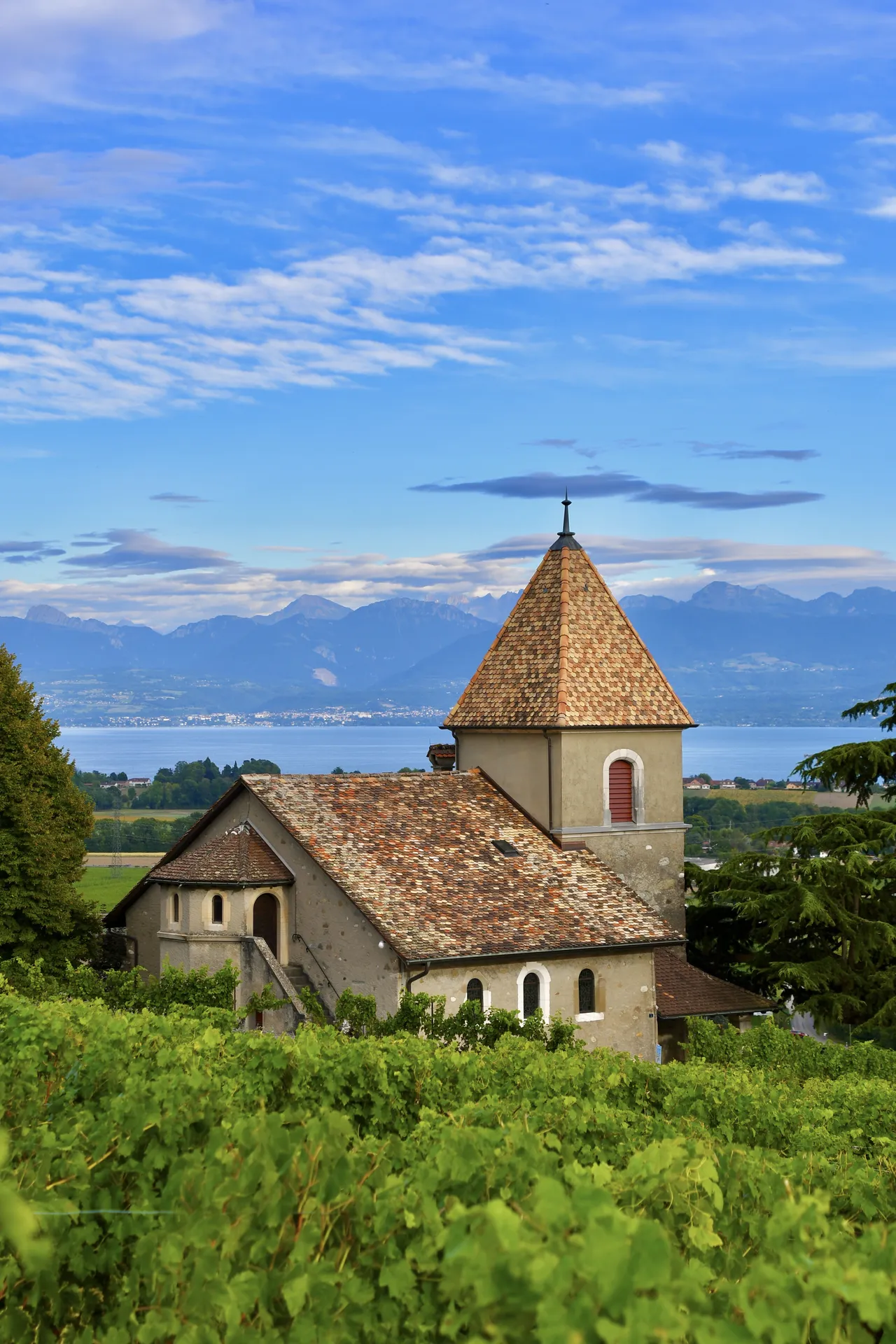 Photo: Jérémy Toma · CC BY-SA 4.0
- Time needed
- 30-45 minutes
- Entry
- Free
- Best season
- Autumn (September-October)
Two bells cast in 1507 still ring from the tower of Luins Church in Luins, Switzerland — twenty-nine years before the Reformation tore through Vaud and turned this Catholic chapel into a Protestant temple. People come for the view as much as the stone: the whitewashed church crowns a hill above the terraced vineyards of La Côte, with Lake Geneva and Mont-Blanc stacked on the horizon. Locals call it La Sentinelle, the sentinel, and it has kept watch through demolition threats, restorations, and half a millennium of wine harvests.
The climb from the village is short but steep, and the tower rears against the sky long before you reach the churchyard. From the terrace by the stone walls, the view drops through rows of Chasselas vines toward the lake. On a clear morning, Mont Blanc floats on the southern horizon like a white interruption in the blue.
Inside, the register shifts. The nave is modest — no frescoes, no gilded altarpiece. Cool air smells of old stone and wood. A communion table installed in 1953 carries the words 'I am the bread of life.' Light through a 1955 stained-glass window by Bernard Viglino, honouring local regent and cantor Ulysse Rochat, changes colour through the afternoon.
The church shares its hilltop world with Luins Castle, the fourteenth-century château still tied to the commune's wine-growing identity. After the bells and the panorama, the château is the other reason the church feels less like a stop than an anchor for the whole vineyard slope.
What to see
-
The Bell Tower and the 1507 Bells
Start at the bell tower, because it carries the church's oldest voice. Two bells cast in 1507 still hang here, made a full generation before the Reformation turned this Catholic chapel into a Protestant temple in 1536. The tower itself is older below, with fifteenth-century buttresses, and newer above; a 1763 clock mechanism the size of a bedside table sits inside, signed by its makers. Look for the pale seam where the 1952–53 restoration stitched the stone together. That pale seam is the visible bruise of the 1896 scare, when the church nearly came down and cantonal architect Albert Naef stepped in to save it. -
The Vineyard Panorama from the Churchyard
Step out from the church porch and the reason for its nickname hits you. Locals call it La Sentinelle, the sentinel, and from this hilltop above the La Côte AOC vines you see why: Lake Geneva stretches below like hammered pewter, the Jura ridge runs north, and Mont Blanc pokes up on clear days like a white sail beyond the water. This is not a view you observe; you stand inside it, with vine leaves moving at knee height and the smell of warm limestone rising from the path. Go in autumn after harvest, when the vines turn to rust and the air carries the sugary tang of crushed grapes from the Caveau des Vignerons below. -
The Sentinel Walk: Castle, Vines, and a 15th-Century Puzzle
Start at Luins Castle, the 14th-century estate that once owned most of these vineyard plots, and climb toward the church through the rows of La Côte vines. The path is short but steep, and it follows the route villagers used for centuries when the Catholic chapel still held three chapels and the parish answered to the Payerne convent. Stop halfway. Turn around and watch the castle recede among the trellises. Finish at the church porch with a question: where did the third chapel go? The remaining fabric hides blocked arches and suspicious stonework if you are patient enough to look, and the Caveau des Vignerons de Luins-Vinzel waits below with cold Chasselas.
Plan your visit
- Getting There
- Nyon is the regional hub, about 15 km away, with SBB trains from Geneva and Lausanne. From Nyon, local PostBus routes serve the La Côte villages — check sbb.ch for current connections to "Luins." By car, it's a short detour off the Nyon–Rolle road, with village street parking.
- Opening Hours
- No fixed public visiting hours are published. As an active Reformed temple, it opens for Sunday services and special events. The Les Intimes literary-musical festival runs May 1–August 28, 2026, with events inside the church. Call the commune at +41 21 824 10 53 to confirm access before making the trip.
- Time Needed
- Quick exterior visit with photos: 15–20 minutes. Thorough exploration including interior and the panoramic viewpoint: 30–45 minutes. Budget 1.5–2 hours if you combine it with wine tasting at the Caveau des Vignerons de Luins-Vinzel or a walk to Luins Castle.
- Cost & Tickets
- No admission fee is published — as a working Protestant temple, entry is free. The August 28, 2026 Les Intimes concert (19:00) has separate ticketing via infomaniak.events. The church can also be rented for weddings and events through the commune.
- Accessibility
- No official accessibility information is published. The church sits on elevated ground above the village, with likely steps at the entrance and uneven terrain around the churchyard. Contact the commune directly before visiting if mobility is a concern.
Photo Gallery


History
The Sentinel's Narrow Reprieve
Records place a church here as early as the twelfth century, when it belonged to the Cluniac priory at Payerne. What stands today is a palimpsest: a fifteenth-century Gothic nave and tower over older Romanesque bones, heavily rebuilt in 1674 and restored again in 1896–1897.
The Catholic past is easy to overlook behind the Protestant present. Two bells cast in 1507, a sixteenth-century brass communion plate, and a dedication to Saint Peter are quiet holdouts from before 1536, when Bernese troops brought the Reformation to Vaud.
The turning point
Albert Naef's Rescue, 1896
By the late nineteenth century, the church had become a problem. Since 1536 it had been a satellite of the parish of Begnins, and without a resident pastor it slipped into neglect. According to the canton's tourism records, by 1896 authorities judged the old building ready for demolition.
Albert Naef saw something else. The first cantonal archaeologist of Vaud, Naef had already earned a reputation as a fierce and polarising defender of the region's medieval fabric — a man who, one account says, made many enemies. For him, Luins was not an obsolete chapel but a survivor worth defending.
The turning point came in 1896, when Naef pushed to halt the demolition and led a restoration instead. The Historical Dictionary of Switzerland confirms the work continued into 1897. Six years later, the church was classified as a historic monument. Naef's methods were contested elsewhere, but at Luins the equation is simple: the building exists because he refused to let it disappear.
The Reformation Arrives in 1536
The Bells You Walk Past
Tips for visitors
Say "Temple," not "Église"
Locals call it the Temple de Luins, not the Église. Using "temple" signals you know the Reformation history — the church has been Protestant since 1536, when Bernese forces brought the new faith to Vaud.Pair with the Château
Don't make a special trip just for the church. Combine it with Luins Castle, the 14th-century winegrowing estate a short walk away, then taste at the Caveau des Vignerons de Luins-Vinzel.Wait for a Clear Day
The view from the church steps spans Lake Geneva, the La Côte vineyards, and Mont-Blanc's 4,808-metre massif. Haze swallows the Alps fast — check the forecast and aim for a crisp morning or after a cold front passes through.Get Inside via Les Intimes
The Les Intimes festival runs May 1–August 28, 2026, celebrating 20 years with the concept "one day, one place, one author." It's the most reliable way to get inside the church outside of Sunday services — and the acoustics reward the effort.Photography Etiquette
No formal photography policy is posted, but skip flash and tripods during services or concerts. Drone flights over the village require permits under Swiss regulations — the paperwork isn't worth it for a shot you can get from the church steps.Respect the Vineyard Rows
During harvest season, vineyard workers are direct about keeping tourists out of the rows. Stay on marked paths and public roads. The Komoot loop from Luins to Le Rosey Castle is a solid 7.2 km walk that keeps you legal.Dress for a Working Church
No formal dress code is posted, but this is an active Reformed temple, not a museum. Smart-casual is the safe standard for Sunday services. If you attend communion and aren't baptized, simply remain seated — no one will mind.
Frequently asked
Is Luins Church worth visiting?
Yes, if you're already exploring the La Côte wine region or want a postcard-perfect Swiss panorama. The church itself is modest, but its hilltop position above the vineyards, with Lake Geneva and Mont-Blanc on the horizon, makes the detour worthwhile. Pair it with a tasting at the Caveau des Vignerons de Luins-Vinzel and a look at Luins Castle.
How long do you need at Luins Church?
Fifteen to twenty minutes covers the exterior and the view; allow thirty to forty-five if you can get inside and want to study the bell tower's restoration seams. The real time sink is the setting — a 7.2 km hiking loop from the church through the vineyards takes a couple of hours. Combine it with wine tasting and you've got a relaxed half-day.
How do I get to Luins Church from Geneva?
Take a train from Geneva to Nyon (about 15 minutes), then a local PostBus toward Luins — check sbb.ch for current connections since the specific bus line wasn't confirmed in research. Driving takes roughly 30 minutes via the A1 motorway. The church sits on elevated ground in the village, so expect a short uphill walk from wherever you park.
What is the best time to visit Luins Church?
Autumn, during harvest, when the surrounding vines turn gold and red and the air smells of ripe grapes. Summer offers the clearest views of Mont-Blanc across the lake, while spring brings birdsong and bare-earth contrast between the vine rows. Winter is stark but beautiful — frost on the vines, the church a dark silhouette against white Alps.
Can you visit Luins Church for free?
Almost certainly yes — no ticket prices or admission fees appear in any source, and it functions as an active Protestant temple. The catch is that no public opening hours are published either. Your best bet for getting inside is attending a Sunday service or a festival event like Les Intimes, which runs May through August.
What should I not miss at Luins Church?
The two bells cast in 1507 — pre-Reformation survivors that predate the church's Protestant identity by nearly three decades. Also look for the visible restoration line on the bell tower from the 1952–53 work, where newer stone meets old. And don't skip the view from the churchyard steps: Lake Geneva below, the Jura to the north, Mont-Blanc's white massif to the south.
Why is Luins Church called 'La Sentinelle'?
Locals call it 'The Sentinel' because it dominates the village silhouette, standing watch over the houses and vineyards below. The nickname reflects genuine affection — the church is literally the commune's brand image, used in tourism promotion and municipal identity. It's a landmark, not just a building.
What happened to Luins Church during the Reformation?
In 1536, when Bern conquered Vaud and imposed Protestantism, the church was stripped of its Catholic identity and converted to a Protestant temple. It was then annexed to the neighbouring parish of Begnins — a demotion it still feels today, with no resident pastor. The 1507 bells are among the few physical objects that survived this forced transformation.
Sources & attribution 8
- Canton de Vaud Tourism — The Church of Luins — Primary source for the church's dedication to Saint-Pierre, the 1507 bells, the 1896 threat of destruction and Albert Naef's rescue, the 1903 historic monument classification, and the 'La Sentinelle' nickname.
- Historical Dictionary of Switzerland — Luins — Scholarly source confirming the church was cited from the 12th century, belonged to the Priory of Payerne, was rebuilt in 1674, and underwent restoration in 1896–97 and 1952–53.
- La Côte Tourisme — The Church of Luins — Regional tourism source describing the church as a picturesque edifice in the vineyards, its panoramic views over La Côte AOC, Lake Geneva, and Mont-Blanc, and its role in defining the village silhouette.
- Notre Histoire — Luins Church Restoration — Local history source documenting the 1952–1953 exterior and interior restoration, specifically visible at the bell tower level.
- Commune de Luins — Official Website — Municipal website listing church rental tariffs, access information, and the Les Intimes festival schedule, confirming the church's ongoing community use.
- Wikipedia — Albert Naef — Biographical details on Albert Naef (1862–1936), the cantonal architect and archaeologist who saved the church from demolition in 1896, including his controversial restoration methods.
- FAOVD — Luins Commune History — Source for the 1922 coat of arms rejection featuring Saint Peter's keys, and the Château de Luins' 14th-century winegrowing history.
- EERV — Sunday Service at Luins — Confirms the church's current status as an active Protestant temple within the Coeur de la Côte parish grouping, with regular Sunday services.
Built from cited sources · see the method · How we make our guides →
More in Luins.
1 places to discover — a few worth pairing.
Pick up where you left off
Saved and recently read places — kept on this device only.
Photo credits (7)
- Lavaux - Rivaz — Attila Terbócs, User Pasztilla — CC BY-SA 3.0 (https://creativecommons.org/licenses/by-sa/3.0/) — Source: https://commons.wikimedia.org/wiki/File:Lavaux_-_Rivaz.jpg
- Lavaux - Dézaley — Attila Terbócs, User Pasztilla — CC BY-SA 3.0 (https://creativecommons.org/licenses/by-sa/3.0/) — Source: https://commons.wikimedia.org/wiki/File:Lavaux_-_Dézaley.jpg
- Lavaux - Chexbres — Alessandra Volterra — CC BY-SA 4.0 (https://creativecommons.org/licenses/by-sa/4.0/) — Source: https://commons.wikimedia.org/wiki/File:Lavaux_-_Chexbres.jpg
- Temple de Luins (VD) — Jérémy Toma — CC BY-SA 4.0 (https://creativecommons.org/licenses/by-sa/4.0/) — Source: https://commons.wikimedia.org/wiki/File:Temple_de_Luins_(VD).jpg
- Vinzel chapelle2 — Nicolas Ray — CC BY-SA 3.0 (https://creativecommons.org/licenses/by-sa/3.0/) — Source: https://commons.wikimedia.org/wiki/File:Vinzel_chapelle2.JPG
- Luins - Église et vignobles — Pymouss — CC BY-SA 3.0 (https://creativecommons.org/licenses/by-sa/3.0/) — Source: https://commons.wikimedia.org/wiki/File:Luins_-_Église_et_vignobles.jpg
- Vinzel chapelle1 — Nicolas Ray — CC BY-SA 3.0 (https://creativecommons.org/licenses/by-sa/3.0/) — Source: https://commons.wikimedia.org/wiki/File:Vinzel_chapelle1.JPG
Photos may have been resized or cropped.