Luins Castle
LuinsSwitzerland 46° N · 6° E Updated Aug 2026
Luins Castle hides in plain sight: 13th-century wine archives, six 1920s oak presses, and a weekly village apéro, still run by the same family since 1909.
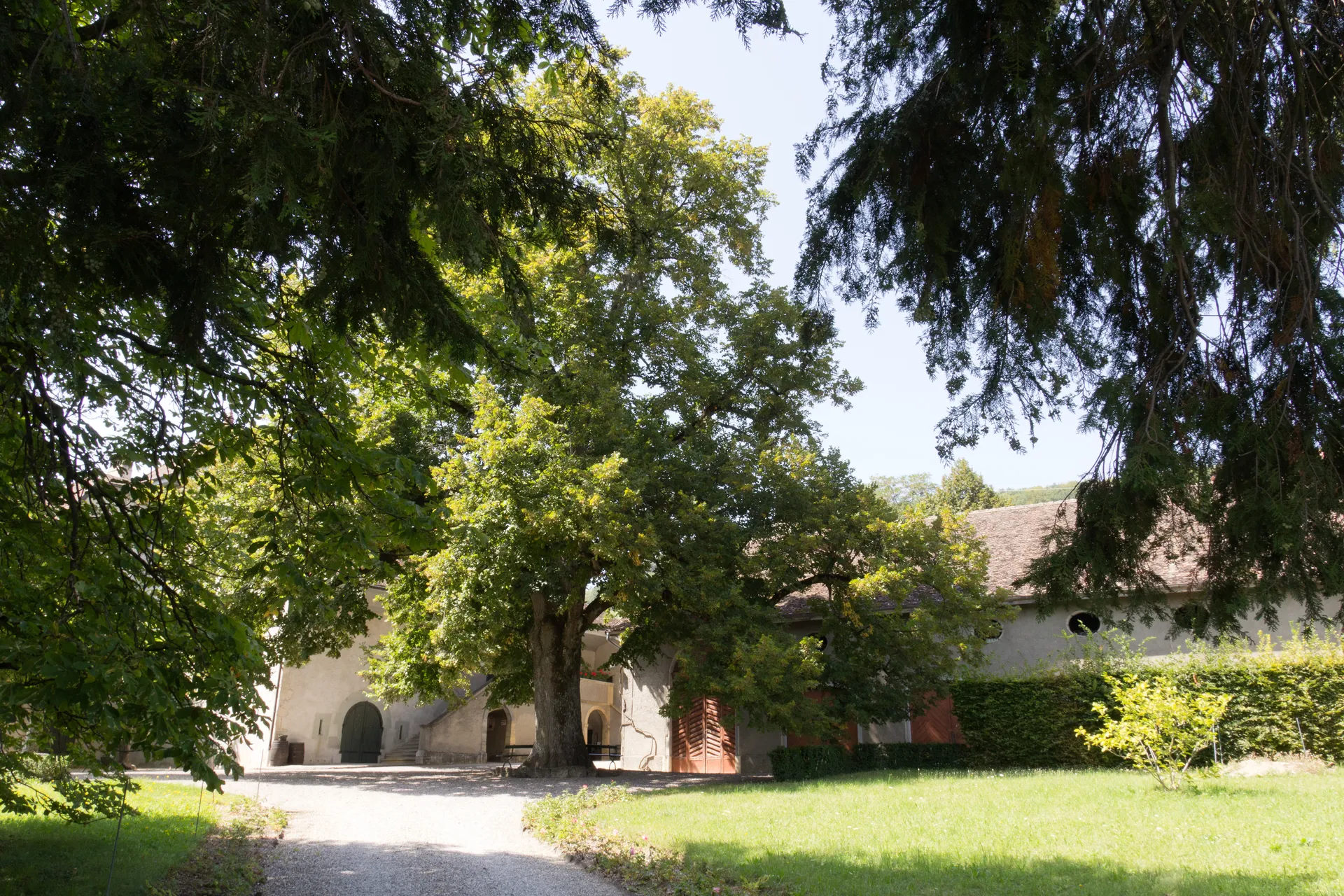 Photo: EdouardHue · CC BY-SA 3.0
- Time needed
- 1-2 hours
- Best season
- Summer (June–August)
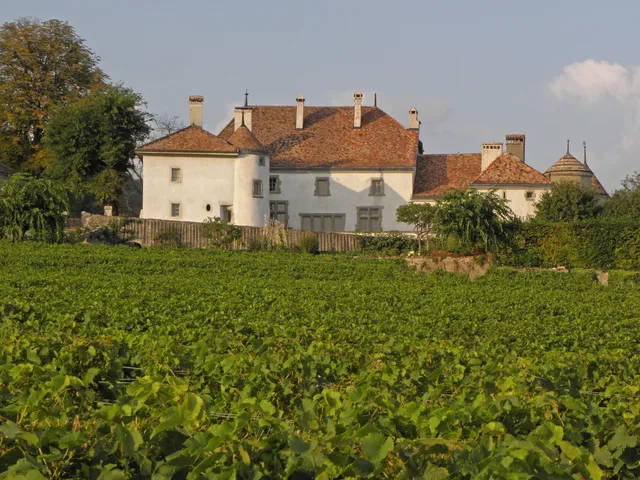
Exactly six 1920s wine presses stand shoulder to shoulder in the cellars of Luins Castle, a wine estate in the village of Luins, Switzerland, that has never stopped doing the quiet work of growing grapes. The castle hides behind roadside walls and old trees, a discreet rectangle of Vaudois stone wrapped on three sides by vines. Come for the strange intimacy of a national heritage site that still smells of pressed Chasselas, not varnish.
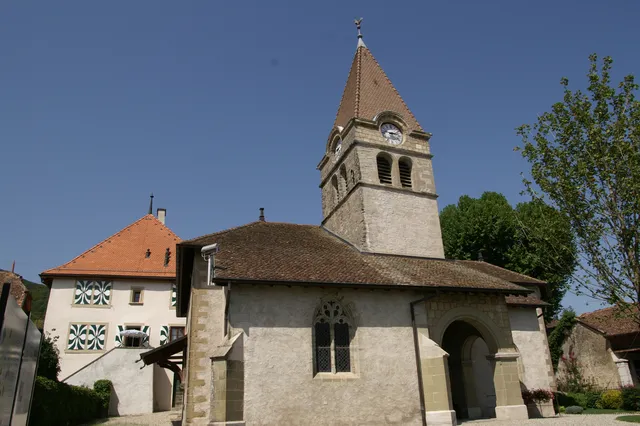
Most visitors miss it. The road climbing through Luins rises beside a wall that masks the castle, and only the crown of vines gives away what sits behind. Inside, the courtyard is shaded by enormous trees and an old fountain still runs with fresh water, according to the Swiss castles chronicle. Records describe a building patched from yellow limestone and newer gray stone, the bones of an older structure embedded in its façade.
The castle is listed as a Swiss cultural property of national importance, yet this is no roped-off monument. The Baechtold family, descendants of the wine merchant who bought the place in 1909, still vinifies ten hectares of La Côte grapes here. Their tasting room opens on ordinary weekday mornings. In October 2018, one of those six 1920s presses was brought back into service for an old-fashioned pressing.
What to see
-
The 1612 Courtyard That Hides from the Road
You won’t spot Luins Castle from the lane until you’re almost on top of it—the squat, cheerful masonry disappears behind vineyard walls and a chestnut tree broad enough to shade the gateway. Push into the courtyard and the east wing gives you 1612 carved into yellow limestone, with the Wurstemberger and Wyttenbach coats of arms above the door like a marriage contract in stone. The west wing is older, Savoyard in its bones, so the facade is a patchwork of sun-bleached limestone and grey repairs; the old fountain still runs cold in the corner. It never announces itself. That’s the invitation. -
The Working Estate: Vines, Cellar, and a 1920s Press
Ten hectares of vines wrap the castle on three sides—mostly Chasselas, with a few rows of Pinot Noir and Chardonnay added in the early 1960s—and every bottle is still fermented on site in oak casks. The cellar feels older than the house above it: six vertical presses from the 1920s stand in the dim, stone-floored room, smelling of old wine, wet chalk, and wood dust. Look for the one revived in October 2018 for a pressurage à l’ancienne; on a harvest afternoon the whole room groans like an old ship. Ask to step into the carnotzet afterward. It seats just twenty-five, and the tasting list feels less like a menu than a family argument about what the land does best. -
Walk the Luins–Vinzel Vineyard Loop
Two smartphone-guided walks leave from Luins and neighbouring Vinzel, threading through terraced Chasselas rows that catch the light off Lake Geneva. Pack an hour, not because the distance demands it but because the best stretch is the pause: stop where the vines open and the castle reappears below, half-hidden in its bowl of green. The path passes close to the village church that appears in 13th-century wine lists, and on a Tuesday you can end at the carnotzet for the Apéro du mardi from 17:00 to 19:00. That’s the best glass of Chasselas you’ll drink all week—sweet, quiet, and slightly understated, like Luins itself.
Plan your visit
- Getting There
- By car: take the A1 motorway between Geneva and Lausanne, exit at Rolle or Gland, then follow signs to Luins; park in the village and walk to Route du Village 23. By train: SBB main line to Rolle or Gland, then a regional bus or taxi into Luins. Check SBB Mobile for connections, or arrive on foot via the 5.5 km Luins–Begnins vineyard trail.
- Opening Hours
- As of 2026, the carnotzet tasting room is open Monday, Tuesday, Thursday, Friday (typically 08:00–18:00) and Saturday 09:00–12:00; closed Wednesday and Sunday unless by appointment. Hours vary by source and season, so call ahead. The weekly Apéro du mardi runs Tuesdays 17:00–19:00, May through December.
- Time Needed
- A quick tasting at the carnotzet takes 30–45 minutes. Allow 45–60 minutes to include the cellars and the 1920s press room. Set aside 2–3 hours to combine the tasting with the 5.5 km Luins–Begnins vineyard trail.
- Cost & Tickets
- There is no general admission ticket: Luins is a private working wine estate, not a public museum. Wine tastings are typically free or included with a bottle purchase, and the Tuesday apéro is a pay-by-the-glass social hour. Private events like weddings are quoted directly by the estate.
- Accessibility
- This is not a barrier-free site. The carnotzet and cellars are historic spaces likely reached by steps, and vineyard paths are uneven gravel. No published ramp or lift details exist, so contact the estate ahead at chateaudeluins.ch for wheelchair access.
Photo Gallery

History
Seven Centuries of Vines
Luins Castle first surfaces in the written record in 1315, when the domain was documented in the hands of the Cossonay family. Scholars date the core of the building to the 14th century, though the west wing probably preserves Savoyard-era fabric and the east wing was renewed in the early 1600s. The medieval record is thin, which may be less a loss than a clue: this was never a warrior's stronghold. It was a working estate tied to the wine trade.
For centuries ownership passed through regional dynasties. Jean de Chablié held seigneurial rights here in 1338 under the Cossonay fief. Amédée II de Viry took the domain in 1409. Jean Steiger bought the castle in 1558. Then the Wurstembergers, then the Wattevilles for two centuries, then a Neuchâtel count in Paris. The real constant was the harvest.
The turning point
The Count Who Bought a Vineyard at the Edge of an Empire
James-Alexandre de Pourtalès was not born noble. He grew up in Neuchâtel, a Protestant banking scion of Huguenot refugees, with money but no title. In 1809, aged 32, he married Anne Henriette de Palézieux-Falconnet and, the same year, bought Luins for 150,000 Swiss francs. Records tie both events to the same season, though no surviving document says whether the castle was wedding present, investment, or both.
What was at stake for Pourtalès was legitimacy. Money could be made, but standing in Swiss society required land, and a castle in the La Côte wine country gave him an anchor older than his family's fortunes. Luins was not his main residence — he lived in Paris — but it added weight to a portfolio that already included Gorgier and Begnins. This was the same man who would later own a Rembrandt, a Bronzino, and Frans Hals's The Laughing Cavalier.
The turning point came in 1814, when King Frederick William III of Prussia made him Comte de Pourtalès-Gorgier. The banker from Neuchâtel became a count, and Luins sat inside that new identity like a quiet credential. He held the estate until his death in 1855, after which it passed to his daughter and her husband, the Marquis de Ganay. Pourtalès's art collection was dispersed in 1865; the castle, unlike the paintings, stayed put.
A Date Carved in Stone
From Aristocrats to Wine Merchants
Tips for visitors
Tuesday Apéro Ritual
Come Tuesday between 17:00 and 19:00, May through December, when the estate opens for apéro. That's the closest thing to a communal living-room wine hour, with current vintages and locals unwinding after work.July 2026 Festival
The Caveau de Luins-Vinzel celebrates 40 years on July 3–5, 2026, with winegrowers, a local market, and concerts at the château. If you're nearby then, this is the biggest weekend of the year.Walk to Begnins
Pair your tasting with the 5.5 km balade oenotouristique from Luins to Begnins. An interactive smartphone guide covers medieval lords, vines, and views toward Mont Blanc along vineyard footpaths.Post-Tasting in Nyon
The castle has no restaurant. Head 10 km to Nyon for Tête de Course, a cyclist-friendly café with homemade iced tea and mains around CHF 20–35; closer, the Caveau des Vignerons de Luins à Vinzel offers simple local plates on weekends.Ask Before Photos
Exterior and vineyard shots from public paths are fine, but the carnotzet and cellars are private working spaces. Ask before photographing inside, and don't launch a drone over the château without prior permission.Buy a Bottle
Skip the tour-ticket mindset: there's no entry fee. Pay for your experience through a glass or bottle of the estate's Chasselas, and ask about the 1920s press room—it's usually part of the cellar visit.Respect the Rows
This is a family-owned working estate, not a manicured attraction. Stay out of the vineyard rows, don't pick grapes, and avoid wandering toward private-house windows or the family's residential areas.
Frequently asked
Is Luins Castle worth visiting?
Yes, if you want a working wine estate rather than a museum-piece castle. The Baechtold family, descendants of wine merchant Hermann Trüssel, has run the 10 hectares of vines since 1909; the carnotzet tasting room is the public face. Skip it if you expect furnished staterooms or a ticketed tour — the residence itself stays private.
How long do you need at Luins Castle?
Allow 45 minutes to an hour for a tasting and cellar look. Add two more hours if you want to walk the vineyard trails toward Begnins or Vinzel, where clear days open views toward Lake Geneva and Mont Blanc.
How do I get to Luins Castle from Geneva?
Take the train from Geneva toward Lausanne and get off at Rolle or Gland, then continue by bus or taxi to Luins village. By car, leave the A1 motorway at Rolle or Gland and follow signs to Luins; parking is limited, so park in the village and walk the last stretch.
What is the best time to visit Luins Castle?
Tuesday evening between May and December is the best window, when the estate runs its Apéro du mardi from 17:00 to 19:00. Autumn adds harvest atmosphere: one of the six 1920s presses was revived for a traditional pressing in October 2018. Summer suits garden and vineyard wandering.
Can you visit Luins Castle for free?
Yes, entry to the carnotzet and cellar area is free; you pay only for what you taste or buy. The residence itself is not open for casual visits, so there is no general admission ticket.
Is Luins Castle open to the public?
Partially. The tasting room, called a carnotzet, opens Monday, Tuesday, Thursday and Friday plus Saturday mornings, while the main residence remains private. The most reliable public access is the Tuesday aperitif, May through December, 17:00 to 19:00.
What should I not miss at Luins Castle?
Don't miss the six 1920s wooden wine presses in the cellar, especially the one revived in 2018 for a traditional pressurage à l'ancienne. Taste the Chasselas — the grape that made Luins wines famous by the 13th century — and pause at the old chestnut tree by the entrance. Its leaf appears on the estate's wax-seal logo, a quiet clue most visitors pass.
Sources & attribution 16
- Château de Luins — official website — Opening hours, Tuesday apéro schedule, estate wines and contact details.
- La Côte Tourism — Castle of Luins — Tasting room hours, vineyard size, 1920s presses, 2018 pressing, heritage status.
- Swisscastles — Château de Luins — Architectural notes: 1612 east wing date, coats-of-arms, courtyard fountain and historical anecdotes.
- Caveau de Luins-Vinzel — Open cellar events, bourru tasting dates and 40th anniversary festival.
- Vaud Promotion — Château de Luins — Visitor hours and viticultural profile of the estate.
- MySwitzerland — Luins & Vinzel wine tourism walks — Smartphone-guided vineyard walks starting from Luins and Vinzel.
- Hymn Design — Château de Luins — Chestnut leaf logo story tied to the old tree at the entrance.
- Mariages.net — Château de Luins — Wedding venue description and event capacities.
- Wikipedia — Luins Castle — Construction period, heritage listing and owner history.
- Wikipedia — James-Alexandre de Pourtalès — 1809 purchase of Luins for 150,000 Swiss francs and later inheritance.
- Cavo-Pass — Château de Luins — Caveau opening hours and wine route pass details.
- Komoot — Attractions around Luins — Nearby attractions and outdoor routes around Luins.
- faovd.ch — Luins — Local heritage note describing 14th-century construction.
- letourfemmes.fr — Patrimoine stage 2 — Dates construction from 14th to 17th centuries and 1315 attestation.
- Agorha / INHA — Pourtalès, James Alexandre — Biographical detail on James-Alexandre de Pourtalès.
- HLS — Pourtalès, James Alexandre de — Scholarly biography of James-Alexandre de Pourtalès.
Built from cited sources · see the method · How we make our guides →
More in Luins.
1 places to discover — a few worth pairing.



Pick up where you left off
Saved and recently read places — kept on this device only.
Photo credits (1)
- Entrée du château de Luins (Suisse) — EdouardHue — CC BY-SA 3.0 (https://creativecommons.org/licenses/by-sa/3.0/) — Source: https://commons.wikimedia.org/wiki/File:Entrée_du_château_de_Luins_(Suisse).jpg
Photos may have been resized or cropped.