Vincy Castle
GillySwitzerland 46° N · 6° E Updated Aug 2026
A Grand Cru winery operates inside an 18th-century château once owned by Norman Foster; Voltaire, Lamartine, and royalists left echoes above Lake Geneva.
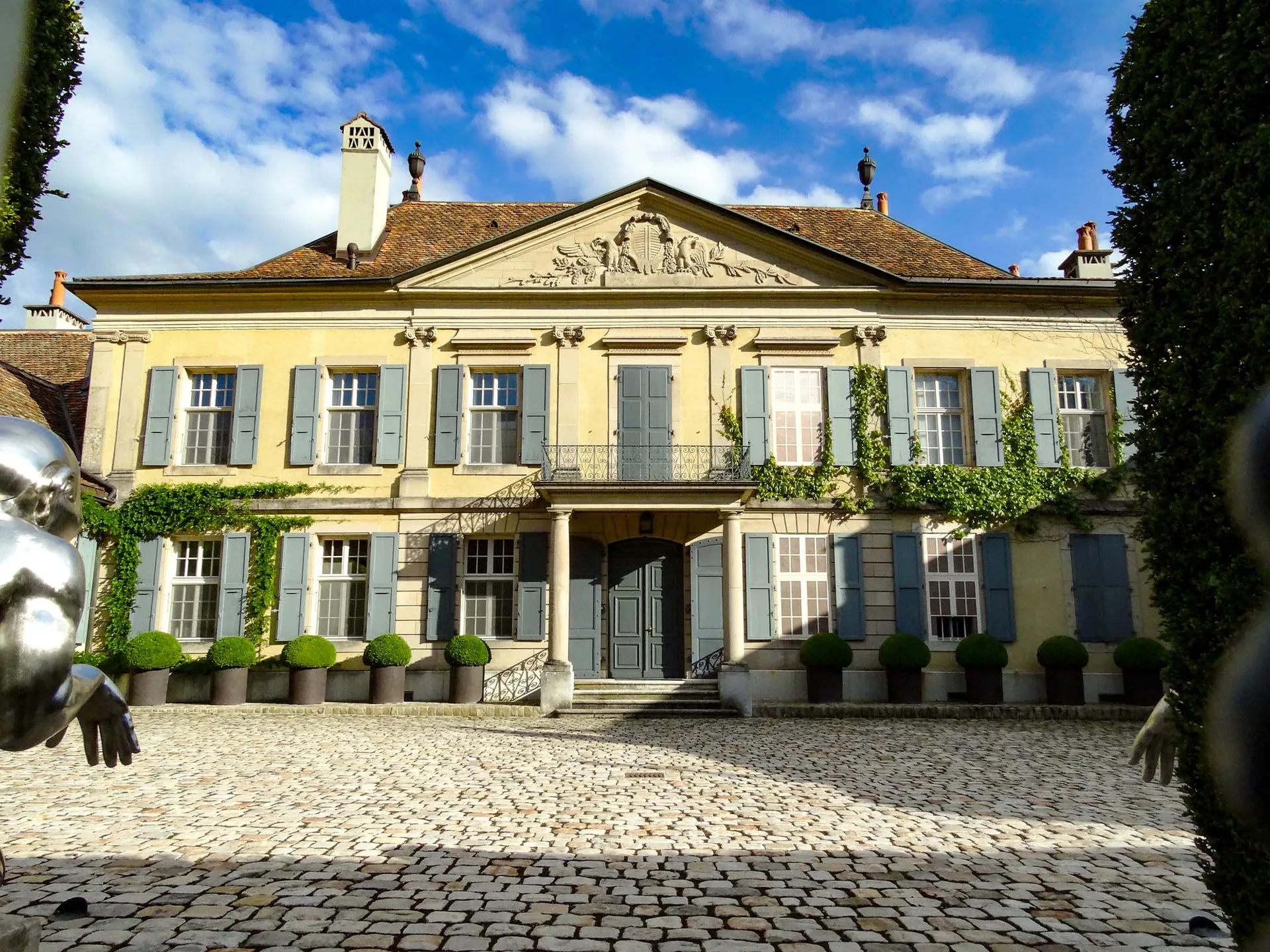 Photo: Leemburg-CH · CC BY-SA 4.0
Twenty-five gold louis and a smuggler’s path across the Jura carried a hungry twenty-five-year-old to the door of Vincy Castle in Gilly, Switzerland. That refugee was Alphonse de Lamartine, and the baron who questioned him before letting him in was quietly losing his fortune while refusing to blush. You come to Vincy today for the same tension: a working winery wrapped in late-18th-century classical politeness, above vines that have outlasted frosts, revolutions, and celebrity owners.
The château sits in the commune of Gilly, a few curves above Lake Geneva among the vines of La Côte. The present manor went up between 1721 and 1724 for the Vasserot family, Huguenot merchants and bankers whose money crossed Holland and France before it bought a Vaud seigneurie. The original south façade wore neoclassical ornament—denticules and curved consoles—until later architects toned it down in the twentieth century.
Inside, the showpiece is not armour but light: a columned hall and a long terrace added by Auguste de Vasserot after 1793, when his military career had already collapsed. He spent money he no longer had on colonnades, cornices, pediments and a French garden that is, surprisingly, mostly a twentieth-century backdrop. The older survival is the working vineyard—old Chasselas and Pinot Noir vines that predate the killing frost of 1956.
Approach from the lake road on a clear morning and the pale façade rises above the vine rows, with tractor drone sometimes closer than the clink of porcelain. You will not always get past the gate: this is a private estate and a functioning domaine. But the reward is exactly that glimpse of something real—a house that has been burned, rebuilt, embellished, sold for fifty-six million francs in 2007, and still smells of cellar and cut grass.
What to see
-
The Classical Façade and Lamartine's Terrace
Vincy doesn’t announce itself. The 1721–24 château sits above the village of Gilly like a Loire Valley house that took a wrong turn and decided to stay. Jean and David Vasserot, father-son speculators grown rich on John Law’s money, gave Geneva architect David Jeanrenaud the commission. What he made is not a fortress: colonnades, pediments, a cour d'honneur, and a long terrace built for evening air rather than cannon. Stand where Lamartine stood in 1815, when he arrived with a rifle, 25 gold louis, and smuggler’s dust on his boots. The terrace drops toward Lake Geneva; on clear evenings the moon does exactly what he described, moving its glimmers over water and snow. You can’t wander the interior without arranging a wine visit. That’s fine. The façade and the view are the real collection. -
Vines Since Vintius
Wine was here before the château. The name Vincy comes from a Gallo-Roman landowner called Vintius, which means somebody was pressing grapes on this slope two millennia before the Vasserots put up their pediments. Today the estate still works, and the vines around the house are not décor. Autumn air near the press sharpens sweet with fermenting must. Call ahead for a tasting; don’t expect a ticket desk. Generations of winemakers built the Grand Cru reputation. The original furniture went to auction in 1996, but the cellars and terraces keep the older story. -
A Walk Through Three Lost Castles
This is a walk through three castles, none of them obvious. Start at the current château’s gates and follow the Flon-de-Vincy stream. On one bank stood the maison forte des Vaux; on the other, the old maison forte de Vincy. A farm replaced the latter around 1745, then the farm was demolished in 1939. Climb toward the Vallon des Vaux and you’re walking toward the oldest layer: a motte castle destroyed around 1292/93, burned into the grass before the Dukes of Savoy or Bern ever argued over the Vaud. The ground holds the ghosts of all three. Bring two hours, good shoes, and count how many centuries you can stand inside at once.
Plan your visit
- Getting There
- Drive via the A1 to the Rolle exit, then follow Route de Gilly toward Gilly; the estate is at Route de Gilly 48, 1180 Rolle, with parking near the entrance. By train, take the Geneva–Lausanne line to Rolle, then a taxi or a 2–3 km walk through the Côte vineyards.
- Opening Hours
- As of 2026, Vincy has no fixed public opening hours. It remains a private residence and working winery, so tastings and visits are by appointment only. The regional Caves Ouvertes Vaudoises weekend falls on May 23–24, 2026; check directly whether Vincy participates.
- Time Needed
- Allow 30–60 minutes for a pre-booked tasting and a look at the courtyard and south facade. Add another hour if you walk up from Rolle through the vines or linger for photos; there is no public interior tour to fill a longer visit.
- Cost & Tickets
- No standard entry fee applies because this is not a public museum. Private tastings are priced by the domaine; for the Caves Ouvertes Vaudoises weekend (May 23–24, 2026), a CHF 40 wristband covers transport, a glass, and tastings at participating wineries.
Photo Gallery


History
Last Splendour, Frugal Table
According to local tradition, the name Vincy preserves the memory of Vintius, a Gallo-Roman landowner said to have kept a villa here. No surviving excavation confirms that villa. What records do show is that Bernese troops burned an earlier fortified house on the estate in 1530, and the present stone manor followed in the 1720s.
Construction began in 1721 for the Vasserot family, Huguenot merchants and bankers who carried the title of Prussian barons into the Vaud countryside. What rose by 1724 was not a fortress but a classical country seat—symmetrical windows, a central entrance, an air of calm above the lakeside vines. The calm, like most things at Vincy, was partly performance.
The turning point
The Baron, the Poet, and the Twenty-Five Louis
Auguste de Vasserot de Vincy had been a captain in the Swiss regiment of Lullin de Châteauvieux until 1790, when his own soldiers mutinied during the revolutionary ferment and ended his military career. The Revolution then stripped much of the family fortune. From 1793 onward, he did the most unreasonable thing available: he poured money into Vincy, adding colonnades, cornices, pediments, a broad terrace and a columned hall, with the Geneva sculptor Jean Jacquet overseeing interiors. According to family accounts, his wife’s line became the household motto: “We will be ruined, and the table is frugal, but we do not blush for it.”
The turning point came in 1815, when Napoleon’s return drove a twenty-five-year-old royalist poet out of France. Alphonse de Lamartine crossed the Jura on smugglers’ paths with a gun and twenty-five gold louis, then knocked at Vincy without any letter of introduction. Auguste did not wave him away. He questioned the exhausted stranger—where he had come from, why he was in exile, how he meant to live in the Vaud country—and only then opened the house to him.
Lamartine stayed, walking the long terrace with Madame de Vasserot and her daughter, writing above the lake. He later remembered Vincy as a place of lost splendour: dinner simple and sober, but the welcome unquestionably noble. For Auguste, the moment proved that hospitality, not income, was the family’s final line of defence. And it bought him a footnote in literary history he never asked for.
A Name Older Than Wine
Voltaire, Bears, and a Hidden Recipe
Tips for visitors
Book Before You Go
Vincy is a working wine estate, not a walk-in castle. Contact Laurent Michon at Domaine du Château de Vincy, Route de Gilly 48, 1180 Rolle, to arrange a tasting; don't expect to tour the private rooms.Ask Before Shooting
Facade shots from the public road are fine, but drones, tripods, or any interior and cellar photography need permission from the domaine. This is still someone's home.Eat in Rolle
Gilly itself has no confirmed dining; head 3 km down to Rolle for lakeside bistros. Budget CHF 20–35 for a casual main, CHF 40–70 for a proper meal with local Chasselas.May Open Cellars
The Caves Ouvertes Vaudoises weekend on May 23–24, 2026 is the best moment to taste across La Côte. Otherwise, late afternoon light warms the south facade and gives the clearest lake view toward Coppet.Respect Vineyard Gates
No pickpocket or scam issues are documented around Gilly, but the real risk is trespassing. Stay on public lanes and don't enter vineyard rows or gateways marked private.Wristband Over Walk-Ins
If you plan to visit several Vaud wineries, the CHF 40 Caves Ouvertes wristband (May 2026) can be cheaper than multiple private tastings. For one-off visits, ask the domaine for its current tasting fee before booking.
Frequently asked
Is Vincy Castle worth visiting?
Yes, if you plan ahead, because Château de Vincy is a private working winery, not a drop-in museum. Book a tasting or arrive during the Vaud Caves Ouvertes weekend and you get a rare mix of 1720s classical architecture, Lamartine's terrace, and La Côte Grand Cru wines. If you just show up expecting a furnished castle tour, you will likely only see the facade from the road.
Can you visit Vincy Castle for free?
No, there is no free interior access; the château is a private residence and winery. You can see the classical facade and gardens from the public road near Route de Gilly 48, but tastings and tours require advance arrangement. The Vaud Caves Ouvertes weekend in late May is the closest thing to an open day, and that has a ticket.
How do I get to Vincy Castle from Geneva?
Drive about 30 minutes on the A1 to the Rolle exit, then follow signs to Gilly and Route de Gilly 48; parking is available near the entrance. By train, go to Rolle station on the Geneva–Lausanne line, then take a taxi or walk about 2–3 km through the vineyards. No direct bus service to the castle is documented.
What is the best time to visit Vincy Castle?
Autumn, during harvest, is the most authentic time to see the working winery in action and the vines turning gold. Spring is best for the formal gardens and long lake views from the terrace; late May's Caves Ouvertes Vaudoises offers the most reliable public access. Winter can be beautiful but access is even more limited.
What should I not miss at Vincy Castle?
Stand on the long terrace at the foot of the château where Lamartine spent his evenings in 1815, looking toward Lake Geneva and Coppet. Also look for the 18th-century colonnades, cornices, and pediments added by Auguste de Vasserot after 1793, and ask about Jean Jaquet's interior stucco work if you get inside. The wine, especially the estate's Chasselas and Pinot Noir, is the real reason to book a tasting.
How long do you need at Vincy Castle?
Plan 60–90 minutes for a wine tasting and a look at the exterior, terrace, and vineyard setting. Since there is no regular museum route, you won't need half a day; combine it with a walk through the Gilly vineyards or a stop in Rolle.
Is Vincy Castle open to the public?
No, Château de Vincy is not open for regular drop-in visits; it is a private residence and working winery. You can arrange wine tastings in advance through Domaine du Château de Vincy, and the estate sometimes participates in the Vaud Caves Ouvertes weekend. Otherwise, you can view the building from the public road.
Sources & attribution 9
- Swisscastles – Château de Vincy — Provided core architectural history, private status, Voltaire and Lamartine connections, and the estate's classical character.
- Swisscastles – Château de Vincy (German detailed history) — Supplied details on Auguste de Vasserot's renovations, Jean Jaquet's stucco work, the 1815 Lamartine stay, and the terrace.
- Wikipedia – Vincy Castle — Confirmed construction dates 1721–1724, the Vasserot family, and the national heritage listing.
- Domaine du Château de Vincy – Les vins — Documented the estate's wine production and the 1934 purchase by Charles Michon.
- Domaine du Château de Vincy – Contact — Provided the practical contact route for arranging wine tastings at the private estate.
- Tribune de Genève – Les Foster, «seigneurs» de Vincy, ont quitté leur château — Reported the 2007 Foster purchase and later departure from the château.
- Hammel.ch – Château de Vincy — Described the estate as a Grand Cru wine property and gave the Vintius etymology for the name Vincy.
- Mes Caves Ouvertes Vaudoises — Listed the late May Caves Ouvertes weekend that offers public access to Vaud wineries, including Vincy if participating.
- Dictionnaire historique de la Suisse – Gilly — Provided background on Gilly's medieval castles and the Bernese burning of the earlier Vincy fortress.
Built from cited sources · see the method · How we make our guides →
More in Gilly.
3 places to discover — a few worth pairing.

Pick up where you left off
Saved and recently read places — kept on this device only.
Photo credits (5)
- Gilly, Château de Vincy 01 — Leemburg-CH — CC BY-SA 4.0 (https://creativecommons.org/licenses/by-sa/4.0/) — Source: https://commons.wikimedia.org/wiki/File:Gilly,_Château_de_Vincy_01.jpg
- Gilly - Château de Vincy 02 — Pymouss — CC BY-SA 3.0 (https://creativecommons.org/licenses/by-sa/3.0/) — Source: https://commons.wikimedia.org/wiki/File:Gilly_-_Château_de_Vincy_02.jpg
- Gilly, Château de Vincy 03 — Leemburg-CH — CC BY-SA 4.0 (https://creativecommons.org/licenses/by-sa/4.0/) — Source: https://commons.wikimedia.org/wiki/File:Gilly,_Château_de_Vincy_03.jpg
- Gilly - Château de Vincy 01 — Pymouss — CC BY-SA 3.0 (https://creativecommons.org/licenses/by-sa/3.0/) — Source: https://commons.wikimedia.org/wiki/File:Gilly_-_Château_de_Vincy_01.jpg
- Gilly, Château de Vincy 02 — Leemburg-CH — CC BY-SA 4.0 (https://creativecommons.org/licenses/by-sa/4.0/) — Source: https://commons.wikimedia.org/wiki/File:Gilly,_Château_de_Vincy_02.jpg
Photos may have been resized or cropped.