Farmhouse No. ECA 148
GillySwitzerland 46° N · 6° E Updated Aug 2026
Behind an insurance-inventory code on Gilly's main lane lies a medieval winegrower's house with late-Gothic details, still known as the propriété Rolaz.
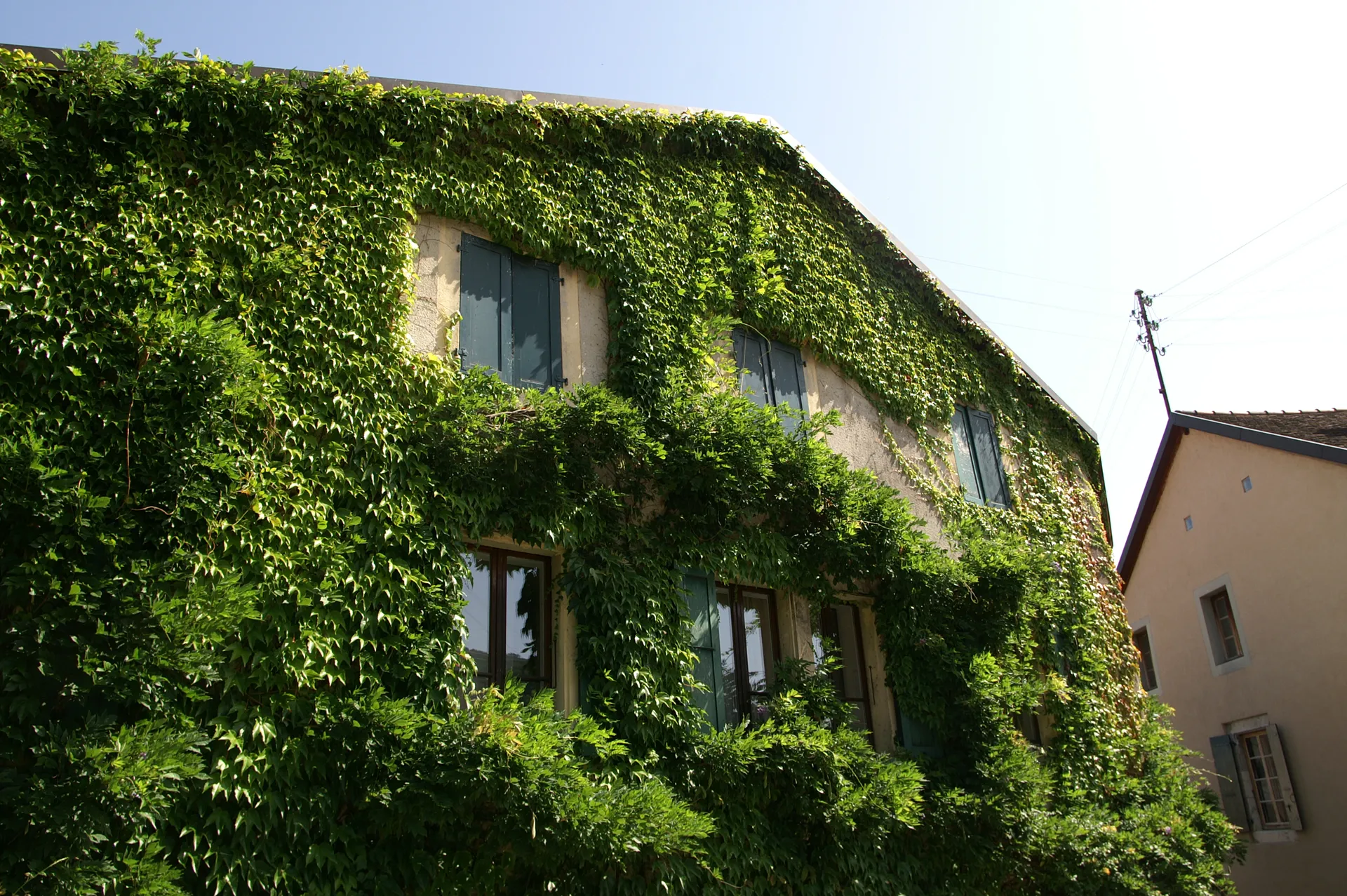 Photo: Pymouss · CC BY-SA 3.0
- Time needed
- 15–30 minutes (exterior only)
- Entry
- Free (street view only)
- Access
- Street-level view from public lane; no public entry
- Best season
- Spring–autumn (vineyard season)
One photograph is the most detailed public record of Farmhouse no. ECA 148 in Gilly, Switzerland — a nationally protected wine-grower's farmhouse with no published construction date, architect, or historical event. The farmhouse belongs to the same ancient wine landscape as Gilly and its feudal hamlets, but it keeps its own story almost entirely hidden. You come here for the rare architectural silence: a standing monument that asks you to look at walls instead of plaques.
Gilly's written history reaches back to 1179, when the village appeared as de iusliaco, and again in 1278 as Gillie. By the 14th century, power over the slopes around this farmhouse passed among the lords of Rolle, Vincy, and Mont — names still echoing in nearby Vincy Castle.
The Swiss federal heritage inventory records this farmhouse under KGS number 10323. That number marks it as a cultural property of national importance — not because it is grand, but because it preserves a regional building type: wine cellar, stable, and living quarters under one roof.
Yet the date of its construction is unknown. The only verified date attached to the building is 21 August 2011 — the day a photographer took the single image now filed under Wikimedia Commons. In a country that documents nearly everything, this farmhouse has stayed strangely quiet.
What to see
-
The Farmhouse Façade
A plaque? There isn't one. No rope line, no ticket booth, no gift shop. Just a substantial Vaudois farmhouse sitting on a village street in Gilly, its rendered walls the color of old cream, its clay roof tiles glowing like baked earth in the late-afternoon light.
This is a Swiss cultural property of national significance — Class A, the same category as cathedrals and castles. Almost everyone walks straight past it. The building follows the classic ferme vaudoise pattern: dwelling, barn, and stable compressed under one long, steeply pitched roof.
Stone on the ground floor, timber above. Look for the carved date stone above the entrance — most farmhouses of this class bear the builder's initials chiselled into the lintel, a signature that's survived centuries. The worn threshold too, polished smooth by generations of footsteps.
The building is a private residence, so the experience is one of reading the façade from the street. Window asymmetry betrays the internal division between living quarters and agricultural space. Photograph it in late afternoon — the archival photo was taken at 15:34 on an August day, and the warm side-light is what gives the plaster its glow.
-
Vincy Castle
Ten minutes' walk from the farmhouse sits the commune's other Class A monument, and it's the one most visitors to the region never hear about. Vincy Castle doesn't have the scale of Chillon or the fame of Coppet, but that's precisely its appeal. A compact medieval stronghold tucked into the same wine-growing landscape, it shares the farmhouse's quiet dignity — heritage without the crowds.
The castle and the farmhouse form a pair worth seeing together. One speaks of aristocratic power, the other of agricultural wealth. Walk between them and you've traced the social history of the La Côte in twenty minutes.
-
The Vineyard Walk
Start at the farmhouse, then let the village streets pull you upward. Gilly's lanes climb toward the vineyards that give the commune its identity — first mentioned in 1179 as de iusliaco, the village has been growing wine for over eight centuries. The vines begin where the houses end, and within ten minutes you're standing among rows of Chasselas grapes with Lake Geneva spreading below.
The panorama from the upper vineyards is the classic La Côte view: the lake a sheet of hammered silver, Mont Blanc rising beyond it on clear days, the village rooftops clustered below with the farmhouse's clay tiles anchoring the foreground. Autumn is the most atmospheric season — the smell of ripening grapes, tractors working the rows, the village busy with harvest.
Finish at the Auberge Communale de Gilly for traditional Vaudois cooking, or knock on a village cellar door for a tasting. The wine route passes through Gilly on its way along the Côte, and the local caves pour what the vineyards above have grown.
Plan your visit
- Getting There
- Ride PostAuto line 835 from Gland or Rolle to "Gilly, village"; Gilly-Bursinel station on the Lausanne–Genève line is the nearest train stop. From the village bus stop, walk a few minutes uphill into the old core to La Rue 14.
- Opening Hours
- As of 2026, there are no opening hours: Ferme ECA 148 is a privately owned farmhouse and the interior is closed to visitors. You can see the facade from La Rue at any daylight hour.
- Time Needed
- Allow 5–10 minutes for a street-side look at the facade. For the full Gilly weave—fountains, church, vineyard trails—plan 1–2 hours; add a meal or cellar tasting for a half day.
- Accessibility
- No visitor access means no wheelchair route into the farmhouse itself; viewing is from the public street. Gilly climbs roughly 100 m above the lake, so expect slopes and narrow old lanes between the station and La Rue.
- Cost/Tickets
- There is no ticket, no booking, and no legitimate third-party entry pass for this building—it is free to view from the street. Pair the stop with wine-tasting fees only if you visit a local cave; Coteaux de Vincy Chasselas runs about CHF 8.50 a bottle.
Photo Gallery

History
The House With No Paper Trail
Gilly's history is the history of Swiss wine. The village first appears as de iusliaco in 1179 and as Gillie in 1278, long before the canton of Vaud existed. In the early 14th century, power over these slopes sat with the lords of Rolle, Vincy, and Mont — feudal landholders whose traces still mark the local cadastral map.
Farmhouse ECA 148 enters the written record far later — or rather, it barely enters at all. No known document gives its construction date, architect, or original owner. What survives is its presence on the federal protection list, a single 2011 photograph, and the deep grain of a village shaped by wine, fire, and regime change.
The turning point
The Soldier Who Redrew Gilly's Fate
No document places Hans Franz Nägeli inside Farmhouse ECA 148. But the Bernese commander who led troops into the Pays de Vaud in 1536 is the reason this building stands in a Protestant Swiss canton rather than on Savoyard territory.
At stake for Nägeli was whether Bern could secure the Vaud as a subject territory and keep Savoy from reclaiming the Lake Geneva shoreline. For Gilly's wine-growing families, the conquest shifted everything: land tenure, tithes, and religious practice all passed under Bernese administration by 1536. The farmhouse's combined cellar, stable, and dwelling — the regional form protected here — took shape inside that new rural order.
The turning point arrived not in battle but in administration. Within years, Bern's bailiffs sat in the region and the former lords of Rolle and Vincy had to submit or leave. A farmhouse standing through that transition would absorb the change in its beams and roofline, even if no document ever named it.
What National Protection Actually Protects
The Fire That Wasn't This House
Tips for visitors
Call it propriété Rolaz
Locals don't call it Ferme ECA 148; ask for the old Rolaz property on La Rue. The house is someone's home, so treat it as a facade stop, not a museum.Malakoff on the square
Book the Auberge Communale de Gilly (La Place 16) for malakoff or lake perch; an à-la-carte meal averages CHF 55 and the kitchen closes Sunday and Monday. The communal épicerie's café corner is the cheap fallback.Catch late light
The south-facing La Rue facade glows in late afternoon; visit then before the Auberge terrace fills. Summer 2026 can bring drought fire bans, so check the commune noticeboard before planning any barbecue.Facade shots only
Street-side photographs of La Rue 14 are fine without a permit. Keep lenses off windows and private yards; drone use over the house needs owner consent.Lock up at trailheads
Gilly feels safe, but the commune warned of daytime burglaries in 2026. Hide valuables when you park for the Sentier des Golettes or vineyard walks.Weave the wine hamlets
From the farmhouse, loop the Sentier des Golettes to Château de Saint-Vincent and the old Beaulieu property. Vincy's castle sits just uphill, making a 1–2 hour ramble feel like a private history route.
Frequently asked
Is Farmhouse no. ECA 148 worth visiting?
Not as a standalone destination — it's a private home at La Rue 14, so you can only look at the façade from the street. But if you're already in Gilly for Chasselas tastings or a slow walk through the old winegrowers' village, the farmhouse earns a five-minute detour: local histories describe a medieval core rebuilt around 1570, with late-Gothic details hiding behind the render.
How long do you need at Farmhouse no. ECA 148?
Five to ten minutes, because you're only seeing the exterior from La Rue. Give Gilly itself one to two hours to walk the old village core, drink from the five communal fountains, and maybe stop for a malakoff at the Auberge Communale.
Can you visit Farmhouse no. ECA 148 for free?
Yes, the façade is free to view from the public street — but that's the whole experience. No tickets, no hours, no tours: the building is a private residence, so stay on the pavement and don't point a camera through the windows.
How do I get to Farmhouse no. ECA 148 from Rolle?
Take PostBus line 842 from Rolle toward Gilly and get off at 'Gilly, village,' then walk a few minutes to La Rue 14. Line 835 also links Gland, Gilly and Rolle; if you arrive by train, Gilly-Bursinel is the closest station, though Rolle has better connections and station lockers.
What is the best time to visit Farmhouse no. ECA 148?
Late afternoon, especially from May to October, when the light hits the rendered street façade and clay roof tiles warmly. September is the most atmospheric month: the harvest is moving through the village and the air smells of ripe grapes.
What should I not miss at Farmhouse no. ECA 148?
Don't just glance at the door — look for late-Gothic stonework and the proportions of a working Vaudois farmhouse. Then keep walking to the communal fountains or the cellar doors of the Rolaz family wineries, whose name is attached to the old property; pair the stop with Vincy Castle and the Château de Saint-Vincent vineyards.
What is Ferme ECA 148 in Gilly?
The farmhouse is a Category A Swiss heritage property at La Rue 14, listed under KGS number 10323 and known locally as the old propriété Rolaz. The inventory protects it as a well-preserved Vaudois winegrower's house, not as a showpiece; it's medieval in origin, largely rebuilt around 1570, with late-Gothic elements.
Sources & attribution 48
- Wikimedia Commons: Gilly - Ferme ECA 148.jpg — Heritage status, coordinates, KGS number 10323, and 2011 photograph metadata.
- Dictionnaire historique de la Suisse — Gilly — Village history: first mentions in 1179 and 1278, district transfer in 1798, population figures, wine-growing context.
- German Wikipedia file page: Gilly - Ferme ECA 148.jpg — Photograph date of 21 August 2011 and camera metadata.
- Canton de Vaud press release: fire at La Dolle, Gilly — Details of the 2009 Gilly farmhouse fire that did not involve ECA 148.
- zentralplus: Baar farmhouse fire and rebuild — Background on a 2024 farmhouse fire and renovation risks, used to contextualize Swiss farmhouse hazards.
- Baarer Zytig: Baar farmhouse rebuild — Rebuilding context for historic Swiss farmhouses.
- Kantonspolizei St. Gallen: Hoffeld farmhouse fire — Context on Swiss farmhouse fires.
- Erni Gruppe: farmhouse renovation reference — Context on farmhouse renovation patterns.
- Schulze Elektro: farmhouse LED retrofit — Context on farmhouse renovation modernization.
- Wikipédia: Ferme ECA 148 — Confirmation of address or use as private dwelling, heritage status, and building type.
- Liste der Kulturgüter in Gilly — Official KGS listing: La Rue 14, KGS number 10323, Category A.
- Wikimedia Commons category: Ferme ECA 148, Gilly — Heritage category confirmation.
- igotoworld: Ferme ACE 148 — Third-party address listing; less reliable than official KGS address.
- OpenCaseLaw decision BGer 1C_611_2017 — Shows an unrelated ECA 148 building numbering in Lausanne, clarifying not to confuse them.
- Commune de Gilly official site — Local practical notices: trails, burglary warning, dog rules, water/fire bans, village events.
- PostAuto: Rolle local transport — Bus network and stops around Rolle/Gilly.
- PostAuto: Gland local transport — Confirms line 835 linking Gland, Gilly, Rolle.
- PostAuto network plan Rolle-Gland 2025-26 — Confirms stops 'Gilly, village' and 'Gilly, église'.
- SBB: Rolle station — Facilities, lockers, and parking at Rolle station.
- Wikipedia: Gilly VD — Elevation, transport context, and village heritage.
- Mobilis Vaud — Fare zone system for buses in Vaud.
- FAOVD: Gilly commune profile — Local societies, fountains, épicerie, and village character.
- Auberge Communale de Gilly — Restaurant/hotel details, terrace, menu.
- Switzerland Tourism: Auberge Communale de Gilly — Restaurant hours and cuisine.
- Passeport Gourmand: Auberge Communale de Gilly — Restaurant details.
- TheFork: Auberge Communale de Gilly — Price level and reservations.
- AroundUs: Vincy Castle — Nearby heritage context and same commune.
- Switzerland Tourism: Auberge Communale de Gilly (EN) — Local dining context.
- Komoot: attractions around Gilly — Scenic routes and viewpoints around Gilly.
- Swiss Farmers: stable visits — Nearby farm experience context.
- Paysans Suisses: stable visits — Farm visit options in Switzerland.
- Canton de Vaud: agritourism — Regional farm and produce experiences.
- World Wikisort: Gilly (Vaud) — Identifies Ferme ECA 148 as the old propriété Rolaz, with medieval origin and ~1570 rebuild.
- La Côte: Gilly village feature — Local pride, population growth, village preservation.
- Cabedita: Gilly — Pays des Raffa-Pépins — Village nickname and local patois.
- Franco.wiki: Gilly (Vaud) — Nickname and village context.
- Cuvée 1182 — Gilly's municipal wine brand.
- Gilly village site — Caves ouvertes, local events, and village activities.
- Rolle tourisme pédestre — Local walking trails.
- Vins Confédérés: Coteaux de Vincy Chasselas award — Award-winning local Chasselas and price/bottle.
- Coteaux de Vincy — Rolaz family winery visits.
- Domaine Chamvalon — Rolaz-Bally wine estate.
- Domaine de Chantegrive — Alain Rolaz estate.
- Cave Saint-Vincent — Guy Rolaz wine estate.
- Notre Histoire: Gilly church and square — Old church demolished 1882 for village square.
- Canton de Vaud police statistics — Low-crime context.
- Auberge Communale de Gilly: restaurant — Menu, chef, hours.
- Booking.com: Auberge Communale à l'Union — Hotel price range.
Built from cited sources · see the method · How we make our guides →
More in Gilly.
3 places to discover — a few worth pairing.

Pick up where you left off
Saved and recently read places — kept on this device only.
Photo credits (1)
- Gilly - Ferme ECA 148 — Pymouss — CC BY-SA 3.0 (https://creativecommons.org/licenses/by-sa/3.0/) — Source: https://commons.wikimedia.org/wiki/File:Gilly_-_Ferme_ECA_148.jpg
Photos may have been resized or cropped.