Château De Saint-Vincent
GillySwitzerland 46° N · 6° E Updated Aug 2026
A winegrower owned this château for three decades but never slept there—except once in the cellar with clients. Its blue-slate towers flout tile-roof Vaud.
- Time needed
- 30 minutes (exterior view only)
- Entry
- Free to view from the path; wine tastings by appointment
- Access
- Private estate; no public interior access
- Best season
- Autumn (September–October)
The man who bought Château de Saint-Vincent in 1934 may have spent exactly one night on the property—not in the manor, but in the cellar, with clients. In Gilly, Switzerland, that feels about right: this is a place where wine matters more than grandeur, and you visit to taste its gold-medal Chasselas beside blue-slate towers that shouldn't be here but deliciously are.
The estate's current 9.4 hectares wrap around the house and its English-style park in a single block, a rarity after centuries of fragmentation. The flagship grape is Chasselas, the Vaudois king, and a 2019 vintage took gold at the Sélection des Vins Vaudois in 2020. Tastings happen by appointment, with wines the cave itself calls 'apéritif and conviviality' bottles.
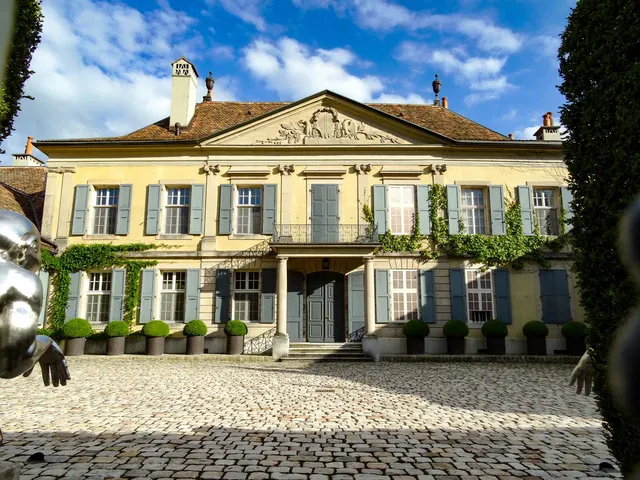
The château you photograph has a secret: its silhouette is largely a 19th-century invention. In 1838, a childless Hamburg diplomat named Vincent Rumpff removed the pediment and added two trapezoidal towers covered in blue slate, an architectural provocation in a region where terracotta tile rules every roofline.
And then there is the family saga. The Rolaz family held the estate from 1608 to the late 18th century, but their fertility kept shattering the inheritance into thirds of thirds of vine plots. Generation after generation, one member would ruin himself trying to reunite the whole—a cycle that ended only in the 20th century with a winegrower who bought the château and never slept upstairs.
What to see
-
The Blue Slate Towers
Look up before you even reach the gate. Two trapezoidal towers rise out of a prim white facade, clad in bluish slate that has no business being here—every nearby roof in La Côte glows with terracotta tile. That was exactly the point, or the nostalgia, of Vincent Rumpff, the Hamburg ambassador who bought the domain in 1835 and remade the manor three years later. Stand on the gravel path and you'll see the seam where smooth white render meets dark stacked slate; the towers taper as they climb, a Baltic memory grafted onto a Vaudois vineyard. -
The English Park and Bassin
The two-hectare English park behind the house is Rumpff's other foreign import. Cedars planted around 1838 now throw a deep, damp-green shade across the lawn, and a still bassin mirrors the white facade on windless afternoons. The estate had a rigid checkerboard garden in the late 1700s, all perpendicular alleys and a circular pond; Rumpff replaced that geometry with romantic, free-flowing calm. Follow the trunks to the southern edge—Lake Geneva opens below, the Alps hang beyond, and the whole place feels like a landscape painting a childless diplomat arranged for someone else's grandchildren. -
The Vineyard Walk and the Cellar
The real story here isn't the manor—it's the 9.4 hectares of vines wrapping the estate like a green apron. A land deed dated 994 records vines near a church to Saint Vincent on this slope—a thousand years of fermented patience, if the single source is right. Walk the rows in September, when the secateurs snap low and the air smells faintly of bruised grapes, then book a tasting at Cave Saint-Vincent. Guy and Emmanuel Rolaz pour their 2019 Chasselas, a mineral, gold-medal white from the 2020 Vaud selection that would probably have tasted familiar to the medieval vintners. For a darker contrast, the burned ruins of Vincy Castle sit close enough to remind you that this vineyard survived what its neighbour did not.
Plan your visit
- Getting There
- Reach Gilly in about 10 minutes from the Morges, Bussigny, or Cossonay motorway exits. Bus 730 from Morges station (13 minutes) stops in the village. The Chemin de Saint-Jacques pilgrimage trail passes through the vines and under the château's century-old park — the most atmospheric approach on foot.
- By Appointment Only
- Honest truth: the château itself is private and never opens to the public. The Cave Saint-Vincent wine cellar runs tastings by appointment only — call 021 824 17 53 or email [email protected]. As of 2026 there are no fixed shop hours, so book ahead rather than showing up.
- Time Needed
- Allow 45–60 minutes for a wine tasting in the carnotzet, including the vine-cycle explanation. Walking the pilgrimage path through the vineyards and under the park takes 1–2 hours. If you're just passing to photograph the slate towers from the road, 15 minutes suffices.
- Cost & Wine Prices
- No entry fee — you're paying for wine, not admission. The 2020 Grand Cru Chasselas runs CHF 11.65 for 75 cl, CHF 23 for a 140 cl Pot Vaudois. Pinot Noir starts at CHF 9 (50 cl). Le Carré Noir blend costs CHF 19. Tasting fees aren't published; confirm when booking.
History
The Vine Before the Château
Before there was a château, there was wine. A land deed from around 994—cited by the domaine, though not independently verified—records 279 perches of vines near a church dedicated to Saint Vincent, the patron saint of vintners. By 1172, records show Saint-Vincent as a dependency of the Cistercian Abbey of Bonmont, already described as a 'high and lordly house.'
The essential continuity is this: someone has pressed grapes on this slope for more than a millennium. The church is gone. The medieval manor has been reworked. But the vine rows still climb the same hillside, and the current growers, Guy and Emmanuel Rolaz, still bottle Chasselas under Saint Vincent's name.
The turning point
The Widower Who Built in Blue Slate
Vincent Rumpff was a Hamburg-born diplomat, ambassador of the Free Cities of Germany in Paris, and a widower with no children. When he bought the domaine in 1835, he was not acquiring an inheritance project. He was constructing a memory of himself.
In 1838 he made the gesture that still puzzles visitors: he removed the central pediment and added two trapezoidal towers covered in blue-grey slate. In the Vaud countryside, where terracotta tile still caps nearly every roof, this was architectural heresy. The Swiss Castles account asks, 'What? Slate here, in the land where the tile is queen of all roofs?'
Rumpff then tripled the estate from 46 to 150 poses vaudoises, planted a two-hectare English park with cedars, and dug a pond. At stake was not profit but permanence: a childless man determined to leave a visible mark on a slope that had no memory of him. The turning point came with those two towers—after 1838, Saint-Vincent could never again be mistaken for just another Vaudois manor.
What Changed
What Endured
Tips for visitors
Book the carnotzet
Tastings happen in the carnotzet — the traditional Swiss cellar bar — and cover both wine creation and the vine's yearly cycle. Call 021 824 17 53 at least a few days ahead; walk-ins usually find a locked door.Take the pilgrim's path
The Chemin de Saint-Jacques cuts through the vines and passes directly under the château's park with its 150-year-old cedars. It's a public right-of-way — the only way to legally get close to the estate.Don't cross the greenery
The Swiss heritage inventory describes the château as 'sealed off behind vegetative barriers.' The grounds beyond the pilgrimage path are private. Admire from the road or trail, not from someone's lawn.Spot the Hamburg folly
Those two trapezoidal towers wear blue-grey slate — an architectural scandal in a region where terracotta tile rules every roof. Hamburg diplomat Vincent Rumpff built them in 1838, importing a bit of northern Europe to the Vaudois slope.Buy the gold-medal vintage
The 2020 Grand Cru Chasselas won gold at the Sélection des Vins Vaudois. At CHF 11.65 a bottle, it's cheaper than most Swiss museum tickets — and you can drink the thousand-year history.Don't mix up your castles
Gilly has two châteaux: this one (Saint-Vincent) and Vincy Castle, a separate wine estate. And don't confuse either with Château de Vullierens — that's the one with public gardens and ticket booths, 10 km away.Avoid harvest traffic
September and October bring tractors and harvest trailers to the narrow vineyard roads around Gilly. Drive slowly, and if you're walking, step well aside — the harvest waits for no tourist.Pair with Vincy Castle
Vincy Castle sits in the same village and also operates as a wine estate. Its history is darker — the Bernese burned it during their conquest of the Vaud. See both in one afternoon.
Frequently asked
Is Château de Saint-Vincent worth visiting?
Yes, if you want a working Swiss wine estate rather than a furnished castle. The manor itself is private and screened by old trees, but the 1838 slate-covered towers, two-hectare English park, and 9.4-hectare vineyard make a strange and memorable stop. Book a tasting at Cave Saint-Vincent to make the detour pay.
Can you visit Château de Saint-Vincent for free?
You can't enter the château, but seeing it from public paths is free. The Chemin de Saint-Jacques runs through the vineyards and beneath the estate's park, so walkers get a legitimate view of the manor. Tastings at Cave Saint-Vincent are by appointment and may carry a fee.
How long do you need at Château de Saint-Vincent?
Allow 45–60 minutes for a tasting, plus 1–2 hours with the vineyard trails. The site isn't a room-by-room museum; your time goes into the exterior, the park, and a glass or two. A photo-and-bottle stop can be done in under an hour.
What should I not miss at Château de Saint-Vincent?
Look up at the two trapezoidal towers covered in blue-grey slate. They're a deliberate foreign note in a region of terracotta roofs. Then taste the Chasselas—the 2019 vintage won gold at the Sélection des Vins Vaudois in 2020.
How do I get to Château de Saint-Vincent from Geneva?
Driving takes roughly 35–45 minutes from Geneva. Take the A1 toward Lausanne and exit at Morges, Bussigny, or Cossonay; the estate is about 10 minutes from any of those exits. Public transport leaves you in Morges needing a bus or taxi to Gilly, so confirm the last mile before you set out.
What is the best time to visit Château de Saint-Vincent?
Go in September or October for harvest activity and the smell of ripe fruit in the vineyard. The vines flush gold and red, and the wine cellar feels most alive. Late spring or summer shows off the English-style park and the view toward Lake Geneva, but the manor stays a private backdrop year-round.
Can you go inside Château de Saint-Vincent?
No, the manor interior remains private and closed to visitors. You can walk the vineyard paths and the Chemin de Saint-Jacques around the park, and you can book a wine tasting at the on-site Cave Saint-Vincent SA. But there's no house tour or ticket hall.
Sources & attribution 6
- Swiss Castles: Château de Saint-Vincent — History of the property and owners, including the 1838 Rumpff renovation, blue-slate towers, English park, and 1968 sale.
- Swiss Castles: Château de Saint-Vincent (German) — German-language description of the manor as a high and stately house and its notable architectural features.
- Cave Saint-Vincent SA — Current wine estate contacts, tasting availability, and the 2020 Vaud wine gold medal result.
- La Côte Tourisme: Domaine St-Vincent Gilly — Visitor information: wine tasting in the carnotzet, location 10 minutes from three motorway exits, and walking paths.
- Schenk Wine: Château St-Vincent — Context on the 9.4-hectare vineyard and the around-year-1000 vine reference used in the estate's brand history.
- Federal Inventory of Swiss Heritage Sites (ISOS): Bursins — Inventory notes describing the estate as heavily wooded and sealed off behind vegetation, informing the privacy observations.
Built from cited sources · see the method · How we make our guides →
More in Gilly.
3 places to discover — a few worth pairing.
Pick up where you left off
Saved and recently read places — kept on this device only.