Beaulieu
GillySwitzerland 46° N · 6° E Updated Aug 2026
Behind locked gates above Gilly's vines, a Genevan banker's 1827 estate hides trompe-l'œil salons, Parisian marble-dust statues, and a doomed Greek friendship.
- Time needed
- 20–30 minutes (roadside view)
- Entry
- Free (view from road only)
- Access
- Roadside view only
- Best season
- Harvest (September–October)
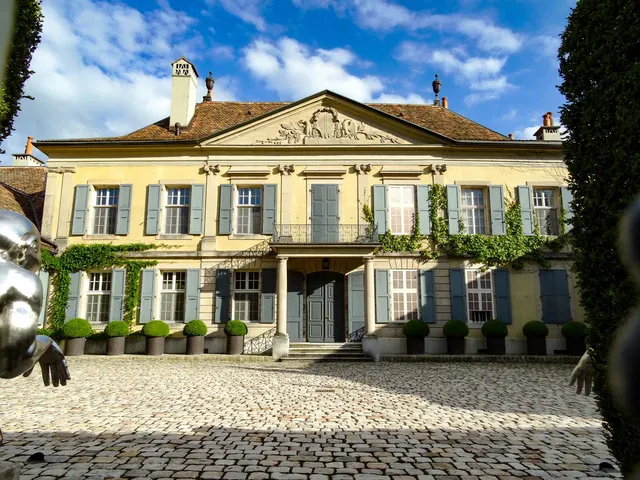
One hand of cards in a Paris salon nearly erased Beaulieu, a neoclassical estate in the vineyards of Gilly, Switzerland, from the Eynard family's ambitions. Come for the 1827 south facade with its Serlian arches and marble-dust statues, but stay for the quieter contradiction: this is a summer house that helped bankroll a Greek revolution. It is not a medieval fortress, however much the word château suggests one.
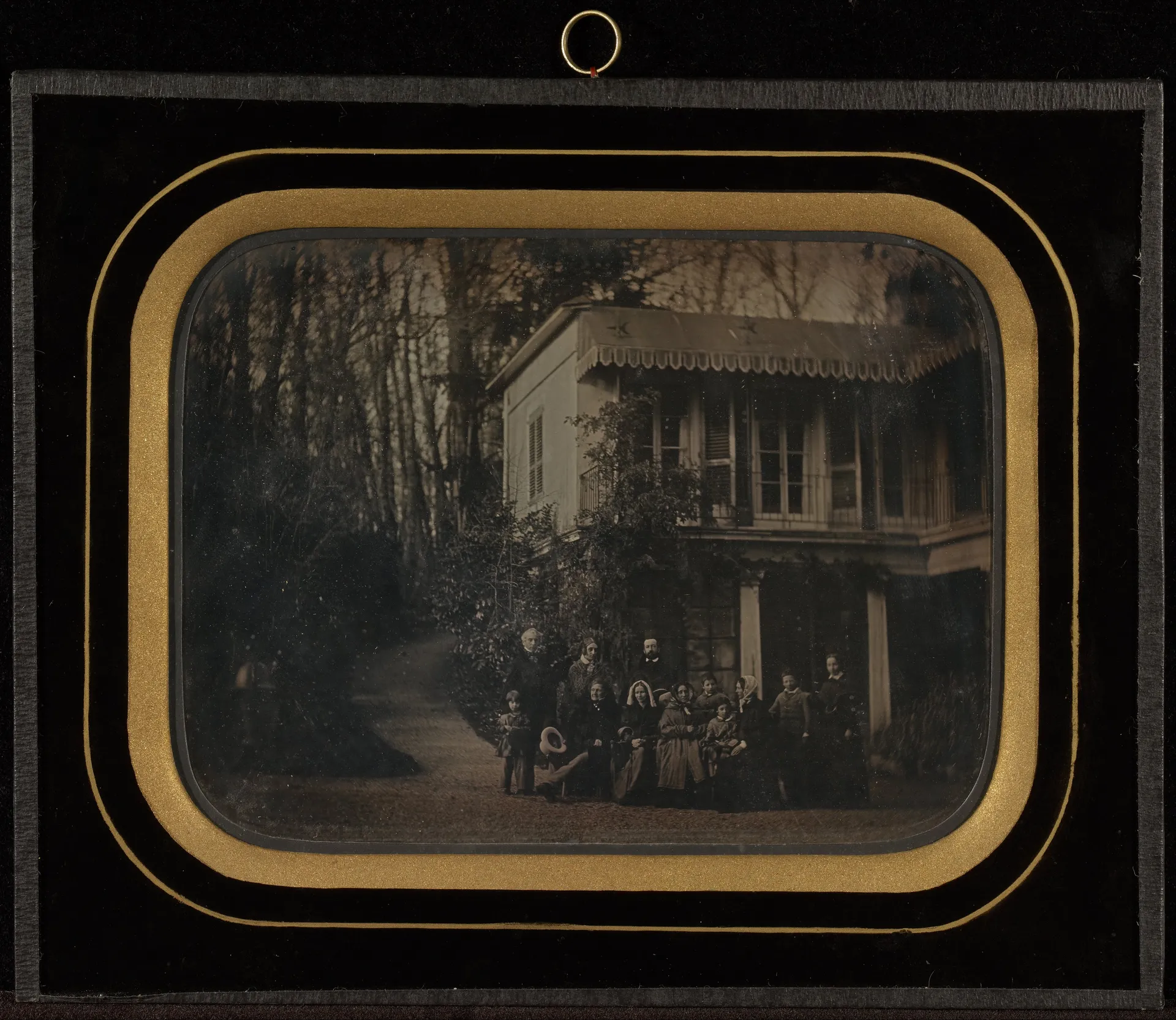
The name means 'beautiful place,' and cadastral maps record the Beau Lieu as early as 1754. But the building glimpsed from the public road is almost entirely the creation of one couple: Jean-Gabriel Eynard, a self-made Geneva banker, and his wife Anna Eynard-Lullin, who shaped the gardens and the social world around them.
Between 1808 and 1827, the estate grew from a modest rural house into a major work of Swiss neoclassicism. Architect Jean-Pierre Noblet raised a new main house in 1811, and Luigi Bagutti added the theatrical south wing in 1827 with Serlian bays and alternating statues set into niches.
Today Beaulieu remains a private residence and working wine estate. The facade is visible from the road; the trompe-l'œil rooms, friezes and original wallpapers are not, unless a heritage day or future guided tour opens the doors.
What to see
-
The 1827 south facade
Luigi Bagutti’s 1827 south front alternates Serlian windows—tripartite openings with a central arch—with niches holding figures cast from compressed marble dust, likely ordered from Paris. Genevan money wanted Parisian taste, and you can see that gravitational pull in every measured bay. Stand close and the statues stop reading as ornament and start reading as guests looking out over the vineyard slope. Bagutti, an Italo-Ticinese architect, understood light. Come in late afternoon when the limestone turns the color of warm parchment and the grisaille rooms beyond the glass go almost ghostly grey. -
The grisaille salons
Inside, Italian painters under Joseph Spampani—including young Milanese artists Jacques Soldi and Joseph Cinatti—covered the ceremonial rooms in grisaille, a monochrome grey painting so precise you may catch yourself reaching out to test whether the frieze is carved. It isn’t. That is the joke, and it still works two centuries later. David IV Balthasar Doret supplied the salon fireplaces. The parquet floors are described as exceptional, and some original wallpapers survived the 2015–17 restoration. The property remains private, so a full interior depends on luck or a special opening—but a glimpse through the south windows shows rooms that look like an engraving come to life. -
A slow loop through Anna’s garden and the outbuildings
Even the dovecote and aviary received neogothic touches—pointed little details on buildings made for pigeons and songbirds. Start at the old gates, pass the Gentilhommière that Eynard found here in 1808, then trace the path toward the orangery, the ice house, and the two pyres that give the garden a whisper of Arcadian melancholy. Anna Eynard-Lullin shaped this vast garden, though records stay frustratingly quiet about her planting schemes. That silence fits: you walk a designed landscape whose designer is known but whose choices remain private, with scent and birdsong doing the work documents never bothered to do.
Plan your visit
- Getting There
- Train to Rolle station (SBB line Lausanne–Geneva, about 10 minutes from Nyon), then bus 720 to 'Gilly, village' or a 35-minute walk (2.5 km). By car, exit the A1 at Rolle and follow signs to Gilly. Park in the village near the church or at Rolle station — there is no visitor parking at the estate itself.
- Opening Hours
- As of 2026, Beaulieu is a private residence with no regular public opening. The only reliable chance to enter is during the Journées européennes du patrimoine (European Heritage Days), usually the second weekend of September. The estate participated in 2023 and 2024 for exterior and garden visits only.
- Time Needed
- Allow 30–60 minutes to walk the gardens and study the façade from the road. If the interior opens during heritage days — a rare treat — budget 45–90 minutes. Most visits are exterior-only, so pair it with a stroll through Gilly's vineyards.
- Accessibility
- The estate grounds are not wheelchair accessible. Gravel paths and lawn areas make movement difficult, and the historic house has no public lifts or adapted routes. Contact the commune of Gilly (+41 21 828 20 00) ahead of heritage days for event-specific details.
- Cost & Tickets
- No general admission tickets exist — the estate is not a conventional museum. Entry during European Heritage Days is free, no booking required, but arrive early. Private events are arranged directly with the owners or the Association Beaulieu-Gilly.
History
The Banker's Beautiful Place
Jean-Gabriel Eynard was not born into the old Swiss gentry. He made a fortune in Paris and Italy, then spent it with the precision of a man who wanted every wall, statue and sightline to prove he had arrived.
In 1808 he bought the estate at Gilly with its modest older farmhouse, the Gentilhommière. Over the next nineteen years he transformed it into the Campagne de Beaulieu, a neoclassical monument in the Côte de Vaud vineyards.
The turning point
The Night the Estate Hung on a Card
According to the Dictionnaire historique de la Suisse, Jean-Gabriel Eynard once gambled recklessly in a Paris salon and lost a sum so vast that Beaulieu itself seemed forfeit. Creditors circled. Word spread that the new Swiss estate would have to be sold.
The next morning, Eynard returned to his creditor's table and produced a cashier's check for the entire amount. The gamble, it turned out, had been theater backed by reserves.
For Eynard, the stake was not just money. It was the physical proof of his rise: a country seat he had commissioned beside the old farmhouse. Beaulieu survived that hand, and with it survived the rooms where Greek revolutionaries would later be received and financed.
Early Life & Vision
Legacy & Influence
Tips for visitors
No Interior Photos
Photographing the façade from the public road is fine under Swiss law, but interior photography is prohibited even during open days. Personal garden photos are allowed during heritage events; commercial shoots and drones require prior owner authorization.Eat at Auberge de Gilly
Auberge de Gilly in the village serves entrecôte and magret de canard (CHF 25–45 mains) — go Sunday noon to see winemakers and pétanque players together. For a splurge, L'Ambio in Rolle (3 km) earns 4.8 stars on TripAdvisor.September Is Everything
Plan around the second weekend of September for European Heritage Days — the only reliable public access. Harvest (vendanges) runs September–October, when the whole village is in the vines and you can smell the grapes from the road.Respect the Gates
Beaulieu is someone's home. The façade is visible from Route de Beaulieu, but do not climb fences, enter the grounds, or walk through the vineyard rows — all private property. The municipality has 16 dog-waste bins; use them.Fire Ban in Force
A total fire ban is in force across the canton of Vaud as of summer 2026 — no open fires, no fireworks, no grills. Drought restrictions also limit water use. Check gilly.ch before your visit.Don't Say 'Beaulieu' in Lausanne
In Gilly, 'Beaulieu' means this estate. In Lausanne, it means the Palais de Beaulieu convention centre. In Geneva, something else entirely. Say 'Campagne de Beaulieu' or 'the Eynard estate' to avoid confusion.Drink the Réserve Communale
Gilly's municipal wine selection includes Chasselas and Merlot in 50cl bottles. Order a glass at Auberge de Gilly — it's the taste of the same vines that surround the estate.
Frequently asked
Is Beaulieu in Gilly worth visiting?
Yes, if you're near Rolle and interested in neoclassical architecture—but expect a roadside view, not a walk-up attraction. The privately owned estate rarely opens. Your main view is the 1827 south façade by Luigi Bagutti, with Serlian windows alternating with statues—one of the sharpest compositions in the La Côte wine country.
How long do you need at Beaulieu?
Allow 15 to 30 minutes for an exterior look from the road. If you get into the garden or house during a European Heritage Days opening, plan for 45 to 90 minutes. The estate has no regular visitor circuit—it's still a private home.
How do I get to Beaulieu from Rolle?
Take bus 720 from Rolle station toward Gilly, get off at Gilly village, and follow signs for Beaulieu–Domaine Eynard. The estate sits about 2.5 km from Rolle, so walking takes roughly 35 minutes. By car, leave the A1 at Rolle, follow signs to Gilly, and park in the village—the estate has no public lot.
What is the best time to visit Beaulieu?
September, during European Heritage Days, is the most reliable time because the estate sometimes opens its grounds or, on rare occasions, the house. For roadside viewing, early morning or late afternoon in autumn gives raking light across the 1827 statues and Serlian windows. Check the Heritage Days program for Gilly before making the trip.
Can you visit Beaulieu for free?
Yes, when the estate opens for European Heritage Days, entry is usually free. Outside those rare open days, you cannot buy a ticket—it's a private house with no regular public access. Viewing the façade from Route de Beaulieu costs nothing and stays legal.
Is Beaulieu open to the public?
No, Beaulieu in Gilly is a private residence with no regular public opening hours. It may open for European Heritage Days in September, sometimes only the garden and exterior. Check the Heritage Days program for Gilly and don't enter the grounds outside an official day.
What should I not miss at Beaulieu?
Look for the 1827 south façade by Luigi Bagutti—Serlian windows ranked between statues make the defining image of the estate. Inside, if you ever get in, the grisaille state rooms look carved but are flat paint; don't mistake them for relief. Out in the park, the ice house, aviary, and old dovecote carry the older working rhythm of the place. The pre-Eynard Gentilhommière still stands and is easy to overlook.
Sources & attribution 16
- French Wikipedia – Campagne de Beaulieu — Construction chronology: 1808 purchase, 1811 main house by Jean-Pierre Noblet, 1827 Bagutti wing, Anna Eynard-Lullin's garden role, grisaille interiors, Bartolini sculptures, private status.
- Burrus Nussbaumer – Château de Beaulieu — 2015–17 restoration details, 1819 enlargement, trompe-l'œil frescoes, parquet floors, and original wallpapers.
- Wikidata – Q2935353 (Campagne de Beaulieu) — Estate component list: gates, two pyres, annexes, orangery, aviary, old dovecote, and ice house.
- Bibliothèque de Genève – Eynard chronology — Jean-Gabriel Eynard's dates, the 27 July 1808 purchase, and his photography pioneer background.
- Heritage Days Switzerland — European Heritage Days program and dates, the main realistic public access route.
- Commune de Gilly – Communication et agenda — Local events, road closures, water and fire restrictions, and village administrative contacts.
- La Côte – Jean-Paul Liardet rachète le château de Beaulieu — 2023 purchase by composer Jean-Paul Liardet and current private ownership of the estate.
- Wikimedia Commons – Category:Campagne de Beaulieu (Gilly VD) — Address, photographic documentation, and Swiss cultural property of national significance classification.
- Historical Dictionary of Switzerland – Gilly — Older village history, Romainmôtier landholdings, and the Château de la Motte destroyed in 1292.
- FAOV – Gilly — Local municipality profile and wine-village context.
- TripAdvisor – Gilly — Regional wine tourism context and vineyard listings around Gilly.
- Le Temps – Jean-Gabriel Eynard et le soutien de Genève à la Grèce — Eynard's role in Greek independence and the political life connected to the estate.
- English Wikipedia – Gilly — Population, commune structure, and geography near Lake Geneva.
- Auberge de Gilly — Official village restaurant site with local cuisine and opening information.
- Switzerland Tourism – Auberge communale de Gilly — Regional dining recommendation for Gilly village.
- Bibliothèque de Genève – Vaud, vues de Gilly et Beaulieu — Anna Eynard-Lullin's funding of Gilly's kindergarten school in 1839–1841 and related views.
Built from cited sources · see the method · How we make our guides →
More in Gilly.
3 places to discover — a few worth pairing.

Pick up where you left off
Saved and recently read places — kept on this device only.