Introduction
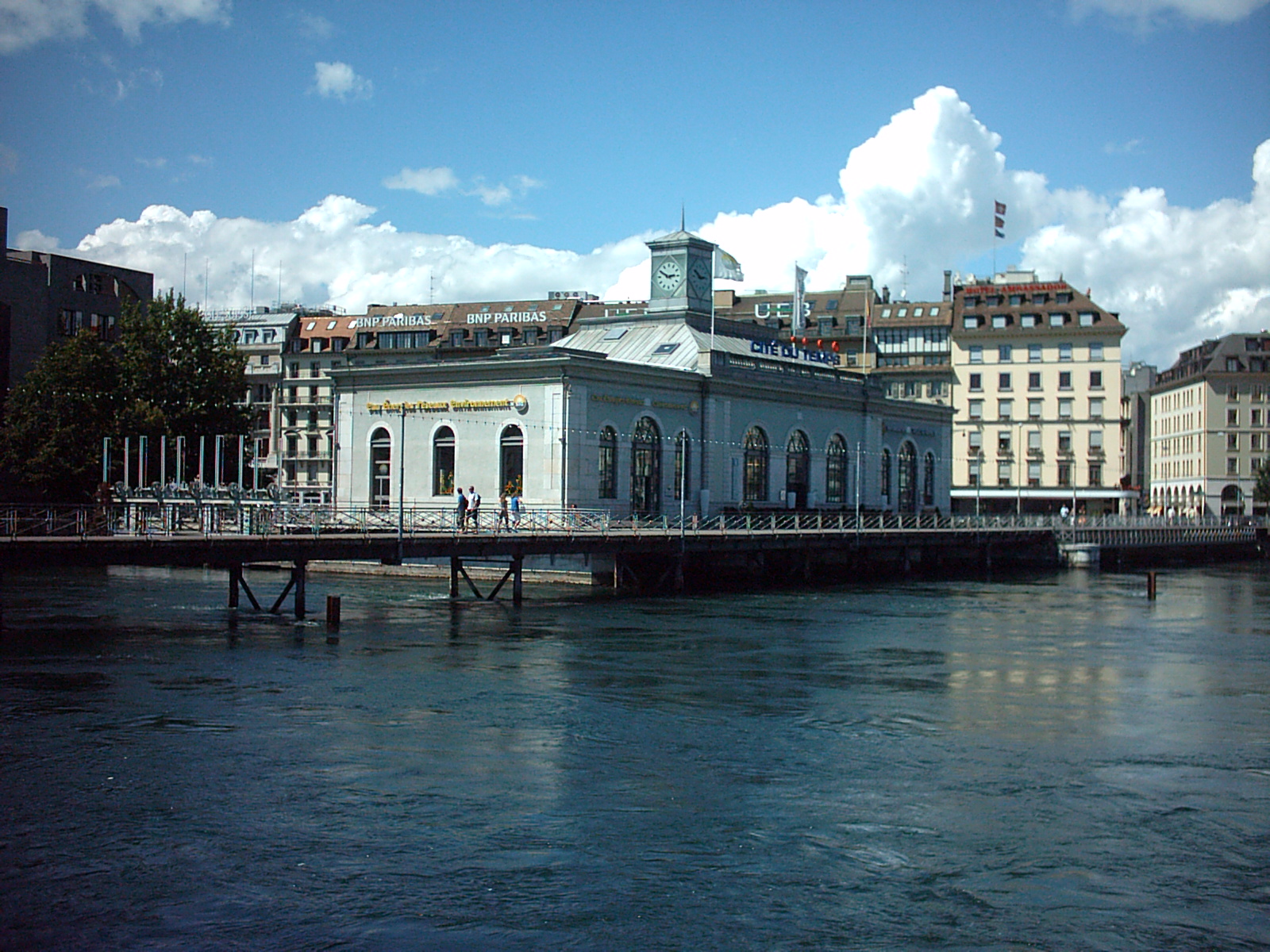
Rising at the heart of Geneva, where the Rhône River meets the city center, the Pont de la Machine is more than a bridge—it's a living testament to Geneva’s industrial ingenuity, architectural evolution, and vibrant cultural life. Originally constructed in the 18th century as a hydraulic pumping station, it has been transformed into a dynamic urban hub that blends historical significance with contemporary exhibitions and watchmaking heritage. Whether you’re a history buff, an architecture enthusiast, or a traveler seeking the best of Geneva’s attractions, this guide provides everything you need to plan your visit: from opening hours and ticket details to accessibility, highlights, and nearby sights. For further planning, refer to official resources such as Wikipedia, the Geneva tourism portal, and the Watches and Wonders Geneva Foundation.
Early Origins (1709–1840s)
The origins of the Pont de la Machine are tied to Geneva’s early efforts at water management and urban modernization. In 1709, Joseph Abeille, a pioneering French engineer, designed the first hydraulic machine to pump water from the Rhône to the city’s fountains (Wikipedia). This marked a leap in public infrastructure, with a dam built from rockfill and wooden piles. By 1770, a similar installation on the right bank enhanced water flow control.
By 1841, Jean-Marie Cordier introduced a more advanced hydraulic machine. Sitting on an island in the Rhône and accessible by a wooden footbridge, this system met the water needs of a growing Geneva (Wikipedia).
Industrial Transformation (1840s–1880s)
The present Pont de la Machine took shape in the early 1840s as part of the new pumping station, which began operation in 1843. A pedestrian footbridge followed in 1844, symbolizing Geneva’s industrial progress (geneva.info). By 1886, the station was converted into Geneva’s first hydroelectric power plant, illuminating the city and marking a milestone in Swiss electrification (Wikipedia).
Engineering Challenges and Legal Disputes
The dams and infrastructure raised lake levels and altered regional hydrology, leading to disputes between the cantons of Vaud and Geneva. The conflict reached the Swiss Federal Tribunal (1877–1884) and concluded with an 1884 international convention that established new water management protocols (Wikipedia).
Architectural Evolution and Preservation
The bridge underwent substantial modifications in the late 19th century to better manage water flow. The Rhône was divided into two watertight channels, prompting reconstructions in 1884 and 1887. An iron framework and wooden deck with asphalt provided increased durability and load capacity. The dam featured 39 larch-wood sluice gates, capable of retaining water up to 3.3 meters high (Wikipedia).
Despite changes, the Pont de la Machine remains the oldest urban structure over the Rhône, never having been completely rebuilt. When the Seujet Dam assumed regulatory duties in 1995, the original dam was dismantled, but the bridge’s architectural heritage was preserved through careful restoration (geneva.info).
Adaptive Reuse: Cultural Significance Today
After its industrial era ended, the Pont de la Machine was repurposed as a cultural venue, exemplifying Geneva’s approach to sustainable heritage conservation. The bridge now houses Quartier Libre SIG—a free exhibition space managed by Services Industriels de Genève (SIG)—and the Cité du Temps, which showcases permanent and rotating art and watchmaking exhibitions (SIG Geneva; La Cité du Temps). The space features:
- Art and design exhibitions
- Interactive watchmaking displays
- A tourist information center
- A riverside café/restaurant
Restoration works (2007–2009) preserved the bridge’s heritage using traditional techniques such as hand-driven hot rivets, while adding modern amenities like access ramps and a panoramic platform over the water (Wikipedia).
Geneva’s Watchmaking Heritage at Pont de la Machine
Pont de la Machine is home to the Watches and Wonders Geneva Foundation (WWGF), founded in 2022 by Rolex, Richemont, and Patek Philippe (Watches and Wonders). The foundation’s annual Watches and Wonders event transforms the bridge and surrounding venues into an international showcase for Swiss horology. Highlights include:
- Time Design: An exhibition of over a hundred remarkable timepieces spanning centuries (geneva-expats.ch)
- Guided tours and interactive workshops
- “Watchmaking Village” during Watches and Wonders, featuring free public activities (watchesandwonders.com)
This ongoing commitment cements Geneva’s status as a global capital of fine watchmaking.
Visiting Information: Hours, Tickets, and Accessibility
Opening Hours
- Bridge: Open to pedestrians 24/7, year-round.
- Quartier Libre SIG / Cité du Temps: Generally open Tuesday to Sunday, 10:00 AM – 6:00 PM. Closed on Mondays and some holidays. Confirm up-to-date hours on the SIG Geneva website or La Cité du Temps.
Admission
- Bridge: Free access at all times.
- Exhibitions: Entry to the Quartier Libre SIG and most Cité du Temps exhibitions is free; some special events may require tickets. Check details online or at the ticket desk.
Accessibility
- Fully accessible for wheelchair users, with ramps and adapted restrooms.
- Induction loop systems for hearing-impaired visitors.
- Staff assistance available on request.
Guided Tours
- Guided tours may be arranged, especially during major events like Watches and Wonders. Advance booking is recommended.
Nearby Attractions and Practical Tips
Getting There
- Location: Pont de la Machine, 1204 Geneva, Switzerland.
- Public Transport: Tram and bus stops “Bel-Air” and “Molard” are within a 3-minute walk. Cornavin Main Station is a 10-minute walk away.
- By Foot/Bike: Easy pedestrian and cycle access from both banks.
What to See and Do
- Fil du Rhône Platform: A scenic wooden deck for river views and relaxation (geneve.ch)
- Shopping: Steps from the Rues Basses district, Geneva’s premier shopping area
- Dining: Numerous cafés and restaurants nearby serve Swiss and international cuisine
- Water Taxis: Mouettes Genevoises water taxis depart just downstream (Mouettes Genevoises)
Best Times to Visit
- Early mornings: Tranquil for photography
- Evenings: Illuminated cityscape and romantic ambiance
- During events: Lively atmosphere, but expect larger crowds
Practical Tips
- Most shops accept credit cards and Swiss francs; some take euros.
- Public restrooms and water fountains are nearby.
- French is the main language, but English is widely spoken in tourist areas.
Frequently Asked Questions (FAQ)
Q: What are the Pont de la Machine visiting hours?
A: The bridge is open 24/7. Exhibition spaces are usually open Tuesday to Sunday, 10:00–18:00.
Q: Is there an entrance fee?
A: Access to the bridge and most exhibitions is free. Some special exhibitions may require tickets.
Q: Is the site accessible for people with disabilities?
A: Yes, including ramps, accessible restrooms, and hearing assistance systems.
Q: Are guided tours available?
A: Yes, especially during major events or by arrangement.
Q: How do I reach Pont de la Machine by public transport?
A: Use tram or bus to “Bel-Air” or “Molard”; the bridge is a short walk from either stop.
Q: Can I take photographs?
A: Yes, but please respect exhibition rules and private events.
Listen to the full story in the app
Your Personal Curator, in Your Pocket.
Audio guides for 1,100+ cities across 96 countries. History, stories, and local insight — offline ready.
Audiala App
Available on iOS & Android
Join 50k+ Curators
Sources
- verified
- verified
- verified
- verified
- verified
- verified
- verified
- verified
Last reviewed: