Introduction
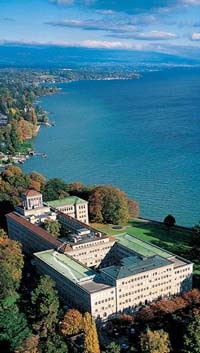
Every tariff on every product crossing every border on Earth traces back to negotiations inside this lakeside building. Centre William Rappard, on Geneva's southern shore in Switzerland, has housed the machinery of global trade since 1947 — first as the secretariat of GATT, then its successor, the World Trade Organization. The neoclassical facade could pass for a Florentine villa on holiday by Lake Geneva, but behind it, delegates from 164 nations argue over decimal points that determine whether your coffee costs three dollars or five.
The building opened on 6 June 1926 — the first structure in Geneva purpose-built for an international organization. Swiss architect George Epitaux won the commission over 67 competitors with an unusual constraint: preserve the existing lakeside trees. He bent his floor plan around them, and a century later, those same trees still frame the entrance.
Inside, the corridors double as a gallery of interwar idealism. Portuguese azulejo tiles by Jorge Colaço date to 1928, Maurice Denis contributed a mural called "The Dignity of Labour" in 1931, and Gustave-Louis Jaulmes painted the Salle des Pas Perdus in 1940 — each one the work of a world trying to talk its way to peace. Give or take, that's still the project underway upstairs.
You won't stumble across it by accident. The building sits on Rue de Lausanne behind security that reflects its current tenant, but the grounds and periodic open days reveal a place where the twentieth century's faith in institutions remains visible in the stonework, the murals, and the oak-paneled rooms where disputes worth billions are settled over bad coffee.
What to See
The Neoclassical Facade and Lakeside Grounds
George Epitaux won a competition against 67 other architects in 1923, and his brief came with an unusual constraint: don't touch the trees. The result is a building that bends to nature rather than bulldozing it, a Beaux-Arts facade inspired by Florentine villas that wraps around mature lakeside plantings older than the League of Nations itself. Stand at the Rue de Lausanne entrance and the symmetry feels almost governmental in its confidence — pale stone, tall windows, classical proportions stretching roughly 120 meters along the shore, longer than a football pitch. Walk around to the lake side and the mood shifts entirely. The gardens slope toward Lac Léman with a gentleness that makes you forget this is the headquarters of an organization governing 98% of world trade. A villa from 1785 still sits on the property, now a Montessori school, quietly predating everything around it by more than a century.


The Murals and Portuguese Tile Panels
The interior of the Centre William Rappard functions as an accidental gallery of interwar idealism. Jorge Colaço's azulejo tile panels, installed in 1928, line the walls with blue-and-white scenes of labor and industry — the same artist who decorated São Bento railway station in Porto, working here in a language of Portuguese craftsmanship for a Swiss international building. Three years later, Maurice Denis added "The Dignity of Labour," a mural cycle whose soft post-Impressionist palette feels almost devotional. Then in 1940, Gustave-Louis Jaulmes painted the Salle des Pas Perdus, the ceremonial hall where footsteps echo off marble in a way that makes whispered conversations carry. One painting didn't survive the building's evolution: "In GATT We Trust" was permanently removed in October 2019 after staff objections to its depictions of women. The absence says as much about the building's living politics as the surviving art does about its origins.
A Lakeside Walk Through International Geneva
Centre William Rappard doesn't exist in isolation — it anchors the eastern stretch of Geneva's international quarter along the lake. Start at the WTO building, where a small park named after William Rappard himself opens onto the water. The man was born in New York in 1883 to Swiss parents, graduated Harvard, then personally convinced Woodrow Wilson to place the League of Nations in Geneva rather than Brussels. He co-founded the Graduate Institute in 1927 and gave the opening address at the 1947 Mont Pelerin Conference, where modern free-market economics was born. From the park, walk west along Quai du Mont-Blanc toward the Palais Wilson, the original League of Nations headquarters less than a kilometer away. The 2008–2013 extension by Group8 architects and Jens Wittfoht — a CHF 130 million project approved by Geneva voters in a 2009 referendum — is visible from the path, its contemporary glass and steel making no apology next to Epitaux's 1926 stone. Two buildings, two centuries of architectural conviction, separated by a ten-minute stroll along water so clear you can count the stones on the bottom.

Look for the Portuguese azulejo tile panels installed in 1928 by Jorge Colaço — a surprising burst of Iberian blue-and-white narrative tilework inside a Swiss neoclassical building. They line interior corridors and are easy to miss if you're focused on the grand ceremonial rooms.
Visitor Logistics
Getting There
The Centre William Rappard sits on Rue de Lausanne 154, right on Lake Geneva's western shore. Tram 15 to the Nations stop puts you about a 5-minute walk away; bus 8 (Sécheron) is even closer. From Cornavin station, it's a 20-minute lakeside walk heading north — pleasant enough to count as sightseeing.
Opening Hours
As of 2026, the Centre William Rappard is the working headquarters of the WTO and is not open for casual walk-in visits. Guided tours run on select dates and must be booked in advance through the WTO's official website. The exterior, lakeside grounds, and surrounding park are accessible during daylight hours.
Time Needed
A guided tour of the interior takes about 60–90 minutes and covers the original Beaux-Arts halls, the Portuguese tile panels, and the 2013 extension by Group8. If you're only walking the exterior and grounds, allow 20–30 minutes to circle the building and take in the lake views. Pair it with nearby Ariana Museum or the Palais des Nations for a full International Geneva half-day.
Security & Access
This is an active international organization headquarters — bring a valid passport or national ID, not just a photocopy. Bags go through airport-style screening. Pre-registration is required; showing up unannounced will get you a polite but firm refusal at the gate.
Tips for Visitors
Photography Rules
Exterior photography is unrestricted, and the neoclassical lakeside façade photographs best in morning light when the sun hits the stone directly. Inside, photography during guided tours is generally permitted in the historic halls but forbidden in active meeting rooms — your guide will specify where.
Dress Smart-Casual
This is a working diplomatic building, not a museum. Flip-flops and beachwear will look conspicuously out of place among WTO delegates. Smart-casual is the minimum — think of it as dressing for a business lunch rather than a cathedral.
Find the Colaço Tiles
The 1928 Portuguese azulejo tile panels by Jorge Colaço are the interior highlight most visitors miss on a quick tour. These hand-painted panels depict global trade and labour scenes — the same artist tiled Lisbon's São Bento Palace. Ask your guide to linger here.
Eat Nearby
Café du Soleil in Petit-Saconnex (15 minutes by bus) serves what many locals consider Geneva's best fondue — budget CHF 30–35 per person. For something quicker, the WTO cafeteria is occasionally accessible to tour visitors and offers surprisingly decent lakeside lunch at institutional prices.
Combine with Palais
The Palais des Nations is a 10-minute walk north along the same lakeside stretch. Book both tours on the same morning to build a full picture of International Geneva — the CWR predates the Palais by a decade, and seeing them in chronological order makes the architectural evolution click.
Best Time to Visit
Spring and early autumn offer the clearest views across the lake to Mont Blanc from the CWR grounds. Avoid mid-December through January, when WTO ministerial schedules and holiday closures make tour availability unpredictable.
Historical Context
One Table, One Hundred Years
Since 1926, Centre William Rappard has done exactly one thing: given nations a room in which to sit across from each other. The occupants changed — the ILO gave way to GATT in 1947, which gave way to the WTO in 1995 — but the function never did. For a full century, diplomats have walked the same corridors to argue over rules that bind sovereign states, while the lakeside trees Epitaux was ordered to preserve still shade the windows.
Geneva's international quarter has grown enormously since the 1920s, sprouting glass towers and modernist campuses. Centre William Rappard remains neoclassical, deliberately rooted, its stone facade a quiet argument that the institutions inside are meant to outlast their occupants.
The Swiss-Born New Yorker Who Gave Geneva Its Destiny
William Rappard was born in New York in 1883 to Swiss parents — though the WTO's own website lists his birth year as 1887, a discrepancy no one has publicly reconciled. He returned to Switzerland at seventeen, earned his degree at Harvard by 1908, and became what historian Susan Pedersen described as a man who "looked like a Swiss farmer" but moved through diplomatic circles in three languages without breaking stride.
In 1920, Rappard faced the task that would define both his career and his city: persuading Woodrow Wilson to choose Geneva as the seat of the League of Nations. Brussels, The Hague, and several Swiss cities lobbied hard, but Rappard argued that Geneva's neutrality and compactness made it the natural home for a body meant to prevent another war. Wilson agreed — and that single decision transformed Geneva from a prosperous lakeside city into the capital of international cooperation.
Rappard co-founded the Graduate Institute of International Studies in 1927 and delivered the opening address at the 1947 Mont Pelerin Conference, the gathering that launched modern free-market economic thought. When the ILO vacated the building in 1975, there was only one serious candidate for its new name. A park and a road in Geneva also bear it, but the building is the monument that matters.
What Changed
The tenants rotated: the ILO departed in 1975, GATT's secretariat moved in two years later alongside UNHCR, and the WTO replaced GATT in 1995. Between 2008 and 2013, a CHF 130 million renovation by Geneva's Group8 and Stuttgart architect Jens Wittfoht reshaped the interior, while earlier additions — a 1937 north wing, a 1998 conference center by Ugo Brunoni — had already altered Epitaux's original footprint. In October 2019, a painting titled "In GATT We Trust" was permanently removed after MeToo-era staff objections to its depictions, a reminder that even institutional art must answer to the people who work beneath it.
What Endured
The mission stayed constant: bring nations to one table and make them talk. The Colaço azulejo tiles from 1928, the Denis mural from 1931, and the lakeside trees that shaped the building's footprint in 1923 all remain — physical continuity matching the institutional kind. FIPOI, the joint foundation of the Swiss Confederation and Canton of Geneva, has managed the property since 1975, with the Confederation covering renovation costs and the Canton providing the land rent-free, an arrangement as durable as the building itself.
Listen to the full story in the app
Your Personal Curator, in Your Pocket.
Audio guides for 1,100+ cities across 96 countries. History, stories, and local insight — offline ready.
Audiala App
Available on iOS & Android
Join 50k+ Curators
Frequently Asked
Can you visit Centre William Rappard in Geneva? add
Not freely — the building is the World Trade Organization headquarters, so public access is restricted. Guided tours are occasionally offered during events like Geneva's Journées du Patrimoine (Heritage Days), and the WTO sometimes arranges group visits by request. The lakeside grounds and exterior, however, are visible from Quai Wilson and the surrounding public paths.
What is Centre William Rappard used for? add
It serves as the headquarters of the World Trade Organization, the body that replaced GATT in 1995. The building has housed international organizations since its inauguration in 1926, when it opened as the first purpose-built home for an international body in Geneva — originally the International Labour Office. A 2008–2013 renovation costing CHF 130 million expanded it with modern conference facilities designed by Group8 and Jens Wittfoht.
Who was William Rappard? add
A Swiss-born academic and diplomat who convinced Woodrow Wilson to pick Geneva as the League of Nations seat in 1920. Born in New York in 1883 to Swiss parents, he studied at Harvard, spoke three languages without apparent effort, and co-founded the Graduate Institute of International Studies in 1927. He also opened the 1947 Mont Pelerin Conference — the meeting that launched modern free-market economic thought.
How do I get to Centre William Rappard from Geneva city centre? add
Walk along the right bank of Lake Geneva toward the Pâquis district — it takes about 15 minutes from Gare Cornavin. The building sits at 154 Rue de Lausanne, near the Jardin Botanique. Bus lines 1 and 25 stop nearby, and the lakefront promenade from the Bains des Pâquis makes it a pleasant approach on foot.
What art is inside Centre William Rappard? add
The building holds several works commissioned across its first two decades. Portuguese artist Jorge Colaço installed elaborate tile panels in 1928, and Maurice Denis added his mural "The Dignity of Labour" in 1931. Gustave-Louis Jaulmes painted murals in the Salle des Pas Perdus in 1940. One painting, "In GATT We Trust," was permanently removed in October 2019 after staff objections over its imagery.
Why is Centre William Rappard historically important? add
It was the first building in Geneva designed and constructed specifically for an international organization — a fact that still surprises people who assume the Palais des Nations holds that distinction. Inaugurated on 6 June 1926 for the International Labour Office, the neoclassical structure by Swiss architect George Epitaux predates the Palais by over a decade. Its design brief required preserving the lakeside trees, so the building was shaped around them rather than the other way round.
What happened during the Centre William Rappard renovation? add
A major renovation and extension ran from 2008 to 2013 at a cost of CHF 130 million — roughly the price of a mid-range Premier League footballer. The Swiss Confederation covered CHF 70 million outright; the remaining 60 million came as a 50-year interest-free loan from FIPOI, the Swiss-Genevan foundation that manages the property. Geneva voters approved the WTO expansion in a 2009 cantonal referendum with 61.8% in favor.
Sources
-
verified
Wikipedia — Centre William Rappard
Building history, timeline of occupants, 2009 referendum details, and removal of 'In GATT We Trust' painting
-
verified
WTO Official History Page
Construction background, GATT-to-WTO transition, and biographical details on William Rappard
-
verified
Geneve-int.ch (International Geneva portal)
Architectural competition details, tree-preservation brief, 2008–2013 renovation costs and architects (Group8, Jens Wittfoht)
-
verified
Springer (2023 academic publication)
Context on the 2019 removal of the 'In GATT We Trust' painting following MeToo-era complaints
-
verified
Wikipedia — William Rappard (biography)
Rappard's birth year discrepancy, Harvard education, role in persuading Wilson to choose Geneva, Mont Pelerin Conference involvement
Last reviewed: