Medieval Old Town intact
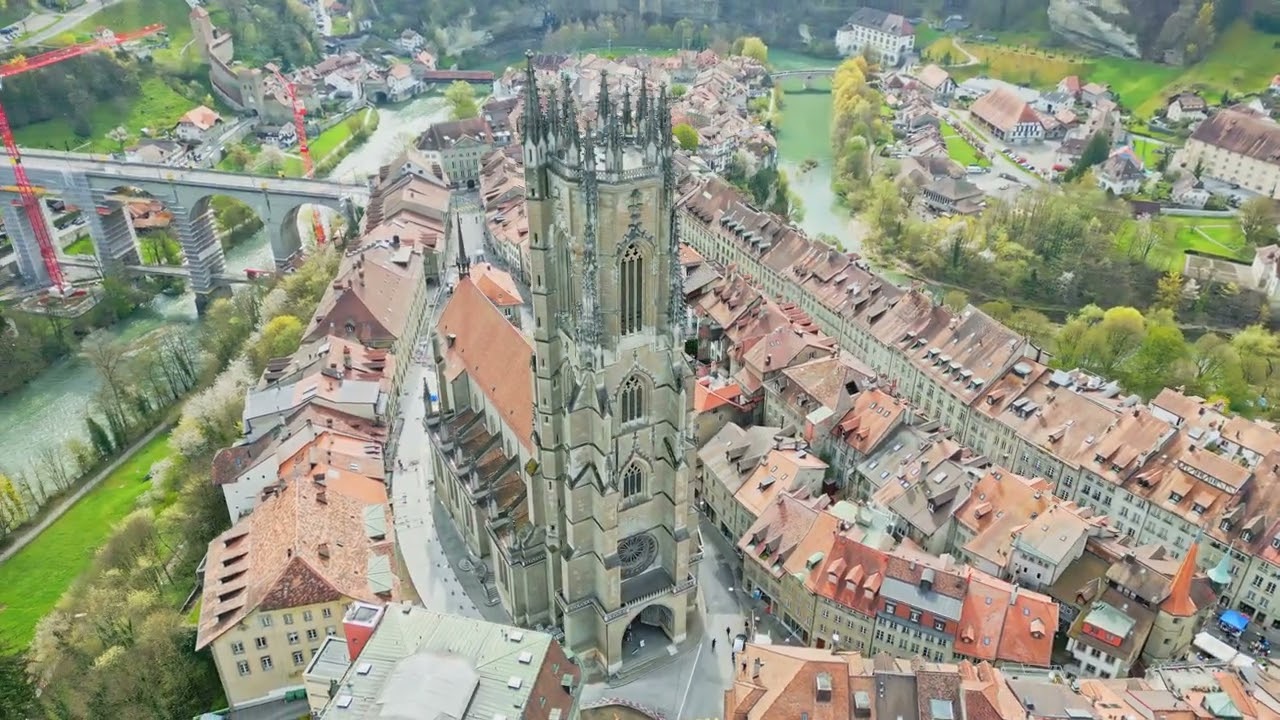
Over 200 Gothic facades line cobbled streets that drop down a sandstone peninsula carved by the Sarine. The Bourg and Basse-Ville feel less restored than simply unbothered by the centuries.
Fribourg, Switzerland, is a medieval town with 200 Gothic facades and a funicular that still runs on sewage water since 1899. The guide covers 21 attractions. The best season to visit is late spring (April–June), with an average visit duration of 1-2 days.
Fribourg is a city that speaks two languages on the same street, sometimes in the same sentence. Perched on a sandstone peninsula carved by the Sarine river, this Swiss medieval town sits exactly on the Röstigraben — the invisible frontier where French-speaking Switzerland meets the German-speaking half. Two hundred Gothic facades have stood here since the 1400s, give or take a restoration, and the funicular that climbs from the lower town still runs on wastewater. It has since 1899. No, really.
 Fribourg · Switzerland
Built from cited sources · see the method · How we make our guides →
FFribourg is a city that speaks two languages on the same street, sometimes in the same sentence. Perched on a sandstone peninsula carved by the Sarine river, this Swiss medieval town sits exactly on the Röstigraben — the invisible frontier where French-speaking Switzerland meets the German-speaking half. Two hundred Gothic facades have stood here since the 1400s, give or take a restoration, and the funicular that climbs from the lower town still runs on wastewater. It has since 1899. No, really.
The geography does most of the work. The Sarine loops around the old town in a tight hairpin, leaving the medieval core stranded on a rocky spur seventy meters above the water. Walk to almost any edge of the Bourg and you find yourself looking down into a green gorge, with the 74-meter spire of Saint-Nicholas Cathedral anchoring everything behind you. The Pont de Berne, the last covered wooden bridge in the city, still creaks under your feet the way it did under merchants hauling cloth in the fifteenth century.
Roughly two-thirds of the city speaks French, one-third German, and the bilingual reality shapes everything from bus announcements to bakery counters. You'll see Rue de Lausanne become Lausannegasse halfway down the hill. Menus list rösti next to fondue moitié-moitié without irony. The university — one of the few bilingual ones in Europe — keeps the place feeling younger and stranger than its Gothic skyline suggests.
What makes this place worth slowing down for.
Over 200 Gothic facades line cobbled streets that drop down a sandstone peninsula carved by the Sarine. The Bourg and Basse-Ville feel less restored than simply unbothered by the centuries.
The 74-meter Gothic tower took roughly two centuries to finish, from the 1280s into the 1490s. Climb the 365 steps for a view that runs from the river gorge to the Alps.
Fribourg sits exactly on the linguistic border between French and German Switzerland — about two-thirds Francophone, one-third Germanophone. Menus, street signs, and overheard conversation switch language mid-block.
The Funi has climbed between the upper Bourg and the Neuveville since 1899, counterweighted by tanks of sewage water from the old town above. It is the last funicular in Europe still running on the stuff.
Not every monument, just the ones we'd walk you past ourselves.

Nestled in the heart of Fribourg, Switzerland, the Cardinal Beer Museum offers visitors a remarkable journey through over two centuries of brewing heritage…

Nestled in the heart of Fribourg, Switzerland, the Cathédrale Saint-Nicolas, also known as Kathedrale Sankt Niklaus, stands as a Gothic masterpiece of immense…
Nestled in the picturesque city of Fribourg, Switzerland, the University of Fribourg stands as a unique bilingual academic landmark that beautifully marries…
Nestled in the historic heart of Fribourg, Switzerland, the Museum of Art and History (Musée d’Art et d’Histoire Fribourg, MAHF) stands as a beacon of…
Nestled within the University of Fribourg’s Miséricorde campus, the Bible and Orient Museum (Musée Bible+Orient) offers a profound and immersive exploration…
The Pont de Berne, also known as the Bernbrücke, is a historic wooden bridge located in the charming city of Fribourg, Switzerland.
Nestled on the scenic shores of Lake Neuchâtel, the Musée d’Art et d’Histoire Neuchâtel (MAHN) stands as a cultural beacon that beautifully intertwines the…
Where to wander, by quarter — each with its own rhythm.
The upper old town, sitting on the highest part of the sandstone spur. This is the postcard Fribourg: the cathedral, the Hôtel de Ville, the Place des Ormeaux, and the densest concentration of Gothic facades. Most of the cafés and bookshops worth your time are here, tucked behind doorways that look closed even when they aren't. Best explored on foot, ideally with no plan.
The lower town, down by the river, reached by the wastewater funicular or a steep walk down the Stalden. Houses press against the cliff, the Sarine runs cold beside them, and the Pont de Berne — the last covered wooden bridge in the city — crosses to the Auge quarter on the far bank. Quieter, more working-class historically, and where locals come to swim in summer.
The medieval quarter on the right bank of the Sarine, opposite the Neuveville. Cobbled, narrow, and almost entirely residential, with the Saint-Jean church and a handful of artisan workshops. The Pont du Milieu and the Pont de Berne both land here. Walk it at dusk when the streetlamps come on and the gorge fills with shadow.
East of the gorge, across the Pont de Zaehringen and the Pont de la Poya. Largely twentieth-century housing and the German-speaking centre of gravity in the city. Less picturesque than the old town but worth crossing for the views back at the medieval skyline — the Pont de la Poya gives you the best of them.
South of the centre, the university quarter. Wide boulevards, modernist faculty buildings, and the student cafés that keep the city's average age down. Boulevard de Pérolles is where Fribourg does its everyday shopping and eating, away from the tourist itineraries. Tram-like buses run frequently from the station.
The area around the train station, more functional than charming, but useful: hotels, supermarkets, and the launching point for any walk into the Old Town five minutes downhill. The Espace Jean Tinguely–Niki de Saint Phalle museum sits nearby, full of clattering kinetic sculptures by the Fribourg-born artist.
The people who shaped the city — and were shaped by it.
Tinguely grew up in the canton before fleeing its conservatism for Paris, where his self-destroying machines made him a giant of post-war art. He never quite forgave Fribourg, and Fribourg never quite forgave him back — yet the city now claims him proudly. His ironwork would feel right at home in the Sarine gorge today, all rust and racket against the Gothic quiet.
Where locals actually book dinner — not the tourist menus.
Small things that change how the city treats you.
The Funi has shuttled between the Bourg and Basse-Ville since 1899, counterweighted by wastewater — Europe's last of its kind. It runs in near silence and costs less than a coffee.
Fribourg straddles the Röstigraben. Start a sentence in French, finish in German, and locals barely blink. Menus and signs run bilingual, so either language gets you fed.
The lower town along the Sarine has the covered Pont de Berne, cheaper guesthouses, and morning mist rising off the gorge. The Funi or a steep ten-minute climb returns you to the Bourg.
The Cathedral of St. Nicholas tower charges a few francs for a view stretching from medieval rooftops to the Alps. Skip it on hazy days; the Poya Bridge gives a free, wider panorama.
Switzerland's longest cable-stayed bridge frames Gothic spires on one side and Alpine ridges on the other. Late afternoon light hits the sandstone facades and turns the gorge gold.
April and May bring open terraces, wildflowers along the Sarine, and no coach-tour crowds. July adds humidity to the gorge without much payoff.
A few films to set the scene before you go.

The city, as it actually looks.

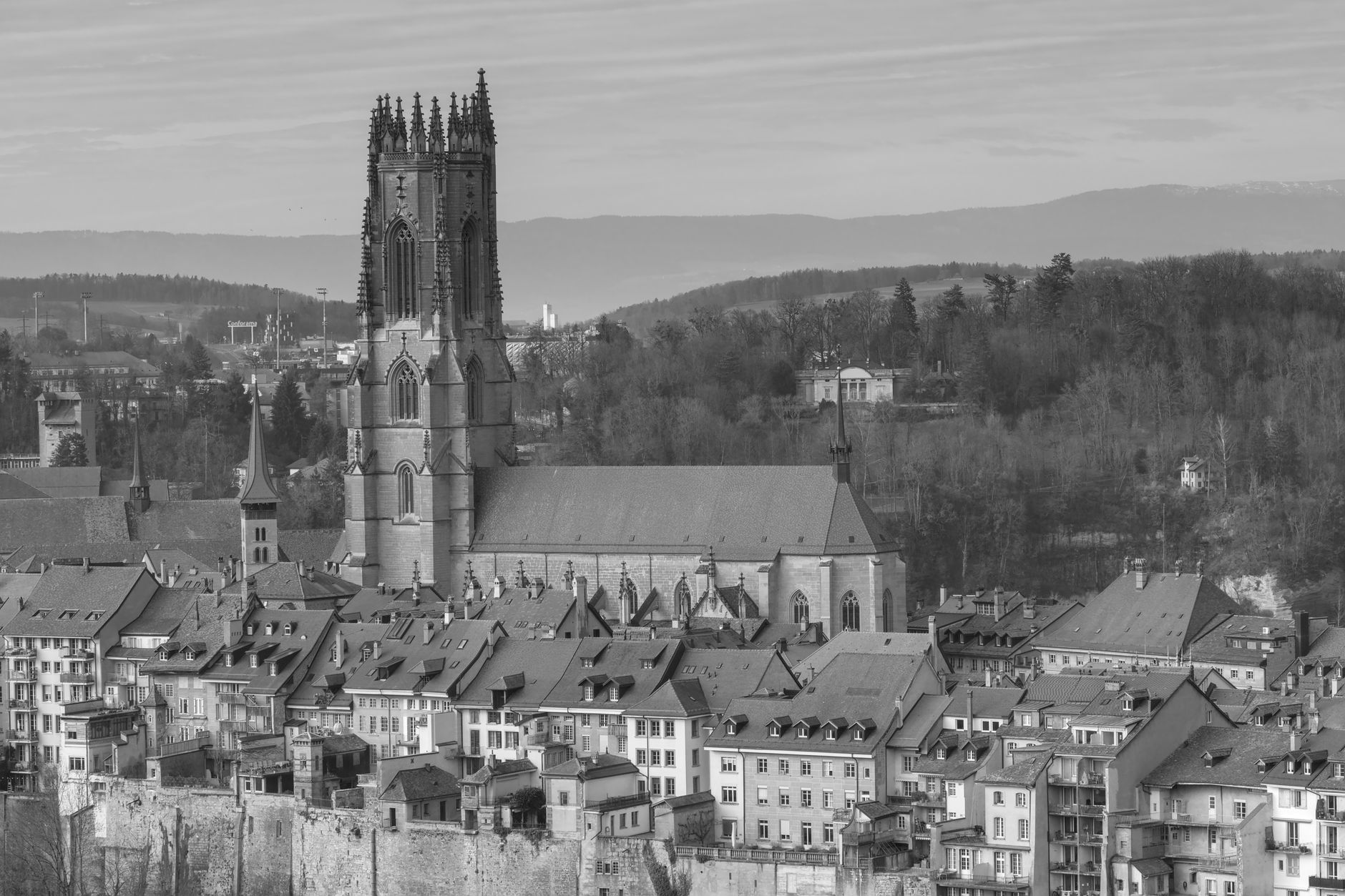
Fribourg’s Gothic cathedral rises above red-tiled roofs and pale stone houses, with wooded hills fading into the Swiss distance. The elevated view catches the city in cool, soft daylight.
Jean-Paul Wettstein on Pexels

Fribourg spreads across the Sarine valley, with its Gothic cathedral, tiled roofs, stone bridges, and wooded slopes layered into one steep cityscape. The clear daylight gives the old town's cliffs and rooftops sharp definition.
Jean-Paul Wettstein on Pexels

Fribourg's Gothic cathedral rises above the red roofs of the old town, with wooded cliffs and pale hills beyond. The elevated view shows the city's layered architecture in clear, soft daylight.
Jean-Paul Wettstein on Pexels
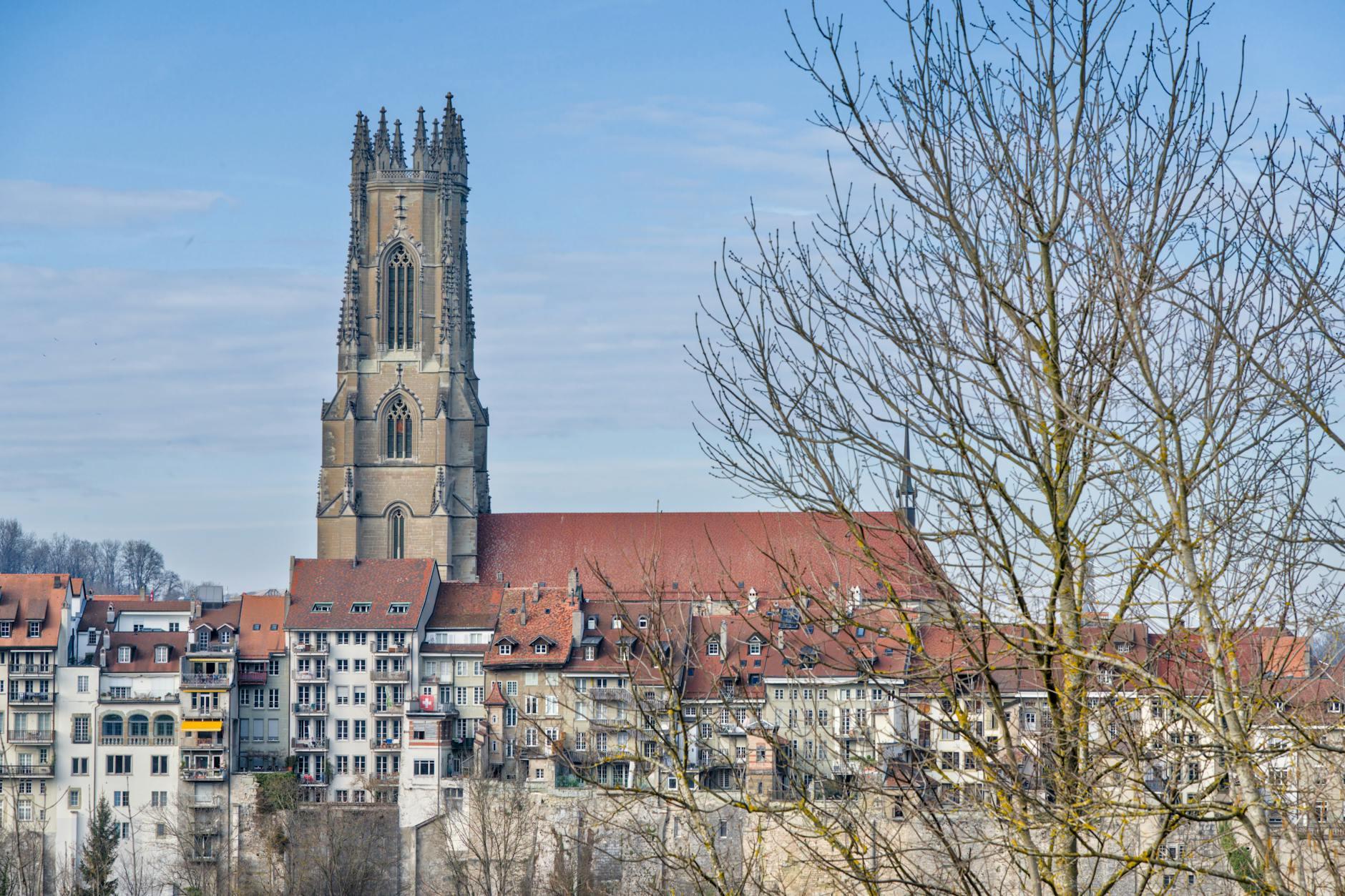
Fribourg’s old town rises along the hillside beneath a Gothic cathedral tower, with red roofs and pale facades catching the clear daylight. Bare winter branches frame the view across the city.
Jean-Paul Wettstein on Pexels

Fribourg's old town sits on steep cliffs above the river valley, with its Gothic cathedral rising over tiled roofs. Modern bridges and wooded hills frame the Swiss city in soft daylight.
Jean-Paul Wettstein on Pexels

Fribourg's old town rises above wooded cliffs, with the Gothic cathedral tower anchoring the skyline. A modern cable-stayed bridge cuts through the pale daylight behind the red-tiled roofs.
Jean-Paul Wettstein on Pexels
Yes — it holds one of Europe's largest intact medieval old towns, with 200-plus Gothic facades, covered wooden bridges, and a working 13th-century cathedral. Most Swiss itineraries skip it for Lucerne or Bern, which is precisely why it stays uncrowded. Plan it as a stop between Bern and Lausanne.
One full day covers the Old Town, the cathedral tower, and a Funi ride down to the Basse-Ville. Two days lets you add the art museums, a walk along the Sarine gorge, and a half-day trip to Gruyères. Beyond that, use it as a base for the Three-Lakes region.
Both French and German, officially. The city tips roughly two-thirds Francophone, but you'll see every street sign and menu in both languages. English works fine in hotels and restaurants; a 'bonjour' or 'grüezi' is appreciated either way.
Direct trains run roughly every 15-30 minutes and take about 22 minutes. The station sits a short walk from the upper Old Town. A Swiss Travel Pass or half-fare card covers the ride.
It's cheaper than Geneva, Zurich, or Lucerne but still Swiss-priced. A sit-down lunch runs 20-30 CHF, a beer 6-8 CHF, a mid-range hotel 140-200 CHF. Staying in the Basse-Ville and eating at café-restaurants rather than tourist spots near the cathedral noticeably softens the bill.
It's the funicular linking the upper Bourg to the lower Neuveville, in operation since 1899 and the last in Europe still powered by wastewater. The full counterweight tank fills with sewage water, then gravity does the rest. The ride lasts barely two minutes.
Late April through June and September are the sweet spots — mild weather, long evenings, and open terraces without summer crowds. Winter brings fog in the gorge but a quiet Old Town and Christmas markets. Avoid mid-August if you dislike heat trapped between the sandstone walls.
Ready to book?
No airport in Fribourg itself. Fly into Geneva (GVA) or Zürich (ZRH) and take the direct InterCity train — about 1h20 from Geneva, 1h10 from Zürich, all arriving at Fribourg/Freiburg station in the upper town. Bern is 22 minutes away, Lausanne 45. The A12 motorway links the city to Bern and Vevey.
The compact old town is best walked, though steep — wear real shoes. TPF runs the city buses and two trolleybus routes plus the historic Funi between Bourg and Basse-Ville. In 2026 a Fribourg Guest Card, issued free by hotels, covers all public transport within the city zone for the length of your stay.
Continental, with cold damp winters (-2 to 4°C, frequent fog in the gorge) and warm summers (18-26°C, occasional thunderstorms). May to early July and September deliver the best light on the sandstone facades and the thinnest crowds. July-August coincides with Swiss school holidays and the Belluard Bollwerk festival; February brings the Carnaval des Bolzes in the Basse-Ville.
21 places to discover