La Gordanne
FéchySwitzerland 46° N · 6° E Updated Aug 2026
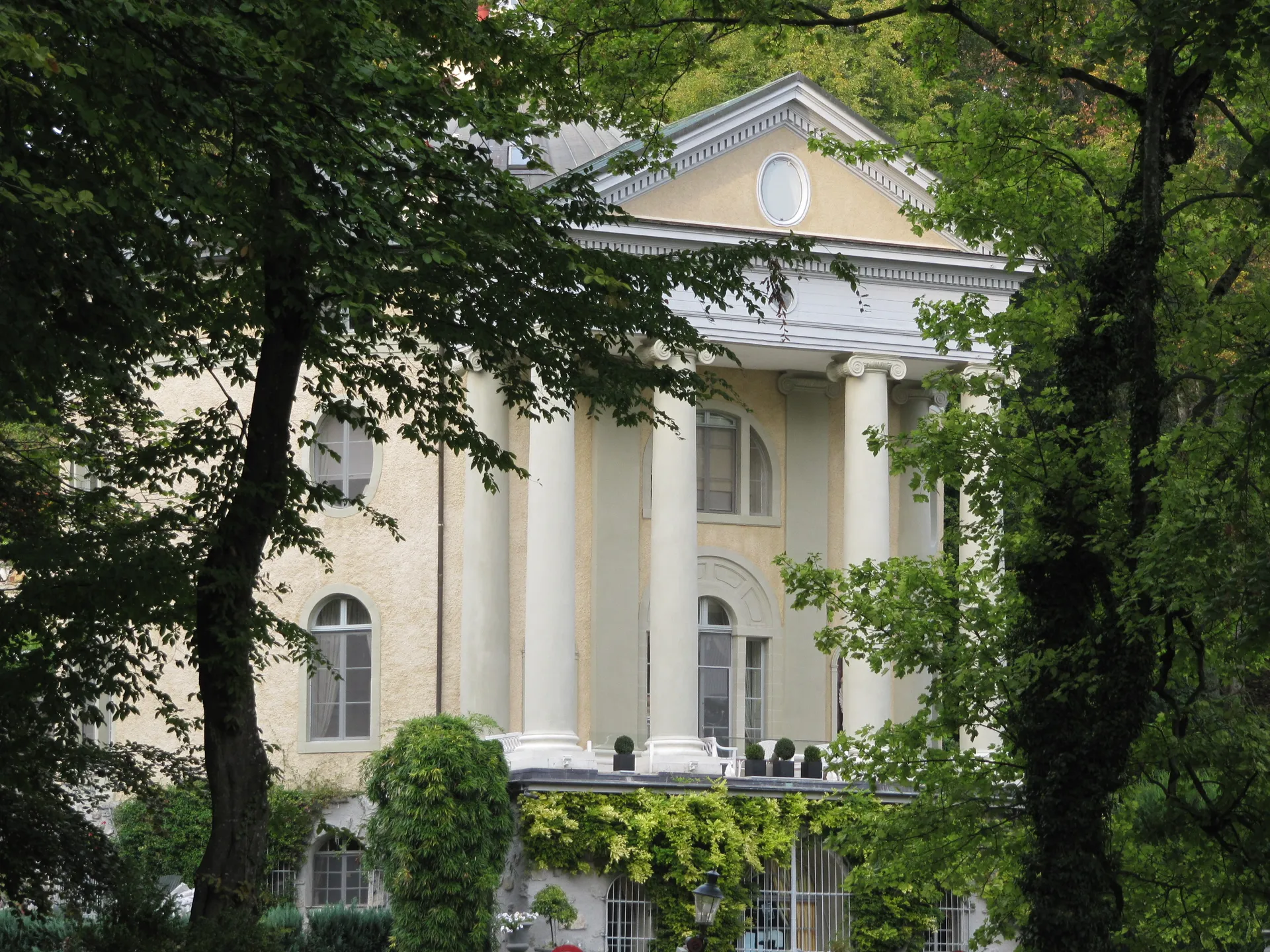
Built by a Dutch general Napoleon personally hated, this Pantheon-like rotunda rises above Féchy's vines; its small Temple of Love later became a tomb.
- Time needed
- 30–45 minutes (exterior view)
- Entry
- Free (exterior only)
- Access
- Exterior views only; no public interior access
- Best season
- Spring–autumn
The most Roman building in Switzerland is not in Rome, or even in a Swiss city — it is a perfect domed cylinder rising from the terraced vines of Féchy, above Lake Geneva. This is La Gordanne, a neo-Palladian villa in Féchy, Switzerland, and you come for the shock of a Pantheon clone in a wine village, then stay for the exiles, a love temple turned tomb, and an architect nobody can name.
Seen from the Route Suisse as you climb toward Perroy, it appears as a flash of white in the trees: a four-storey cylinder capped by a dome, with an Ionic-columned portico pinned to the front like a Roman temple. The plan is an exact circle, rare enough in a canton of rectangular barns. Inside, an oval room carries painted landscapes of Italy's Salerno coast, and a circular library wraps its shelves around the attic like a wheel.
The design is not original. It is, with small changes, a copy of Belle Isle, the round house John Plaw built on an island in England's Lake Windermere around 1775, itself a homage to the Pantheon in Rome. The chain runs pagan Rome to English Lakeland to Swiss lakeshore. Yet no one signed the drawings; the architect's identity remains an open question.
The house was built between 1803 and 1806 for Hendrik van Oyen, a Dutch general in the service of Hesse-Darmstadt, as a private refuge from Napoleon. That political exile story still clings to the place. The estate is private, so keep to the road or the vineyard paths; the view of that white rotunda against the vines is the point.
What to see
-
The round house itself
You catch it from the Route du Lac between Allaman and Perroy: a flash of white through the trees, then a full Roman rotunda with an Ionic portico and a low dome, sitting in a Swiss vineyard like a misplaced Pantheon. Completed by 1806, the villa copies Belle Isle, the circular house John Plaw built on Windermere in 1775. It's four storeys of curve, a cylinder in a canton of rectangular barns, so the first glimpse genuinely stops the breath. Private estate, so you won't get inside, but the view from the road in winter is the reward: bare branches, low light, and a dome that belongs to Rome more than to Vaud. -
Temple de l'Amour turned tomb
Above the villa on the neighboring hill sits a six-columned temple built as a garden folly to love before 1833. Then Henri Isaac Mayor died in 1843, and it was converted to his tomb. The switch from pleasure pavilion to mausoleum feels like a novelist's plot. If you walk the public paths below it, the columns cut the sky in a way that suggests both romance and grief. Look for it after you've taken in the round house: a small white crown on a green shoulder of the hill. -
The Féchy vine loop
Start in Féchy under the twin columns of the coat of arms, then walk the old Vy d'Etraz toward Perroy. This road has carried Romans, brigands, and wedding guests since Charlemagne, and the vines alongside it were planted by monks from Grand-St-Bernard. Keep your eyes on the plain as you go: the white dome of La Gordanne appears and disappears through the vines like a trick of light. The best moments are autumn, when the leaves thin and the dome floats above the red vine rows, or winter when the air is sharp and the house is fully visible.
Plan your visit
- Getting There
- Allaman and Perroy stations sit on the Lausanne–Geneva main line, each about 2 km from the estate. PostBus 835 serves the villages — check sbb.ch for current stops and times. By car, exit the A1 at Rolle and take the lakeside road toward Perroy; park in Féchy village and walk 15–20 minutes down toward the lake.
- Viewing Access
- As of 2026, La Gordanne remains a private residence with no public interior access — no hours, no tickets, no tours. The exterior is visible from public roads and vineyard paths any time of day. A rare European Heritage Days opening is your only chance at a closer look; contact Morges Région Tourisme to ask.
- Time Needed
- A drive-by photo stop takes 5–10 minutes — though the white rotunda hides among trees and is easy to miss. Walking from Allaman station, viewing the dome and columned portico from the road, and returning takes 45–60 minutes. There is no grounds access, so that is the full experience.
- Accessibility
- The lakeside road is paved and flat for wheelchair users, but there are no designated viewpoints, benches, or parking at the estate. Vineyard paths from Féchy village involve moderate inclines. The interior is inaccessible — this is a private home, not a heritage attraction with visitor infrastructure.
- Cost
- Viewing from the road costs nothing. There is no ticket office, no audio guide, no gift shop. Be wary of a Trip.com listing for 'Château de Féchy' offering tickets — it is either an error or a different property. No official source confirms any paid access to La Gordanne.
Photo Gallery


History
The Exile's Pantheon
La Gordanne begins as a story about a man who refused to live in Napoleon's Europe. Hendrik van Oyen was a Dutch-born general and diplomat who had climbed to the top of the army of Hesse-Darmstadt. By 1803, records show, he had the money and the motive to build a Roman temple on Lake Geneva.
He bought the lakeside plot for 32,000 francs — double what the previous owner had paid four years earlier — and began raising a round, domed villa copied from an English pattern-book design. The house was finished by 1806. Its architect left no signature; the building itself became the biography.
The turning point
Van Oyen's Defiant Pantheon
Van Oyen had more than taste at stake. According to Swiss Castles, his brilliant trajectory in Hesse-Darmstadt earned him the personal hostility of Napoleon Bonaparte. When Napoleon's armies entered Munich in 1805, van Oyen lost his position at the Darmstadt court and fled to his half-finished round villa above Lake Geneva. He stayed until 1813, the year Napoleon's star broke.
The exile carried private grief too. His wife brought him a county near Passau in Bavaria as her dowry, but their two children died young. The great round house rose over a family in mourning, and there were no heirs to inherit it.
In 1814, the neighboring commune of Perroy requisitioned the property to quarter troops. The Roman villa of Napoleon's enemy became a barracks for the coalition troops passing through. Van Oyen sold La Gordanne in 1825 and moved to nearby Fraid'Aigue, where he kept building — a neo-Gothic house, a Dutch-style farm — as if architecture were the only homeland he had left.
Early Life & Vision
Legacy & Influence
Tips for visitors
It's someone's home
Don't climb gates or follow anyone offering to take you 'inside' for money — that's unauthorized and almost certainly a scam. The owners enforce the propriété privée boundary politely but firmly. Stay on public roads and vineyard lanes.Drones stay grounded
Swiss drone rules already restrict flights near private property, and hovering over the estate would be treated as an intrusion. Exterior photos from the road are fine for personal use, but any commercial shoot needs the landowner's permission.The tomb on the hill
That six-columned temple above the house isn't a romantic folly — it's the tomb of Henri-Isaac Mayor, converted from a Temple of Love after his death in 1843. If you approach it from a public path, treat it as a burial place, not a photo prop.Eat at the auberge
The Auberge Communale de Féchy serves solid Swiss village cooking — reviewers praise the welcome and the cuisine. Expect CHF 25–45 per main. For wine, Domaine La Colombe in Féchy hosts tastings and a harvest day on 12 September 2026.Morning light on the dome
The white rotunda catches morning light best when viewed from the lakeside road before Perroy, heading toward Geneva. Come early — the sun hits the dome from the east, and the road is quieter before commuter traffic.Don't trust the internet's date
The Féchy commune website once claimed the house dates to 1600 — wrong by two centuries. The actual construction is 1803–1806, and the error has been copied across the internet for years. The round house is neoclassical, not medieval.Pair it with Rolle or Morges
Since you can't enter the estate, make the trip worthwhile by combining it with Rolle's medieval old town and harbor (5 km west) or Morges's lakeside promenade and castle (8 km east). The Lavaux terraces, a UNESCO site, sit 10–15 km further east.
Frequently asked
Is La Gordanne worth visiting?
Honest answer: yes, but only as a look-don't-enter detour, not a special trip on its own. You can't go inside or walk the grounds—this is a private estate with no ticket office. What you get is a strange, beautiful thing: a circular, domed villa with an Ionic portico, built 1803–1806, more Roman temple than Vaud farmhouse. Swiss Castles calls it one of the first Palladian houses in Switzerland; it'd be worth the detour if you're already drinking Féchy wine nearby.
Can you visit La Gordanne for free?
Viewing it from the public road is free; going inside is not possible. There's no public tour, no opening hours, and no admission—La Gordanne remains a private house and active farm. The best free sighting is from the lakeside road between Allaman and Perroy, where it appears on the right as you head toward Geneva.
How do I get to La Gordanne from Geneva?
By train, ride the Lausanne–Geneva line to Allaman, then walk roughly 2 km east along Route de la Gordanne. By car, leave the A1 at Rolle or Morges and follow signs toward Féchy/Allaman. Park in Féchy or Allaman—there's no visitor parking at the estate—and approach on foot.
How long do you need at La Gordanne?
Plan five to ten minutes for a drive-by photo stop, or 45–60 minutes if you walk from Allaman or Féchy to view the exterior. Since the interior is closed to the public, there's no half-day visit here. The reward is a single good look—and maybe searching out the half-hidden temple-tomb above the estate from a public vantage.
What is the best time to visit La Gordanne?
For the clearest public view, go in winter, when bare trees stop hiding the dome and portico. Summer foliage mostly screens the house from the road. Spring and autumn are prettier for the surrounding vineyards, but the architecture is hardest to read when the leaves are full.
What should I not miss at La Gordanne?
Don't miss the Temple of Love on the hill above the estate—it became the tomb of owner Henri Isaac Mayor in 1843. Also look for the half-moon outbuilding that once housed a spinning mill, a surprising industrial curve beside the Pantheon-like villa. The main act is the house itself: four levels stacked inside a circular drum, topped by a dome and a portico copied from Belle Isle on Lake Windermere.
Sources & attribution 10
- Wikipedia FR — La Gordanne — Chronology, legal protection, 1814 requisition, Mayor tomb, Belle Isle model, and note on the erroneous 1600 construction date.
- Swiss Castles — La Gordanne — Architectural description, circular plan, dome, Ionic portico, unknown architect, van Oyen biography, interior oval room, circular library, and road viewpoint.
- FAOVD — Allaman commune page — Local name maison ronde de la Gordanne and cross-communal location.
- Commune de Féchy — Historique — Local history context, Féchy's own mention of Gordanne, and vineyard history.
- Groupe Volet — Domaine de la Gordanne, Féchy — Modern restoration detail: decorative 30 m car-rim ceiling element in the rotunda.
- PaysansSuisses — Domaine de la Gordanne SA — Confirms the estate still operates as an agricultural enterprise, not a public visitor attraction.
- Historical Dictionary of Switzerland — Féchy — Commune origins, Roman and monastic context behind the Féchy vineyard landscape.
- Morges Région Tourisme — Commune de Féchy — Local tourism contact and area orientation.
- Swiss Castles — Aerial views of La Gordanne — Aerial photographs revealing the circular plan, dome, and wooded park.
- NotreHistoire.ch — Signes de vie à la Gordanne — Local archival document and photographic memory of La Gordanne.
Built from cited sources · see the method · How we make our guides →
Pick up where you left off
Saved and recently read places — kept on this device only.
Photo credits (1)
- Domaine de la Gordanne - panoramio — P.-A. Chassot — CC BY 3.0 (https://creativecommons.org/licenses/by/3.0/) — Source: https://commons.wikimedia.org/wiki/File:Domaine_de_la_Gordanne_-_panoramio.jpg
Photos may have been resized or cropped.