Ruins of Mont-Le-Vieux Castle
Essertines-Sur-RolleSwitzerland 46° N · 6° E Updated Aug 2026
A whole medieval market town vanished here in 1475, burned by Swiss troops; today only forest-shrouded foundations and a broken tower survive above Lake Geneva.
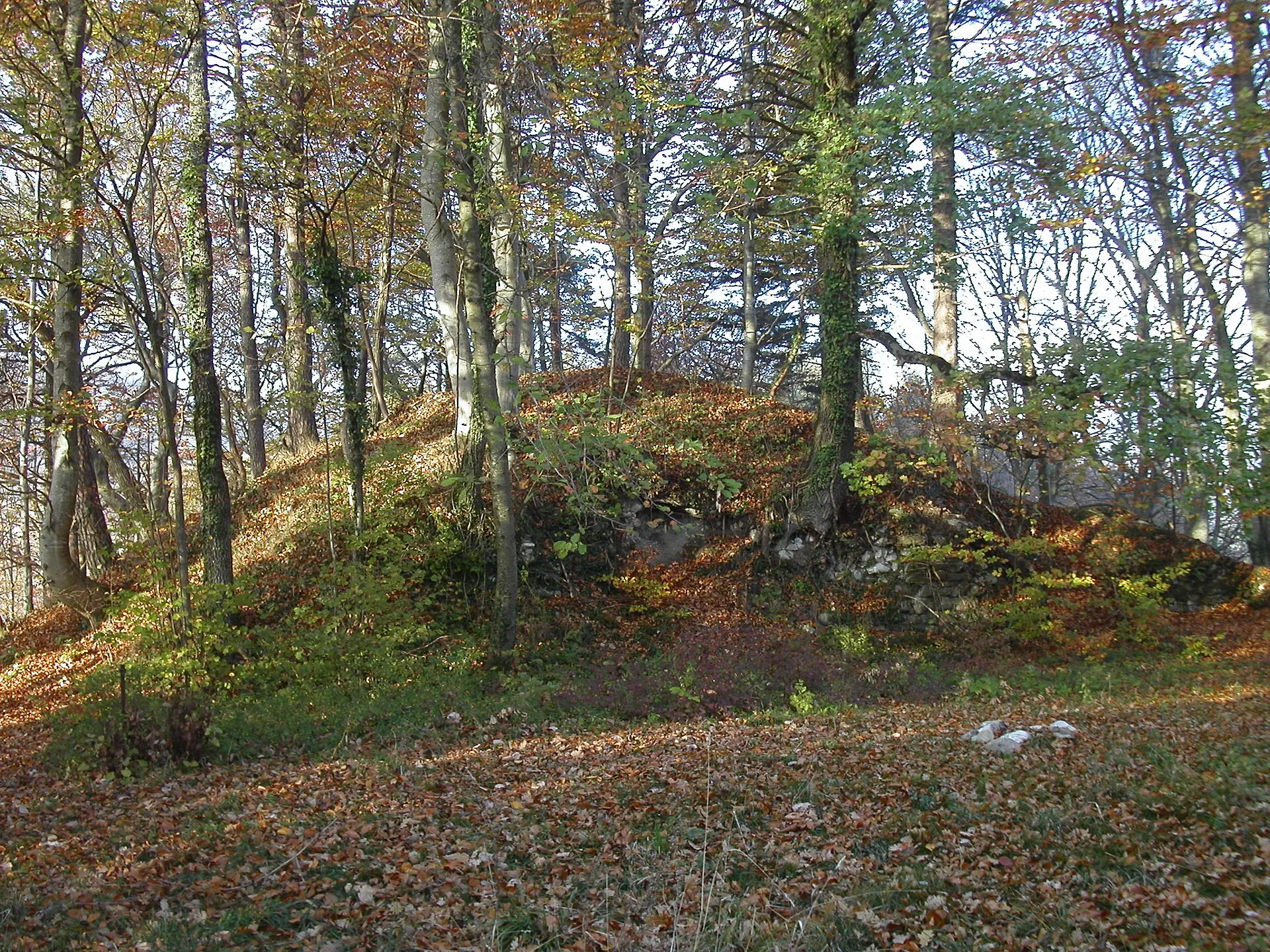 Photo: Marc Mongenet · CC BY-SA 2.5
- Time needed
- 1-2 hours
- Entry
- Free
- Access
- Not wheelchair accessible; uneven, overgrown forest paths
- Best season
- Spring or autumn
The most important medieval watchtower between the Jura foothills and Lake Geneva now hides in plain sight above Essertines-sur-Rolle, Switzerland. The Ruins of Mont-le-Vieux Castle — burned on 28 October 1475 and left where it fell — reward anyone willing to find them with crumbling curtain walls, a vanished market town just underfoot, and a view that once decided who controlled the La Côte vineyards. Come because this ruin tells a sharper story than the restored châteaux by the lake: a small feudal world that ended in one afternoon of smoke.
All of it once fit into a rough rectangle 35 metres wide and 65 metres long — smaller than a football pitch. Inside those walls stood two rows of attached houses, a central plaza, and a semicircular tower wrapped in a matching curtain wall. Walk the clearing today and you cross a planned medieval town that was already thinning out before the fire.
The tower was no hollow shell. Records describe a habitable semi-cylinder, and in 1436 a legal deed was witnessed in 'the great front tower of the castle.' Picture Dame Claude de Viry and Olivier Mestral standing in a curved stone room, parchment laid down, while the afternoon light fell through narrow openings.
The châteaux below have roofs, collections, and ticket desks. This one asks for a walking route — about ten kilometres through riverbanks and wildflowers before the stones appear among the oaks. What you get is a true ruin, what the newspaper La Côte calls 'the forgotten sentinel,' with Lake Geneva spread below exactly where the medieval watchmen knew it would be.
What to see
-
The Semi-Cylindrical Tower
The tower's shape is the first surprise. Not the square donjon you'd expect from a 13th-century Vaudois fortress, but a semi-cylinder — a habitable curve of stone that once rose above the treeline, its curtain wall sweeping around in a matching arc. In 1436, a legal deed was witnessed and signed in 'the great front tower,' which tells you this wasn't just a lookout post; it was a room where Dame Claude de Viry and Olivier Mestral put their names to parchment. On October 28, 1475, confederate troops put fire to the roof and the tower went silent forever. What remains now is a broken arc of mortared rubble, moss creeping into every joint, the curve still readable if you stand back and let your eye trace it. -
The Lost Town Inside the Walls
Most castle ruins stand alone. Mont-le-Vieux had a town inside its walls — 35 by 65 meters, a city block's footprint, with two rows of attached houses facing each other across a central plaza. A market town, attested from 1179, where people traded and argued and watched the road from the hilltop. The confederate fire of 1475 didn't just destroy a castle; it erased a small world. By the end of the 15th century the settlement was abandoned, its residents scattered into the hamlets that now make up Essertines-sur-Rolle. Walk the plaza today and you're walking on a street plan that's been silent for over 500 years. The foundations are there if you look — low lines of stone under the leaf litter, the ghost of a doorway, a threshold no one has crossed since the Burgundian Wars. -
The Forest Walk: In the Monks' Footsteps
The approach is half the experience. La Côte newspaper calls Mont-le-Vieux 'la sentinelle oubliée' — the forgotten sentinel — and that's exactly what it feels like: a 6.5-mile loop trail from Rolle climbs through forest and wildflower meadows, past river views, and then the stone appears, camouflaged in the trees. Local tradition says monks from Bourg Sainte-Marie kept a tavern in Geneva to sell their wine, and every evening they climbed back up the hill, exhausted. Tired of the daily climb, they built shelters at various points on the slope — and those shelters became the hamlets that still exist today. So the walk you're taking is the same tired climb the monks made, past the same hillsides, toward the same stone. On September 20, 1315, Louis de Savoye, Baron de Vaud, granted a charter of liberties to the commune from this very hill. The parchment survived. The castle didn't. That's the trade-off this place offers: you lose the building, you gain the walk.
Plan your visit
- Getting There
- Rolle station, on the Geneva–Lausanne main line, is the closest reliable rail stop. From there, no confirmed bus reaches the ruin itself; the mapped Tour de Mont-le-Vieux loop starts near Rolle and runs 10.5 km, about 3 h 18 min on foot. By car, aim for Essertines-sur-Rolle and the Châtel hamlet — the ruin lies below it at Malagny, with no dedicated parking documented.
- Opening Hours
- As of 2026, there are no official hours: this is an unstaffed, ungated forest ruin open year-round. Plan for daylight and treat April through October as the practical season — snow and ice can make the path slippery in winter.
- Time Needed
- The ruin itself rewards 30–45 minutes of exploring the tower stump and enclosure walls. If you walk the full loop trail, budget about 3 h 18 min; a relaxed half-day of 4–5 hours covers the hike, a picnic, and the lake views.
- Cost / Tickets
- Entry is free — there is no ticket office, no booking system, and no staffed gate. Personal photography is unrestricted, but the site is privately owned by the domaine de Favières, so stay on the visible path.
- Accessibility
- Not wheelchair accessible. Reaching the ruin means unpaved forest paths, elevation gain, and loose ground; there are no ramps, lifts, or surfaced walkways. Visitors with limited mobility should not attempt it without all-terrain assistance.
History
The Forgotten Sentinel
Mont-le-Vieux means the old mountain, a name that separated it from Mont-le-Grand on the next ridge long before either was a ruin. Records show the first documented mention of the castle, also called Malagny, in 1179, when the lords of Cossonay-Prangins held it. A small market town stood at its foot — part watchpost, part toll point, part village.
Power on this ridge was never purely local. In the summer of 1293 Amadeus V of Savoy and his brother Louis confiscated Mont-le-Vieux from local lords and brought it under Savoyard control. From then until its last day, the castle would serve as a sentinel on the boundary between Savoyard territory and rival domains.
The turning point
The Summer Savoy Took the Old Mountain
Amadeus V of Savoy did not need a siege tower. Records show that in summer 1293 he and his brother Louis confiscated Mont-le-Vieux from the Cossonay-Prangins lords. Whoever held this ridge watched the approaches from Lake Geneva toward the Jura foothills and controlled the vineyard roads of La Côte.
Amadeus was assembling a Savoyard Vaud, castle by castle. For him, Mont-le-Vieux was a forward post on the edge of rival domains — a place to see trouble before it reached the lake. For the dispossessed lords, losing the castle turned a family seat into an administrative garrison, the kind of dynastic injury noble houses remembered for generations.
The turning point has unusual precision. In the summer of 1293 the castle stopped being a local family's fortified home. It became a Savoyard watchtower, later reinforced with modern military architecture, and its medieval power shifted from kinship and memory to territorial control.
The Town That Vanished
A Charter for the Castle's Subjects
Tips for visitors
Two castles, one name
Make it a two-castle walk: these forest ruins contrast with the partly standing Mont-le-Grand manor in Mont-sur-Rolle, a few kilometres away. Ask locals specifically for “Mont-le-Vieux” or you may be sent to the wrong one.Dress for undergrowth
Long pants and trail shoes beat shorts and sneakers here. The ruin hides under brambles and forest litter, and ticks are common in Swiss woods from spring through autumn — do a leg check afterward.Eat at the auberge
Auberge de Mont-sur-Rolle, roughly 2–3 km away, serves seasonal Vaudois plates Tuesday–Saturday, 10:30–15:00 and 18:00–23:00. Its two sheltered terraces face Lake Léman and Mont-Blanc, a mid-range upgrade from trail snacks.Taste in Bugnaux
Below the ruin, Bugnaux is a working wine hamlet. Knock at a caveau for Chasselas from AOC La Côte — most tastings run CHF 10–20, but hours are informal, so look for signs or call ahead.Chase late light
Spring and autumn late afternoons give the broken tower soft side-light and clearer air over Lake Geneva. Summer mornings work too, but midday can flatten the view into haze.Leave drones at home
The ruins sit on private land belonging to the domaine de Favières. Swiss rules restrict drone flights over private property, and the quiet here is part of the point — photograph with your feet on the ground.
Frequently asked
Is Mont-le-Vieux Castle worth visiting?
Yes, if you like ruins that feel genuinely forgotten rather than gift-shop-adjacent. This is a ground-level ruin in a forest above the La Côte vineyards — no ticket office, no interpretive panels, just wall fragments and a view over Lake Geneva. La Côte newspaper calls it "la sentinelle oubliée" (the forgotten sentinel), and that's exactly the appeal. Skip it if you want a standing castle; seek it out if you want the quiet thrill of finding something most people drive past.
How long do you need at Mont-le-Vieux Castle?
Budget 30–45 minutes at the ruins themselves, plus the hike in. The AllTrails loop that passes the site is 10.5 km and takes about 3 hours 18 minutes. A half-day covers the walk, the ruin, and a stop at the Auberge de Mont-sur-Rolle for lunch.
How do I get to Mont-le-Vieux Castle from Rolle?
Take the train to Rolle on the Lausanne–Geneva line, then hike or drive up to Essertines-sur-Rolle. The ruin sits below the hamlet of Châtel, above Bugnaux, at a viewpoint called Malagny. No direct bus to the ruin is documented — plan on a walk from the village or a car with street parking nearby.
What is the best time to visit Mont-le-Vieux Castle?
April through October, with autumn as the sweet spot. The forest thins out as leaves fall, so the camouflaged ruins become easier to spot, and the light over Lake Geneva turns golden in late afternoon. Winter can make the trail slippery, and summer foliage hides the stone.
Can you visit Mont-le-Vieux Castle for free?
Yes — it's an unstaffed, open-air ruin with no gate, ticket office, or booking system. The site belongs to the domaine de Favières, so stay on marked paths and respect private property boundaries. Bring water and sturdy shoes; there are no facilities on site.
What should I not miss at Mont-le-Vieux Castle?
Look for the outline of the lost bourg — about twenty houses once clustered around the castle and were abandoned before the 1475 fire. Also scan the surviving wall fragments for heat-cracked stones, evidence of the blaze that ended the castle's life. And stand where the sentinel stood: the view over the La Côte vineyards to Lake Geneva is the whole reason the castle existed.
What happened to Mont-le-Vieux Castle?
Swiss Confederate troops burned it in autumn 1475 during the Burgundian Wars, and it was never rebuilt. The castle had already been seized from the Cossonay-Prangins family by the Counts of Savoy in 1293. After the fire, the de Viry family shifted the seigneurial seat to Rolle, and Mont-le-Vieux crumbled into the forest.
Sources & attribution 8
- La Côte — Le passé sous nos pas: Mont-le-Vieux, la sentinelle oubliée — Local newspaper article framing the ruins as a 'forgotten sentinel' camouflaged in the forest; source of the site's emotional core and local sentiment.
- Historical Dictionary of Switzerland — Mont-le-Vieux — Confirms the castle was known from 1179, held by Cossonay-Prangins lords, and seized by Amédée V of Savoy in 1293.
- Historical Dictionary of Switzerland — Essertines-sur-Rolle — Documents the small bourg attached to the castle, its abandonment in the 15th century, and the 1475 destruction.
- Swiss Castles — Le château de Mont le Vieux — Detailed history including the original 11th–12th century castle at Les Dudes, the 1293 assault, the 1475 burning, and the 19th-century rescue from quarrying by the du Martheray family.
- AllTrails — Tour de Mont le Vieux — Provides trail distance (10.5 km), estimated time (3h18m), difficulty rating, and best visiting months (April–October).
- Mont-sur-Rolle — Histoire — Regional context including the 1475 fire that caused Sire Gérard de Mont's flight, the monks' Geneva tavern story, and the 1315 charter of liberties.
- FAOVD — Essertines-sur-Rolle — Confirms the bourg of about twenty houses was abandoned at the time of the 1475 fire, and that wall sections still stand at the site overlooking La Côte.
- Cantonal Archives of Vaud (Davel) — AMH A 105/5 — Archival file documenting the ruins, photographs, and the 1960 excavation authorization granted to René Maire of Gland.
Built from cited sources · see the method · How we make our guides →
More in Essertines-Sur-Rolle.
1 places to discover — a few worth pairing.

Pick up where you left off
Saved and recently read places — kept on this device only.
Photo credits (1)
- Mont le Vieux 02 — Marc Mongenet — CC BY-SA 2.5 (https://creativecommons.org/licenses/by-sa/2.5/) — Source: https://commons.wikimedia.org/wiki/File:Mont_le_Vieux_02.jpeg
Photos may have been resized or cropped.