Place
Essertines-Sur-Rolle
Switzerland Updated Aug 2026
From the upper lanes of Essertines-sur-Rolle, the air smells of cut hay and cold limestone, and through a gap in the Jura foothills the whole arc of Lake Geneva shimmers below. This small commune in the canton of Vaud, Switzerland, doesn’t demand attention—which is precisely why it rewards it. The real draw lies in the heights: a pass at 1,449 meters, a hidden Carthusian ruin, and an anti-tank trail that resembles a chocolate bar.
 Photo: Jérémy Toma · CC BY-SA 4.0
- Attractions
- 9
- Trip length
- 2-3 days
- Best season
- Late spring and early autumn
Why Essertines-Sur-Rolle
Built from cited sources · see the method · How we make our guides →
The village itself is quiet, a scatter of stone houses and lanes that dead-end into cow pasture. Use it as a base, not a destination. The Col du Marchairuz climb out of nearby Bière is the local cycling test—long, steady ramps at 12 to 13 percent and road quality that invites speed—while hikers pick up the Haut Sentier du Jura toward Crêt de la Neuve. At 1,495 meters, the summit opens over Lake Geneva and the Alps with a view sharp enough to pick out boats crossing from Nyon to Yvoire.
The valley floor has stranger stories. The Sentier des Toblerones follows a line of concrete anti-tank barriers poured during the 1939–45 mobilization; moss and celadon river water have since done their work, and the walk is now a gentle, family-friendly one. Farther into the trees, the Ruines de la Chartreuse Notre-Dame d’Oujon mark the oldest Carthusian monastery in Switzerland, founded around 1146. The cellar walls survive, and their footings give a sharper sense of the place than any plaque.
Down at the lake, Rolle’s 13th-century château sits so close to the water that the courtyard seems to float on blue; go for the exterior and the view, since the interiors open irregularly. The better evening move is to walk the small roads above Essertines as the light flattens across the lake. The Alps turn pink before the dark draws in, and the day’s last sound is often just cowbells and your own footsteps.
The View from Crêt de la Neuve
At 1,495 m, Crêt de la Neuve offers the best Lake Léman panorama in the region, from the Jura edge to the Alps. You climb through almost unbroken forest, then the lake appears without warning below.Switzerland's First Carthusian Monastery
Hidden in the forest, the ruins of Chartreuse Notre-Dame d'Oujon date from around 1146 and are the oldest Carthusian monastery in Switzerland. The surviving cellar walls still stake out the original scale, and the silence is part of the visit.A Defence Line Called Toblerone
The Sentier des Toblerones follows a river the colour of celadon, past rows of concrete anti-tank blocks built during the 1939–45 mobilisation. The blocks look like the chocolate bar they were named after, and the walk is easy enough for young children.Château de Rolle on the Water
Rolle's 13th-century castle stands directly on Lake Léman's shore, its courtyard planted and its facade almost touching the deep blue water. The interior opens only sometimes, but the exterior and waterfront setting are the point.
Places to Visit
Not every monument, just the ones we'd walk you past ourselves.
-
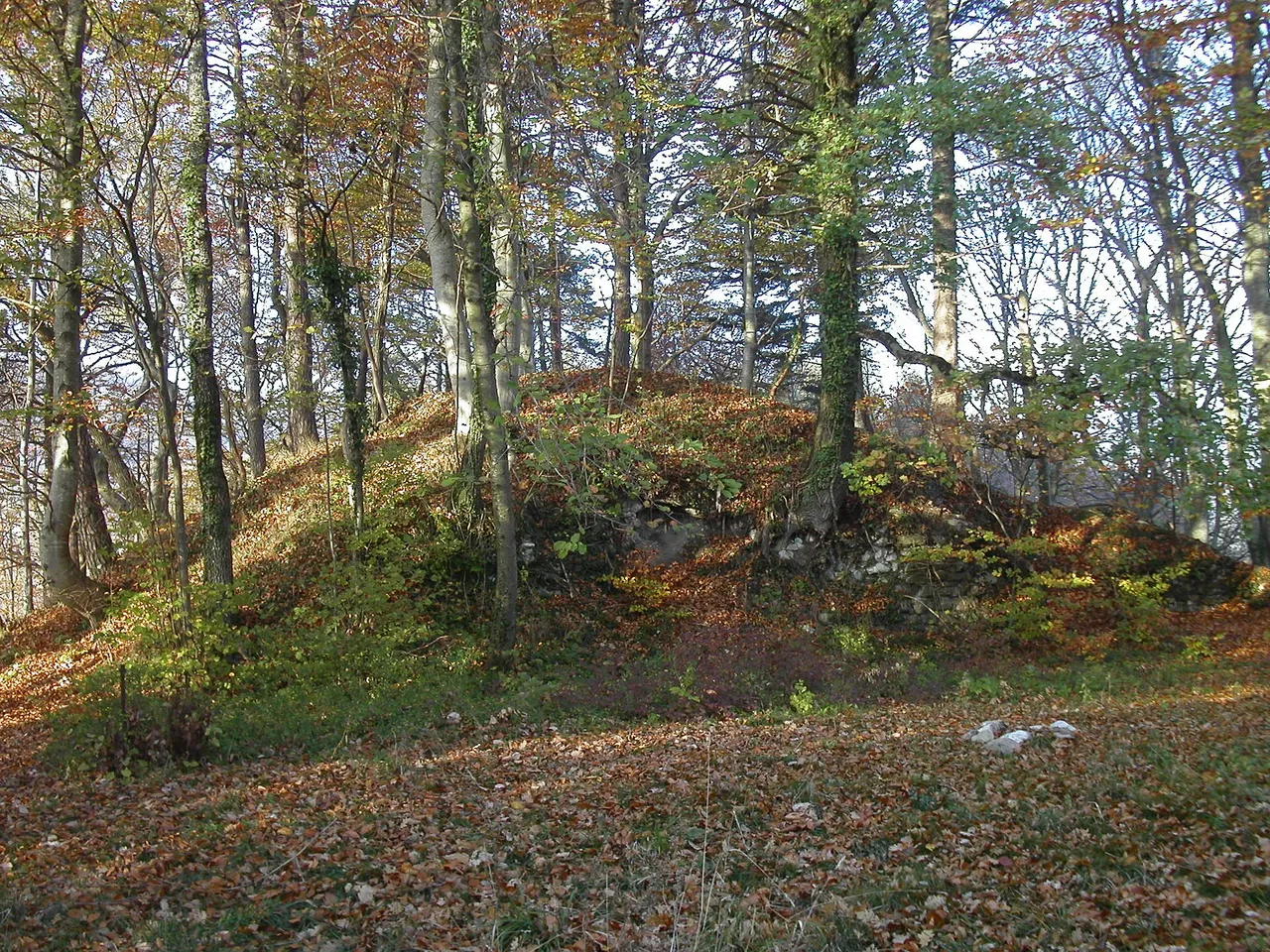
Ruins of Mont-Le-Vieux Castle A whole medieval market town vanished here in 1475, burned by Swiss troops; today only forest-shrouded foundations and a broken tower survive above Lake Geneva.
- Château De Favières A 'château' that's really a winegrower's house: the same family since 1675, biodynamic vines, a monumental 1908 chimney, and Mont-Blanc views over Lake Geneva.
Plan your trip
Before you go
- Getting There
- Geneva Airport (GVA) is the closest international hub, about 40 km southwest of Essertines-sur-Rolle; Zürich Airport (ZRH) is roughly 230 km northeast. Rolle station, on the SBB main line between Geneva and Lausanne, lies 4 km downhill, with local buses and taxis up to the village. By car, exit the A1 motorway at Rolle and climb the local road through vineyards.
- Getting Around
- Essertines has no metro or tram; the practical base is Rolle station, where trains reach Geneva in about 25 minutes and Lausanne in under 20. CarPostal buses connect the hill villages, and the Swiss Travel Pass or Mobilis day pass covers rail, bus, and Lake Léman boat services in 2026. For the Jura passes and trailheads, a car or bicycle is far more flexible.
- Climate & Best Time
- Spring runs roughly 8–19°C, often showery, while summer brings 18–27°C and occasional days above 30°C by the lake. Winter temperatures sit between about -1°C and 6°C, with snow affecting the higher Jura passes. July and August are the busiest months; May–June and September–October are the sweet spot for clear light, empty trails, and cooler climbs.
- Language & Currency
- French is the local language, with English common in Rolle's hotels and restaurants but less reliable in small village shops. Switzerland uses the Swiss franc (CHF), not the euro. Cards work in most places, though small farm stands and cafés may still prefer cash.
Where to Eat
Where locals actually book dinner — not the tourist menus.
-
Filets de perche du Léman
Lake Léman perch, dusted in flour and fried in butter, then finished with lemon and parsley. Order them at the port-side restaurants in Rolle, where the fish is treated as local geography, not fine dining theatre.
-
Papet vaudois
A leek and potato stew cooked until it collapses into a pale green tangle, served with Saucisse aux choux, Vaud's fat cabbage sausage. This is the canton's midwinter plate, best after a cold walk on the Toblerones trail.
-
Saucisse aux choux vaudoise
The cabbage sausage that anchors papet is worth ordering on its own — smoked, savory, and built for sharp mustard and a glass of Chasselas. Butchers around Rolle and Aubonne sell it for picnics.
-
Raclette and fondue
In the nearby Jura villages, these cheese rituals are not tourist kitsch. Expect half-moon raclette scraped at the table and fondue moitié-moitié made with Gruyère and Vacherin Fribourgeois, served with boiled potatoes or bread and cornichons.
-
La Côte AOC wines
The terraced vineyards between Nyon and Lausanne produce Chasselas whites and Gamay reds. Look for caveaux in wine villages near Essertines; many sell by the glass without ceremony.
-
Meringues with Gruyère cream
A bone-white meringue the size of a small fist, smashed and drowned in thick double cream from nearby Gruyère. The contrast is sweeter than you think, and entirely appropriate after a summit walk.
-
Tomme vaudoise
A soft, earthy cow's milk cheese from the Vaud countryside. It appears on local cheese boards and melts well over a slice of dark bread, best bought directly from a fromagerie.
Insider tips
Small things that change how the city treats you.
Start Marchairuz early
Begin the Col du Marchairuz climb from Bière before 08:00. The 12–13% sections are steady but exposed, and the switchbacks down toward Vallée de Joux deserve full concentration.Sudden alpine viewpoint
Crêt de la Neuve is wooded nearly to the top, then opens to the best view over Lake Léman and the Alps. Wait for a clear morning or late afternoon.Toblerones with kids
The Toblerones Trail follows a river with celadon-colored water and is flat enough for young children. You stay close to rail and road, so it's easy to cut the walk short.Switzerland's oldest charterhouse
The Ruines de la Chartreuse Notre-Dame d'Oujon, founded around 1146, sit hidden in forest. Only cellar walls remain, but they reveal the monastery's scale.Check before Château de Rolle
The 13th-century Château de Rolle isn't always open inside. The lakefront courtyard and planted grounds are the draw — check the events board nearby for entry times.3,000 trees at Aubonne
The Arboretum du Vallon de l'Aubonne holds over 3,000 species of trees and shrubs. Combine it with Château d'Aubonne for a hilltop medieval view over Lake Léman.
Gallery
The city, as it actually looks.


Frequently asked
Is Essertines-sur-Rolle worth visiting?
Yes, if you want a quiet base for Jura foothill hiking and La Côte vineyards. It's not a big-sight village, but it puts you minutes from the Toblerones Trail, Crêt de la Neuve, and Lake Geneva châteaux.
How many days do you need in Essertines-sur-Rolle?
Two to three days is enough to hike Crêt de la Neuve, walk the Toblerones Trail, and see Rolle and Aubonne. If you're cycling Col du Marchairuz or exploring vineyards, add another day.
How do you get to Essertines-sur-Rolle?
The nearest rail gateway is Rolle, on the Lake Geneva line. From there you'll need a bus or car to reach the village; the Toblerones Trail itself is close to rail and highway links.
Is Essertines-sur-Rolle safe?
Very. It's a small Swiss village with typical low crime, and the main risks are outdoor ones: steep switchbacks, changing mountain weather, and forest trails after rain.
What is there to do in Essertines-sur-Rolle when it rains?
Head to Château de Rolle's exhibitions or the Arboretum in Aubonne if rain is light. The Chartreuse d'Oujon ruins are atmospheric in mist but paths get slick.
When is the best time to visit Essertines-sur-Rolle?
Late spring and early autumn give you clear lake views and fewer cyclists on the Col du Marchairuz. Summer is warm for vineyard walks, while winter can be muddy on forest trails.
Pick up where you left off
Saved and recently read places — kept on this device only.
Photo credits (12)
- Essertines-sur-Rolle (VD) 6 — Jérémy Toma — CC BY-SA 4.0 (https://creativecommons.org/licenses/by-sa/4.0/) — Source: https://commons.wikimedia.org/wiki/File:Essertines-sur-Rolle_(VD)_6.jpg
- Essertines-sur-Rolle — Marc Mongenet — CC BY-SA 2.5 (https://creativecommons.org/licenses/by-sa/2.5/) — Source: https://commons.wikimedia.org/wiki/File:Essertines-sur-Rolle.jpeg
- Essertines-sur-Rolle (VD) 2 — Jérémy Toma — CC BY-SA 4.0 (https://creativecommons.org/licenses/by-sa/4.0/) — Source: https://commons.wikimedia.org/wiki/File:Essertines-sur-Rolle_(VD)_2.jpg
- Essertines-sur-Rolle (VD) 1 — Jérémy Toma — CC BY-SA 4.0 (https://creativecommons.org/licenses/by-sa/4.0/) — Source: https://commons.wikimedia.org/wiki/File:Essertines-sur-Rolle_(VD)_1.jpg
- Essertines-sur-Rolle (VD) 4 — Jérémy Toma — CC BY-SA 4.0 (https://creativecommons.org/licenses/by-sa/4.0/) — Source: https://commons.wikimedia.org/wiki/File:Essertines-sur-Rolle_(VD)_4.jpg
- Carte commune Essertines-sur-Rolle 2021 — Tschubby, translation by Christophe95 — CC BY-SA 3.0 (https://creativecommons.org/licenses/by-sa/3.0/) — Source: https://commons.wikimedia.org/wiki/File:Carte_commune_Essertines-sur-Rolle_2021.png
- Essertines-sur-Rolle (VD) 3 — Jérémy Toma — CC BY-SA 4.0 (https://creativecommons.org/licenses/by-sa/4.0/) — Source: https://commons.wikimedia.org/wiki/File:Essertines-sur-Rolle_(VD)_3.jpg
- Essertines-sur-Rolle (VD) 5 — Jérémy Toma — CC BY-SA 4.0 (https://creativecommons.org/licenses/by-sa/4.0/) — Source: https://commons.wikimedia.org/wiki/File:Essertines-sur-Rolle_(VD)_5.jpg
- Karte Gemeinde Essertines-sur-Rolle — Tschubby — CC BY-SA 3.0 (https://creativecommons.org/licenses/by-sa/3.0/) — Source: https://commons.wikimedia.org/wiki/File:Karte_Gemeinde_Essertines-sur-Rolle.png
- Essertines-sur-Rolle (VD) 7 — Jérémy Toma — CC BY-SA 4.0 (https://creativecommons.org/licenses/by-sa/4.0/) — Source: https://commons.wikimedia.org/wiki/File:Essertines-sur-Rolle_(VD)_7.jpg
- Karte Gemeinde Essertines-sur-Rolle 2008 — Tschubby — CC BY-SA 3.0 (https://creativecommons.org/licenses/by-sa/3.0/) — Source: https://commons.wikimedia.org/wiki/File:Karte_Gemeinde_Essertines-sur-Rolle_2008.png
- Karte Gemeinde Essertines-sur-Rolle 2007 — Tschubby — CC BY-SA 3.0 (https://creativecommons.org/licenses/by-sa/3.0/) — Source: https://commons.wikimedia.org/wiki/File:Karte_Gemeinde_Essertines-sur-Rolle_2007.png
Photos may have been resized or cropped.