Church of Saint-Martin, Bursins
BursinsSwitzerland 46° N · 6° E Updated Aug 2026
Monks once stored wine barrels in this Bursins temple; a bishop threatened excommunication in 1412. Beneath it lie a Roman villa and a Cluniac priory.
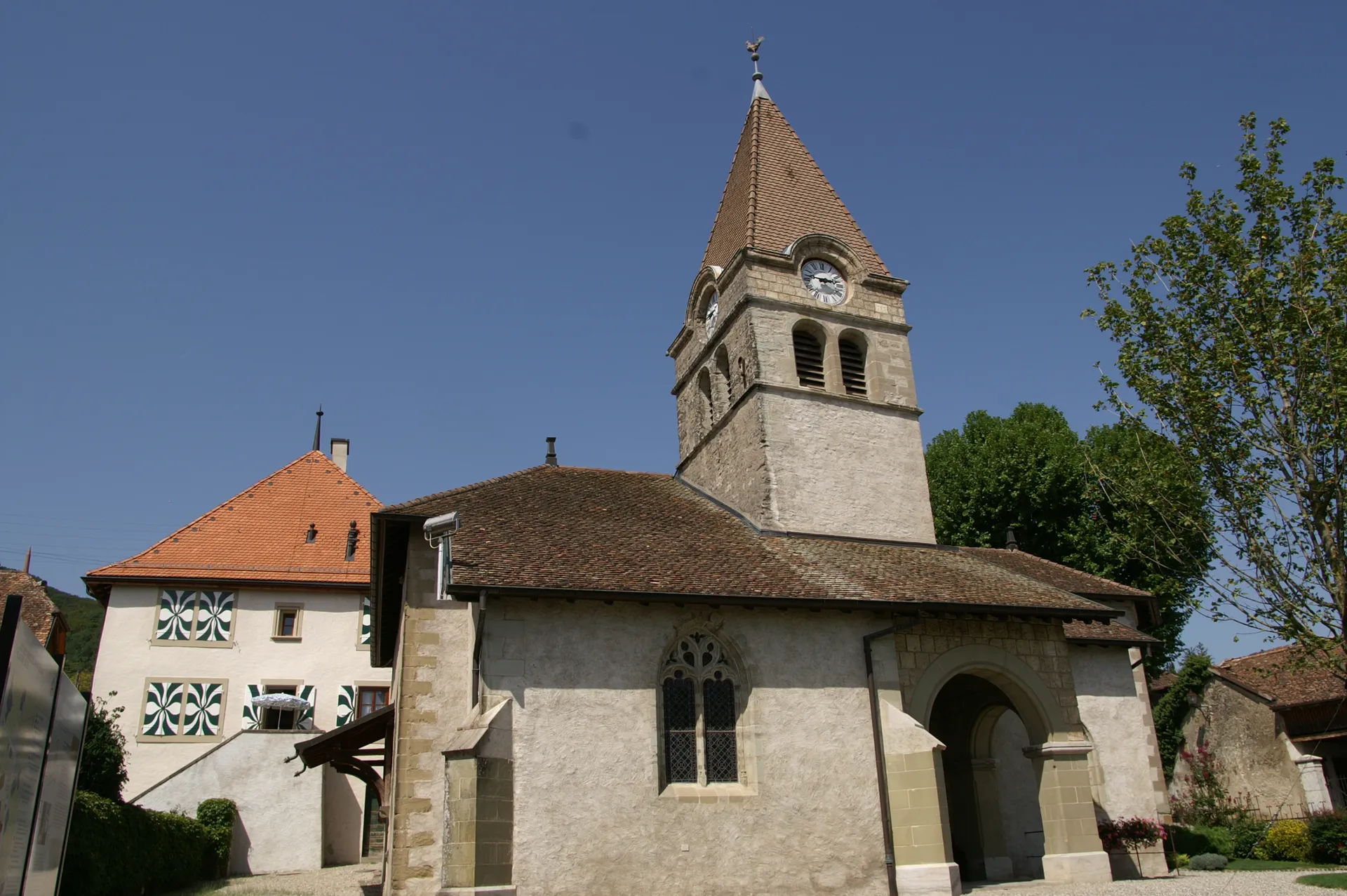 Photo: Pymouss · CC BY-SA 3.0
- Time needed
- 30-45 minutes
- Entry
- Free
The holiest corner of this Swiss village church once doubled as a wine warehouse — barrels stacked against the nave walls, chests of goods piled where the altar should be. The Church of Saint-Martin in Bursins, Switzerland, has spent a thousand years defying expectations: monastery, fortress, wine cellar, and now a nationally protected monument that still keeps secrets beneath its floor.
The church stands at the highest point of Bursins, a wine village on the old Roman road — the Vy de l'Etraz — that once linked France to Italy. What looks like a postcard-perfect Swiss village church from the outside is actually a palimpsest of power: royal, monastic, and military, built directly on the foundations of a Roman villa.
The 1011 charter that first mentions Bursins (spelled "Brucins") is the oldest surviving document naming King Rodolphe III, Abbot Odilo of Cluny, and the village together. That single parchment tied this hillside to the most powerful religious network in medieval Europe — and to a king who would soon lose his kingdom.
Today the church is open year-round, a Reformed temple whose light-filled interior reflects centuries of transformation. But walk around the back, past the facade most visitors photograph, and you'll find the Château du Rosay nearby and, more importantly, the medieval fortified house that proves this was never just a place of prayer.
What to see
-
The Romanesque Nave (Year 1000)
The exterior gives nothing away. La Côte Tourisme calls it the village's "real jewel," hidden inside a modest stone shell.
Step through the west door and the temperature drops — those thick molasse walls hold winter chill even in August. The 1736 renovation punched three large windows through the nave, flooding the space with light as a deliberate Protestant statement: clarity over mystery, sermon over altar. But the bones are still year 1000. Run your hand across the door jamb — a thousand years of fingers and feet have polished the stone smooth. This is the same threshold referenced in the 1011 deed, when King Rodolphe III of Burgundy gave the church to the Cluniac priory of Romainmôtier.
And in 1412, a visiting bishop discovered the parishioners were storing wine barrels in the chapel. He threatened excommunication. The church was the house of prayer, he thundered, not of commerce. The barrels went. But the story lingers — a reminder that this space was always lived-in, practical, human.
-
The Chapel of Saint Nicolas (c. 1518)
Art historians call its vault a chef-d'œuvre. Flamboyant Gothic, exceptional for this region — the kind of stonework you'd expect in a cathedral, not a village church.
Completed around 1518, it was the final flowering of Catholic devotional architecture in Bursins. Eighteen years later, the Bernese conquered Vaud and the Mass was abolished. Altars stripped, images destroyed, the church became a Reformed temple.
The chapel survived. Its intricate ribs and carved details remain — a frozen moment, the last gasp of medieval splendor before everything changed. Stand under the vault and think about the masons who finished it, never knowing their work would outlive the faith that commissioned it.
-
The Maison Forte & Cluniac Walk
Start at Place des Tilleuls. In June and July, the linden trees flower and the whole square smells of honey, the air thick with bees. From the church steps — the highest point in the village — the vineyards roll down toward Lake Geneva, a bright band on the horizon.
Behind the church stands the maison forte, built in 1260 to defend against neighboring lords and the Bishop of Geneva. Monks needed walls. In 1925, the State of Vaud bought it for demolition. Then resold it to the Bourse des Pauvres — a charity for the poor — which saved it. A medieval fortress rescued from the wrecking ball by a fund for the destitute.
Walk the vineyard paths below the church. Bursins sits on the old Roman road connecting France to Italy. The builders of this church recycled Roman stone — check the lower courses of the apse and tower for bricks and fragments that don't match the local molasse. In autumn, the vines turn gold and red, and the tower anchors a sea of color. The same monks from Romainmôtier walked these paths for five centuries. You can still feel their road under your feet.
Plan your visit
- Getting There
- Take the Lausanne–Geneva line to Rolle or Allaman, then a regional bus toward the Côte villages (check sbb.ch for exact connections). By car, leave the A1 at Rolle or Nyon and follow signs to Bursins, then park at a village carpark and walk up to Place des Tilleuls.
- Opening Hours
- As of 2026, the commune publishes no fixed opening hours; the temple is described as 'à visiter librement' and is normally open during the day. It remains an active Protestant church, so avoid services and ceremonies or check the church door for the day's notices.
- Time Needed
- Allow 15–30 minutes for the church interior and the Flamboyant Saint-Nicolas chapel. Add 30–45 minutes to explore the maison forte courtyard and Place des Tilleuls; a full village heritage walk with the chestnut trail takes 1.5–2 hours.
- Accessibility
- The church sits at the highest point of the old village (483 m), reached via narrow cobbled lanes and some steps. No ramp or lift is documented, and the tower and raised rooms are likely inaccessible to wheelchair users; contact [email protected] or +41 21 824 14 53 before visiting.
- Cost and Tickets
- Entry is free, with no ticket office or booking needed; the commune confirms the church can be visited freely. The adjacent medieval maison forte is also visitable, but by appointment through the commune—ask [email protected] about access and any fee.
Photo Gallery


History
Wine, Walls, and a Dying Dynasty
Before there was a church, there was a Roman villa. Before the villa, there was the road — the ancient artery that put Bursins on the map for soldiers, merchants, and pilgrims. The church standing here today is at least the third sacred structure on this spot, each one built on the bones of the last.
The first written record of Bursins is also its most consequential. In 1011, Rodolphe III — the last King of Burgundy — gave the village and its church to the Priory of Romainmôtier, a Cluniac house. That single act tied this hillside village to one of the most powerful religious networks in medieval Europe, and ensured Bursins would never be just another wine village.
The turning point
The King Who Bought His Salvation
Rodolphe III was a king without an heir. The last sovereign of Burgundy, he ruled a kingdom that would not survive him. In 1011, he donated Bursins and its church to Romainmôtier — a gift to Cluny, the monastic powerhouse that had become the spiritual engine of Europe. For Rodolphe, this was not bureaucracy. It was a transaction with eternity.
By giving land and churches to Cluny, he was purchasing prayers — masses said for his soul, intercessions that would outlast his dynasty. The monks of Cluny were the medieval equivalent of a spiritual insurance policy, and Rodolphe was paying the premium. Records show the donation was no casual gift: it placed Bursins under the direct authority of Romainmôtier's prior, with all the economic and religious obligations that entailed.
The irony is sharp. Four years after Rodolphe's death in 1032, the Kingdom of Burgundy ceased to exist, absorbed into the Holy Roman Empire. The last king had given away pieces of his realm to secure his soul — and in doing so, wrote Bursins into history. The charter survives today, though only in later transcriptions, in the Archives cantonales vaudoises.
The Fortified Priory
The Gothic Masterpiece and the Reformation
Tips for visitors
Say le temple, not l'église
Locals call this Protestant temple 'le temple de Bursins'—it has been Reformed since 1536. Calling it a Catholic church is the fastest way to sound like a guidebook that missed the story.Find the Saint-Nicolas chapel
The south chapel, completed around 1518, has a Flamboyant Gothic vault described as a regional 'chef-d'œuvre'—a last flash of Catholic ornament just before the Reformation. It hides on the south side of the nave and is easily missed.Light is best late, not early
Late afternoon sun catches the polygonal chevet and Place des Tilleuls from the west, and the uphill view toward Château du Rosay frames the tower against lake and Alps. Morning visits leave the west facade in shadow.Skip the motorway rest stop
Eat at Auberge Communale du Soleil in the village for rustic Vaudois plates (mains around CHF 25–40), or grab pastries at the village boulangerie-tea room. The Restoroute La Côte on the A1 has motorway prices and no village atmosphere.Make it a Cluniac-and-wine loop
After the priory ensemble, follow the Vinzel–Bursins wine trail to Caveau des Vignerons de Luins for local Chasselas, or walk the 6 km Sentier des Châtaignes from the picnic area for Lake Geneva and Mont Blanc views.Drone? Don't.
No formal photography ban exists, but keep flash and tripods out of services or concerts. Drones buzz a compact heritage zone of occupied patrician houses—Swiss rules require visual line of sight and permission over private property, so leave it at home.
Frequently asked
Is the Church of Saint-Martin in Bursins worth visiting?
Yes, if you like thousand-year-old stone that still works as a village church. Rodolphe III, the last King of Burgundy, gave it to Cluny in 1011, and it sits on a Roman villa foundation beside an old Roman road. Bursins earned its 2022 'most beautiful villages of Switzerland' label largely because of this building.
How long do you need at the Church of Saint-Martin in Bursins?
Fifteen to thirty minutes covers the nave, the 1518 Saint-Nicolas chapel, and a slow look at the exterior. Give it forty-five if you also peek behind the church at the medieval fortified house and the linden courtyard. The village has a short vineyard circuit if you want to stretch the visit to two hours.
How do I get to the Church of Saint-Martin in Bursins from Geneva?
Train to Rolle or Allaman, then a local bus or taxi for the last few kilometres. By car, exit the A1 near Rolle and follow signs to Bursins; parking is not formally marked, so leave the car near the village centre and walk up to Place des Tilleuls. The church stands at the highest point of the village, visible from the vineyards.
What is the best time to visit the Church of Saint-Martin in Bursins?
Late afternoon, when the western sun warms the stone and the linden trees throw shade across Place des Tilleuls. June and July are richest for scent—linden blossom and bees—and the cool interior feels like refuge after a vineyard walk. Winter is bone-cold but still, with snow on the Alps across Lake Geneva.
Can you visit the Church of Saint-Martin in Bursins for free?
Yes, the commune says it is open freely ('à visiter librement') and no ticket office exists. It remains an active Protestant temple, so avoid wandering in during a wedding or Sunday service; otherwise you can walk in quietly. The adjacent fortified house is also free but requires an appointment through the municipal office.
What should I not miss at the Church of Saint-Martin in Bursins?
Do not skip the Saint-Nicolas chapel on the south side—finished around 1518, it is a flash of Flamboyant Gothic in a rural Vaud village. Then walk behind the church to find the 13th-century fortified house, built because the Bishop of Geneva wanted what the Cluniac monks had. Last, run a hand over the worn main-door threshold; that smooth dip is a thousand years of feet.
Sources & attribution 6
- Commune de Bursins — official website — Official municipal site confirming free visits, 2022 'Les plus beaux villages de Suisse' status, and village amenities.
- Église réformée Saint-Martin de Bursins — French Wikipedia — Historical chronology including the 1011 donation, Gothic rebuilding around 1472, Saint-Nicolas chapel c. 1518, and monument classification in 1900.
- La Côte Tourisme — Bursins — Regional tourism description of Bursins as a tranquil wine village and the church as its Romanesque jewel.
- Historical Dictionary of Switzerland — Bursins — Scholarly entry confirming Rodolphe III's 1011 donation of the parish church to Romainmôtier.
- Swiss Spectator — Bursins and the network of Cluny — Detailed context on the 1011 deed, oldest surviving mention of Bursins, and Cluniac network ties.
- Clunypedia — Prieuré Saint-Martin de Bursins — Cluniac sites database entry with details on the fortified house and visit by appointment.
Built from cited sources · see the method · How we make our guides →
More in Bursins.
3 places to discover — a few worth pairing.


Pick up where you left off
Saved and recently read places — kept on this device only.
Photo credits (13)
- Place des Tilleuls Eglise de Bursins Bursins Schweiz — Herbert wie — CC BY-SA 4.0 (https://creativecommons.org/licenses/by-sa/4.0/) — Source: https://commons.wikimedia.org/wiki/File:Place_des_Tilleuls_Eglise_de_Bursins_Bursins_Schweiz.JPG
- Bursins - Ancien prieuré - Église 01 — Pymouss — CC BY-SA 3.0 (https://creativecommons.org/licenses/by-sa/3.0/) — Source: https://commons.wikimedia.org/wiki/File:Bursins_-_Ancien_prieuré_-_Église_01.jpg
- Burs01 — Schwizgebel — CC BY-SA 3.0 (https://creativecommons.org/licenses/by-sa/3.0/) — Source: https://commons.wikimedia.org/wiki/File:Burs01.jpg
- Bursins - Ancien prieuré - Église 03 — Pymouss — CC BY-SA 3.0 (https://creativecommons.org/licenses/by-sa/3.0/) — Source: https://commons.wikimedia.org/wiki/File:Bursins_-_Ancien_prieuré_-_Église_03.jpg
- Burs02 — Schwizgebel — CC BY-SA 3.0 (https://creativecommons.org/licenses/by-sa/3.0/) — Source: https://commons.wikimedia.org/wiki/File:Burs02.jpg
- Bursins - Ancien prieuré - Église 02 — Pymouss — CC BY-SA 3.0 (https://creativecommons.org/licenses/by-sa/3.0/) — Source: https://commons.wikimedia.org/wiki/File:Bursins_-_Ancien_prieuré_-_Église_02.jpg
- Bursins - Ancien prieuré - Maison forte — Pymouss — CC BY-SA 3.0 (https://creativecommons.org/licenses/by-sa/3.0/) — Source: https://commons.wikimedia.org/wiki/File:Bursins_-_Ancien_prieuré_-_Maison_forte.jpg
- Bursins - Ancien prieuré - Pressoir — Pymouss — CC BY-SA 3.0 (https://creativecommons.org/licenses/by-sa/3.0/) — Source: https://commons.wikimedia.org/wiki/File:Bursins_-_Ancien_prieuré_-_Pressoir.jpg
- Bursins - Ancien prieuré - Maison de la Dîme — Pymouss — CC BY-SA 3.0 (https://creativecommons.org/licenses/by-sa/3.0/) — Source: https://commons.wikimedia.org/wiki/File:Bursins_-_Ancien_prieuré_-_Maison_de_la_Dîme.jpg
- Bursins - Ancien prieuré - Cure — Pymouss — CC BY-SA 3.0 (https://creativecommons.org/licenses/by-sa/3.0/) — Source: https://commons.wikimedia.org/wiki/File:Bursins_-_Ancien_prieuré_-_Cure.jpg
- Bursins - Clocher faces ouest-sud — VIGNERON — CC BY-SA 3.0 (https://creativecommons.org/licenses/by-sa/3.0/) — Source: https://commons.wikimedia.org/wiki/File:Bursins_-_Clocher_faces_ouest-sud.jpg
- Bursins - escalier — VIGNERON — CC BY-SA 3.0 (https://creativecommons.org/licenses/by-sa/3.0/) — Source: https://commons.wikimedia.org/wiki/File:Bursins_-_escalier.jpg
- Bursins - Clocher face sud — VIGNERON — CC BY-SA 3.0 (https://creativecommons.org/licenses/by-sa/3.0/) — Source: https://commons.wikimedia.org/wiki/File:Bursins_-_Clocher_face_sud.jpg
Photos may have been resized or cropped.