Château Du Rosay, Bursins
BursinsSwitzerland 46° N · 6° E Updated Aug 2026
A nobleman's spoon oath led to this Bursins castle being torched in 1530; it's now a biodynamic wine estate shaded by a 300-year-old chestnut over Lake Geneva.
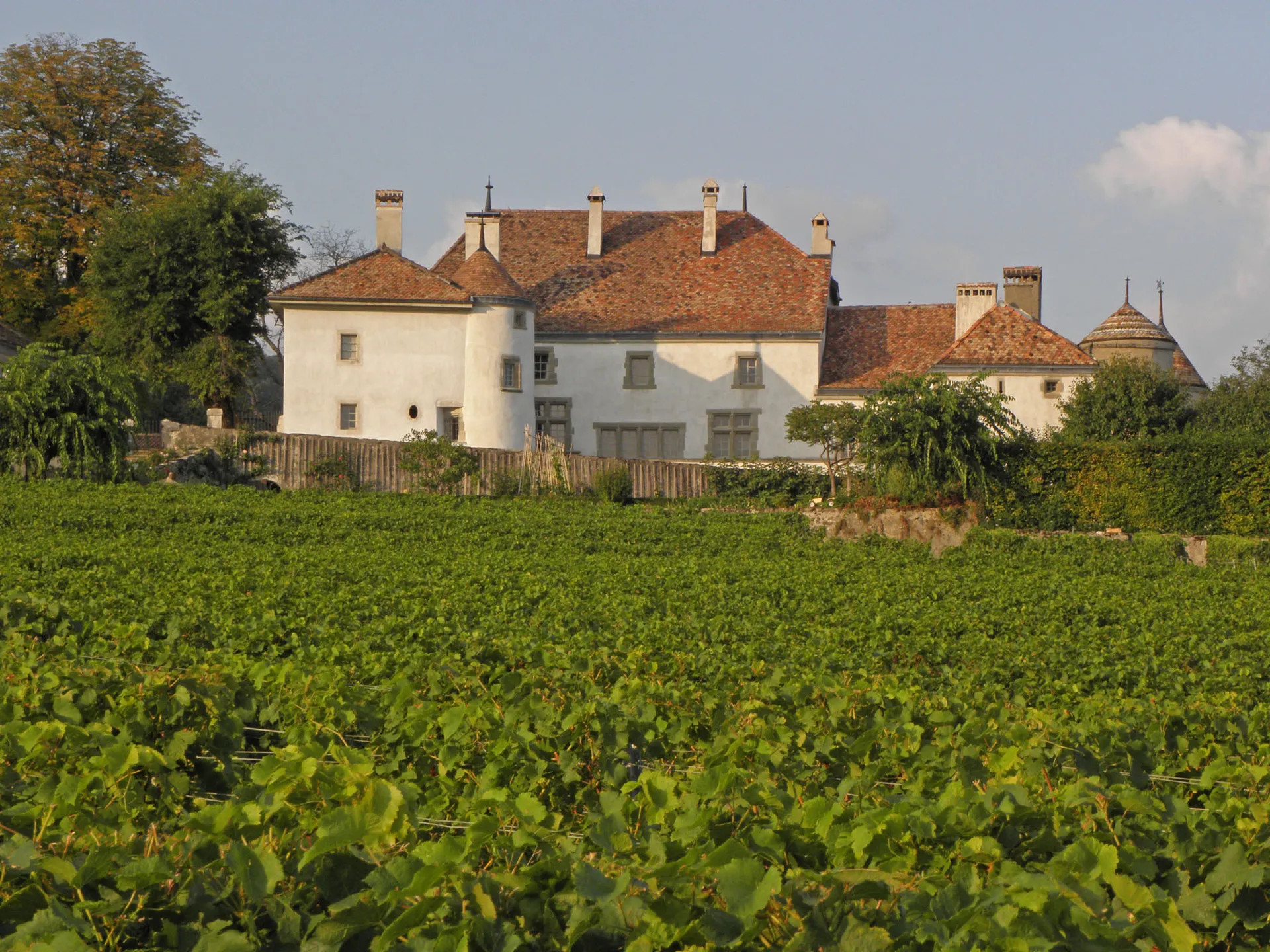 Photo: Eric Bajart · CC BY-SA 3.0
- Time needed
- 1-2 hours for a tasting
- Entry
- Gastronomic dinner ~CHF 200; tastings by reservation
- Best season
- Autumn (harvest and game dinners)
A spoon nearly burned Château du Rosay to the ground. In the village of Bursins, Switzerland, above the vineyards of La Côte, this once-burned carré savoyard survives as a working wine estate and tiny hotel. Come for the heraldic roses in the chapel vault, stay for the 300-year-old chestnut tree and a glass of Chasselas with Mont Blanc in the distance.
Do not confuse it with Institut Le Rosey in Rolle, the boarding school that shares its name. The Bursins château was the 'petit château' that feudal records link to the Rolle estate. Today it opens only to hotel guests, wine-tasting reservations, and occasional diners — a private estate, not a public museum.
The bones are classic Savoyard square: four round corner towers around a rectangular core, one still carrying an exterior spiral staircase, its steps undercut with two concave surfaces that scholars attribute to early 16th-century craftsmen, possibly Machard's workshop. A neoclassical salon from around 1830 preserves a painted ceiling of grisaille rosaces, oak and laurel wreaths, and a thyrsus with vine tendrils around a central circle of colored flowers. The contrast sounds discordant; in person it feels like an argument the house has learned to live with.
The estate's recent stewards, Pierre and Silvia Bouvier, came as architects rather than trained vintners. From 2000 onward they replanted varieties, stopped bulk wine sales, and by 2017 pushed production to about 17,000 bottles a year. Their wines include Côté-Nil, a Chasselas that winks at the Nile, and Héliodore, a sweet late-harvest Chasselas.
What to see
-
The Savoyard Square and Its Burned Past
Start with the shape: a rectangular keep pinned at each corner by a round tower, the classic carré savoyard that made this place a small fortress before it became a wine estate. One tower still carries an external spiral staircase, its steps undercut into two concave curves — early 16th-century work, possibly from the Machard workshop — and so finely dressed it feels like furniture under your hand. Stand in the courtyard under the 300-year-old chestnut and you'll hear pigeons, not soldiers: the stone still carries the memory of the League of the Spoon, when François de Senarclens joined that belligerent supper club in 1527 and Bernese troops replied with fire in 1530, then again at the end of January 1536 — while the long-demolished fifth tower leaves only an unexplained gap east of the main block. -
The Chapel, the Salon, and the Heraldic Ceilings
Push through one of the carved oak doors and the air drops a few degrees, tasting of stone and cool plaster. The 16th-century chapel is now a reception hall, but look straight up: two vaulted keystones show the arms of Senarclens and Benoît — three stars, then three stars with three roses — the marriage that bound the family to both the château and its near-destruction. In the neoclassical salon created around 1830, a painted ceiling survives with rosaces, oak-and-laurel wreaths, and a thyrsus with vine tendrils around a central circle of colored flowers; breakfast under the Gothic fireplace and worn terracotta tiles downstairs is the easiest way to feel how all these centuries fit together. -
The Vineyard Loop: From Dovecote to Mont Blanc
Save an hour for the chemin du Rosay as it climbs through the upper village, past a small dovecote tower that copies the château's silhouette like a child playing dress-up. At the top, the slope eases and the vines run toward Lake Geneva; on clear mornings Mont Blanc hangs beyond the far end of the rows, and the Jura forest sits dark behind you. Walk the 4.5 hectares of vines — roughly six football pitches — then ease into the courtyard for a glass of Côté-Nil Chasselas under that enormous chestnut; call ahead, since the interior is mostly for overnight guests and event bookings but the estate and tasting room welcome visitors who ask nicely.
Plan your visit
- Getting There
- By car, take the A1 motorway between Geneva and Lausanne and exit at Rolle or Gland, then follow signs to Bursins; Geneva airport is about 20 minutes away, Lausanne 30–40. Free parking is available on site. By train, ride SBB to Rolle station, then take a taxi or local bus about 5 km up to Bursins village and walk uphill on Chemin du Rosey.
- Opening Hours
- As of 2026, there are no standard public opening hours: this is a private wine estate and boutique hotel, not a museum. Visits happen by reservation only — Thursday evening tastings run 17:00–22:00, Saturday tastings start at 11:00, and gastronomic dinners are served Tuesdays and Fridays. Check lerosey.ch/agenda for seasonal open-house dates and any closures.
- Time Needed
- A focused wine tasting plus a look at the courtyard and cellar takes 1–1.5 hours. Seasonal open-house events with tastings run 2–4 hours. For the full experience — overnight stay, vineyard walk, breakfast by the gothic fireplace, and a dinner — allow 24 hours or more.
- Accessibility
- The château is medieval in structure: stone spiral staircases, multi-level interiors, and no elevator. Wheelchair access is not confirmed, and the surrounding terrain slopes through vineyards. Call +41 21 824 09 00 before booking to discuss specific mobility needs.
- Cost & Tickets
- There is no general admission ticket. Thursday evening tastings cost CHF 80 per person with a minimum of 8 people, and gastronomic dinners are CHF 200 per person including aperitif, wines, water, and coffee. Free entry happens only during seasonal events like the early-October harvest festival and late-November artisan market.
Photo Gallery


History
The Spoon That Burned a Castle
Bursins enters written history in 1011, when Rodolphe III of Burgundy gave his church to the priory of Romainmôtier. The château's own birth date is murkier: a fortified house may have stood here around 1260, but the archives offer no proof, and the first written mention of the manor comes only at the end of the 15th century.
By then, the de Benoît family held the property. Pierre de Benoît, ennobled in 1498, put his black-and-gold arms with three red roses in the château. The roses would marry the Senarclens stars, and that alliance would very nearly burn the house down twice.
The turning point
The Spoon That Burned a Castle
At a 1527 feast in nearby Bursinel, a Savoyard noble raised his spoon and swore, 'As surely as I hold this spoon, we will swallow Geneva.' That theatrical toast became the League of the Spoon, whose members wore precious-metal spoons around their necks as a pledge to crush Calvinist Geneva. François de Senarclens, who lived at Château du Rosay with his wife Andrée de Benoît, signed on.
When Bernese troops marched into the Pays de Vaud in 1530, they torched the houses of league members. François had his wife's ancestral seat to lose; the roses of her family were cut into the chapel vaults, and his own skin was hardly safe. The soldiers came through the vineyards. The round towers and roofs caught; the château was gutted. At the end of January 1536, during the Bernese conquest, the place burned again.
That the château survived at all is the quiet miracle recorded in its walls: a 1655 buttress at the southwest corner, a rebuilt 16th-century chapel, worn terracotta floors, and vault keystones showing the Senarclens stars alone and beside the Benoît roses.
The Lost Fifth Tower
Eight Generations, One Right of Passage
Tips for visitors
Dress Smart-Casual
For Thursday tastings or a Saturday cellar visit, skip hiking boots and beachwear; French-speaking Switzerland expects polish. For the CHF 200 dinners, a jacket and closed shoes match the vaulted chapel dining room.Ask Before Shooting
Outdoors and vineyards are fine for personal photos, but this is a private residence. Ask before photographing interiors near the gothic fireplace or painted ceiling; flash is discouraged around delicate decoration, and drones require written permission under Swiss rules.Eat Where Locals Do
For a simpler meal than the château dinner, try Café de l'Union in Bursins (budget-mid) for a classic village café, or Auberge de Gilly in adjacent Gilly (mid) for traditional Swiss auberge cooking and a solid La Côte wine list. Auberge du Soleil in Bursins is another mid-range rustic option.Harvest Chaos Is Real
September to October is harvest: tractors and pickers crowd the lanes, but the cellar is at its most alive. Drive slowly, never park in front of cellar doors, and if you want free tastings, aim for the early-October harvest weekend.Free Entry Only Twice a Year
You can avoid tasting fees only during seasonal open-house events — the early-October harvest festival and late-November artisan market offer free entry with tastings. Otherwise you're committing to CHF 80 for a Thursday tasting (minimum 8 people) or CHF 200 for dinner.Not the Famous School
Don't confuse Château Le Rosey in Bursins with Institut Le Rosey in Rolle, the renowned boarding school. Set your GPS to Chemin du Rosey 6, 1183 Bursins; locals will correct you with a patient sigh if you show up asking about princes at the wrong gate.
Frequently asked
Is Château du Rosay worth visiting?
Yes, if you want a private wine-estate stay or tasting rather than a walk-in museum. It's a Savoyard-square castle with four round towers, a 300-year-old chestnut tree, and a 16th-century chapel turned reception room. But it's not open for casual tours; book a tasting, dinner, or one of four guest rooms.
How long do you need at Château du Rosay?
Allow 1–1.5 hours for a wine tasting, or 24 hours for the full experience with dinner and overnight. The Thursday evening tastings run 17:00–22:00, so even a quick visit can stretch. For a slower rhythm, book a Saturday morning tasting at 11:00.
How do I get to Château du Rosay from Geneva?
Drive about 20 minutes from Geneva Airport via the A1, exit at Rolle or Gland, then follow signs to Bursins. By train, take the SBB main line to Rolle and a taxi or bus the last 5 km. A car is strongly recommended because the château sits in a small wine village with limited public transport.
What is the best time to visit Château du Rosay?
September and October, when the harvest is on and the domaine opens for a free October festival. November's artisan market is another good free-entry window. Winter suits fireside breakfasts and the indoor spa; summer gives you long light over the lake and courtyard tastings.
Can you visit Château du Rosay for free?
Only during seasonal open-house events like the early October harvest festival or late November artisan market. Otherwise, reserve a tasting (from CHF 80), a gastronomic dinner (CHF 200), or an overnight stay. No general admission ticket exists.
What should I not miss at Château du Rosay?
Look up in the former chapel for the vault keystones bearing the Senarclens stars and Benoît roses. Also find the external spiral staircase on one tower, the 300-year-old chestnut tree in the courtyard, and the wine cellar down below. If staying, ask for the room with a bathtub view of Lake Geneva.
Can you stay overnight at Château du Rosay?
Yes, the château operates four guest rooms as a boutique hotel. Breakfast is served beside a gothic fireplace, and guests can tour the wine cellar. Book well ahead for harvest season or wedding weekends.
Is Château du Rosay the same as Institut Le Rosey?
No. Château du Rosay in Bursins is a wine estate and boutique hotel; Institut Le Rosey is the famous boarding school in Rolle. The Bursins castle was historically the 'petit château' and even depended on the Rolle estate, but they are separate places.
Sources & attribution 12
- Swisscastles – Le château de Rosay/Rosey à Bursins (French) — Primary source for the 1530 Bernese burning, League of the Spoon, chapel vault keystones, fifth tower, ownership chain, and ancestral right of passage.
- Swisscastles – Le château de Rosay/Rosey à Bursins (German) — German version with the 1260 fortified house date and architectural details of the Savoyard square.
- Château Le Rosey official site — Current wines, estate philosophy, and event sections for the domaine.
- Château Le Rosey agenda — Seasonal tastings, free harvest festival, artisan market, and reservation requirements.
- Marilyn Rebelo – Visite du Château Le Rosey — Private estate and boutique hotel context, 300-year-old chestnut tree, gastronomic dinner pricing, and guest room details.
- TripAdvisor – Château Le Rosey hotel reviews — Guest reports on breakfast by the gothic fireplace, wine cellar tours, four guest rooms, and split opinions on the estate wines.
- Naef Prestige – Exceptional castle for auction in Bursins — Property details including 4.5 hectares of vines, three courtyards with fountains, spa, and 20-minute drive from Geneva Airport.
- Luxury Places – For sale castle Bursins — Views over Lake Geneva, Mont Blanc, orchard and kitchen garden, and the château's medieval refuge character.
- OVV – Château Le Rosey producer page — Biodynamic certification, 4.5 hectares, 10 grape varieties, and 19 single-varietal cuvées.
- Guide du Vin – Château Le Rosey Bursins — Terroir details including south-facing slope, roughly 430 m elevation, and La Côte AOC context.
- Wikipedia – Institut Le Rosey — Used to distinguish the Bursins wine estate from the famous boarding school in Rolle.
- Trip.com – Château Le Rosey hotel detail — Address and hotel listing details for the Bursins property.
Built from cited sources · see the method · How we make our guides →
More in Bursins.
3 places to discover — a few worth pairing.


Pick up where you left off
Saved and recently read places — kept on this device only.
Photo credits (6)
- Chateau du Rosey 01 — Eric Bajart — CC BY-SA 3.0 (https://creativecommons.org/licenses/by-sa/3.0/) — Source: https://commons.wikimedia.org/wiki/File:Chateau_du_Rosey_01.jpg
- Bursins, Château du Rosey (1) — Leemburg-CH — CC BY-SA 4.0 (https://creativecommons.org/licenses/by-sa/4.0/) — Source: https://commons.wikimedia.org/wiki/File:Bursins,_Château_du_Rosey_(1).jpg
- Bursins (5) — Leemburg-CH — CC BY-SA 4.0 (https://creativecommons.org/licenses/by-sa/4.0/) — Source: https://commons.wikimedia.org/wiki/File:Bursins_(5).jpg
- Bursins (3) — Leemburg-CH — CC BY-SA 4.0 (https://creativecommons.org/licenses/by-sa/4.0/) — Source: https://commons.wikimedia.org/wiki/File:Bursins_(3).jpg
- Bursins, Château du Rosey (2) — Leemburg-CH — CC BY-SA 4.0 (https://creativecommons.org/licenses/by-sa/4.0/) — Source: https://commons.wikimedia.org/wiki/File:Bursins,_Château_du_Rosey_(2).jpg
- Bursins (6) — Leemburg-CH — CC BY-SA 4.0 (https://creativecommons.org/licenses/by-sa/4.0/) — Source: https://commons.wikimedia.org/wiki/File:Bursins_(6).jpg
Photos may have been resized or cropped.