Bursinel Castle
BursinelSwitzerland 46° N · 6° E Updated Aug 2026
A medieval castle razed in 1530 after pro-Savoy nobles plotted against Geneva now produces biodynamic wine for the Knights of the Spoon above Lake Geneva.
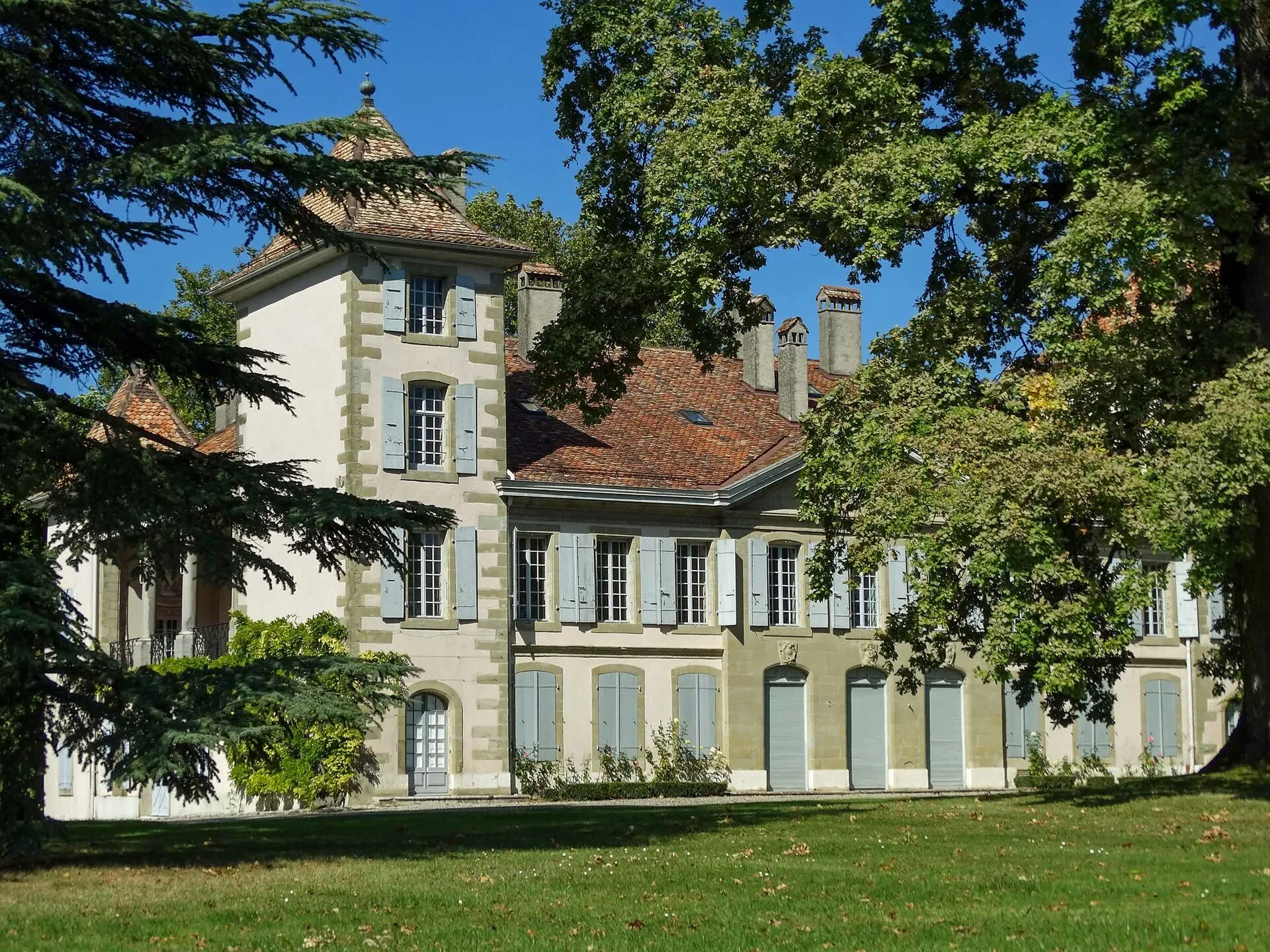 Photo: Leemburg-CH · CC BY-SA 4.0
- Time needed
- 30-45 minutes
- Entry
- Free to view from outside; no public interior access
- Access
- Exterior viewable from public roads; private estate has no public interior access
- Best season
- Late spring to early autumn
The most dangerous dinner party in Swiss history took place in the first-floor hall of Bursinel Castle — and the weapon of choice was a spoon. Here, according to tradition, a roomful of pro-Savoy nobles swore in 1527 to "swallow Geneva" like a mouthful of soup, founding the mock-chivalric order of the Chevaliers de la Cuiller. The castle they toasted in still stands above Lake Geneva in Bursinel, Switzerland, though it burned for their arrogance just three years later.
What you see from the road is largely an 18th-century classical residence — white façades, a pediment, a colonnaded gallery. But the square medieval donjon survives inside it, and its first-floor hall is the traditional site of the Spoon Oath. A Roman road passes directly in front of the château; paving stones from antiquity were found during excavations, meaning visitors strolling the lane may be walking on a road older than the castle itself.
Today Bursinel Castle is a private wine estate of about 6.5 hectares — roughly nine football pitches of vines — worked biodynamically on the slopes above the lake. You can't tour the interior, but the story is everywhere: the bottles carry the label "Château de Bursinel, ancien fief des Chevaliers de la Cuiller." The spoon is still in the name, five centuries after the oath.
What to see
-
The Keep Where a Spoon Became a Weapon
October 1527: pro-Savoy nobles crammed into the first-floor Rittersaal of the square medieval keep and brandished spoons, not swords. The story goes that one swore he would swallow Geneva the way he held that spoon, and the Chevaliers de la Cuiller were born — members wore gold or silver spoons around their necks. The castle burned in 1530 as punishment, but the keep survived, its mullioned windows still framing the room where that oath echoed. You can't just wander in; this is a private domaine, but a tasting with winemaker Marc Pernet (+41 79 293 76 74) can get you closer than most visitors ever get. -
The 18th-Century Residence and the Chasselas Vines
Gabriel Delagrange's 1761–1770 rebuild gave the castle a classical colonnade and a clear facade that still catches the lake light. Marc-Frédéric-Charles de Sacconay called the old place 'a sad château' in 1744, but after the work he boasted it was 'convenient, solid, pleasant' — and he was right. Today the domaine covers 6.5 hectares, roughly nine football pitches, mostly Chasselas grapes worked by Marc Pernet. Walk the vine rows in autumn and you'll smell fermenting fruit and hear the clatter of harvest bins, the same rhythms that have kept this estate alive since the 13th century. -
A Footpath from Roman Paving to the Lake
Start at the old cantonal road where excavators found Roman paving stones worn smooth by cart wheels two millennia ago. Then climb through the vines toward the castle's bright facade, past the spot where the Bourla-Papey faction burned the seigneurial archives in 1802 — a bonfire of centuries of records. From the upper terrace, Lake Geneva opens wide; on clear days you can see France and, if you're lucky, Mont Blanc. This is not a museum route but a working landscape, and the best time is late afternoon when the Jura foothills turn blue and the vines glow gold.
Plan your visit
- Getting There
- Take the A1 motorway to the Rolle/Allaman exit, then follow signs toward Bursinel. The castle sits above the cantonal road between Rolle and Nyon, impossible to miss from the lakeside route. Street parking exists on Route du Village; the nearest rail stations are Rolle and Allaman.
- Opening Hours
- As of 2026, there are no public opening hours — this is a private residence and working wine domaine, not a museum. You can view the exterior from the public road at any time, but the grounds, park, and interiors are closed to visitors. No ticket office, no tour booking page, no seasonal schedule.
- Time Needed
- A quick photo stop takes 15–30 minutes. Add an hour to wander the village lanes and lakeshore below the castle. Interior exploration isn't possible without an invitation, so don't budget time for it.
- Cost & Wine Contact
- Free — there's nothing to buy a ticket for. The exterior view from the road costs nothing. If you want to purchase wine or arrange a legitimate visit, contact winemaker Marc Pernet at [email protected] or 079 293 76 74.
- Accessibility
- No official accessibility information exists. The castle sits on a hill above the cantonal road with sloped terrain, and viewing from the road isn't wheelchair-friendly. No elevators, ramps, or adapted paths are documented.
Photo Gallery


History
The Oath in the Donjon Hall
The noble family de Bursinel appears in records as early as 1210, with their residence first mentioned in 1244. The fortified house sat above Lake Geneva on a hillside where the Roman road ran past the gates — a seat of local power in a landscape of competing castles.
In 1802, during the Bourla-Papey uprising, revolutionaries burned the seigneurial archives, obliterating centuries of administrative records in a single act of fire. But the defining drama of this place came three centuries earlier, in a candlelit hall, over dinner.
The turning point
The Knights Who Swore to Swallow a City
Legend holds that in 1527, Savoyard and Vaudois nobles gathered in the first-floor hall of the donjon, furious at the rich, Protestant-leaning, Swiss-allied city of Geneva. One knight raised his spoon and swore: "Aussi vrai que je la tiens nous avalerons Genève" — as surely as I hold this spoon, we shall swallow Geneva. The company founded a mock-chivalric league on the spot, with statutes, officers, and a rule that every member wear a gold or silver spoon around his neck on pain of a fine.
The league was no joke. Under François de Pontverre, seigneur de Faucigny and captain-general of Savoy, the Knights of the Spoon attacked Geneva with 700 to 800 men carrying scaling ladders — a column that would have stretched the length of the lakeside road. Pontverre died at Geneva's walls around 1528, and his death radicalized the league rather than breaking it.
In 1530, the knights gathered nearly 4,000 men — the population of a small town, marching on one city — and attempted an escalade. Geneva called on Bern and Fribourg. Swiss troops invaded Vaud and burned the castles of every Spoon Knight, including Bursinel. From Geneva's ramparts, the besieged citizens watched the fires of their rescuers advancing across the countryside. The chronicler François Bonivard, the famous prisoner of Chillon, later wrote of the affair: "After it had thundered for a long time, it finally had to rain."
The Man Who Called It a 'So-Called Castle'
From Supermarkets to Wine Labels
Tips for visitors
Exterior Only
Photography from the public road is fine, but don't step onto the grounds — this is someone's home and a working vineyard. Swiss property owners are protective, and drone use over private land requires owner permission.Eat at La Clef d'Or
The village's Gault & Millau-rated restaurant, run by the Puget family, changes its menu 6–8 times a year — splurge territory at CHF 60–100+ per person, but the lake and Mont-Blanc views justify it. For something sweeter, Patisserie Ch. Moret in Rolle has what one visitor called 'probably the best cakes I have ever had.'Wait for Clear Weather
On clear days you can see across the lake to France and, if you're lucky, Mont Blanc. Check the forecast before making the trip — the view is the whole point, and haze or cloud turns this into just another roadside stop.Walk the Toblerone Trail
The Sentier des Toblerones is 3.8 km away — a hiking path along WWII anti-tank barriers shaped like the chocolate bar. Combine the castle photo stop with this walk for a proper half-day outing.Contact the Winemaker
Marc Pernet produces the Chevaliers de la Cuiller rosé at the castle, continuing a tradition tied to the medieval wine brotherhood. Email [email protected] if you want to buy wine or arrange a visit — a purchase might open doors a photo stop never will.Route Suisse Caution
The road past the castle is one of Switzerland's busiest lakeside arteries — a motorcyclist died in a collision here. Pull over safely in the village, never stop on the road for photos.Castle-Hop the Coast
Château de Rolle (3.9 km) has massive corner towers and now houses municipal offices, while Château Le Rosey is a wine stopover and Dully Castle is a 25-minute walk. Make a day of it — this coast is dense with fortified houses.Know the Spoon Story
In 1527, pro-Savoy nobles met at this castle and boasted they'd 'swallow Geneva like a spoonful' — hence the Chevaliers de la Cuiller, Knights of the Spoon. Swiss forces destroyed the castle in 1530, but the name survives in the wine label.
Frequently asked
Is Bursinel Castle worth visiting?
For history nerds and wine lovers, yes—but keep expectations realistic. This is a private residence and working wine domaine, not a public monument, so you can only see the 18th-century facade and medieval keep from the road. The payoff is imagining the 1527 banquet where knights allegedly swore to swallow Geneva like a spoonful.
Can you visit Bursinel Castle for free?
Exterior views from the road are free, but the interiors stay closed to the public. No ticket office, no guided tours, no opening hours exist. For more, contact the wine domaine directly—access is at the owner's discretion.
How long do you need at Bursinel Castle?
Fifteen to thirty minutes for an exterior photo stop. Add another hour if you wander the village lanes and vineyard edge above the lake. Since the interiors are private, plan this as a pause, not a half-day.
How do I get to Bursinel Castle from Geneva?
By car, take the A1 motorway toward Lausanne and exit for Rolle/Allaman, then follow signs to Bursinel. By rail, ride toward Lausanne and get off at Rolle, the nearest major stop, then continue the few kilometres by taxi or local bus. The château sits above the cantonal road between Rolle and Nyon, so putting 'Bursinel, village' into the SBB timetable gives the most practical door-to-door route.
What is the best time to visit Bursinel Castle?
Autumn, during the grape harvest, when the vines turn gold and the estate smells of fermenting Chasselas. Spring brings fresh green growth and lighter crowds. Since you're mostly viewing from the road, any clear day works—but harvest has the strongest atmosphere.
What should I not miss at Bursinel Castle?
The medieval square keep, because it's the only part that survived the 1530 Swiss burning. Legend holds its first-floor hall hosted the 1527 Knights of the Spoon banquet. Also look for the old Roman paving stones near the road—the route predates the château by well over a millennium.
Who owns Bursinel Castle?
The castle passed from the Sacconay family to the Caprotti family, founders of the Esselunga supermarket group, and now has new private owners. It operates as a 6.5-hectare wine domaine producing Chasselas. That private status is exactly why you won't find a public ticket desk.
Sources & attribution 6
- Swiss Castles – Château de Bursinel — History of the 1527 Knights of the Spoon banquet, 1530 destruction, medieval keep, and Roman road discoveries.
- Archives cantonales vaudoises – PP 809 Château de Bursinel — Archival details on Marc-Frédéric-Charles de Sacconay, Gabriel Delagrange's 18th-century renovation, and the castle's decay.
- Notre Histoire – Château de Bursinel — Uncertain tradition of the Knights of the Spoon and Guillaume Maccard's 1512 acquisition.
- Organisation Vaudoise des Vignerons – Château de Bursinel — Current wine domaine details: 6.5 hectares, Chasselas, producer Marc Pernet, and contact information.
- 24 heures – Le château de Bursinel a de nouveaux propriétaires — News that the castle has new private owners and remains a piece of Vaudois heritage.
- Giuseppe Caprotti – Bursinel: The Castle on the Lake — Caprotti family ownership history, Esselunga connection, and sale by daughter Violetta.
Built from cited sources · see the method · How we make our guides →
More in Bursinel.
1 places to discover — a few worth pairing.
Pick up where you left off
Saved and recently read places — kept on this device only.
Photo credits (3)
- Bursinel, château 03 — Leemburg-CH — CC BY-SA 4.0 (https://creativecommons.org/licenses/by-sa/4.0/) — Source: https://commons.wikimedia.org/wiki/File:Bursinel,_château_03.jpg
- Bursinel, château 02 — Leemburg-CH — CC BY-SA 4.0 (https://creativecommons.org/licenses/by-sa/4.0/) — Source: https://commons.wikimedia.org/wiki/File:Bursinel,_château_02.jpg
- Bursinel, château 01 — Leemburg-CH — CC BY-SA 4.0 (https://creativecommons.org/licenses/by-sa/4.0/) — Source: https://commons.wikimedia.org/wiki/File:Bursinel,_château_01.jpg
Photos may have been resized or cropped.