Bern
Switzerland Updated May 2026
The Aare runs turquoise through Bern, and on summer afternoons you'll see men in suits walking back to the Bundeshaus with wet hair, their work clothes stuffed into waterproof bags. Switzerland's federal capital does not behave like a capital. It folds itself into a horseshoe bend of the river, hides its parliament behind sandstone arcades, and lets civil servants drift past the seat of government on inflatable rings.
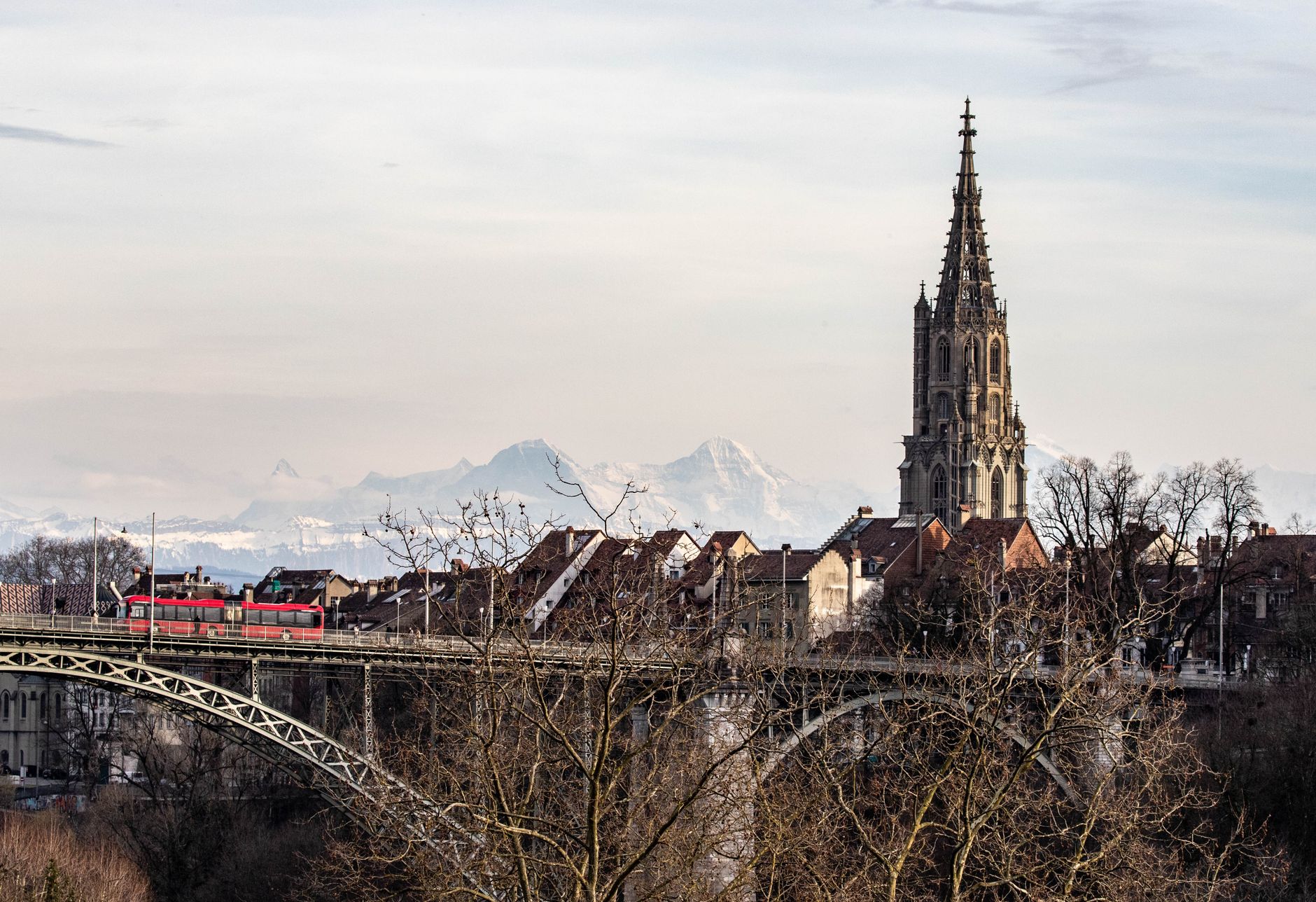 Photo: Louis / Pexels
- Attractions
- 15
- Trip length
- 2-3 days
- Best season
- Late spring to early autumn (May–September)
Why Bern
Built from cited sources · see the method · How we make our guides →
The Old Town has been a UNESCO World Heritage Site since 1983, but the designation undersells what's actually here. Six kilometres of vaulted arcades — the Lauben, Europe's longest covered shopping promenade — were rebuilt in stone after the great fire of 1405. Cellars that once stored wine and grain now hold bars, ateliers, and theatres. People live above them. They argue about parking. The medieval city is not a museum; it is a working neighbourhood that happens to be 800 years old.
Bern was founded in 1191 by Duke Berchtold V of Zähringen, who, legend has it, named it after the first animal killed on a hunt — a bear. The bears are still here, three of them, in a riverside park below the Nydegg bridge. The clock tower still strikes the hour with figures that have rotated since the 1500s. Einstein wrote special relativity in a second-floor apartment on Kramgasse in 1905, and you can climb the stairs to see his desk. The city wears its history without making a fuss about it.
What surprises visitors is the pace. Locals talk about their own "legendary slowness" the way other cities boast about energy. Lunch is the main meal. Apéro on a river terrace runs from five to seven. The Reitschule, the alternative cultural centre covered in graffiti, sits ten minutes from the federal palace, and both consider themselves equally Bernese. Come for a long weekend and you will leave understanding why Swiss-Germans treat a half-day in Bern as a small act of therapy.
A Living UNESCO Old Town
Six kilometres of sandstone arcades — Europe's longest covered shopping promenade — were rebuilt after the 1405 fire and are still inhabited above the vaulted cellars where bars and bookshops now live. UNESCO inscribed the whole peninsula in 1983, but nobody told the bakers and barbers, who still trade under the Lauben.Swimming Through the Capital
The Aare runs glacier-turquoise around three sides of the Old Town, and from June through September locals pack their clothes into waterproof bags and float past the Parliament building. The Marzili baths beside the Bundeshaus cost nothing to enter — the current does the work.The Zytglogge and Einstein's Clock
Bern's 13th-century clock tower performs a four-minute mechanical show every hour with jesters, a rooster, and Chronos turning his hourglass. Einstein lived four doors down at Kramgasse 49 in 1905 and stared at this clock on his tram rides home — the year he wrote special relativity.Bears on the Riverbank
The city is named after one. Legend holds that Duke Berchtold V vowed in 1191 to name his new town after the first animal his hunters killed, and the Bärenpark below the Nydegg bridge still keeps live bears — Finn, Björk, and Ursina — on a forested slope above the Aare.
Neighborhoods
Where to wander, by quarter — each with its own rhythm.
Altstadt (Old Town)
The UNESCO core — a sandstone peninsula wrapped by the Aare, threaded with six kilometres of arcades and punctuated by eleven painted 16th-century fountains. The upper end around the Zytglogge and Kramgasse pulls the tourist traffic; walk east toward Postgasse and Junkerngasse and the crowds thin to nothing. Restaurants, ateliers, and bookshops live in vaulted cellars that smell faintly of cold stone year-round.Matte
The old fishermen's quarter below the cathedral cliff, hugging the Aare. Flood-prone, low-lying, and small enough to walk in fifteen minutes, Matte kept its own back-slang dialect — Matteänglisch — into the 20th century. The Fischerstübli still serves river-trout dinners, and the Matte distillery runs tastings in old workshop spaces. Take the Mattelift, a tiny public elevator, back up to the Old Town.Lorraine & Breitenrain
Across the Lorrainebrücke from the Old Town: the city's left-bank in spirit. The Reitschule sits at the edge — Bern's politically left, graffiti-painted cultural centre with concerts in the attic Dachstock and theatre in the Tojo. Indie cafés, second-hand shops, and the kind of bars where the bartender will recommend a Mani Matter song. Younger, scruffier, and where locals actually go out.Länggasse
The university quarter northwest of the Old Town. Student bookshops, cheap Asian kitchens, and late-opening bars cluster around the main university buildings. The Botanical Garden tucks itself into the slope down to the Aare — a free, quiet detour with views back at the cathedral spire.Kirchenfeld
South across the high Kirchenfeldbrücke, a 19th-century residential district laid out on a grid that feels distinctly un-medieval. The museum row lives here: Bern Historical Museum (with the Einstein Museum inside), the Natural History Museum that still keeps Barry the St Bernard, the Museum of Communication, and the Alpine Museum. Embassies occupy the side streets. Quiet by ten.Marzili
A flat riverside strip directly below the Bundeshaus, defined by one thing: the free public baths. From May through September, locals walk in after work, change in wooden cabins, and float the Aare down from Schwellenmätteli — the current does the work. The Marzili baths are the city's social anchor; if you want to see how Bernese politicians actually unwind, this is it.Liebefeld
Just south of the city limit, an industrial pocket reborn as a cultural quarter. The Vidmarhallen — former factory halls — now house productions for Bühnen Bern, the city's main theatre company. Restaurant Vierte Wand sits inside the complex. Reach it in twelve minutes on the S-Bahn; come for a play, stay for dinner.Gurten Foothills
The base of the Gurten, Bern's house mountain, southwest of the centre. The funicular climbs from Wabern in four minutes to a 858-metre summit with panoramic views, restaurants, and the Gurtenfestival grounds. Below the lift, Heitere Fahne hosts inclusive concerts, Sunday brunch with warm Züpfe braided bread, and pizza nights with a small-village atmosphere ten minutes from the federal palace.
Plan your trip
Before you go
- Getting There
- Bern-Belp (BRN) handles small regional flights; most international travellers arrive via Zurich Airport (ZRH) with direct SBB trains roughly every half hour to Bern Hauptbahnhof in 1h 10–1h 30, or via Geneva (GVA) on direct trains in about 1h 53. Bern Hauptbahnhof sits at the western edge of the Old Town and connects to the A1 (Zurich–Geneva) and A6 (toward Thun and the Bernese Oberland) motorways.
- Getting Around
- BERNMOBIL runs the city's trams and buses (no metro) integrated with the Libero zonal fare system; the Old Town sits inside zones 100/101. Anyone sleeping in Bern in 2026 gets the free Bern Ticket at hotel check-in, covering unlimited trams, buses, S-Bahn, and the Marzili and Gurten funiculars for the entire stay — verify single-fare and day-pass prices at mylibero.ch before travel. PubliBike stations and riverside cycle paths cover the flatter ground; the Old Town itself is walkable end to end in fifteen minutes.
- Climate & Best Time
- Bern has a humid continental climate: winter highs hover near 4°C with occasional snow, spring climbs from 11°C in March to 19°C in May, summers average 23–25°C with frequent thunderstorms and around 110 mm of rain a month, and autumn cools from 20°C in September to 8°C in November. July and August are peak season (and the only time the Aare is warm enough to float); May, June, and September offer mild weather and thinner crowds, while February is the cheapest month for hotels.
- Language & Currency
- Bern is German-speaking — locals speak Bärndütsch among themselves but switch to Hochdeutsch or English with visitors, and French is widely understood. The currency is the Swiss franc (CHF); cards and contactless are accepted nearly everywhere, though the domestic TWINT app needs a Swiss bank account, so keep some cash for kiosks and public toilets.
- Safety
- Switzerland is among the world's safest countries and Bern is no exception, with petty pickpocketing around Hauptbahnhof the main concern. The real hazard is the Aare itself: the current is faster than it looks, swimmers have drowned, and you should only float if you're a strong swimmer, enter at Marzili, and climb out at the marked steel ladders before the river bends. Emergency numbers are 117 (police), 144 (ambulance), 118 (fire).
A City Built on a Bend in the River
From Celtic oppidum to federal capital, eight centuries inside a horseshoe of the Aare
- c. 200 BCE
The Helvetii Fortify the Engehalbinsel
On a peninsula north of today's Old City, a Celtic La Tène community raised earthworks and timber palisades into an oppidum — likely one of the twelve Helvetian strongholds Caesar later names in his Gallic War. A zinc tablet unearthed in the 1980s preserves what was probably the place's old name, Brenodor, from the Celtic word for a gap or chasm in the land. The shape of the river hadn't changed. The people on it would, repeatedly.
- 1st c. CE
A Roman Vicus on the Same Bluff
After Rome subdued Helvetia, a modest Gallo-Roman settlement rose on the Engehalbinsel: a small amphitheater, three temples, workshops, and a bathhouse at the northern tip. A road ran west to Aventicum, then capital of the province. By the early third century, sometime between 165 and 211, the vicus was quietly abandoned, leaving the bend in the Aare empty again for nearly a thousand years.
- 9th–10th c.
A Burgundian Court at Bümpliz
While the Old City hill sat empty, the Kingdom of Burgundy built a timber-fortified Königshof at Bümpliz, a few kilometers west. Graveyards from the sixth and seventh centuries — more than three hundred burials south of the Bremgarten woods — hint at quiet, scattered farming villages. No one yet thought to settle the high, defensible peninsula that the Aare loops around three times.
- 1191
Berchtold V Founds the City
Berchtold V, Duke of Zähringen, planted a small castle at Nydegg on the eastern tip of the river-locked peninsula to guard the crossing. The new town grew westward along three long, parallel streets — the textbook Zähringer plan. Folk tradition says the duke vowed to name the place after the first animal killed on a hunt; out of the forest came a bear. Scholars suspect the name owes more to Verona, called Bern in Middle High German, or to that older Celtic Brenodor. The bear stuck regardless.
- d. 1218
Berchtold V, Duke of Zähringen
He held no duchy of his own, only an imperial license to act like a duke south of the Rhine — and he used it to seed cities. Fribourg in 1157, then Burgdorf, Murten, and Bern. When he died without heirs in 1218, his urban projects survived him by becoming free of any lord. Bern would spend the next six centuries proving him right.
- 1218
The Goldene Handfeste
A charter said to come from Emperor Frederick II declared Bern a Free Imperial City, answering to the emperor and no one in between. Modern scholarship reads the document as a clever mid-13th-century Bernese forgery. It worked anyway. By the end of the century, Bern was effectively independent, and King Rudolf I of Habsburg confirmed the privileges in January 1274.
Show the full timeline (28 moments)
- 1256–1344
The Käfigturm and the Westward March
As the town pushed west along the peninsula, each new defensive line needed a new gate tower. The Käfigturm rose between 1256 and 1344 as the second western gate, later repurposed — true to its name — as a prison. The earlier Zytglogge, already standing by the 13th century, simply stopped being the edge of town and became the heart of it.
- 1339
Victory at Laupen
On 21 June 1339, a Bernese army backed by Forest Cantons crushed a coalition of Habsburg-allied Burgundian and Swabian nobles at Laupen, a few hours west of the city. The battle didn't just defend Bern; it reoriented the city's alliances toward the Confederates and away from feudal lordship. The road to 1353 was now open.
- 1353
Eighth Canton of the Confederacy
Bern joined the Old Swiss Confederacy as its eighth member, the largest and wealthiest yet. Where Lucerne and Zurich brought trade, Bern brought territory and soldiers. It would become the muscle of the Confederation for the next four hundred years.
- 1405
The Great Fire Levels the Town
Wooden Bern burned. Whole streets of timber-framed houses were lost, and when the city rebuilt, it rebuilt in sandstone — the soft, honey-colored Bernese molasse quarried from the nearby hills. The vaulted cellars and ground-floor arcades that define the Old City today were shaped, in large part, by the lesson of 1405: do not build what fire can take twice.
- 1415
The Aargau Falls to Bern
Taking advantage of an imperial ban on Duke Frederick IV of Austria, Bern seized the Aargau from the Habsburgs. The conquest doubled the city-state's territory and gave it the Reuss valley, the Aare's lower course, and a population of subject villages that would pay taxes to Bern for the next four centuries.
- 1421
Foundations of the Münster
Matthäus Ensinger laid out the late-Gothic Bern Minster on the site of an older church near the southern edge of the peninsula. The nave and choir would take most of a century. The spire, planned but unbuilt for generations, finally went up in 1893 — at 100 meters, still the tallest church tower in Switzerland. Climb the 312 steps and the Bernese Oberland opens to the south like a wall of teeth.
- 1476
Charles the Bold Broken at Murten
On 22 June 1476, Bernese troops led the Confederate destruction of Charles the Bold's Burgundian army at Murten, two days' march west. Eight months later Charles himself died at Nancy. The Burgundian Wars made Bern, briefly, one of the most feared military powers in Europe — and seeded the loot, the prestige, and the appetite for territory that would carry the city through the next two centuries.
- 1492–1536
Berchtold Haller, Reformer
He came from Aldingen in Württemberg and arrived at the Minster as a young preacher in 1521. From the pulpit he argued the new theology in plain German, won the council piece by piece, and was the central voice at the 1528 Disputation. He died in Bern eight years later, having turned the largest Catholic city-state north of the Alps Protestant without bloodshed.
- 1528
Bern Becomes Protestant
After ten days of public theological debate in January 1528, the Bern Disputation — staged in the Franciscan church with Zwingli arguing for reform — ended with the city council voting to abolish the Mass. The reformer Berchtold Haller had spent years preparing the ground. Niklaus Manuel had painted and versified it. Within a year, altars were stripped, monasteries dissolved, and Bern's enormous secularized church wealth poured into the city's treasury.
- 1536
Conquest of the Vaud
Taking the Pays de Vaud from the Duchy of Savoy made Bern the largest city-republic north of the Alps — French-speaking subjects, Lake Geneva shoreline, the whole stretch from the Jura to the Rhône. The patriciate that ran Bern would govern these lands until the French swept through in 1798, an unbroken 262 years of rule from the Rathaus.
- c. 1546
Hans Gieng's Painted Fountains
Across the Old City, a sculptor named Hans Gieng installed allegorical figures atop eleven new public fountains — Justice blindfolded with a sword, a Zähringer bear in armor, and most unsettlingly, the Kindlifresser, a seated ogre cramming a naked child into his mouth while more wait their turn in a sack. Nobody quite agrees what the Child-Eater means: Jew-baiting, Greek myth, a warning to disobedient children, or political satire of the Habsburgs. Bern keeps the question open.
- 1708–1777
Albrecht von Haller, Polymath
Born on the Inselgasse, Haller wrote the foundational textbook of human physiology, mapped the irritability of muscle fibers experimentally, catalogued the Swiss flora, and along the way produced Die Alpen — the 1729 poem that taught Europe to see the mountains as sublime rather than terrifying. He returned from his Göttingen chair to serve as Rathausammann in his hometown. Bern made him; he taught Bern how to be looked at.
- 1798
The French Take Bern
On 5 March 1798, Revolutionary French troops broke the Bernese militia at Grauholz and Neuenegg and entered the city the same day. The patrician republic ended in an afternoon. French soldiers carted off the city treasury — gold reserves so substantial that a share is said to have funded Napoleon's Egyptian campaign — and detached Vaud and Aargau as new cantons. Bern lost roughly half its territory and all its sovereignty in a single spring.
- 1848
Chosen as Federal Seat
On 27 December 1848, the new Federal Assembly voted Bern the seat of the Swiss federal government. The first round had given Bern 58 votes in the National Council against Zurich's 38; the Bernese municipal assembly accepted the honor a week earlier by 419 to 313. The Constitution never used the word capital, so to this day Bern is technically the Bundesstadt — the federal city. Everyone calls it the capital anyway.
- 1874
The Universal Postal Union Comes to Bern
Founded in Bern in October 1874 with twenty-two member states, the UPU made it possible to mail a letter from Tokyo to Lima at a single agreed rate. It still has its headquarters here — one of the oldest international organizations on earth, quietly running out of an office near the Helvetiaplatz. The International Telegraph Union (1868) and the International Peace Bureau (1892, Nobel 1910) followed the same instinct: neutral, small, central enough to host the world's quieter machinery.
- 1879–1955
Albert Einstein at the Patent Office
He moved into a third-floor flat at Kramgasse 49 in 1903, walked ten minutes each morning to a desk at the Federal Patent Office, and on evenings and weekends rewrote physics. The four 1905 papers — special relativity, the photoelectric effect, Brownian motion, and the equivalence of mass and energy — were drafted in that flat above the arcades. He stayed until 1909. The apartment is now a small, careful museum that resists making him a saint.
- 1879–1940
Paul Klee, Painter
Born in Münchenbuchsee, raised on Bern's Obstbergweg, schooled at the Progymnasium, Klee left for Munich and the Bauhaus and a slow, careful invention of his own visual language. When the Nazis dismissed him from Düsseldorf in 1933, he came home to Bern. He died in 1940 at the height of his powers; in 2005, Renzo Piano's three-wave Zentrum Paul Klee opened on the eastern edge of the city to hold his four thousand surviving works.
- 1902
The Bundeshaus Opens
On 1 April 1902, the central Federal Palace was inaugurated after eight years of construction by Hans Wilhelm Auer. The dome carries the inscription Unus pro omnibus, omnes pro uno — one for all, all for one — in mosaic, and the Federal Council still meets beneath it on Wednesdays. On the square outside, twenty-six fountains, one per canton, shoot water from the cobblestones in summer.
- 1979
The Jura Secedes
After a 1978 federal referendum, the French-speaking, mostly Catholic northern districts of Canton Bern broke off on 1 January 1979 to form the Canton of Jura — the only new Swiss canton created in the twentieth century. The split ended a culture war that had simmered since 1815 and reduced Bern, once briefly the largest Swiss canton again, to second place behind Graubünden.
- 1983
Old Town Listed by UNESCO
On the strength of six kilometers of unbroken late-medieval arcades, eleven Renaissance fountains, and an urban plan barely altered since the 15th century, the Old City joined the World Heritage list in 1983 under Criterion iii. The protection had begun much earlier — Bern's municipal heritage legislation of 1908 was one of Europe's first — which is why the inscription describes a living city rather than a preserved one.
- 2005
Renzo Piano's Three Waves
On the eastern outskirts, Renzo Piano set three long steel-and-glass waves into a green hillside above the autoroute. The Zentrum Paul Klee opened in June 2005, holding the largest collection of Klee's work anywhere — paintings, hand puppets he made for his son Felix, sketchbooks, the lot. From the Old Town it's a twenty-minute walk through allotments and orchards, which is somehow exactly right for Klee.
- 2009
Bears Move to the River
The cramped concrete Bärengraben opposite the Nydeggbrücke had housed bears since 1857 and was, by the 2000s, an embarrassment. In 2009 the city opened the BärenPark, a sloping six-thousand-square-meter enclosure running down to the Aare so that Finn, Björk, and Ursina can fish, climb, and swim in full view of tourists on the Old Town side. The founding myth gets a slightly less awkward setting.
Who lived here
-
Theoretical physicist · 1879–1955
Albert Einstein
Lived here 1902–1909
Einstein moved to Bern in 1902 to take a 'third class technical expert' job at the Swiss Patent Office, and from a small apartment at Kramgasse 49 he produced the 1905 'Annus Mirabilis' papers — special relativity, the photoelectric effect, E=mc². The flat is now a museum where you can stand in the room where modern physics started, two floors above an arcade still selling watches.
-
Painter · 1879–1940
Paul Klee
Grew up here, returned 1933
Klee was raised in Bern and came home in 1933 after the Nazis fired him from the Düsseldorf Academy, spending his final years here as his health failed. The Renzo Piano-designed Zentrum Paul Klee on the city's eastern edge holds roughly 4,000 of his works — the largest collection anywhere — under three rolling green-roofed waves that mirror the surrounding hills.
-
Anatomist and poet · 1708–1777
Albrecht von Haller
Born here
Haller was the kind of polymath that 18th-century Europe produced once a generation — physiologist, naturalist, encyclopedist, and the poet whose 'Die Alpen' helped invent the Romantic idea of the Swiss mountains. After his star turn at Göttingen he came back to Bern and served as Rathausammann, running civic affairs while corresponding with half of Enlightenment Europe.
-
Painter · 1853–1918
Ferdinand Hodler
Born here
Bern produced Switzerland's most important Symbolist painter and then watched him leave for Geneva, where he developed his 'Parallelism' theory of composition — rhythmic, mirrored figures against alpine landscapes. The Kunstmuseum Bern, the oldest art museum in Switzerland, keeps major works of his and remains the place to read him properly.
-
Surgeon · 1841–1917
Emil Theodor Kocher
Born here, worked here
Kocher won the 1909 Nobel Prize in Physiology or Medicine for his work on the thyroid gland — the first surgeon ever to receive it, and the first Swiss laureate in the category. He spent his career at the University of Bern, and his name is still attached to half a dozen surgical instruments invented in his operating theatre.
-
Chansonnier and lawyer · 1936–1972
Mani Matter
Lived and worked here
Matter wrote witty, melancholy songs in Bernese dialect and performed them with a single guitar, and he is still the cultural patron saint of the city more than fifty years after his death in a car accident. Locals will tell you that knowing two of his songs unlocks instant sympathy at any Bernese dinner table — try 'Hemmige' or 'Dene wos guet geit'.
-
Duke and city founder · c. 1160–1218
Berchtold V von Zähringen
Founded the city in 1191
Berchtold V chose the defensive horseshoe bend of the Aare to plant a new town in 1191, and legend says he named it after the first animal he killed on a hunt — a bear. The choice has shaped Bern ever since: live bears are still kept along the river at the BärenPark, and the coat of arms hasn't budged in 800 years.
Where to Eat
Where locals actually book dinner — not the tourist menus.
Insider tips
Small things that change how the city treats you.
Free Bern Ticket
Every hotel, hostel, and B&B booking in Bern gives you a free Bern Ticket at check-in, covering trams, buses, and S-Bahn in zones 100/101 plus the Gurten and Marzili funiculars for your entire stay.Float the Aare safely
Locals float the turquoise Aare from Schwellenmätteli to the Marzili baths, but the current is brutal. Only go in if you're a strong swimmer, and grab the metal exit handrails before the river bends — people drown every summer missing them.Drink the fountains
Bern has over 100 historic fountains and the water is excellent — refill your bottle anywhere unless you see a 'Kein Trinkwasser' sign. The 16th-century painted ones in the Old Town are working drinking fountains, not just sculptures.Sundays are closed
Almost every shop shuts on Sunday and most close by 18:30–19:00 on weekdays. Stock up Saturday morning at the Bundesplatz market, or use the Hauptbahnhof — its shops are the legal exception and stay open.Cards yes, TWINT no
Visa and Mastercard contactless work everywhere. TWINT, the mobile payment app locals use, needs a Swiss bank account, so don't bother trying to set it up as a visitor — keep a few CHF in cash for kiosks and public toilets.When to come
Mid-May to mid-September delivers the warmest weather and the river swimming season, with July the absolute peak (and priciest hotels). February is cheapest, but expect near-freezing days and a quieter city.Walk the arcades
The Old Town is a peninsula about 1.5 km long — you can cross it in 20 minutes. The 6 km of vaulted arcades ('Lauben') keep you dry in any weather, which matters: Bern gets rain on roughly 10–12 days every month.Eat where locals eat
Skip the postcard restaurants on the main squares. Harmonie does proper rösti with speck, Altes Tramdepot brews its own beer beside the bears, and Fischerstübli down in the Matte quarter feels like a different century.
Gallery
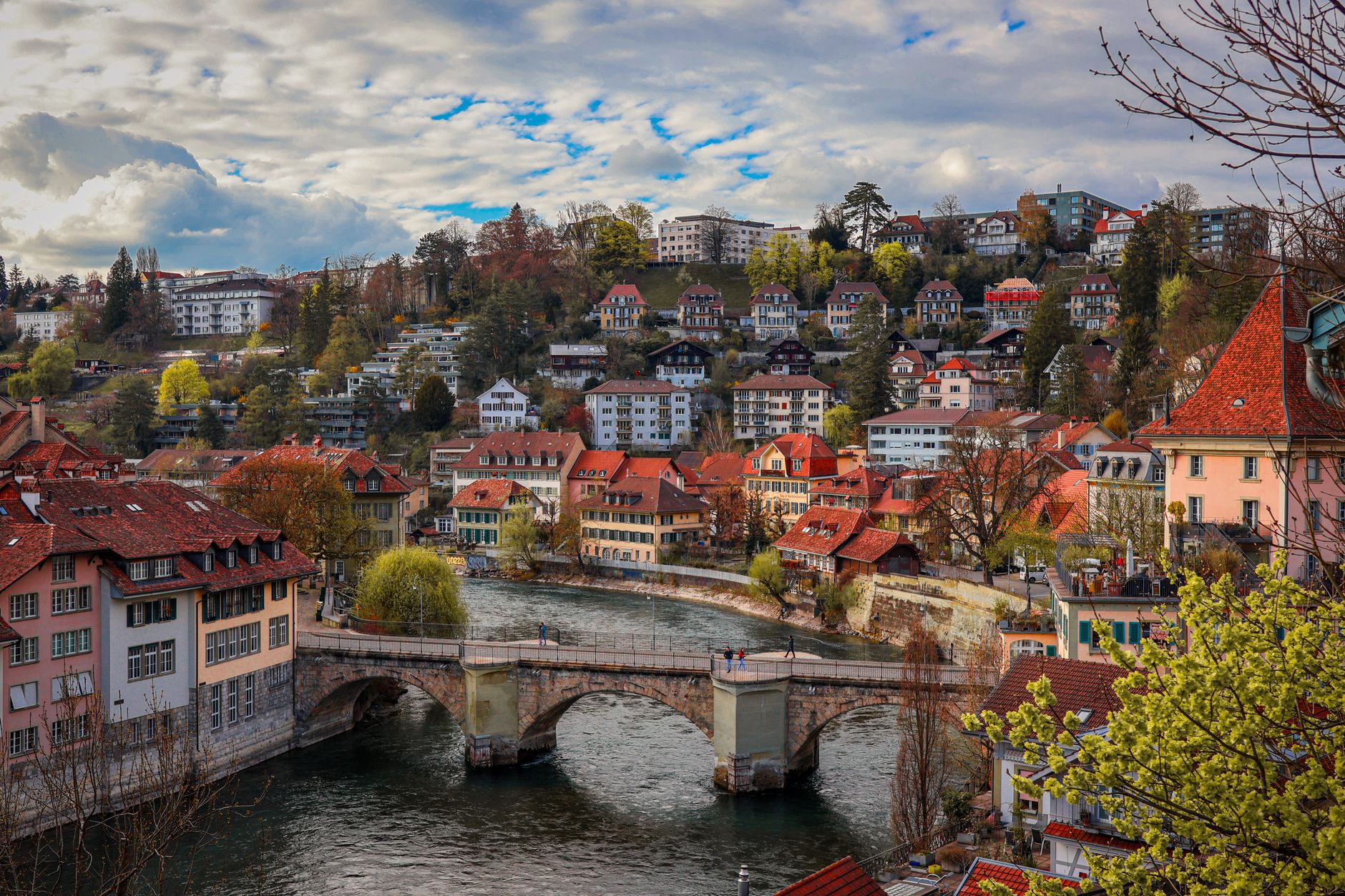
The city, as it actually looks.




Watch
-
Exotic Vacation How to Spend 1 Day in BERN Switzerland | Travel Itinerary
-
Jared and Britt 🤯 The BEST of Bern, Switzerland 🇨🇭 Day Trip to Old Town + Local's Travel Guide and Tips
-
Didi Dorn They Chose THIS as Switzerland’s Capital 🇨🇭
-
Before You Go Bern Switzerland Travel Guide: 12 BEST Things to Do in Bern


Frequently asked
Is Bern worth visiting?
Yes — the entire Old Town has been UNESCO-listed since 1983 and remains a living, working city rather than a museum. You get 16th-century painted fountains, the longest covered shopping arcades in Europe, a turquoise river you can swim in, and a relaxed pace that Zurich and Geneva simply don't have.
How many days do you need in Bern?
Two full days is enough to see the Old Town, climb the Münster tower, visit the Zentrum Paul Klee, and walk the Aare. Add a third day if you want to use Bern as a base for Bernese Oberland day trips to Interlaken, Thun, or the Jungfrau region.
How do I get from Zurich Airport to Bern?
Direct SBB trains run roughly every 30 minutes from the underground station at Zurich Airport, with the journey taking 1h 10 to 1h 30. No transfer needed. Geneva Airport also has direct trains, fastest around 1h 53.
Is Bern expensive?
Yes — Switzerland is one of Europe's priciest destinations and Bern follows suit. Mitigate it with the free Bern Ticket from your hotel, drinking from public fountains, eating lunch menus (12:00–13:30 specials are far cheaper than dinner), and using the free Marzili river baths in summer.
What language do they speak in Bern?
German is the official language, but locals speak Bernese German (Bärndütsch), a distinct dialect. They'll switch to Standard German or English with visitors — English is widely spoken in hotels, restaurants, and museums. French is understood by many.
Is Bern safe for tourists?
Very safe. Violent crime is rare and Switzerland consistently ranks among the safest countries in the world. Watch for pickpockets around Hauptbahnhof and busy tram stops, and take the Aare current seriously — that's the real risk in Bern, not crime.
What's the best time of year to visit Bern?
June through August for warmth, river swimming, and the Gurtenfestival. May and September for shoulder-season prices with mild weather. Late November for the Zibelemärit (Onion Market), a 500-year-old tradition where the city is buried in onion braids before dawn.
Do you tip in Bern?
Tipping is not expected — service is included by law in Swiss restaurants, taxis, and hotels. Rounding up the bill or adding 5–10% for very good service is polite but optional. Always tip in Swiss francs, not euros.
Can you swim in the Aare river in Bern?
Yes, and locals do it constantly from May to September. Enter at Schwellenmätteli or the Marzili baths and float downstream — but only if you're a strong swimmer. The current is much faster than it looks and you must exit at the marked steel handrails before the river bends out of town.
Pick up where you left off
Saved and recently read places — kept on this device only.
Photo credits (6)
- Louis — Pexels License (https://www.pexels.com/license/) — Source: https://www.pexels.com/photo/20283815/
- ILOVESwitzerland — Pexels License (https://www.pexels.com/license/) — Source: https://www.pexels.com/photo/7938597/
- Sergei Gussev — Pexels License (https://www.pexels.com/license/) — Source: https://www.pexels.com/photo/32386002/
- Vish Pix — Pexels License (https://www.pexels.com/license/) — Source: https://www.pexels.com/photo/22039000/
- Louis — Pexels License (https://www.pexels.com/license/) — Source: https://www.pexels.com/photo/31539128/
- Beat Bieri — Pexels License (https://www.pexels.com/license/) — Source: https://www.pexels.com/photo/36550228/
Photos may have been resized or cropped.