An introduction.
Researched by the Audiala editorial team from historical records, architectural archives, and local expertise.
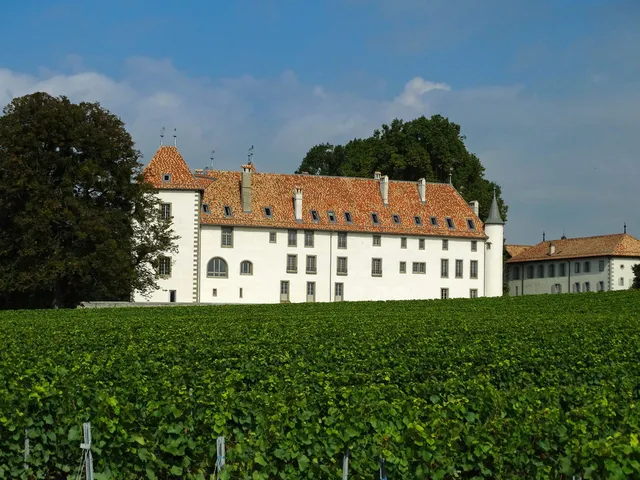
HHigh above a 4.3-hectare vineyard in Allaman, Switzerland, a wrought-iron weathervane turns with the lake winds — and on it, William Tell holds his son's hand, brandishes his crossbow, and faces the mounted bailiff Gessler. The Maison de Rochefort, part of the Château de Rochefort ensemble, hides Switzerland's founding myth in plain sight, spinning above a wine estate that has outlived every political system that ever claimed it.
Swiss castle historians have a phrase for this place: "rusticité tranquille" — tranquil rusticity. Unlike its sister castle down the road, which the Bernese burned in 1530, Rochefort was never pillaged, never besieged, never worth the trouble. "Sans histoire, donc heureux," one writer concluded. Without history, therefore happy.
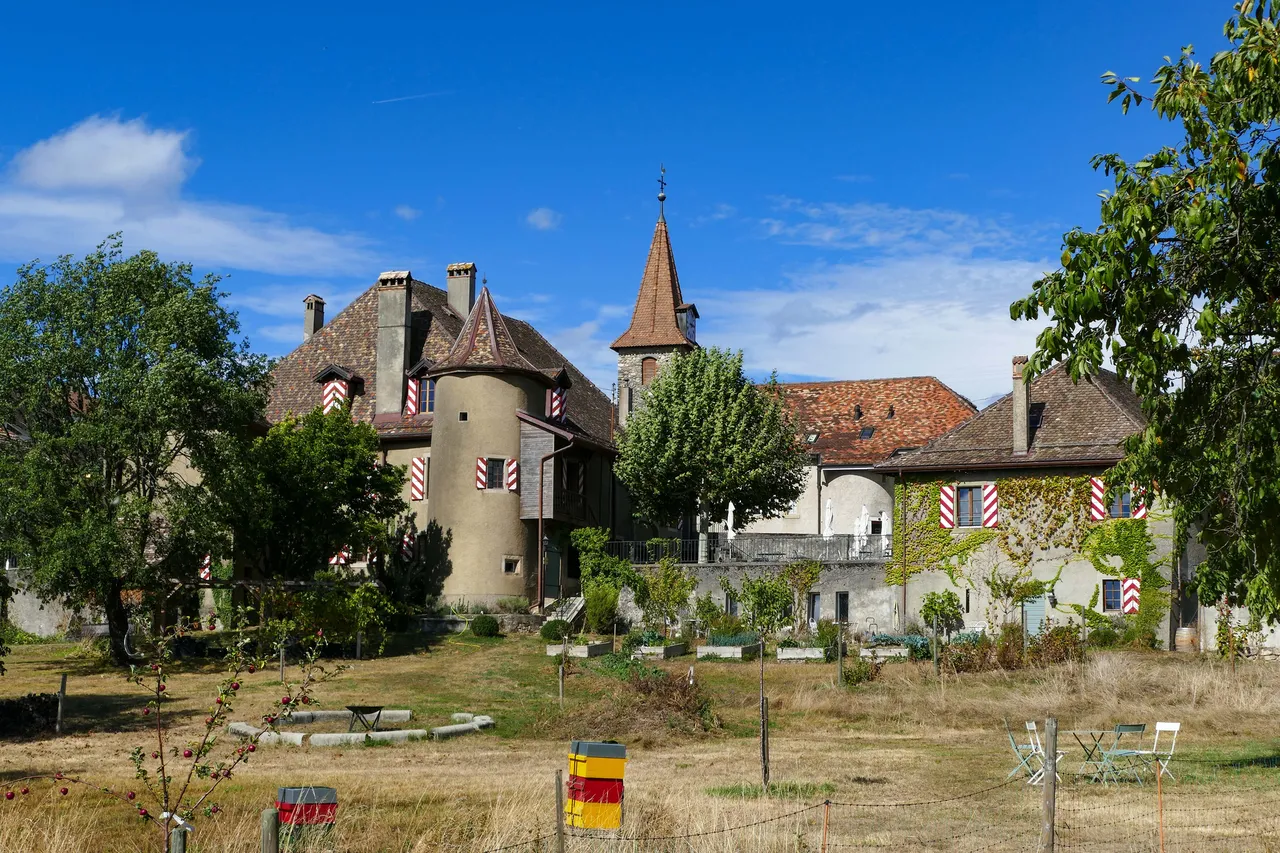
But the quiet hides layers. The red-and-white chevron shutters aren't decoration — they're municipal branding, marking the property as belonging to the City of Lausanne. And the modest building to the right of the château, the Maison de Rochefort itself, spent decades as Allaman's village post office, until 1915.
Today the estate produces wine on just 4.3 hectares — one of Lausanne's smallest municipal domains, and unusually for this white-wine region, over 60% of its plantings are red. Pinot Noir, Gamaret, Merlot. The vines don't care about the weathervane. They've been here longer than the myth it depicts.
01 What to see.
Look Up: The Tell Weathervane
The South Meadow Frame
A Slow Loop Through a Working Estate
02 In pictures.


Plan and listen to Maison de Rochefort with Audiala.
Audio guide in your pocket, itinerary in your browser. Built for the way you actually visit.
03 Visitor logistics.
The practical scaffolding for a good visit — kept short.
Getting There
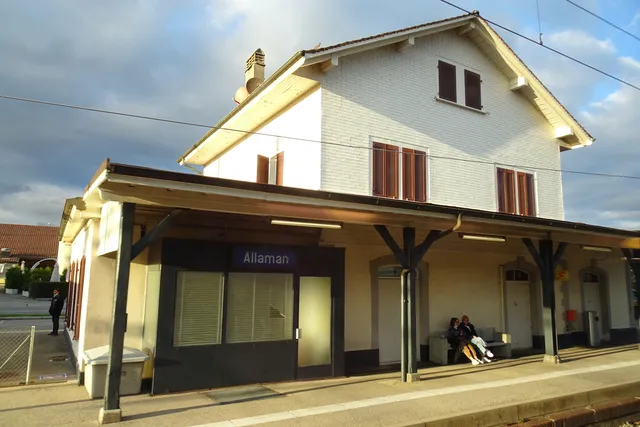
Allaman sits on the Swiss rail line between Geneva and Lausanne; regional trains stop at Allaman station. From the station, walk uphill toward the church and Place de l'Église. By car, take the A1 and follow signs to Allaman village—free parking is available at the château, but it fills during events.
Opening Hours
As of 2026, there are no standard public visiting hours: interiors are generally closed outside wine tastings and cultural events. Recent interim terrace bar hours ran Thursday–Saturday 17:00–22:00, but confirm on chateau-rochefort.ch before turning up.
Time Needed
Allow 15–30 minutes for an exterior walk and a view from the south meadow. A wine tasting plus vineyard stroll and photos runs 1–2 hours. Cultural events add the performance length.
Accessibility
No official accessibility statement exists, and this is a medieval fortified house: expect stairs, uneven floors, no elevator, and sloping gravel or grassy vineyard paths. Wheelchair users should contact chateau-rochefort.ch in advance for specific access.
Cost & Tickets
There is no standard admission fee. Wine can be bought direct; a Grand Cru bottle was CHF 30 in 2017. For the 2026 Caves Ouvertes Vaudoises general ticket, expect CHF 40 including glass and bracelet—confirm Rochefort's participation.
04 Tips for visitors.
Small things that change the day.
Spot the Tell weathervane
Look up at the octagonal donjon roof: the wrought-iron weathervane shows William Tell holding his son's hand and brandishing a crossbow at Gessler on horseback. Most visitors never lift their eyes.
Buy the reds here
Château Rochefort is the only Lausanne wine domain with majority red plantings—over 60% Pinot Noir, Gamaret, and Merlot. Try a Grand Cru Allaman red here; Chasselas is the region's white default.
Drones stay grounded
This is a listed cultural property and a working wine estate. Do not fly a drone without written permission, and ask before photographing in the cellar or near guest rooms.
If the terrace is closed, go to Rolle
The château's interim terrace bar pours estate wine Thursday–Saturday 17:00–22:00. When it is shut, drive to Grand-Rue in Rolle for classic lakeside bistros or Aubonne's old town for cafés.
Golden hour, grey winter
Come in late afternoon for warm light on the wooden east-façade gallery and the lake below. In winter the white-and-red chevron shutters are the only color in the grey scene—deliberate Lausanne branding.
Walk to the plage
The lakeside beach at Allaman is a 5-minute downhill walk from the château. If you cut through the vineyard, look for the Tombeau Mayor, a romantic 'Temple de l'amour' built around 1845.
Arrive early
The 2017 National Day brunch filled the parking lot and created 20-minute waits. If you book a tasting or event, arrive before the listed start.
05 The Happy Castle
The Château de Rochefort was built as a maison forte — a fortified house — by the co-lords of Aubonne, who shared the Allaman region with the lords of Allaman in the medieval period. Its purpose was surveillance: watching over lands and the men who worked them. No written record gives a precise construction date. "Va pour le Moyen Age," as one historian shrugged. Let's settle for the Middle Ages.
In the 15th century, the property passed to the Menthon family, lords of Rochefort in Savoy, who gave the castle its name. From the 16th century onward, the families of Diesbach, de Cerjat, de Langallerie, and de Sellon succeeded each other at the head of the agricultural and wine-growing domain. Through every change of ownership, one thing stayed constant: the vines.
The Huguenot's Gift
Antoine Albert was a bourgeois of Lausanne, descended from Huguenot refugees who fled religious persecution in Ryons, Dauphiné. His wife, Anne-Louise-Georgette Recordon, appears beside him in the records. They owned Château Rochefort together — and they had no children.
What was at stake: with no heir, the couple faced a decision that would determine the property's fate for centuries. Sell it? Leave it to distant relatives? Or something else entirely. According to local tradition, the domain was first offered to the Commune of Allaman itself — which refused it, fearing the financial burden on its meager finances.
The turning point came on 11 October 1838, when the couple's testament was homologated. They left the entire property to the Bourse des pauvres — the poor relief fund of the Commune of Lausanne. A Huguenot refugee's descendant, who had found safety and prosperity in Lausanne, gave his estate back to the city's most vulnerable. The modern municipal wine domain exists because of that decision.
What Changed
What Endured
Listen to the full story in the app
The whole Maison de Rochefort,
told well.
Audio guides for 1,100+ cities across 96 countries. History, stories, and local insight — offline ready.
06 Frequently asked.
The questions travellers send us most about Maison de Rochefort.
Is Maison de Rochefort worth visiting?
Yes, if you like quiet wine villages and buildings with odd secrets, but not if you expect a polished castle tour. It's part of Château de Rochefort, a 4.3-hectare Lausanne-owned wine estate in Allaman with no regular public interior hours. The payoff is exterior: an octagonal donjon roof, red-and-white chevron shutters, and a William Tell weathervane most people never look up to see.
How long do you need at Maison de Rochefort?
You won't find an official visit duration because the house isn't a conventional museum. Budget 15–30 minutes for exterior photos, or 1–2 hours if you taste wine, walk the vines, and linger in the south meadow. Add time for the church next door and the 5-minute downhill walk to Allaman plage.
How do I get to Maison de Rochefort from Geneva?
From Geneva, take the train to Allaman and walk up to Place de l'Église; the estate is beside the church. Driving takes about 30–40 minutes from Geneva Airport (34 km), but parking is not formally documented—street parking in the village is your best bet.
What is the best time to visit Maison de Rochefort?
Go in summer or early autumn for vines in leaf and Lake Geneva behind them; winter is quieter but the red-and-white shutters give the grey stone a jolt of color. Check for Caves Ouvertes Vaudoises or theatre dates if you want inside access.
Can you visit Maison de Rochefort for free?
You can view the exterior from the village and south meadow for free; no standard admission ticket exists. But the interiors are not open for casual visits. You may pay for wine tastings, events, or a regional cellar-open-day bracelet around CHF 40.
What should I not miss at Maison de Rochefort?
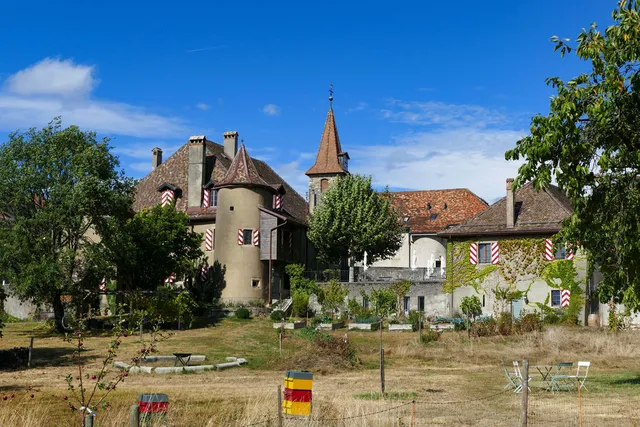
Look up at the donjon's weathervane: William Tell, his son, and Gessler on horseback, cut in iron. Then find the red-white chevron shutters—they're Lausanne's ownership mark—and the south meadow view with the château, Maison de Rochefort, and church steeple stacked together. The Maison de Rochefort itself was Allaman's post office until 1915.
Is Maison de Rochefort open to the public?
Not as a regular museum; the house and château have no published public opening hours. It's a working Lausanne wine estate and has been seeking a new operator since March 2023. Interiors may open for cultural events like theatre or wine cellar days, so check the official Château Rochefort site before going.
Verified, and shown.
Researched and written by the Audiala editorial team from historical records, architectural archives, and local expertise.
Local history of Allaman's two castles, the William Tell weathervane, the Menthon family, and the post office in Maison de Rochefort.
Architectural and ownership history, 'rusticité tranquille', red-white shutters, the 1838 bequest, and the Maison de Rochefort post office until 1915.
Official city page for the 4.3-hectare Lausanne wine estate, its red-wine majority, address, and ownership.
2023 report on visible decay at the estate and the City of Lausanne's search for a new operator.
Trade report on the operator search, interim terrace bar, and the estate's biodynamic wine identity.
Guest reviews with garden details, wine welcome, breakfast in a turret, proximity to Allaman plage, and mixed service notes.
Regional cellar-open-day ticketing details, including the CHF 40 bracelet and tasting glass.
Researched from Wikidata, Wikipedia & official sources · fact-checked · How we make our guides →