An introduction.
Researched by the Audiala editorial team from historical records, architectural archives, and local expertise.
AA Catholic saint's name clings to a Protestant pulpit in Allaman, Switzerland—the Church of Saint-Jean-Baptiste, better known as the Temple d'Allaman. The Reformation stripped its altars, but the building kept its medieval bones and an older bell tower, part of it standing since before 1412. You visit to read a palimpsest of faith: a late Gothic choir, a clumsily engraved 1539 date, and a pair of silver cups that outlived several upheavals.
First cited in 1344 with a cemetery already attached, the church is among the oldest documented structures in Allaman. But the bell tower is older still—local historians say it predates 1412, making it a silent witness to the Black Death and the Bernese conquest. A short walk away, Allaman Castle is showier; this tower is the true elder.
Step inside and look up. A white cross painted on a red ground marks the circular vault key in the choir, a small, legible Protestant symbol overhead. René Martin’s 1935 stained glass filters daylight across the stone in soft patches, modern windows reaching back toward medieval themes.
For a village church, the building holds an outsized tension: seigneurial chapels once attached to the choir, Reformation erasures, and a 1468 property swap by the Russin brothers. It is not one building but several centuries stacked behind a single steeple.
01 What to see.
The Tower That Outlasted the Church
The bell tower has been keeping watch over these vineyards since before 1412—older than the church below it and one of the earliest structures in Allaman. It's built of molasse, a soft sandstone that weathers into rounded, sugar-cube edges under six centuries of rain, so the base looks almost beaten into shape by the weather itself. Walk to the south porch and look for the date 1539 scratched into the wall: not a foundation date, but a clumsy repair, so awkwardly carved you can almost see a mason with a bad chisel and a worse afternoon.
By the door, two shields sit side by side on a polygonal stone. One shows a radiant sun; the other has been hammered smooth, its heraldry deliberately erased during the Reformation. That defaced surface is the most honest thing on the facade—a local lord's mark reduced to a patch of scarred stone by someone who wanted no Catholic noble looking down on the congregation.
The Gothic Choir and the Missing Chapel
The choir was rebuilt shortly after 1481, and its late Gothic vaulting still pulls your gaze forward from the nave like an architectural stage direction. Look for the round vault key: a white cross painted on a red ground, bright as a flag pinned to the grey stone. It's a small detail, but it gives the whole east end its pulse.
Against the choir's outer wall once stood a private chapel belonging to the lords of Allaman. The Russin brothers traded their old Notre-Dame chapel in 1468 to carve out a grander family annex, and the seam where it met the choir still shows faintly near the chancel. Inside, light moves through 1935 stained glass by René Martin, a painter from Perroy, while the communion table sometimes holds two tulip-shaped silver cups by Pierre de Molière, each 220 millimetres tall and gilded inside.
A Seven-Century Loop Around Place de l'Église
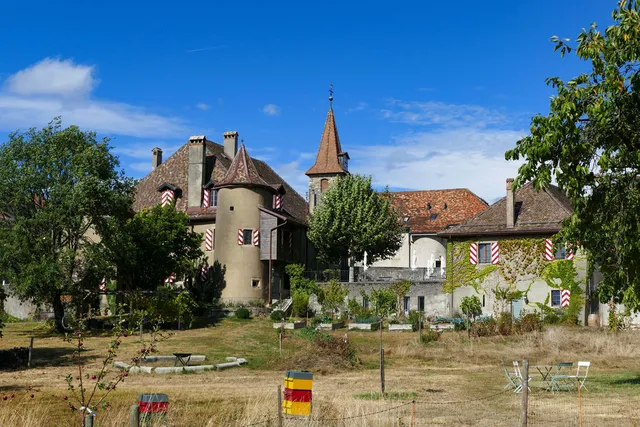
Start on Place de l'Église, where the church forms a tight knot with an old schoolhouse and a pump shed—the village's practical heart in three buildings. Walk the square's edge and look for the ancient house with a truncated tower and a heavy buttress; it's not grand, but it tells you Allaman once needed watchful corners. If the bells ring while you're there, the sound rolls over the vineyards toward Lake Geneva, exactly as it has since the tower first stood.
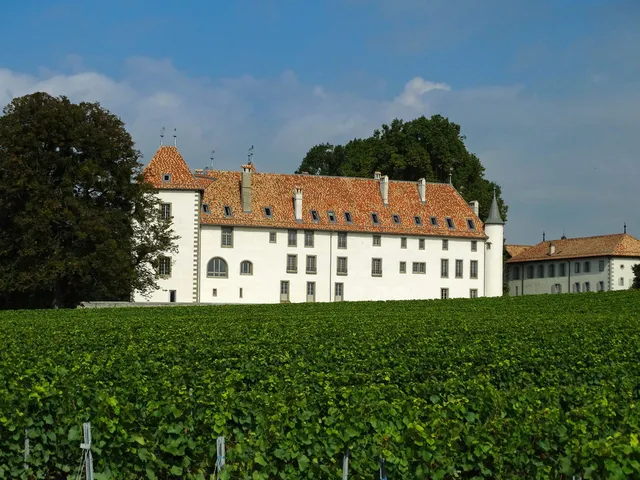
Then wander south, and the same medieval geography that held the church also produced Allaman Castle, which rises further down toward the lake road. The lords who paid for the chapel in the choir held that castle, so the two buildings are different halves of the same power. This loop takes twenty unhurried minutes, but it leaves you with a sharper sense of how a small village wrapped itself around stone, faith, and a very good view.
02 In pictures.


Plan and listen to Church of Saint-Jean-Baptiste, Allaman with Audiala.
Audio guide in your pocket, itinerary in your browser. Built for the way you actually visit.
03 Visitor logistics.
The practical scaffolding for a good visit — kept short.
Getting There
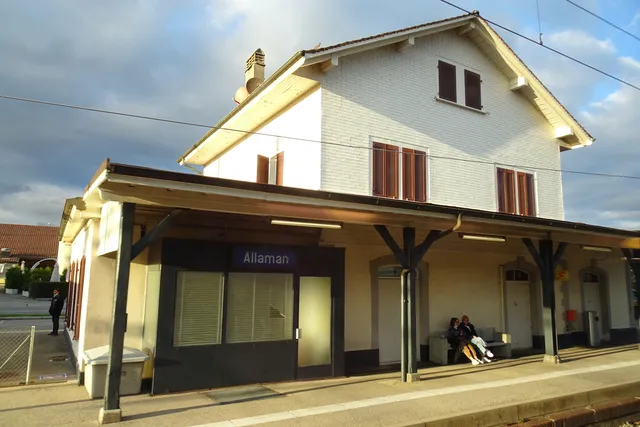
Allaman's CFF station sits north of the village, served by regular trains on the Lausanne–Geneva line. From there, MBC bus 724 runs Morges–Allaman and stops at Grand Rue, Château, and Gare Sud — get off at Grand Rue for the shortest walk up to Place de l'Eglise. Drivers should park near the station commercial area or on signed village streets.
Opening Hours
No published visitor hours exist as of 2026 — this is a working parish church, not a ticketed site. Sunday worship in the Paroisse de L'Aubonne is often at 10:00, though services rotate among village temples. The church is frequently locked outside services, so call the parish office at 021 808 51 18 before making a special trip.
Time Needed
A quick look at the exterior and small nave takes 10–15 minutes. A more attentive visit, including the Gothic choir, north chapel, and village square, runs 30–60 minutes. Add 1.5–2 hours total if you walk down through the vineyards to the lakefront and the Tombeau Mayor.
Accessibility
No ramps or lifts are documented at this medieval-origin building, and old village thresholds are uneven or stepped. The terrain slopes gently toward Lake Geneva, but the church entrance may pose difficulty for wheelchairs. Contact the EERV parish office in Aubonne ahead of time to confirm current access.
Cost & Tickets
Entry is free — no admission desk, audio guide, or booking system. The nearby Allaman Castle is private and closed to casual visits; don't confuse the two.
04 Tips for visitors.
Small things that change the day.
Say temple, not église
Locals call it the Temple d'Allaman. Saying 'église Saint-Jean-Baptiste' in French marks you as a visitor; the Protestant 'temple' is the living name.
Enter via Sunday service
The surest way inside is the Sunday morning culte, usually 10:00. Arrive 10 minutes early, sit near the back, and stay for the whole service — slipping out mid-sermon is conspicuous in a small congregation.
Flash off, drone down
Interior photos are generally fine when no service is running, but skip the flash and tripod. Drones over the church and the protected château ensemble need cantonal authorization.
Perch or Argentine beef
For local filets de perche, book a table at Restaurant de la Pêcherie (mid-range, CHF 35–55). Meat lovers should head to Restaurant du Chasseur for Argentine specialties (CHF 40–70), or keep it cheap at Café de la Gare.
Golden hour glow
The old limestone tower glows warm in late afternoon, and the square is quietest before 9:00. If you can't get inside, late-day light on the exterior gives the best photo condition.
Ghosts and peace treaties
Across the square, Allaman Castle is closed to visitors but full of stories — the walled-up Marquise de Langallerie and the peace society that seeded the League of Nations. Ask a local about the ghost; they enjoy telling it.
05 The Tower That Outlasted Its Faith
Most village churches accumulate history the way old houses gather furniture—quietly, unevenly, and without documenting the moves. Saint-Jean-Baptiste in Allaman is an extreme case. Its tower predates 1412, the church is first cited in 1344, and the Gothic choir was rebuilt shortly after 1481, yet the historical record is mostly silence.
In 1536, Bern took the Pays de Vaud and imposed the Reformation. Allaman lost its independent parish status and became a dependency of nearby Perroy, a shift that reshaped local worship for centuries. The altars vanished, the walls were probably whitewashed, and a building named for John the Baptist became a Protestant temple—two identities still visible in its fabric.
The 1468 Swap That Bought Proximity to the Altar
The Russin brothers, seigneurs of Allaman, surface in the record in 1468 for one transaction: they traded their original Notre-Dame chapel for an adjacent cave belonging to the Confrérie du Saint-Esprit. The exchange freed space to build a grander family chapel against the choir, closer to the altar than any other lay area in the church.
For the brothers, this was dynastic theater. A private chapel meant they could step into the sanctuary without walking through the congregation, and they could fill it with tombs, plaques, and coats of arms. Their souls and their status were equally on display.
For a silversmith whose living depended on Lake Geneva patrons, the Allaman commission was a small but risky test. Pierre de Molière, active in Lausanne around 1735–1755, produced two cups that still belong to the church—each 220 mm tall, tulip-shaped, gilded inside. His turning point came in choosing restraint: the doucine pedestal and urn-shaped nodes did the work that applied decoration would have done in Catholic plate. The cups survived because he understood Reformed taste.
The Tower That Predates the Church
A 'Clumsy' 1539 Date
Listen to the full story in the app
The whole Church of Saint-Jean-Baptiste, Allaman,
told well.
Audio guides for 1,100+ cities across 96 countries. History, stories, and local insight — offline ready.

06 Frequently asked.
The questions travellers send us most about Church of Saint-Jean-Baptiste, Allaman.
Is the Church of Saint-Jean-Baptiste in Allaman worth visiting?
Yes, if you are already in Allaman or passing along the Lausanne–Geneva rail line. It is not a destination church, but the 15th/16th-century stonework and the unexpectedly graceful little nave earn a 15-minute detour. Pair it with the closed-to-the-public exterior of Allaman Castle, right across the square.
How long do you need at the Church of Saint-Jean-Baptiste in Allaman?
Ten to fifteen minutes for a quick look at the exterior and, if open, the nave. Give it 30 to 60 minutes to find the clumsy 1539 engraving, the hammered heraldic shield and the Gothic choir. Allaman itself, with vineyards and lakefront paths, can fill two hours.
How do I get to the Church of Saint-Jean-Baptiste in Allaman from Geneva?
Take a direct CFF train from Geneva to Allaman station, then walk a few minutes into the village to Place de l'Église 2. Trains from Lausanne stop at Allaman as well. MBC bus line 724 from Morges also stops at Allaman Grand-Rue, Château and Gare Sud.
What is the best time to visit the Church of Saint-Jean-Baptiste in Allaman?
Sunday around 10:00, if you want the interior open for a Protestant service. Otherwise, no public opening hours are published, so a locked door is common. For warm light on the molasse facade, go early afternoon between spring and autumn.
Can you visit the Church of Saint-Jean-Baptiste in Allaman for free?
Yes. There is no admission charge and no ticket system; this is an active temple, not a museum. The real cost is timing, as the church may be locked outside services. Contact the parish office in Aubonne if you want to be sure.
What should I not miss at the Church of Saint-Jean-Baptiste in Allaman?
The polygonal molasse stone near the door. On it, one shield shows a radiant sun; a second shield has been deliberately hammered smooth, probably during Reformation iconoclasm in the 1530s. Also look for the clumsily engraved 1539 on the wall and the white cross on red ground painted on the choir vault key.
Why is the church in Allaman called Temple d'Allaman?
Because in French-speaking Switzerland, Protestant churches are called temple, not église. The term is a theological choice: a temple is a meeting house for hearing the Word, not a Catholic sacred space reserved for the sacrament. Locals use Temple d'Allaman, while the Saint-Jean-Baptiste dedication survives as a pre-Reformation relic.
What is the 1539 date on the Church of Saint-Jean-Baptiste in Allaman?
1539 is a date clumsily engraved on the church wall. The municipal website says it marks a repair or renovation, not the original construction. The current building is dated broadly to the 15th/16th century, with earlier roots cited from 1344.
Verified, and shown.
Researched and written by the Audiala editorial team from historical records, architectural archives, and local expertise.
Official municipal page confirming the temple's dedication, gothic choir, north chapel, 1539 inscription, 1956 roof replacement and parish contact details.
Authoritative dating of the 15th/16th-century parish church, patronage by the Chapter of Geneva, the seigneurial chapel and Allaman's viticulture.
Community-sourced dates for the church: first cited in 1344, bell tower predating 1412 and rebuilt gothic choir.
Cultural overview of Allaman: the church as village centrepiece, local restaurants, public fountains, fishing heritage and château context.
Parish page for worship service schedules and access contacts for Temple d'Allaman.
Municipal listing of local dining options including Restaurant la Pêcherie, Restaurant du Chasseur and Pizzeria de la Gare.
Visitor feedback confirming the castle is closed and empty, useful for avoiding confusion with the church.
Confirms the castle is private and not open to casual visitors.
Researched from Wikidata, Wikipedia & official sources · fact-checked · How we make our guides →