An introduction.
Researched by the Audiala editorial team from historical records, architectural archives, and local expertise.
TThe most visible thing at Allaman Railway Station is what's missing: a narrow-gauge tramway that once turned a three-track halt in Allaman, Switzerland, into a proper transport hub. Most passengers only glance up long enough to check the Geneva-bound departure. You should pause because this unassuming stop on the Lausanne–Geneva line still carries the ghost of a vanished network beneath its commuter calm.
Trains slip through at kilometre point 21.48, between Étoy and Rolle. RegioExpress services run twice hourly toward Saint-Maurice, and RER Vaud lines R8 and R9 fan out toward Payerne and Murten. In the few seconds the platform is in view, you could mistake this for anywhere — but nowhere else in the canton has quite this layering of railway archaeology.
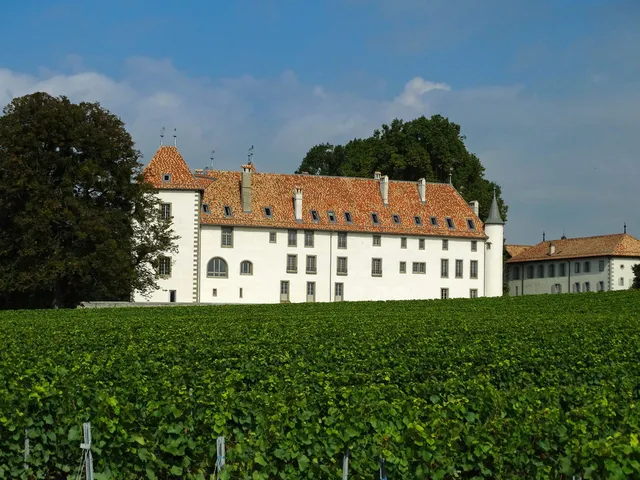
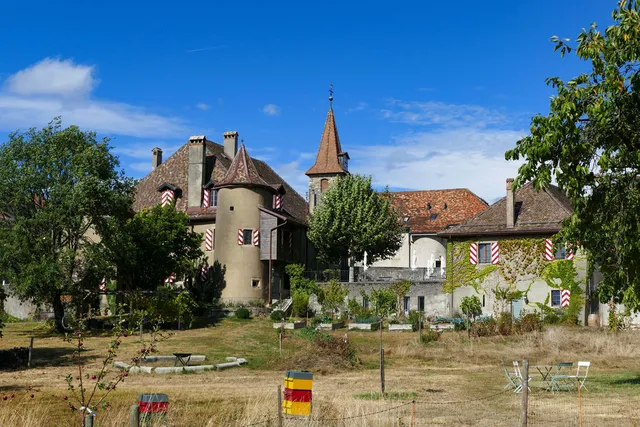
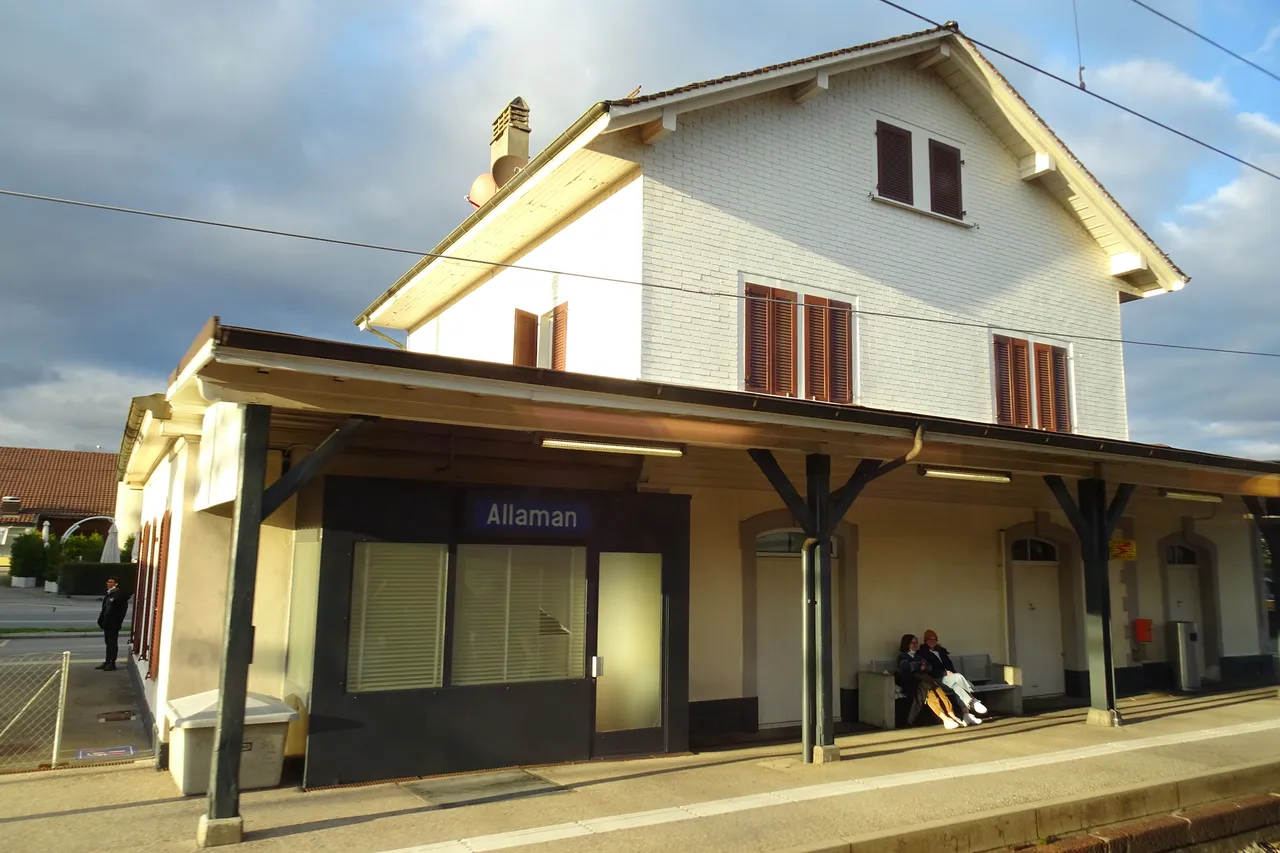
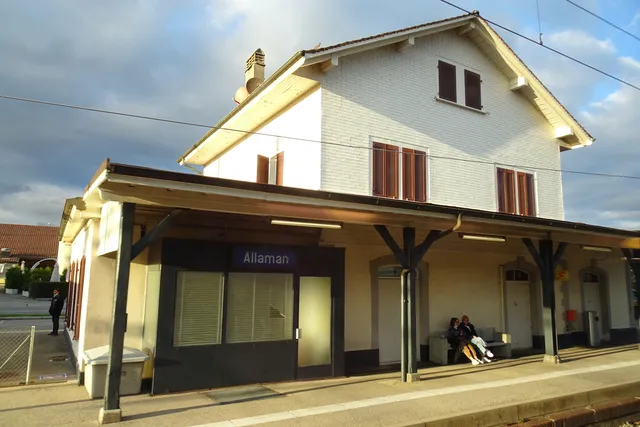
The station building itself is a documented piece of Swiss railway heritage, photographed for the SBB Historic archive from the track side in 2003. A short walk to the north, Allaman Castle predates it by some seven hundred years. That contrast — medieval fortress above, nineteenth-century railway below — is the whole reason to step off the train.
And if you stay past the last RegioExpress, the station becomes something stranger: a place where the removal of a footbridge in 2021 and the absence of a tram since 1937 feel equally present.
01 What to see.
The 46-Tonne Footbridge
The 1858 Station Building
A Slow Circuit from Platform to Château
02 In pictures.


Plan and listen to Allaman Railway Station with Audiala.
Audio guide in your pocket, itinerary in your browser. Built for the way you actually visit.
03 Visitor logistics.
The practical scaffolding for a good visit — kept short.
Getting There
Allaman sits on the SBB Lausanne–Geneva main line, about 18–21 minutes from Lausanne and 30–40 from Geneva, with around 79 direct trains a day. MBC bus lines 720, 721, 723, 724, 727 and 846 call at Allaman gare; drivers find 86 standard P+Rail spaces, 1 disabled space and 4 reservable spots on Route de la Gare. The village centre and Allaman Castle are a 5–10 minute walk.
Opening Hours
Platforms stay open round the clock, all year, and there is no staffed counter or ticket window with fixed hours. As of 2026, trains from Lausanne run from around 00:00 to 23:34, with no seasonal closure of the stop itself.
Time Needed
Treat this as a working station: allow 2–5 minutes just to catch a train, 5–10 for a connection, or 30–60 to wander the village and walk up toward the 11th-century Allaman Castle. From Lausanne, budget at least a 1-hour round trip.
Accessibility
SBB lists Allaman as a barrier-free station after a recent accessibility upgrade, but platform-level detail is thin online. Reduced-mobility travellers should check the SBB trafimage handicap map and book assistance before travelling, as there is no confirmed lift or ramp information for the platforms.
Cost/Tickets
Entering the station costs nothing; you pay only for trains. P+Rail parking is CHF 7 per day, CHF 70 per month, or CHF 700 per year as of 2026, and from 5 May 2026 new Vaud rules apply to monthly and annual subscriptions.
04 Tips for visitors.
Small things that change the day.
Sicilian platform kitchen
Restaurant Pizzeria de la Gare, right at the platforms, has been a local fixture for over a decade and does solid Sicilian pizza and pasta at roughly CHF 18–28. For a quicker, cheaper meal, Coop Restaurant Allaman runs about CHF 10–20.
Ten-minute castle detour
If you have 30–60 minutes between trains, walk 500–800 m to Allaman Castle, an 11th-century fortress burned in 1530 and later nicknamed the Castle of Peace. The route from Route de la Gare is gentle, but keep your return time in view.
Book past peak
SBB super saver fares on the Lausanne–Allaman corridor can undercut standard prices by up to 70%, but avoid weekday departures 06:00–10:00 and 15:00–19:00, when fares climb. A half-fare card or GA Travelcard also softens the 18–21 minute hop.
Dodge the commuter crunch
P+Rail Allaman fills fast on weekdays, with SBB predicting high occupancy from about 07:00 to 16:00. Arrive before 07:00 or after 17:00 for an easy space, and reserve ahead if you want one of the four reservable spots.
No lockers, pack light
Allaman has no luggage lockers or left-luggage desk, so do not plan to store bags here. If you detour to the castle or pizzeria, carry everything with you or leave larger cases in Lausanne or Geneva.
Freight surprises
Allaman handles CFF Cargo trains carrying containers, sugar beet and potatoes, so a freight run can rumble through with little warning. Stand well behind the yellow line, especially when express passenger services pass at speed.
Snap, but don't fly
Casual photos of platforms and trains are fine, but commercial filming on SBB property needs permission, and drones near railway infrastructure are legally sensitive in Switzerland. Ask the private owners before photographing Allaman Castle grounds.
05 The Tramway Ghost at Platform 3
The station opened in 1858 with the Morges–Coppet section of the Lausanne–Geneva line, built by the private Compagnie de l'Ouest-Suisse before the national SBB absorbed it in 1902. Records from French railway sources date the inauguration to that year; English sources stay quiet, as if this wasn't news even then.
By 1896, the halt had a second identity: terminus of the Allaman–Aubonne–Gimel tramway, a narrow-gauge feeder that hauled passengers, wine, and market produce from the Jura foothills. For four decades, this was a working interchange, not a waiting room.
The Preacher, the Fire, and the Ground the Station Inherited
Guillaume Farel, the French reformer, spent the 1520s preaching a radical Protestant faith across what is now canton Vaud. For him the stakes were not abstract. A sermon in the wrong village could mean arrest, exile, or a blade.
The turning point arrived with fire. In 1530, Bernese reinforcements burned Allaman Castle — a moated medieval fortress — to break Catholic resistance. Records confirm the burning; the precise role of preachers like Farel in this particular blaze is less certain. What changed is clear: Allaman passed into the Reformed camp.
Three hundred and twenty-eight years later, engineers built the station almost in sight of the rebuilt castle. The rails landed on ground already scarred by confession and war.
The Little Tram That Fed the Main Line
A Stop on Switzerland's First Rail Generation
Listen to the full story in the app
The whole Allaman Railway Station,
told well.
Audio guides for 1,100+ cities across 96 countries. History, stories, and local insight — offline ready.
06 Frequently asked.
The questions travellers send us most about Allaman Railway Station.
Is Allaman railway station worth visiting?
Not as a destination in itself — it's a small unstaffed commuter stop. But if you're passing through, it rewards a pause: the 46-tonne steel footbridge installed in 2019 gives the best view of the La Côte vineyards and, on clear days, the Alps. And the Restaurant Pizzeria de la Gare, run by Sicilians for over a decade, serves genuinely good pizza right by the platforms.
How long do you need at Allaman railway station?
Two to five minutes if you're just catching a train. Budget 30–60 minutes to walk the footbridge, grab a pizza, and wander toward Allaman Castle, an 11th-century fortress about ten minutes away on foot.
How do I get to Allaman from Lausanne?
Direct SBB trains run roughly 79 times a day, taking 18–21 minutes. RegioExpress and RER Vaud services both stop here. From Geneva, expect 30–40 minutes depending on the service.
What is the best time to visit Allaman station?
Autumn, during the grape harvest, when the smell of fermenting grapes drifts across the platforms and the Jura slopes turn gold. Winter clear days offer the most dramatic Alps views — crisp, snow-covered, and visible right from the footbridge.
Can you visit Allaman railway station for free?
Yes — like all Swiss railway stations, there's no entry fee. You only pay for train travel. Parking costs CHF 7 per day in the P+Rail lot if you drive.
What should I not miss at Allaman station?
Stand at the centre of the footbridge and look both ways — tracks receding toward Rolle and Morges, vineyards climbing the Jura foothills. Then walk to Allaman Castle, burned in 1530 by Bernese troops during the Reformation. The station's own history is hidden too: it was once the terminus of a narrow-gauge tramway to Aubonne and Gimel that ran from 1896 to 1937.
Does Allaman station have parking?
Yes — 86 P+Rail spaces plus one disabled space and four reservable spots. It costs CHF 7 per day, CHF 70 per month, or CHF 700 per year. The lot fills fast on weekday mornings, roughly 7:00 to 16:00, and new subscription rules for Vaud canton kick in from 5 May 2026.
What was the tramway at Allaman station?
From 1896 to 1937, Allaman was the terminus of a narrow-gauge tramway connecting the station to Aubonne, later extended to Gimel. It carried passengers and agricultural produce from the Jura foothills to the main line. Buses replaced it in 1937, and no physical trace remains at the station today.
Verified, and shown.
Researched and written by the Audiala editorial team from historical records, architectural archives, and local expertise.
Station history, tramway to Aubonne and Gimel (1896–1937), footbridge installation dates, platform extension works
Infrastructure details: elevation, platform and track count, ownership, accessibility status
Parking capacity, P+Rail pricing (CHF 7/day, 70/month, 700/year), occupancy patterns, 2026 Vaud subscription changes
Footbridge specifications: 46 tonnes, 33 metres long, 3.6 metres wide
Sicilian restaurant at the station, operating for over 10 years, terrace and local institution status
Castle history: 11th-century fortress, burned in 1530 by Bernese reinforcements during the Reformation
Train frequency (~79/day), journey time (18–21 min), first and last train times
Municipal transport info, day-pass scheme via Aubonne town hall, bus connections
Historical photograph showing freight train entering Allaman station after the viaduct
Walking access from Allaman station to the Signal de Bougy recreation area
Researched from Wikidata, Wikipedia & official sources · fact-checked · How we make our guides →