Introduction
Somewhere beneath Stockholm's Norrmalm district, a passage drilled through Ice Age gravel connects two streets that most locals walk between without thinking. The Brunkeberg Tunnel is 231 meters of arched concrete — roughly the length of two football pitches — that took a meat-freezing machine, a bankrupt entrepreneur, and a king's ribbon-cutting to bring into existence. It is free, open daily, and one of the strangest walks in Sweden.
The ridge the tunnel pierces — the Brunkebergsåsen — is a 20-meter-high esker of sand and gravel deposited by meltwater as the last glaciers retreated. For centuries it split Norrmalm in two, forcing anyone crossing east-west to climb a hill taller than a five-story building. In 1471, the same ridge served as the battlefield where Sten Sture the Elder routed a Danish army and effectively ended the Kalmar Union's grip on Sweden.
Today the ridge is mostly invisible, shaved down by 150 years of urban development. But the tunnel remembers it. Step inside from David Bagares gata and you descend into a passage that smells of damp mineral — cold stone and centuries-old gravel — with footsteps echoing off a barrel-vaulted ceiling just under 4 meters high.
The tunnel has cycled through identities: horse-cart shortcut, failed toll road, forgotten relic, rediscovered landmark. Photographers love it for its vanishing-point symmetry. Cyclists barrel through it on their commutes. And pedestrians still use it for exactly what Captain Knut Lindmark intended in 1884 — getting from one side of the ridge to the other without climbing.
What to See
The Tunnel Walk
The full traverse takes about two minutes at a normal pace — 231 meters from David Bagares gata on the west to Tunnelgatan on the east. The barrel-vaulted ceiling sits 3.9 meters overhead, and the walls close in at just 4 meters apart, narrower than a standard road lane. Sound behaves strangely here: conversations ahead of you arrive before the speakers do, and your own footsteps seem to come from someone else. The lighting is deliberate — warm enough to see, dim enough to feel like you've stepped out of the city entirely. Early morning is the best time, when the tunnel is nearly empty and the echo belongs to you alone.


The Entrances and the Temperature Drop
The western portal at David Bagares gata sits just off Sveavägen, near the corner where Urban Deli occupies a ground-floor space. The eastern exit at Tunnelgatan deposits you on a quiet side street below the ridge — a disorienting shift after the sensory compression of the tunnel. Automatic doors at both ends open for pedestrians and cyclists, a modern addition to a 140-year-old passage. Pay attention to the transition: the temperature drops the moment you step inside, and the city noise cuts off as cleanly as if someone pressed mute.
The Ridge Above Your Head
Before or after the tunnel, walk to Observatorielunden park — a ten-minute stroll north along Sveavägen. The park sits atop the Brunkebergsåsen esker at its highest point, roughly 20 meters above the surrounding streets, about the height of a six-story apartment building. That elevation is the whole reason the tunnel exists. Standing here, you can trace how the ridge once divided Norrmalm, forcing all east-west movement either over the top or around the ends. The tunnel solved the problem from below. Kungsgatan, visible to the south, solved it by cutting straight through. The ridge itself, indifferent to both solutions, remains.

Photo Gallery
Explore Brunkeberg Tunnel in Pictures

Pedestrians walk through the distinctive, curved yellow walls of the historic Brunkeberg Tunnel in central Stockholm, Sweden.
Mika Stetsovski · cc by 2.0

A vintage view of the Brunkeberg Tunnel entrance in Stockholm, Sweden, showing the stone archway and pedestrians walking along the cobblestone street.
Carl Johan Gimberg (1854-1931) · public domain

A historical cast-iron plaque commemorating engineer Knut Lindmark at the entrance of the iconic Brunkeberg Tunnel in Stockholm, Sweden.
Holger.Ellgaard · cc by-sa 3.0

The historic Brunkeberg Tunnel entrance in Stockholm, Sweden, framed by classic urban architecture and city street life.
Holger.Ellgaard · cc by-sa 3.0
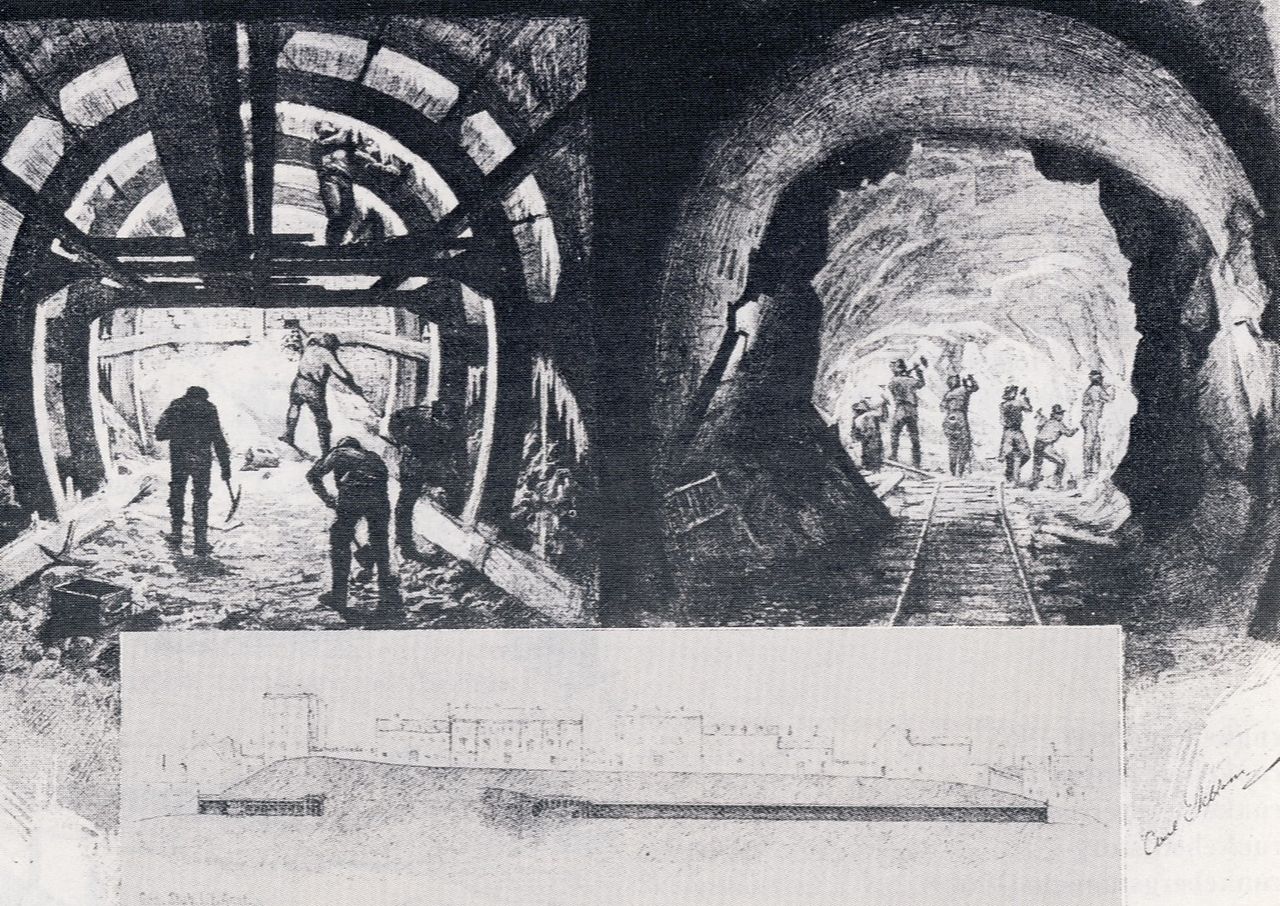
These historical illustrations depict the construction process of the Brunkeberg Tunnel in Stockholm, Sweden, featuring both interior work and architectural diagrams.
Axel Ekblom · public domain

The Brunkeberg Tunnel is a historic pedestrian and bicycle passage in Stockholm, Sweden, known for its distinctive yellow walls and arched metallic ceiling.
Koyos · public domain

A view inside the iconic Brunkeberg Tunnel in Stockholm, Sweden, showing its distinctive yellow slatted walls and illuminated arched ceiling.
Wille Öhgren · cc by-sa 4.0

The iconic Brunkeberg Tunnel in Stockholm, Sweden, features a striking design with bright yellow walls and a curved, illuminated ceiling.
Susanne Nilsson · cc by-sa 2.0

A symmetrical view down the historic Brunkeberg Tunnel in Stockholm, Sweden, showcasing its unique corrugated yellow walls and illuminated arched ceiling.
Fringilla · cc0

A pedestrian walks through the distinctive, brightly lit yellow walls of the historic Brunkeberg Tunnel in Stockholm, Sweden.
Susanne Nilsson · cc by-sa 2.0

Pedestrians traverse the distinctive, bright yellow-walled Brunkeberg Tunnel, a historic pedestrian and bicycle passage in central Stockholm, Sweden.
Holger Ellgaard · cc by-sa 3.0

A view inside the historic Brunkeberg Tunnel in Stockholm, Sweden, showing the unique metallic architecture and illuminated path used by cyclists and pedestrians.
bynyalcin · cc by 3.0
Visitor Logistics
Getting There
The west entrance sits on David Bagares gata, steps from Sveavägen — look for Urban Deli at number 44 as your landmark. T-Centralen metro station is a 5-minute walk south; Hötorget station is equally close to the north. The east entrance emerges on Tunnelgatan, which connects directly to Kungsgatan and the Sergels Torg area.
Opening Hours
As of 2026, the tunnel is open daily from 7:00 AM to 10:00 PM. No tickets, no barriers — just walk through. The automatic doors at each entrance close after hours.
Time Needed
Walking the 231-meter tunnel takes about 3 minutes at a normal pace. Budget 10–15 minutes if you want to stop for photographs, absorb the acoustics, and read any posted information at the entrances. Pair it with a stroll along Sveavägen or through Observatorielunden park and you have a satisfying 30-minute loop.
Accessibility
The tunnel is flat, paved, and level throughout — no steps, no ramps, no elevation changes. Both entrances are flush with the sidewalk, and the 4-meter width comfortably accommodates wheelchairs and strollers alongside pedestrians and cyclists. Lighting is present but dim; visitors with low vision should bring a torch.
Tips for Visitors
Shoot the Vanishing Point
Stand at either entrance and frame the tunnel's full 231-meter barrel vault — longer than two football pitches laid end to end. The converging lines and moody lighting create a natural one-point perspective that photographs beautifully, especially with a single figure silhouetted in the distance.
Go After Dark
The tunnel transforms at night. With fewer pedestrians and the artificial lighting casting long shadows on the arched walls, it feels more like a scene from a Nordic noir than a municipal shortcut. Visit after 8 PM for the full atmospheric effect — it's still open and perfectly safe.
Combine with Kungsgatan
Walk two blocks south to Kungsgatan, the boulevard that made this tunnel obsolete in 1911. The contrast tells a story: one passage is an intimate 4-meter-wide pedestrian tube, the other a grand boulevard sliced clean through the same glacial ridge. Seeing both takes 15 minutes and gives you the full before-and-after.
Eat at the West End
Urban Deli, right at the David Bagares gata entrance, serves solid Swedish lunch plates and coffee at mid-range prices. For something cheaper and faster, Hötorgshallen food hall is a 4-minute walk north — a basement market with everything from Turkish gözleme to fresh shrimp sandwiches.
Find the Ridge Above
Most visitors walk through without realizing they're passing 20 meters beneath a glacial ridge older than human civilization. After exiting, climb to Observatorielunden park — one of the few places where the Brunkebergsåsen esker is still visible above ground. The elevation change makes the tunnel's engineering feel real.
Watch for Cyclists
The tunnel doubles as a bike commuter corridor, and Stockholm cyclists move fast. Stay to the right, keep alert when entering, and avoid stopping in the middle of the passage. The automatic doors swing open for bikes, so expect company even during quieter hours.
Where to Eat
Don't Leave Without Trying
Knut bar
local favoriteOrder: The seasonal Nordic plates showcase Swedish ingredients at their peak—locals rave about the fish preparations and house-cured meats. This is where Stockholmers actually eat, not tourists.
Knut is a beloved neighborhood spot with serious culinary chops and 1,290 reviews that tell the real story. It's the kind of place where you'll see regulars at the bar and families at tables, all genuinely enjoying themselves.
Bageri Två Systrar
cafeOrder: The kanelbulle (Swedish cinnamon bun) is the real deal—cardamom-forward, flatter than its Danish cousins, and still warm if you arrive early. Pair it with strong coffee for the perfect Stockholm fika.
This is where locals queue for their morning pastry. A proper Swedish bakery doing the fundamentals beautifully, no pretense, just excellent bread and buns.
Glenn Miller Café
local favoriteOrder: A classic cocktail in a room steeped in vintage charm. The atmosphere is the main draw here—jazz-age elegance that actually feels authentic, not manufactured.
With 585 reviews, Glenn Miller is a Stockholm institution for evening drinks. It's the kind of bar where the lighting is flattering, the bartenders know their craft, and you feel like you've stepped back in time.
Happy Rooster
quick biteOrder: The tunnbrödsrulle—a Swedish flatbread wrap loaded with sausage, creamy mash, and shrimp salad. It's street food done right, the kind of thing you eat standing up and remember for days.
Happy Rooster delivers authentic Stockholm quick bites without the tourist markup. 227 reviews and a 4.6 rating mean locals trust this place for a proper lunch break.
Dining Tips
- check Fika is sacred in Stockholm: a midday coffee break with a pastry. Arrive at bakeries early for the best selection.
- check Hötorgshallen (the indoor market hall under Hötorget square, 10–15 min walk) is where locals grab lunch—try Kajsas Fisk for legendary fish soup or a fresh räkmacka.
- check Many restaurants have limited lunch hours (11 AM–2 PM); dinner service often doesn't start until 6 PM.
- check Östermalms Saluhall, a historic 1886 market hall 15–20 min walk east, is the place to buy premium Swedish delicacies like gravlax and aged cheese.
- check Stockholm's restaurant scene is relaxed but quality-focused—reservations are recommended for dinner, especially Wednesday–Friday.
Restaurant data powered by Google
Historical Context
Frozen Gravel and a Two-Öre Gamble
Stockholm's planners spent two decades arguing about what to do with the Brunkebergsåsen. The first tunnel proposal appeared in 1863. A competing 1866 plan preferred to carve a boulevard straight through the ridge instead. The city council revisited the tunnel idea in 1877, then rejected it — officials worried about lighting costs and the instability of excavating loose glacial gravel. It took a private entrepreneur with more ambition than caution to force the issue.
That entrepreneur was Captain Knut Lindmark, a military officer who secured a private concession in 1884 and promptly discovered why the city had hesitated. The gravel collapsed as fast as his crews could dig.
The Meat Machine That Built a Tunnel
Knut Lindmark's problem was physics. The Brunkebergsåsen is not rock — it is loose, water-saturated gravel deposited by glacial meltwater roughly 10,000 years ago. Standard excavation produced immediate cave-ins. Workers would clear a section, and the walls would slide inward before reinforcements could be placed.
Lindmark's solution came from an unlikely source: the Australian lamb trade. He imported an English freezing machine — the same technology used to refrigerate meat on long sea voyages — and turned it on the gravel. His crews froze sections of the ridge overnight, then excavated the solid blocks of ice-bound gravel the next morning, pouring concrete reinforcements before the material could thaw. Refrigeration applied not to food preservation but to civil engineering. Nothing quite like it had been tried before.
On June 9, 1886, King Oscar II inaugurated the completed tunnel. The whole project had taken roughly two years. But the financial reckoning was just beginning.
The Toll That Killed a Company
To recover the ballooning costs of frozen-gravel engineering, Lindmark's company charged a toll: 2 öre per passage. A modest sum — but enough to make Stockholmers choose the free, steep road over the flat, paid tunnel. Revenue never matched expenses. The company went bankrupt, and the city of Stockholm acquired the tunnel, abolished the toll, and opened it to everyone. Which is what sensible people had suggested from the beginning.
Kungsgatan and a Century of Irrelevance
On November 24, 1911, the city inaugurated Kungsgatan — a wide boulevard blasted directly through the Brunkebergsåsen just two blocks south of the tunnel. With a proper road cutting through the ridge, the 4-meter-wide passage became obsolete overnight for vehicle traffic. For most of the twentieth century, the Brunkeberg Tunnel existed in urban limbo: too useful to close, too narrow to matter. Its revival as a photogenic landmark and occasional art venue came decades later — proof that sometimes the best thing a city can do for a place is forget about it for a while.
Listen to the full story in the app
Your Personal Curator, in Your Pocket.
Audio guides for 1,100+ cities across 96 countries. History, stories, and local insight — offline ready.
Audiala App
Available on iOS & Android
Join 50k+ Curators
Frequently Asked
Is Brunkeberg Tunnel worth visiting? add
Yes, if you're in Norrmalm and want 230 meters of genuine 19th-century infrastructure beneath your feet for free. The tunnel isn't a set piece — it's a working pedestrian shortcut that happens to run through frozen-gravel engineering history. Allow ten minutes to walk through slowly, pause at the midpoint, and read the wall plaques.
How long do you need at Brunkeberg Tunnel? add
Ten to fifteen minutes end-to-end, longer if you stop to photograph the barrel-vaulted ceiling or read the historical panels. The tunnel is 231 meters long — roughly the length of two and a half city blocks — so the walk itself is brief. Most visitors do it once in each direction.
How was Brunkeberg Tunnel built? add
The builders froze the gravel solid overnight using a refrigeration machine originally designed to keep lamb meat fresh on Australian shipping voyages, then excavated the frozen material in large chunks before it could thaw and collapse. Standard excavation kept failing — the Brunkebergsåsen ridge is loose Ice Age gravel, not bedrock. Construction ran from 1884 to 1886 under private concession to Captain Knut Lindmark.
What are the opening hours for Brunkeberg Tunnel? add
The tunnel is open daily from 7:00 AM to 10:00 PM. Entry is free. The west entrance is on David Bagares gata near Sveavägen, and the east entrance opens onto Tunnelgatan.
Is Brunkeberg Tunnel accessible by wheelchair? add
The tunnel is flat and paved, which makes the passage itself wheelchair-friendly. Automatic doors were installed at both entrances in recent years. The surrounding street-level approach on David Bagares gata is standard Stockholm pavement; check current conditions if mobility is a concern.
Why did Brunkeberg Tunnel become obsolete? add
When Kungsgatan — a full boulevard cut through the same ridge — opened on November 24, 1911, the tunnel's 4-meter width became impractical for vehicle traffic. It was always narrow by design: built for horse-drawn carts, with no ventilation system and barely enough room for two carts to pass. Kungsgatan solved the ridge problem at scale; the tunnel quietly became a pedestrian shortcut.
What is the history of the Battle of Brunkeberg? add
On October 10, 1471, Swedish regent Sten Sture the Elder defeated Danish King Christian I on this very ridge — the Brunkebergsåsen esker. Christian I was struck in the face by handgonne fire and lost several teeth; the defeat weakened the Kalmar Union and moved Sweden decisively toward sovereignty. The same geological feature that made the ridge a medieval battlefield later made it an engineering headache for 19th-century city planners.
Is Brunkeberg Tunnel free to enter? add
Yes, free since the city of Stockholm took over from the bankrupt private company that originally built it. The original owners charged 2 öre per passage to recoup construction costs, but most Stockholmers refused to pay and kept climbing the steep surface roads instead. The city made it toll-free and has maintained it that way ever since.
Sources
-
verified
Wikipedia — Brunkebergstunneln
Tunnel dimensions, construction dates, opening by King Oscar II, and post-1911 pedestrian use
-
verified
Wikipedia — Brunkebergsåsen
Geological context of the esker ridge, Ice Age formation, surviving above-ground remnants
-
verified
Wikipedia — Battle of Brunkeberg
October 10, 1471 battle details, Christian I injured by handgonne fire, Sten Sture the Elder's victory
-
verified
Walking Stockholm blog
Detailed account of frozen-gravel construction method, refrigeration machine origin, toll of 2 öre, company bankruptcy, city acquisition — primary narrative source for construction history
-
verified
Wikipedia — Kungsgatan
November 24, 1911 inauguration date for the boulevard that rendered the tunnel obsolete for vehicles
Last reviewed: