Introduction: History and Cultural Significance
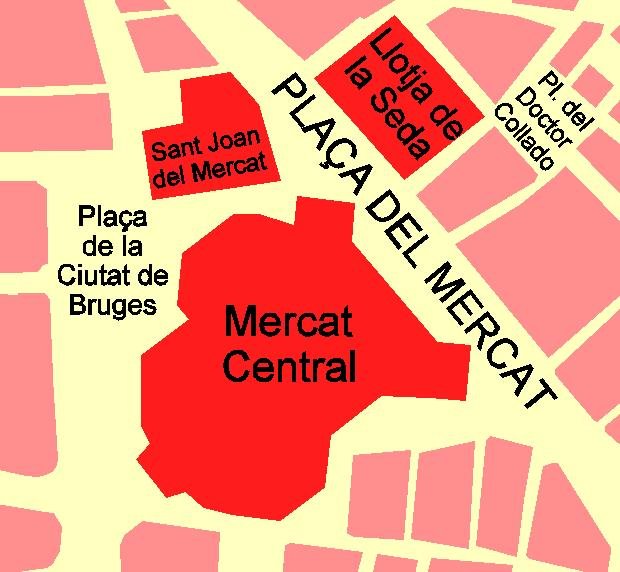
Nestled in the heart of Valencia’s historic district, Plaça Del Mercat stands as a living testament to the city’s layered past, architectural grandeur, and enduring market culture. Originally positioned near ancient Roman and Moorish settlements, the square emerged as Valencia’s commercial nucleus after the Christian reconquest in the 13th century. Over the centuries, it has evolved into a vibrant urban space where commerce, community, and culture converge. Today, visitors can explore the UNESCO-listed Llotja de la Seda, admire the Baroque Iglesia de los Santos Juanes, and experience Mercado Central—one of Europe’s largest and most celebrated markets. Plaça Del Mercat remains a dynamic cultural hub, hosting markets, festivals, and social gatherings that mirror Valencia’s vibrant spirit. This guide offers a detailed exploration of the square’s history, architecture, cultural significance, and all the practical information you need—including visiting hours, tickets, accessibility, and nearby attractions—to enrich your Valencia experience (architectureofcities.com, visitvalencia.com, Lonely Planet).
Photo Gallery
Explore Plaça Del Mercat in Pictures

Historic image of Plaza del Mercado de Valencia showing market stalls and people from the early 19th century.

Historic depiction of Valencia's market square circa 1811, showing architectural styles and daily life of the period.

Detailed 1842 depiction of Plaza del Mercado de Valencia, showcased at Palacio de Cervelló, highlighting historic market area and buildings.
Medieval Origins and Urban Evolution
Plaça Del Mercat’s origins trace back to the Middle Ages. Strategically located near Valencia’s earliest settlements, the square became the city’s main trading space following the Christian reconquest led by James I in 1238. The area quickly flourished as merchants from across the Mediterranean exchanged goods like silk, spices, ceramics, and produce. The 15th century marked Valencia’s “Golden Age,” with Plaça Del Mercat at its commercial and social center (architectureofcities.com).
Architectural Highlights
Llotja de la Seda (Silk Exchange)
Built between 1482 and 1533, the Llotja de la Seda is a masterpiece of late Gothic civil architecture and a UNESCO World Heritage Site. Its grand hall features soaring twisted columns and vaulted ceilings, symbolizing Valencia’s merchant prosperity and cosmopolitan spirit (architectureofcities.com).
Iglesia de los Santos Juanes
This church, initially constructed in the 13th century and rebuilt in Baroque style after a 16th-century fire, showcases ornate facades and a central clock tower—blending Gothic roots with Baroque ornamentation (architectureofcities.com).
Mercado Central
A defining feature of the square, Mercado Central was constructed between 1914 and 1928 in the Valencian Art Nouveau style. Its vast iron-and-glass structure, adorned with ceramic domes and stained glass, houses over 1,200 stalls and stands as a symbol of Valencia’s modernization (atlasobscura.com, mpctravelspain.com).
Cultural and Social Role
Plaça Del Mercat is more than a commercial hub; it is a focal point for civic life. For centuries, it has hosted daily markets, religious festivals, political gatherings, and public ceremonies. The Silk Exchange doubled as a municipal meeting hall, and Mercado Central continues to be a sensory gateway into Valencian culinary traditions (mpctravelspain.com). The area’s architecture reflects the city’s openness to innovation while honoring its roots (architectureofcities.com).
Visiting Information
Hours and Ticketing
- Mercado Central: Monday to Saturday, 7:30 AM – 3:00 PM; closed Sundays and public holidays. Entry is free.
- Llotja de la Seda: Typically 10:00 AM – 7:00 PM; free entry on Sundays. General admission is €2; audio guide €2.50.
- Iglesia de los Santos Juanes: Varying hours; check official sources.
Some guided tours of Mercado Central and Llotja de la Seda require advance tickets.
Getting There
- Metro: Xàtiva or Colón stations (Lines 3, 5, 7, 9)
- Bus: Multiple lines serve the area.
- On Foot: Easily reachable from Plaza de la Reina and other Old Town sites.
Accessibility
The area is predominantly pedestrianized and wheelchair-friendly, with ramps and accessible entrances at Mercado Central and surrounding attractions.
Nearby Attractions
- Plaza de la Reina: Cafés and access to Valencia Cathedral.
- Valencia Cathedral: Home of the Miguelete Tower and religious art.
- Torres de Serranos: Medieval gates with panoramic city views.
Special Events and Festivals
The square hosts artisan fairs, food festivals, and cultural events year-round. On Sundays, a collectibles and antiques market draws locals and visitors alike (visitvalencia.com). During Fallas in March and Christmas, the square becomes a focal point for parades and festive markets.
Tips for Visitors
- Best Times: Early mornings for a lively market; evenings for guided tours and a relaxed ambiance.
- Shopping: Many shops close for siesta (2:00–5:00 PM).
- Food: Sample tapas at Mercado Central, especially at the Central Bar by chef Ricard Camarena (visitvalencia.com).
- Photography: Allowed in most areas; always ask vendors for permission.
FAQs
Q: What are the visiting hours for Mercado Central and Llotja de la Seda?
A: Mercado Central: Monday to Saturday, 7:30 AM – 3:00 PM. Llotja de la Seda: Typically 10:00 AM – 7:00 PM, free entry on Sundays.
Q: Are tickets required?
A: Mercado Central is free; Llotja de la Seda charges €2, but has free entry on Sundays.
Q: Is the area accessible?
A: Yes, the square and main attractions are wheelchair-friendly.
Q: Are guided tours available?
A: Yes, including history, architecture, and gastronomy tours in multiple languages.
Q: What are the best times to visit?
A: Early morning for the market, evenings for tours, Sundays for free entry at Llotja.
Visuals and Media
Include high-quality photographs of Mercado Central, Llotja de la Seda, and the square. Use descriptive alt text such as “Plaça Del Mercat visiting hours,” “Mercado Central architecture,” and “Valencia historical sites.” Embed maps and link to virtual tours for enhanced engagement.
Discover More
Plaça Del Mercat encapsulates Valencia’s historic, architectural, and culinary vibrancy. Whether you’re drawn by Gothic and Modernist landmarks, bustling market life, or immersive cultural events, the square offers an unforgettable window into the city’s soul. Plan your visit with up-to-date information on hours, tickets, and tours, and let Plaça Del Mercat be the centerpiece of your Valencian adventure.
Download the Audiala app for real-time updates, guided tours, and insider tips. Subscribe to our newsletter and follow us on social media for the latest event news and expert advice on exploring Valencia’s historical treasures.
Listen to the full story in the app
Your Personal Curator, in Your Pocket.
Audio guides for 1,100+ cities across 96 countries. History, stories, and local insight — offline ready.
Audiala App
Available on iOS & Android
Join 50k+ Curators
Sources
-
verified
Plaça Del Mercat Valencia: Visiting Hours, Tickets, and Historical Insights, 2025, architectureofcities.com [https://architectureofcities.com/valencia]
-
verified
Cultural Significance, 2025, ca.wikipedia & visitvalencia.com [https://ca.wikipedia.org/wiki/Pla%C3%A7a_del_Mercat_(Val%C3%A8ncia), https://www.visitvalencia.com/en/what-to-do-valencia/valencian-culture/monuments-in-valencia/central-market]
-
verified
Mercado Central Valencia: Visiting Hours, Tickets & Architectural Highlights, 2025, explorial.com & travelinginspain.com [https://explorial.com/sights/valencia-el-mercado-central/, https://travelinginspain.com/valencia-market/]
-
verified
Visitor Experience and Practical Information, 2025, Lonely Planet & Abroad in Valencia [https://www.lonelyplanet.com/articles/plaza-del-mercado-valencia-history, https://abroadinvalencia.com/things-to-do-in-valencia/]
Last reviewed: