Introduction
The Puerta de Alcántara stands as a monumental gateway at the eastern edge of Toledo’s historic center, embodying centuries of architectural evolution and multicultural heritage. First mentioned in 806 CE under the rule of Umayyad emir Al-Hakam I, this iconic city gate has witnessed the passage of Romans, Muslims, Jews, and Christians, each leaving their mark on Toledo’s urban landscape (cultura.castillalamancha.es). Its name, from the Arabic "al-qantara" meaning "the bridge," highlights its integral relationship with the adjacent Roman-built Alcántara Bridge over the Tagus River.
The Puerta de Alcántara is freely accessible to visitors year-round and serves as one of the finest introductions to Toledo’s World Heritage-listed medieval old town. This comprehensive guide details its history, architecture, practical visiting information, and nearby attractions to help you make the most of your visit.
Historical Origins and Significance
Early Beginnings
The Puerta de Alcántara, one of Toledo’s oldest surviving city gates, traces its roots to the early medieval period. Its strategic location on the eastern flank, directly facing the Puente de Alcántara, made it a vital entrance for travelers, merchants, and armies crossing the Tagus River (cultura.castillalamancha.es). The gate not only defended the city but also controlled the main Roman road connecting Caesaraugusta (Zaragoza) and Emerita Augusta (Mérida).
Name and Early Structure
"Alcántara" derives from the Arabic "al-qantara," referring to the adjacent bridge. The first documented references date to the 9th and 10th centuries under Muslim rule, with subsequent mentions during the reigns of Abd al-Rahman II and Abd al-Rahman III. The original gateway was constructed atop Roman foundations, and its design was further enhanced during the Islamic period (Wikipedia).
Architectural Features and Evolution
Structure and Materials
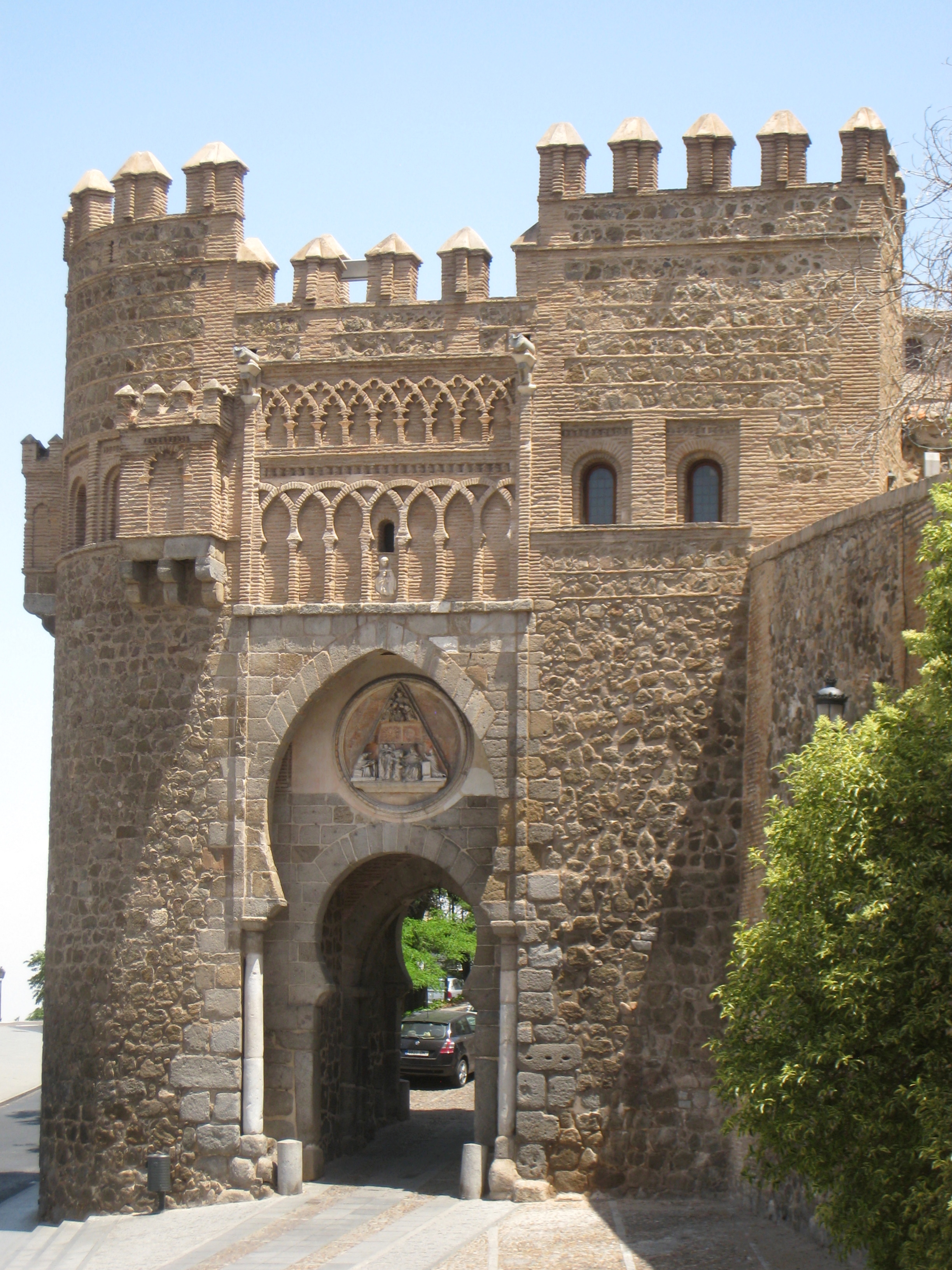
The Puerta de Alcántara is a masterful example of Hispano-Muslim military engineering. Its distinctive horseshoe arch, a hallmark of Islamic architecture, is flanked by two robust square towers. The structure incorporates large ashlars at its base—reused from Roman and Visigothic sources—and upper sections built in the Mudéjar style, combining stone and brick for strength and flexibility (Taxi Toledo).
Defensive Innovations
A key defensive innovation is the "gateway in a bend" (recodo): entrants had to turn sharply within the gate, making them vulnerable to defenders. Arrow slits and battlements atop the towers further enhanced security (Wikipedia).
Stylistic Layers
Throughout its history, the gate received Christian additions—most notably under Alfonso X and the Catholic Monarchs—such as coats of arms, religious motifs like the chasuble of San Ildefonso, and Gothic and Renaissance decorative elements (ToledoSpain.click).
Strategic Role in Defense and Commerce
Military Importance
The Puerta de Alcántara controlled the main eastern approach to Toledo and, together with the bridge, formed a fortified complex essential for the city’s defense, especially during the Christian reconquest and later medieval conflicts (spain.info).
Economic Functions
Beyond military significance, the gate served as a customs checkpoint, collecting the "Portazgo" tax on goods entering the city—a vital revenue source for Toledo (ToledoSpain.click).
Restoration and Preservation
Historical Transformations
By the 16th century, changes in warfare and urban expansion reduced the gate’s defensive role, leading to its closure and partial neglect. Ironically, being walled up preserved much of its fabric (cultura.castillalamancha.es).
Modern Restoration
Declared a national monument in 1921, the Puerta de Alcántara underwent major restorations between 1929 and 1961. Efforts focused on stabilizing the structure, reconstructing battlements, and preserving decorative details, ensuring its survival as a symbol of Toledo’s heritage (ToledoSpain.click).
Cultural and Symbolic Legacy
Multicultural Heritage
The gate exemplifies Toledo’s identity as the “City of Three Cultures,” with architectural and decorative features reflecting Roman, Islamic, Jewish, and Christian influences. It has served as a ceremonial entrance for dignitaries and a focal point for city celebrations (oasistoledo.com).
Symbolic Details
Heraldic shields, religious motifs, and inscriptions—including a record of the bridge’s reconstruction under Almanzor—attest to its enduring symbolic value (ToledoSpain.click).
Visiting Information: Hours, Tickets, and Accessibility
Opening Hours
- Exterior Access: Open 24/7, year-round.
- Interior & Towers: Generally closed to the public; access may be possible during special guided tours.
Tickets & Fees
- Admission: Free. No ticket required to visit or walk through the gate area.
Getting There
- On Foot: 10–15 minute walk from Toledo’s train station; follow signs to the Alcántara Bridge.
- Public Transport: Local buses stop nearby.
- By Car: Parking is available outside the historical center; walk or take a taxi/bus to the gate (Tour Travel World).
Accessibility
- Pathways: Some uneven surfaces and gradients; paved paths nearby. Wheelchair users may need assistance in certain areas.
Top Attractions Nearby
- Puente de Alcántara: The adjacent Roman bridge, rebuilt in the Islamic period, offers scenic river views (Toledo Free Tour).
- Castillo de San Servando: Medieval castle across the bridge, now a youth hostel and viewpoint (Nomads Travel Guide).
- Alcázar of Toledo: Iconic fortress and Army Museum, a short uphill walk from the gate (Touristear).
- Jewish Quarter: Explore Toledo’s rich multicultural neighborhoods and synagogues (Nomads Travel Guide).
- City Walls and Other Gates: Discover Puerta del Sol, Puerta Bisagra, and more (Taxi Toledo).
Photography & Special Events
- Best Times: Sunrise and sunset for dramatic lighting; night visits offer illuminated vistas.
- Photo Tips: Capture the horseshoe arch, heraldic shields, and panoramic river views.
- Events: Look for city festivals and reenactments that may include the gate in their routes (Toledo Free Tour).
Visitor FAQ
Q: Is there an entrance fee?
A: No, visiting the gate and bridge is free of charge.
Q: Are guided tours available?
A: Yes, many local operators offer tours that include the Puerta de Alcántara.
Q: Is the site wheelchair accessible?
A: Most nearby paths are paved, but some areas are uneven. Assistance may be needed.
Q: Can I visit at any time?
A: Yes, the exterior is accessible 24/7, but daylight hours are best for safety and photography.
Q: Are there facilities at the gate?
A: No, but cafes, shops, and restrooms are nearby in the city center.
Practical Tips for Your Visit
- Wear comfortable shoes for cobblestone streets and slopes.
- Stay hydrated—summers in Toledo can be hot.
- Arrive early or late afternoon for the best light and fewer crowds.
- Combine your visit with the nearby castle, Alcázar, and Jewish Quarter.
- Respect the monument—do not climb or damage any part of the structure.
- Check local tourism websites for updates on tours and events (Toledo Tourism Official Website).
Summary
The Puerta de Alcántara is a living testament to Toledo’s centuries-old role as a crossroads of civilizations. Its Roman origins, Islamic engineering, and Christian embellishments encapsulate the city’s rich multicultural legacy. Freely accessible and beautifully preserved, the gate rewards visitors with architectural wonders and panoramic views—making it an essential stop for anyone exploring Toledo’s medieval heart (cultura.castillalamancha.es; ToledoSpain.click; Toledo Free Tour).
For more information, download the Audiala app for guided audio tours and follow local tourism resources for the latest updates.
Listen to the full story in the app
Your Personal Curator, in Your Pocket.
Audio guides for 1,100+ cities across 96 countries. History, stories, and local insight — offline ready.
Audiala App
Available on iOS & Android
Join 50k+ Curators
Sources
- verified
- verified
- verified
- verified
- verified
Last reviewed: