Santiago De Compostela
Santiago De CompostelaSpain 42° N · 8° W Updated Apr 2026
Beneath its pilgrimage façade lies a thriving university hub where Celtic roots run deep, wet granite gleams, and the giant thurible swings only on feast days.
 Photo: amaianos · CC BY 2.0
- Time needed
- Half day to 2 days
- Entry
- Free (Old Town) / Cathedral museum €5
- Access
- Limited due to uneven cobblestones
- Best season
- September–October
Why does a cathedral consecrated to a first-century apostle still hum with the heavy footsteps and quiet relief of modern travelers? Stone remembers. Step onto the Praza do Obradoiro in Santiago de Compostela, Spain, and feel the damp Atlantic wind cool against sun-baked limestone.
Records show a modest basilica rose in the 820s, only for Al-Mansur’s armies to level it in 997. The town rebuilt fast. You will pass bakeries and silversmiths operating from cellars that predate the Inquisition by four centuries.
The architecture reads like a ledger of shifting European power. Romanesque load-bearing walls give way to Gothic vaults. According to tradition, the architects designed the double ambulatory specifically so arriving travelers could circulate without interrupting daily mass.
What to see
-
Pórtico de la Gloria
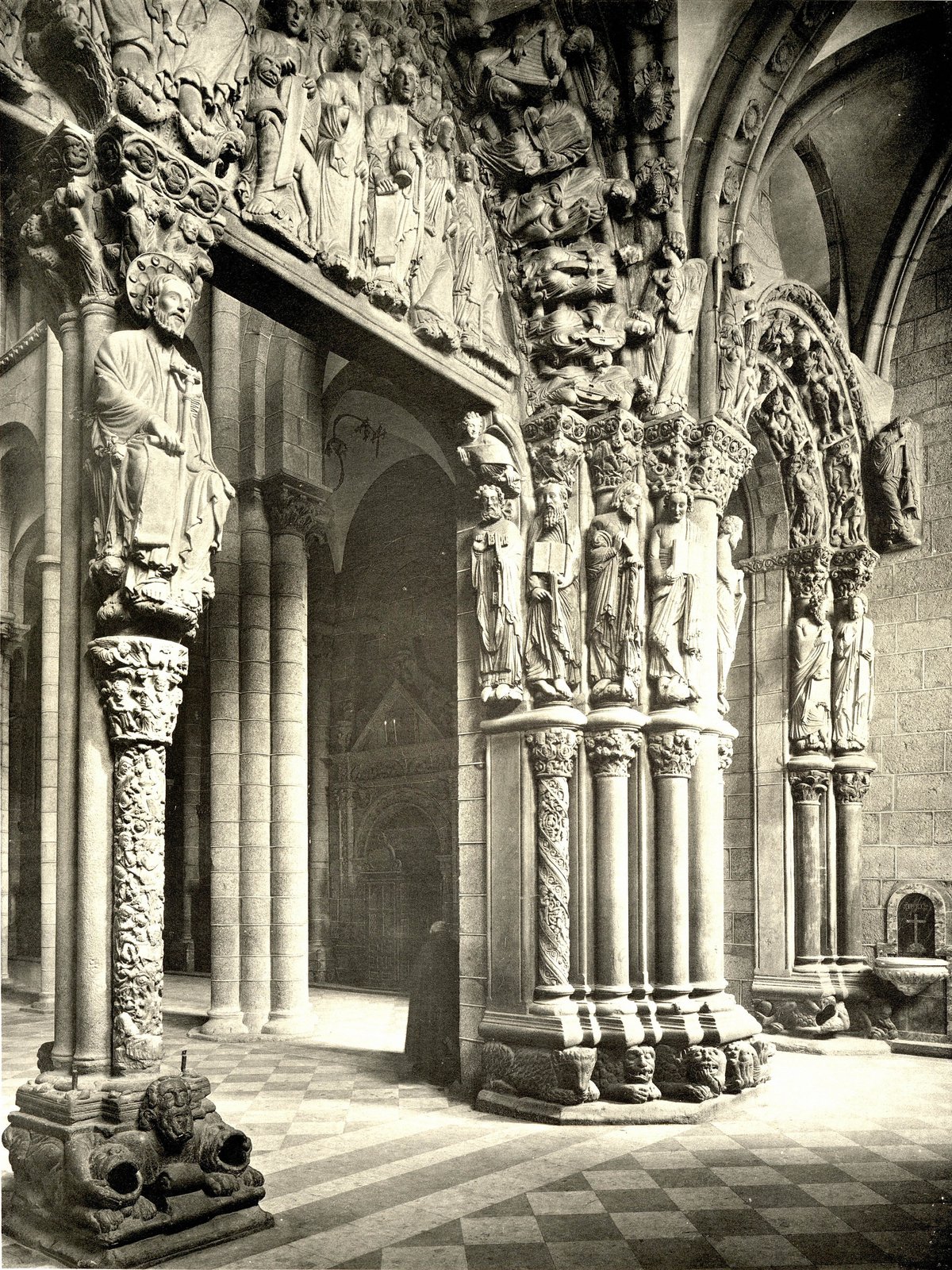
Records show Master Mateo finished the Pórtico de la Gloria between 1168 and 1188, carving two hundred figures into the limestone arches. But look closer. Press your palm against the middle pillar to trace a three-centimeter groove polished glass-smooth by eight centuries of travelers, then listen as the 60-kilogram Botafumeiro swings through the frankincense haze. -
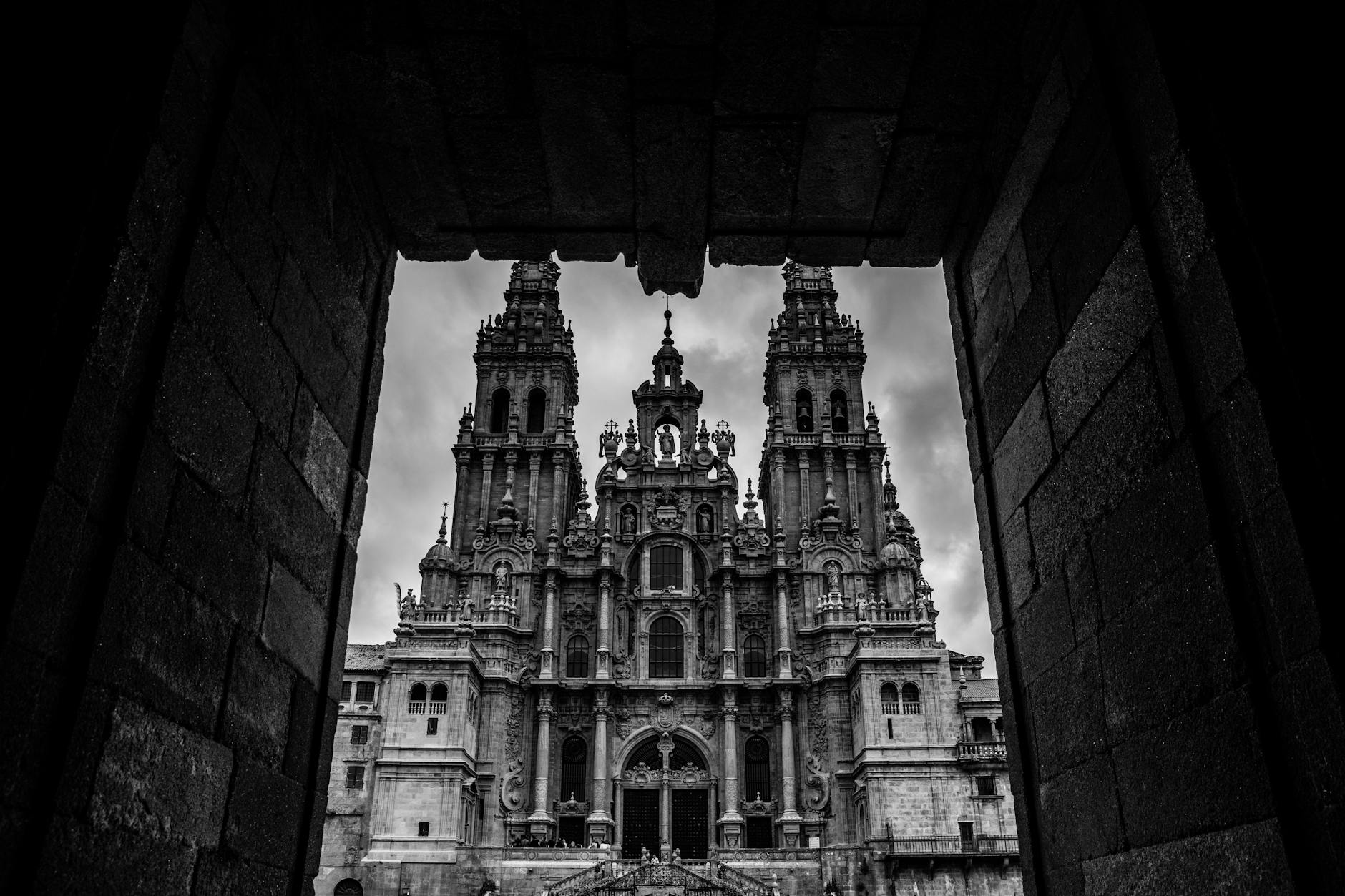
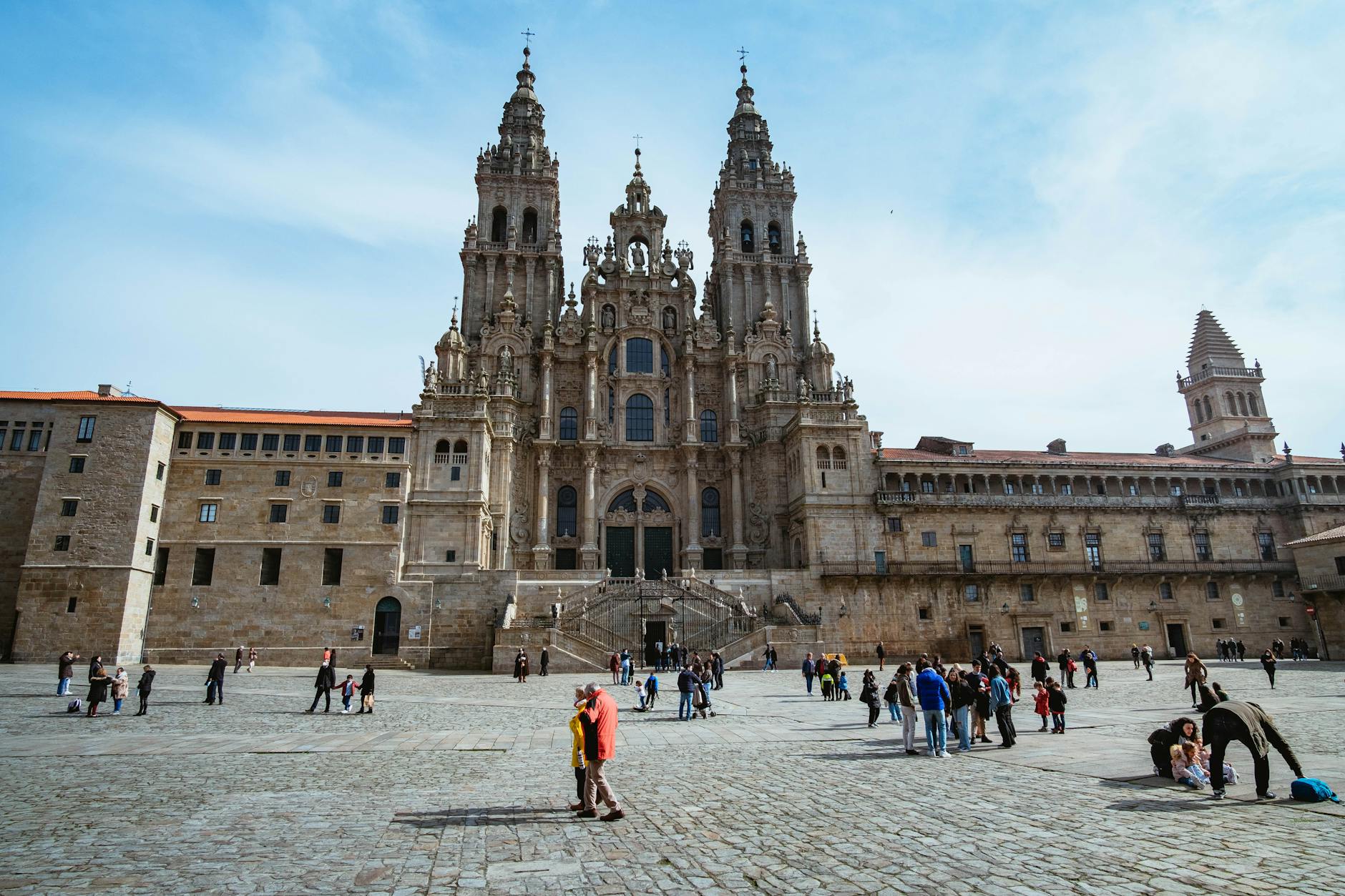
Praza do Obradoiro Facade
Fernando de Casas Novoa completed the western façade in 1738, but the real theater happens at ground level when the afternoon sun strikes the Obradoiro steps. Watch the light. The concave granite planes stretch vertical lines to disguise the heavy Romanesque core, while the northern Quintana corner catches a pilgrim’s silhouette projected across the flagstones. -
Monastic Quarter & Shadow Walk
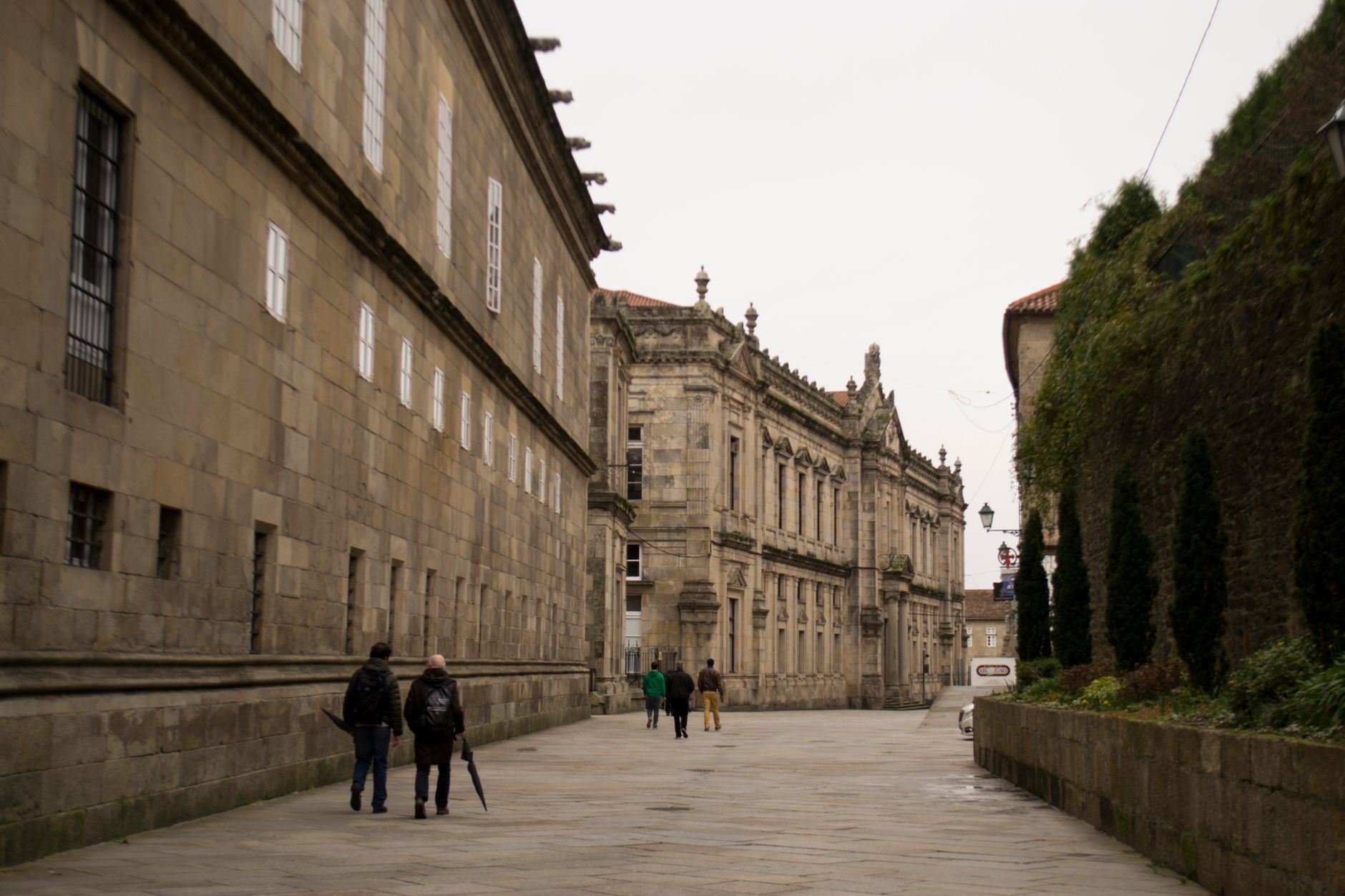
Start at Plaza de la Inmaculada where the Neoclassical Azabachería façade holds back the tourist tide, then slip down Rúa do Franco past shuttered silversmith workshops. Keep moving. Cut through the damp slate paths of Xardín de San Martiño Pinario to feel the acoustic shift as monastic walls swallow plaza noise, leaving only pine needles and distant choir rehearsal.
Plan your visit
- Getting There
- Forget the metro myth; the city never built one. Catch TUSSA Bus 6 from Lavacolla Airport to the Praterías stop in twenty minutes. Walk the final 1.5 kilometers from the train station along Rúa do Hórreo, or park at Aparcamiento San Lázaro and follow the carved stone arrows on foot.
- Opening Hours
- As of 2026, the basilica opens daily at 07:00 for quiet prayer. The Museum and thematic tours run from 10:00 to 20:00, with the Pilgrim Reception Office on Rúa Carretas issuing credentials until 19:00. Expect closures on December 24 after 14:00, plus full museum shutdowns on Christmas Day and New Year's.
- Time Needed
- A quick prayer and Obradoiro photograph consumes thirty minutes. Book a complete museum circuit to trace the cloisters, Gelmírez Palace, and Pórtico de la Gloria, which demands two to three hours. Add a slow lunch at Mercado de Abastos and you will easily fill half a day.
- Accessibility
- The main basilica floor welcomes wheelchairs via a ramp at Porta de Praterías. Medieval cloister corridors retain abrupt stone thresholds that block standard mobility aids. Skip the roofs and tower tours entirely if you rely on wheels, since the spiral staircases climb at punishing angles.
- Cost/Tickets
- As of 2026, skip-the-line museum tickets run around €8. The Pórtico de la Gloria adds another €5, while a complete visit combining both costs roughly €15 to €17. Book every timed slot online at the official cathedral portal, because walk-up sales vanished years ago.
Photo Gallery




History
The Engine of the Walk
Every generation since the ninth century has added mortar and patched roofs. The exterior shifts with fashion. The interior rhythm has not.
Daily at noon, the Misa del Peregrino gathers the exhausted and the devout beneath the same acoustic canopy. The building was engineered as a transit hub for the soul. It still processes arrivals and departures with mechanical precision.
The turning point
Ashes and Ambition
Most guidebooks treat the cathedral as a finished monument that naturally grew into prominence. The ledgers disagree. By 1110, the wooden roof sagged under damp Atlantic air, and rival bishops lobbied Rome to strip Archbishop Diego Gelmírez of his metropolitan authority.
The turning point arrived around 1117 when a catastrophic fire consumed the timber structure. He acted fast. Gelmírez liquidated personal assets to fund French master masons, swapped flammable wood for experimental stone barrel vaults, and survived a noble siege.
Knowing this shifts your eyes upward the moment you step inside. You are not looking at a serene medieval workshop. You are reading an emergency engineering pivot that locked the nave into a permanent silhouette.
The Baroque Mask
The Silver Pendulum
Tips for visitors
Cover Skin Before Entering
Guards at the Porta de Praterías will turn away shoulders and knees left exposed. Pack a lightweight shawl and swap beach shorts for trousers before crossing the threshold into the nave.Leave Tripods Behind
Flash and tripods remain strictly forbidden inside the basilica and museum to protect medieval pigments and prevent crowd bottlenecks. Point your phone freely in the outdoor plazas, but keep it holstered once you step past the Pórtico.Watch Your Wallet Near Obradoiro
Pickpockets concentrate around the main square and Mercado de Abastos entrances, using distraction tactics on exhausted arrivals. Keep valuables in a crossbody bag and ignore anyone selling unofficial credential stamps or fast-track Compostela certificates.Grill Seafood At The Market
Skip the inflated pilgrim menus radiating directly from the cathedral. Buy fresh shellfish at Mercado de Abastos and hand it to an adjacent stall for €5 to €10 grilling, or book a table at Casa Marcelo in the shadow of the university.Brace For Granite Rain
Locals joke that if it is not raining, it is a holiday, so pack waterproof layers regardless of the season. Winter brings mist and empty streets, while summer crowds peak between 10:00 and 16:00; plan quiet plaza walks for early morning or dusk.Chase The Botafumeiro Wisely
The giant silver thurible swings on a specific calendar of roughly eight feast days, not daily as guidebooks often claim. Check the cathedral's official liturgical schedule before arriving, or accept the daily 19:30 Pilgrim Mass as a quieter alternative.
Frequently asked
Is Santiago de Compostela worth visiting?
Yes, because the city layers pre-Christian Roman foundations, a 12th-century sculptural masterpiece, and living pilgrimage rituals into a single, walkable grid. You'll step into a nave where stone vaults rise higher than a three-story townhouse, then watch the 80kg silver thurible slice through frankincense haze like a pendulum. Skip the summer crowds if you can.
How long do you need at Santiago de Compostela?
Plan three full days to balance the cathedral's architectural layers with the surrounding old town. One morning covers the Romanesque nave and Portico of Glory, while another half-day lets you trace the worn tau carvings on stair risers and eat pulpo á feira at the Mercado de Abastos. Rushing through it usually means missing the quiet cloister entirely.
How do I get to Santiago de Compostela from the airport?
Take TUSSA Bus Line 6 directly to the Praterías or Obradoiro stops, a ride that takes roughly twenty minutes. The fare sits around €10, and the bus drops you within walking distance of the pedestrianized historic center where taxis cost closer to €25. You'll save yourself a sweaty trek with heavy luggage.
What is the best time to visit Santiago de Compostela?
October offers crisp air and low-angle sunlight that turns the granite façades gold without the summer crush of pilgrims. The cathedral's acoustic resonance sharpens in the thin autumn chill, and you'll actually hear the tiraboleiros' ropes creak during the rare Botafumeiro swings. Winter works too if you don't mind damp cobblestones and shorter lines.
Can you visit Santiago de Compostela Cathedral for free?
You can enter the main basilica for prayer at no cost, but every architectural tour requires a timed ticket. Access to the crypt, the Pórtico de la Gloria, and the rooftop walkways costs around €17 for a complete pass, and walk-up sales are completely suspended. Book at least a week out or you'll just stare at a closed door.
What should I not miss at Santiago de Compostela?
Press your palm against the central column of the Pórtico de la Gloria to feel the 800-year-old glassy groove worn smooth by countless pilgrims seeking blessings. Then step into the dim crypt where the air carries a metallic dampness and houses a silver reliquary whose bones scholars still debate. Most tourists rush past the worn tau carvings on the stair risers, but they're the actual fingerprints of medieval travelers.
Sources & attribution 7
- UNESCO World Heritage Centre #347 — Cathedral history, 9th-century origins, 10th-century destruction by Al-Mansur, and architectural layout of the Romanesque pilgrimage basilica.
- Santiago Ways — 1075 groundbreaking date, medieval construction phases, and consecration timeline.
- Camino Ways — Botafumeiro weight and mechanics, Pórtico restoration details, and daily mass schedules.
- Catedral de Santiago Official Visits — Ticket pricing, mandatory online booking rules, photography restrictions, and backpack size limits.
- TUSSA Transit Authority — Bus Line 6 airport transfer route, duration estimates, and fare structures.
- Proguías Secrets — Hidden pilgrim shadow alignment in Plaza de la Quintana and lesser-known viewing spots.
- ArchDaily City Guide — Granite thermal mass properties, interior acoustic behavior, and seasonal lighting effects on the façades.
Built from cited sources · see the method · How we make our guides →
More in Santiago De Compostela.
67 places to discover — a few worth pairing.
Pick up where you left off
Saved and recently read places — kept on this device only.
Photo credits (13)
- Rúa do Franco, Santiago de Compostela — Bene Riobó — CC BY-SA 4.0 (https://creativecommons.org/licenses/by-sa/4.0/) — Source: https://commons.wikimedia.org/wiki/File:Rúa_do_Franco,_Santiago_de_Compostela.jpg
- Luis Villasmil — Unsplash License (https://unsplash.com/license) — Source: https://images.unsplash.com/photo-1578301978693-85fa9c0320b9
- Pablo Martínez — Pexels License (https://www.pexels.com/license/) — Source: https://www.pexels.com/photo/356378/
- Iñigo De la Iglesia — Unsplash License (https://unsplash.com/license) — Source: https://images.unsplash.com/photo-1590736969955-71cc94901144
- Santiago de Compostela, Galiza (cropped) — amaianos — CC BY 2.0 (https://creativecommons.org/licenses/by/2.0/) — Source: https://commons.wikimedia.org/wiki/File:Santiago_de_Compostela,_Galiza_(cropped).jpg
- Zally — Pexels License (https://www.pexels.com/license/) — Source: https://www.pexels.com/photo/11324085/
- Victor Damian — Pexels License (https://www.pexels.com/license/) — Source: https://www.pexels.com/photo/35490133/
- Carmen Dominguez — Pexels License (https://www.pexels.com/license/) — Source: https://www.pexels.com/photo/33306364/
- Jo Kassis — Pexels License (https://www.pexels.com/license/) — Source: https://www.pexels.com/photo/11690252/
- Jo Kassis — Pexels License (https://www.pexels.com/license/) — Source: https://www.pexels.com/photo/11690259/
- Carmen Dominguez — Pexels License (https://www.pexels.com/license/) — Source: https://www.pexels.com/photo/33505995/
- Yunuen Caballero — Pexels License (https://www.pexels.com/license/) — Source: https://www.pexels.com/photo/11664254/
- Jo Kassis — Pexels License (https://www.pexels.com/license/) — Source: https://www.pexels.com/photo/11690124/
Photos may have been resized or cropped.