An introduction.
Researched by the Audiala editorial team from historical records, architectural archives, and local expertise.
TThe largest Gothic rose window in the world sits in the wrong place. At Palma Cathedral — Palma de Mallorca's 14th-century sea-facing giant on the southern edge of Spain — the great oculus hangs above the altar, not the entrance, so morning light falls on the priest instead of the people walking in. Locals call it La Seu. Come for a storm-vow cathedral built on a mosque, stay for an Antoni Gaudí restoration he never finished and a contemporary chapel that still divides the island.
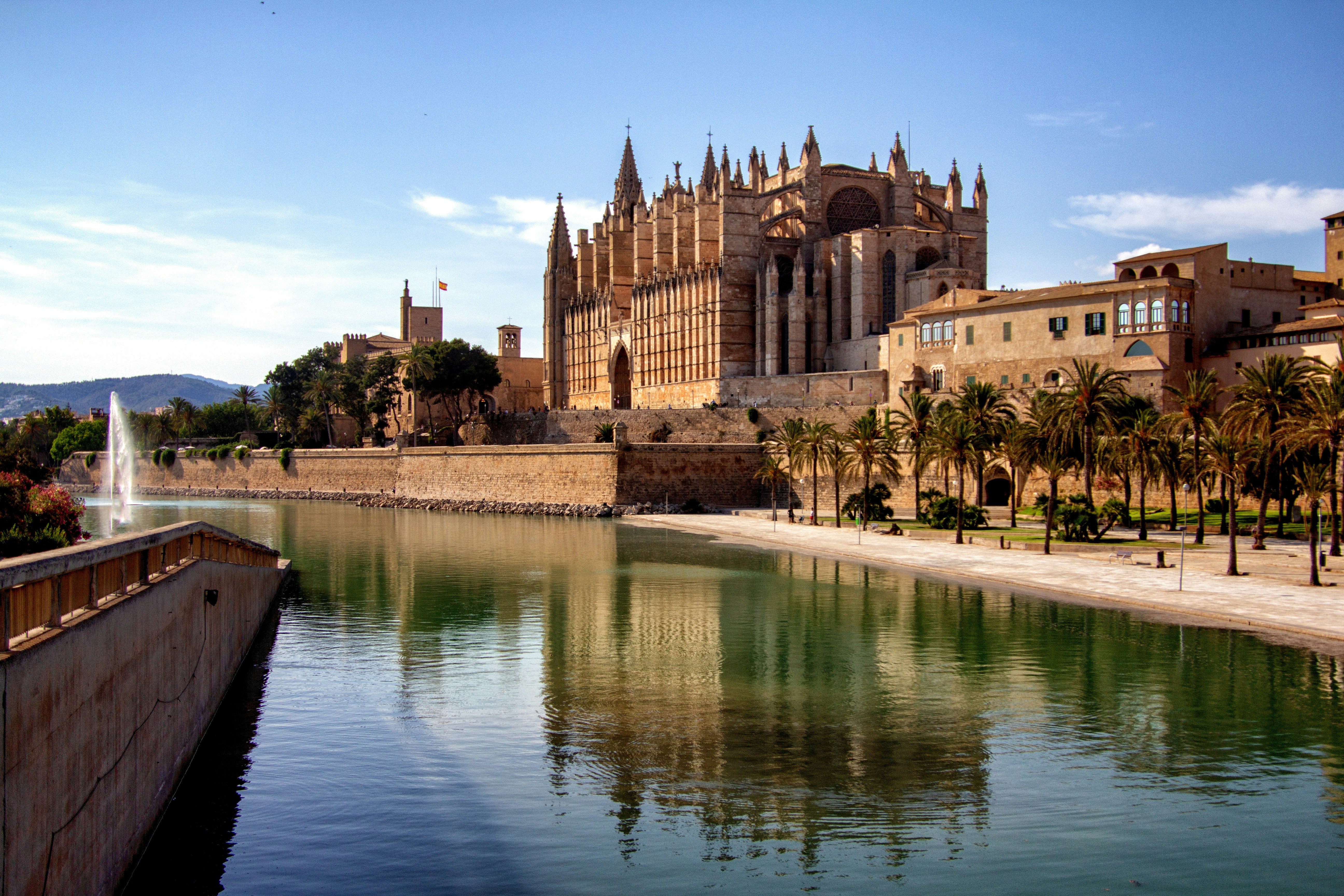
La Seu rises straight out of the old city walls above Parc de la Mar, a honey-coloured limestone cliff quarried from sea caves at Portals Vells and floated around the island by boat. From the reflecting pool below, the cathedral doubles itself in water at golden hour — the single best free view in Palma, and the one most locals will send you to first.
Inside, the scale disorients. Octagonal pillars thinner, relative to the vaults they hold, than any other Gothic cathedral on earth. A nave that reaches 44 metres — taller than a twelve-storey building — lit by 1,200-plus crystals in that misplaced rose window. Above the altar, Gaudí's hexagonal baldachin hangs where it has hung for more than a century, a provisional model the contractor rejected and nobody has replaced.
Then there's the Barceló chapel at the eastern end, where Mallorcan artist Miquel Barceló covered the walls in a ceramic reef of fish, skulls and bread loaves between 2001 and 2006. Some locals love it. Others haven't forgiven the bishop for letting him do it. Either way, you'll want to see it yourself before deciding.
01 What to see.
The Nave and the Gothic Eye
Walk in from the harbor glare and the nave swallows you whole. The central vault climbs 44 meters — only Beauvais in France goes higher — and it rests on fourteen octagonal pillars so slender for their load that structural engineers still argue about how they hold. You feel small the way you feel small in a forest, not in a crowd.
Then the eastern rose window registers. It's about 13 meters across and stitched from 1,236 individual crystals, the largest Gothic rose still in its original place anywhere in the world, dating to roughly 1370. On sunny mornings, light pours through it and paints the stone floor in rose, gold, and violet that drifts as the sun climbs.
Look up and hold the angle. The 24 triangular tracery sections resolve into a clean Star of David — a detail the cathedral doesn't advertise, and one most visitors miss entirely because they're photographing the projection on the floor rather than reading the window itself.
Gaudí's Presbyterium and the Barceló Chapel
Antoni Gaudí worked on La Seu from 1904 to 1914, and the heart of what he did hangs directly over the high altar. That enormous heptagonal crown — dripping with 35 brass oil lamps — looks permanent and finished. It isn't. The structure above your head is a full-scale mock-up in cardboard, wire, wood, and paper; Bishop Campins died in 1915, the money dried up, and the definitive baldachin was never built. Every visitor since has been standing under a prototype that's been "temporary" for 110 years.
Gaudí also hollowed a resonance cavity beneath the organ, which is why the 1,797-pipe instrument fills a 44-meter nave without a single microphone. Come on the first Tuesday of any month at noon and you'll feel it in your sternum before you register it as sound.
Walk to the right-hand apse and the century changes. Between 2001 and 2006, Mallorcan artist Miquel Barceló coated the walls of the Capilla del Santísimo with 300 square meters of raw ceramic relief — fish, skulls, seaweed, loaves, bread like geology — fired in Vietri sul Mare with clay dragged in from Germany, Rome, and Salerno. The five grisaille windows from Toulouse were tuned to the color temperature of Mediterranean seawater at different depths, so the light shifts from cool blue-green at breakfast to amber by late afternoon. Locals are still divided about it. Some call it grotesque. Others won't visit the cathedral without stopping here first.
Rooftop Terraces and the Bells
02 In pictures.




Videos
Watch & Explore Palma Cathedral
Palma de Mallorca Spain : 3 days itinerary, best places to visit #travel #spain #mallorca
ULTIMATE GUIDE TO PALMA DE MALLORCA | Top Travel Tips And Must-see Attractions!
Plan and listen to Palma Cathedral with Audiala.
Audio guide in your pocket, itinerary in your browser. Built for the way you actually visit.
Tickets & tours.
These are guided options from our partners — same price as booking direct.
Prices are indicative — final pricing and availability are confirmed at checkout. Audiala may earn a commission from bookings made through these links.
Also on GetYourGuide
More tours for Palma Cathedral
Curated from GetYourGuide. Same price as official, free cancellation on most.

Palma: Cathedral of Mallorca Skip-the-Line Entry Ticket
from
€11

Old Town and Cathedral Tour
from
€28

Palma de Mallorca: Walking Tour, Cathedral & Local Tasting
from
€39

Mallorca: Premium Catamaran Day Trip with Food, Swim Stop & Optional VIP Area
from
€85

Palma de Mallorca: Valldemossa & Cathedral Shore Excursion
from
€135
Prices shown are indicative — final pricing and availability are confirmed at checkout. Audiala may receive a commission from bookings made via these links.
03 Visitor logistics.
The practical scaffolding for a good visit — kept short.
Getting There
Bus line 35 from Palma's Intermodal Station drops you a four-minute walk from Plaça de la Seu; lines 102 and 111 from the Marina are wheelchair-accessible. On foot, it's about ten minutes south from Plaça Major or five minutes southeast from Passeig del Born. Driving in is pointless — the historic centre is closed to private cars; park at Aparcament Parc de la Mar (around 600m away) and walk up.
Opening Hours
As of 2026, La Seu opens Monday to Friday 10:00–17:15 and Saturday 10:00–14:15 from April through October, with shorter winter hours (10:00–15:15 Mon–Sat) from November to March. Sundays are closed to sightseers — Mass only — along with December 25–26, December 31 and January 1. Rooftop terraces run May 2 to October 31, weekday 10:00–16:30, Saturday until 13:30.
Time Needed
Budget 90 minutes to two hours for the cathedral and Museum of Sacred Art at a normal pace, or three hours if you add an audio guide and the Barceló chapel deserves the lingering it asks for. Add another hour if you've booked the rooftop terraces — the climb is 215 steps and your slot is capped at 30 minutes. A quick rose-window-and-Gaudí-canopy lap can be done in 45 minutes if you must.
Tickets & Costs
In 2026, standard adult entry is €9 (€7 reduced, free under-10s); the cathedral-plus-terraces combined ticket is €25 and sells out in season — book direct at catedraldemallorca.org rather than through resellers who tack on markups. Mallorca residents enter free on Fridays with ID. The terrace tour runs about €12 on its own and the guided sunset version €30.
Accessibility
The nave and museum are fully wheelchair-accessible via the Carrer de Sant Bernat entrance — ask staff rather than tackling the main steps. A stair lift handles interior level changes and there's an adapted WC near the cloister. The 215-step rooftop climb has no lift and is not advised for anyone with reduced mobility, vertigo, or children under 11.
05 Tips for visitors.
Small things that change the day.
Cover Up
Knees and shoulders must be covered for both men and women — no tank tops, short shorts, swimwear or hats inside. In summer, throw a light scarf in your bag; staff will turn you away at the door otherwise.
Light Phenomenon Dates
On February 2 and November 11, sunrise light passes through the western rose window and projects a perfect figure-of-eight onto the wall opposite — it lasts only minutes. Arrive by 8:00 AM on those dates; this is the single most spectacular free moment at La Seu.
Camera Rules
Personal photos without flash are fine; tripods, selfie sticks, and drones are banned and staff enforce it. During Mass, put the camera away entirely — locals actually worship here, and the friction is visible when tourists forget that.
Watch Your Pockets
Three pickpockets were arrested right outside the cathedral in March 2026, with a documented trick: someone dressed like a tourist asks you to translate a menu while a partner lifts your wallet. Keep bags in front and ignore strangers asking for help in the entrance corridor.
Eat Like a Local
For breakfast, walk five minutes to Ca'n Joan de S'Aigo (open since 1700) for thick hot chocolate and ensaïmada — budget, no booking. Mid-range: Maura for tapas around the corner. Splurge: DINS Santi Taura for a Michelin-recognised modern Mallorcan tasting menu.
The Real Money Shot
The best view of La Seu isn't from inside — it's from across the lagoon at Parc de la Mar at golden hour, when the sandstone burns gold and the whole façade reflects in the water. Free, uncrowded, and the view locals actually use.
Pair With Sa Llotja
Five minutes west sits Sa Llotja, Guillem Sagrera's 1420s Gothic merchant exchange — one of Europe's finest civil Gothic buildings and almost always empty. Free entry when open; the same hand that designed La Seu's rose window built it.
Quietest Mornings
Tuesday or Wednesday at 10:00 sharp in April or October is when the nave is genuinely calm and the rose-window light is at its best. Avoid June through September mid-mornings — the cruise crowds peak between 10:30 and 12:30.
Where to Eat
Don't Leave Without Trying
Dining Tips
- check La hora del vermut (noon–2 PM) is a cultural ritual, not a meal: locals stop for vermouth over ice with an olive and a tapa—purely a social pause before lunch.
- check Lunch (2–4 PM) is the main meal; dinner rarely starts before 9 PM. Arriving at 7:30 PM means dining almost alone.
- check Monday is the most common restaurant closing day across Palma.
- check Tipping is discretionary (5–10%). Always check the bill for 'Servicio incluido' first—if shown, no additional tip is needed. Cash tips go directly to staff.
- check Card payment is nearly universal (~99%), including contactless. Small market stalls and traditional bakeries may still need cash.
- check All major food markets (Mercat de l'Olivar, Santa Catalina, Pere Garau) operate Mon–Sat mornings, closing by 2–3 PM. None are open Sundays.
- check Reservations: tapas bars and cafés are walk-in; popular restaurants need 1–2 weeks in high season (May–September); fine dining needs 1–3 months.
Restaurant data powered by Google
04 A history of reinvention.
A Cathedral Built on a Vow, a Mosque, and 370 Years of Arguments
The story starts with a storm. In December 1229, James I of Aragon was sailing toward Mallorca with his invasion fleet when the weather turned. Legend holds he vowed to build a cathedral to the Virgin Mary if he survived. He survived, conquered the island, and kept his word — but he never saw the building. Records show construction began on the foundations of Madina Mayurqa's principal mosque in 1230, when Bishop Pere de Morella consecrated the altar stone.
Then they kept building. And building. The cathedral was formally consecrated in 1346, the bell tower finished in 1498, the main portal not completed until 1601 — 371 years after that first altar stone. By then the kings it was meant to glorify were long gone, the kingdom they ruled had been absorbed into Aragon, and the mosque it replaced had been fully demolished only in 1386.
The Last King of Mallorca, Buried 556 Years in the Wrong Country
James II ordered La Seu's eastern Trinity Chapel built as his dynasty's mausoleum, starting around 1306. His grandson James III was meant to lie there too. Instead, on 25 October 1349, the last independent king of Mallorca died in a field at Llucmajor, trying to reconquer the island his cousin Peter IV of Aragon had seized from him six years earlier. His small army was destroyed. His body was taken to Valencia and buried there.
He stayed in Valencia for 556 years. It was not until 1905 — on the personal orders of Alfonso XIII — that his remains were escorted back to Mallorca aboard the frigate Yáñez Pinzón, with full military honours. The alabaster cenotaph you see today in the Trinity Chapel, sculpted by Frederic Marès, wasn't installed until 1947.
Stand in that chapel and do the arithmetic. The cathedral outlasted the kingdom it was built to house by more than 680 years. The room was ready by 1327. The king finally arrived in 1947. That's the timescale La Seu works on.
Gaudí's Unfinished Restoration
The Façade Almost Nobody Notices is Fake
Listen to the full story in the app
The whole Palma Cathedral,
told well.
Audio guides for 1,100+ cities across 96 countries. History, stories, and local insight — offline ready.

06 Frequently asked.
The questions travellers send us most about Palma Cathedral.
Is Palma Cathedral worth visiting?
Yes, and not just for the postcard. La Seu holds the world's largest original Gothic rose window (1,236 crystals, c.1370), Gaudí's unfinished 1904-1914 restoration, and Miquel Barceló's 300m² ceramic chapel — three radically different eras in one building. Skip it and you miss the most architecturally layered cathedral in Spain.
How long do you need at Palma Cathedral?
Budget 1.5 to 2 hours for the interior and Museum of Sacred Art, or 2.5 to 3.5 hours if you add the rooftop terrace tour. A quick pass through the nave, rose window and Gaudí baldachin takes 45-60 minutes, but you'll walk straight past the Barceló chapel and Jujol's polychrome murals. The terraces alone are 60 minutes once you're inside.
How do I get to Palma Cathedral from Palma airport?
Take the EMT Bus A1 from the airport directly to Plaça d'Espanya or the Intermodal Station (around €5, 25 minutes), then walk 15 minutes south to the cathedral. A taxi runs roughly €25 and drops you on Avinguda Antoni Maura next to Parc de la Mar. Private cars can't enter the historic centre — park at Aparcament Parc de la Mar, 600m away.
What is the best time to visit Palma Cathedral?
Tuesday or Wednesday at 10:00 opening, ideally April or October. Morning sun fires the eastern rose window and throws rose, gold and violet across the nave floor; by 11:00 the tour groups swarm in. For something rarer, come at 8:00 on February 2 or November 11 for the Festa de la Llum — the figure-eight light projection lasts minutes.
Can you visit Palma Cathedral for free?
Not really, unless you're a resident of the Diocese of Mallorca (free on Fridays with ID). Standard adult entry is €9, or €25 combined with the rooftop terraces. The best free experience is from Parc de la Mar at golden hour — the sandstone glows amber above the reflecting lagoon, and locals consider this the money shot.
What should I not miss at Palma Cathedral?
The Barceló chapel in the right apse — 300m² of ceramic fish, skulls and loaves that most visitors blow past expecting conventional altar art. Look up at the baldachin hanging over the main altar: it's a cardboard-and-wire mock-up by Gaudí that was never replaced, 110 years later. And find the eastern rose window from inside — it's at the altar end, not the entrance, which breaks every Gothic convention.
Is Palma Cathedral a UNESCO World Heritage Site?
No. Despite what many guidebooks claim, La Seu is not individually inscribed on the UNESCO list — the nearby Serra de Tramuntana mountains are. The cathedral is a Spanish national monument (1931) and was elevated to minor basilica by the Vatican on 9 September 1905.
What's the dress code at Palma Cathedral?
Shoulders and knees must be covered for everyone — no tank tops, short shorts, swimwear or transparent fabrics, and no hats inside. Staff enforce it at the door and will turn you away or hand out disposable covers. Carry a light scarf in summer; it's the easiest fix for a Mediterranean afternoon.
Can you go up on the roof of Palma Cathedral?
Yes, the rooftop terraces reopened on 5 March 2026 after restoration, running May 2 through October 31. It's €25 combined with the cathedral, 60 people per slot, 30-minute limit, and pre-booking is essential in summer. You'll climb 215 steep steps past flying buttresses and eye-level gargoyles — not accessible for motor disabilities or under-9s.
Verified, and shown.
Researched and written by the Audiala editorial team from historical records, architectural archives, and local expertise.
Official opening hours, ticketing, and visitor information
Official 2026 terrace reopening details
Details on the 1789 organ, 5,000 pipes, and Gaudí's acoustic chamber
Official sunset terrace guided tour information
Official photography and visitor rules
General history, dimensions, and construction timeline
Spanish-language detail on Jujol murals, Portals Vells stone, and architectural debates
Detailed rose window history including 1936 bomb damage
Biography of the architect who worked on Portal del Mirador and La Lonja
Sagrera's career, dispute with merchants' guild, and Naples exile
Biographical details on Sagrera's sculptures and architecture
Last king of Mallorca, death at Llucmajor, and 1905 return of remains
25 October 1349 battle where James III died
Spanish-language detail on James III's exile and return
Architect linked to La Seu's three-nave design
1851 earthquake and Peyronnet Neo-Gothic façade reconstruction
Hidden architectural details and sensory experience
Gaudí's baldachin as provisional prototype
Gaudí's 1904-1914 restoration and unbuilt stained glass
Gaudí's interventions and design choices
Why the permanent Gaudí baldachin was never built
Barceló ceramic chapel (2001-2006) details
Local perspective on the Barceló chapel controversy
Material sourcing and construction details of the Barceló chapel
Art-historical analysis of the Barceló chapel
Insider perspective on the Barceló controversy
Analysis of the hexagram in the rose window tracery
Scholarly review of vault construction theories
Historical episodes connected to La Seu
James I storm vow legend and cathedral founding
Opening hours, transport and practical information
Nearest parking lots and distances
Enforced dress code rules
Rooftop terrace pricing and booking
Recommended nearby dining
Comprehensive visitor guide
Neighborhood context around the cathedral
2026 ticket info and tours
Terrace tour experience and capacity limits
Figure-eight light phenomenon details
Third-party terrace ticketing
Wheelchair access, ramps and adapted toilets
Practical wheelchair access details
Accessible travel in Palma including the cathedral
Reviewed restaurants near La Seu
Curated Palma dining recommendations
Luggage storage options in Palma
Photography rules and practical tips
Cathedral attraction overview with pricing discrepancy
Hotel-partner cathedral visitor guide
Interior experience and key features
February 2026 article on terrace reopening
March 2026 terrace reopening coverage
Festa de la Llum 2026 coverage
Light phenomena at La Seu
Cultural context of the cathedral
January 20 patron saint festival
Cathedral light show details
Additional Festa de la Llum detail
Curiosities and hidden details
Lesser-known cathedral facts
Details on the 1789 main organ and 1477 pipes
Official tourism info on figure-eight phenomenon
Official tourism info on terraces
Corpus Christi procession details
First-person account of Festa de la Llum
Gargoyles visible from the rooftop terraces
General cathedral overview
Hidden corners of the cathedral
Local resident perspective on visiting La Seu
Gentrification of neighborhoods around the cathedral
Academic analysis of tourism displacement in old town
La Calatrava neighborhood guide
Pickpocket tactics in Palma centre
2026 terrace accessibility constraints
March 2026 arrest of three pickpockets near cathedral
March 2026 terrace reopening news
Local magazine cathedral guide
Neighborhood guide adjacent to cathedral
Palm Sunday blessing at La Seu
Semana Santa processions at La Seu
Ca'n Joan de S'Aigo and other local spots
Restaurant curation near cathedral
Traditional Mallorcan foods
Ensaïmada, sobrassada, tumbet, and coca de trampó
Drone restrictions in urban Palma
AESA drone regulations
Traveler Q&A on cathedral visits
Traveler reports of common scams in Palma
Travel guide on UNESCO status misconceptions
Last reviewed

