


Place
Spain Updated Apr 2026
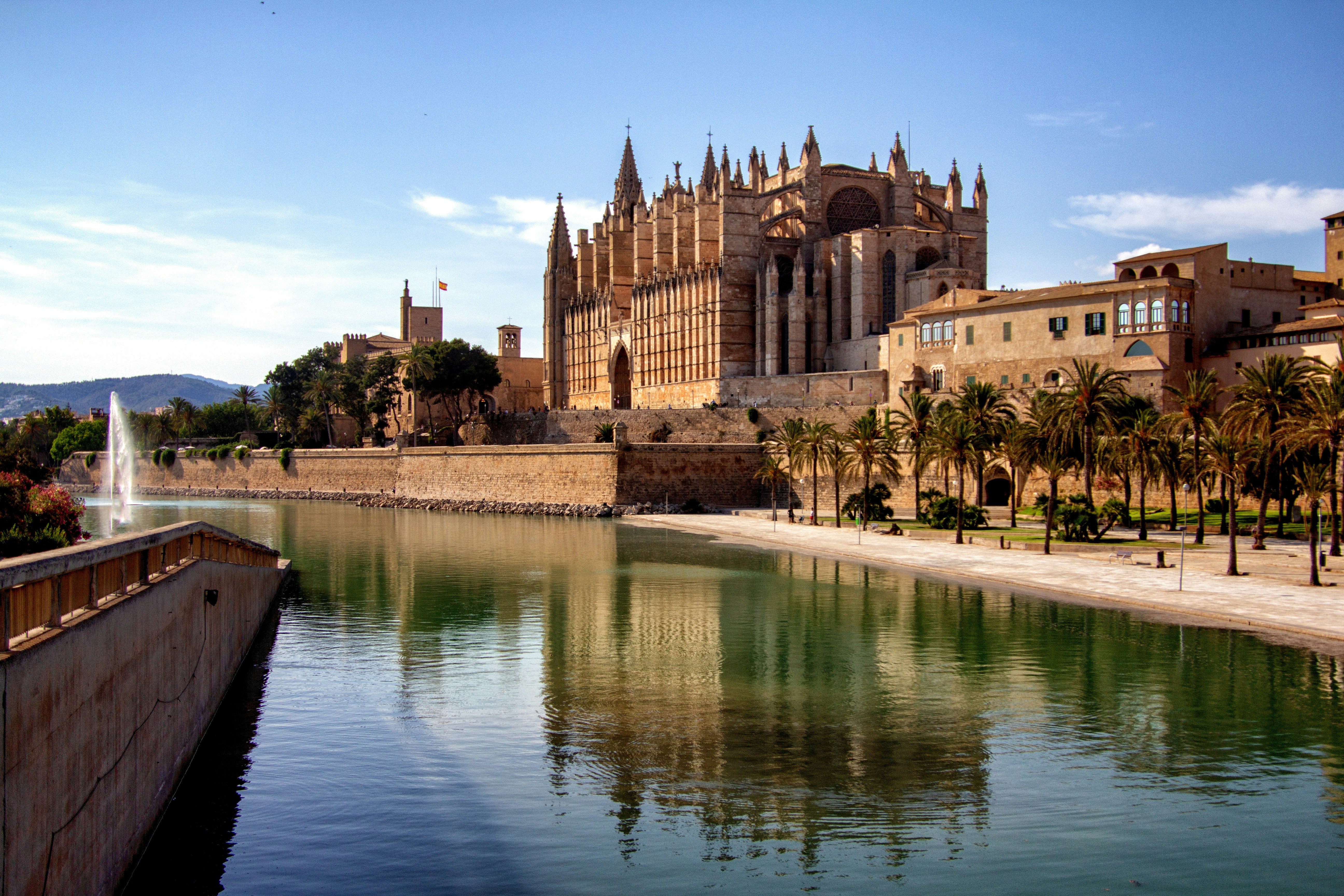
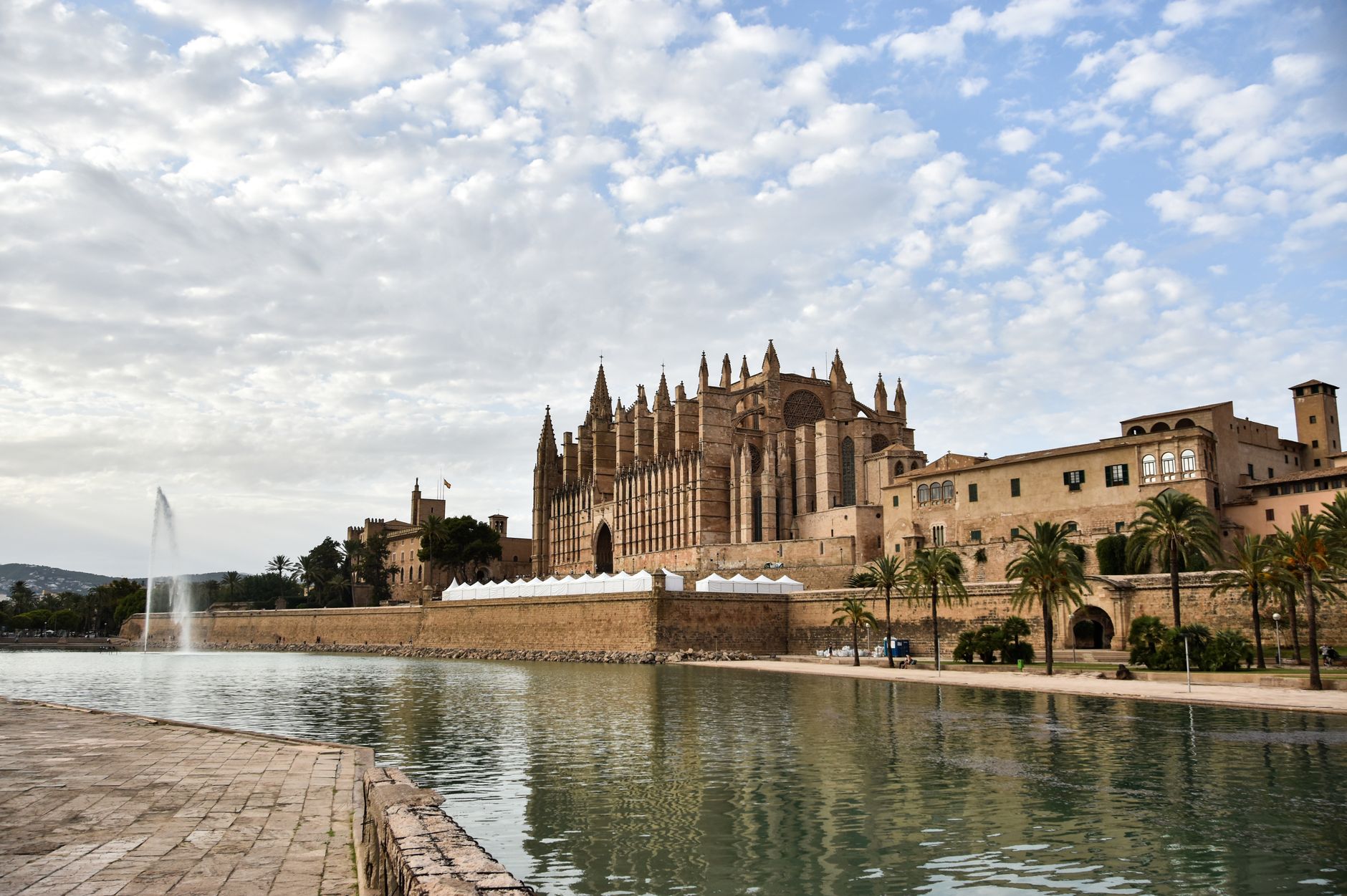
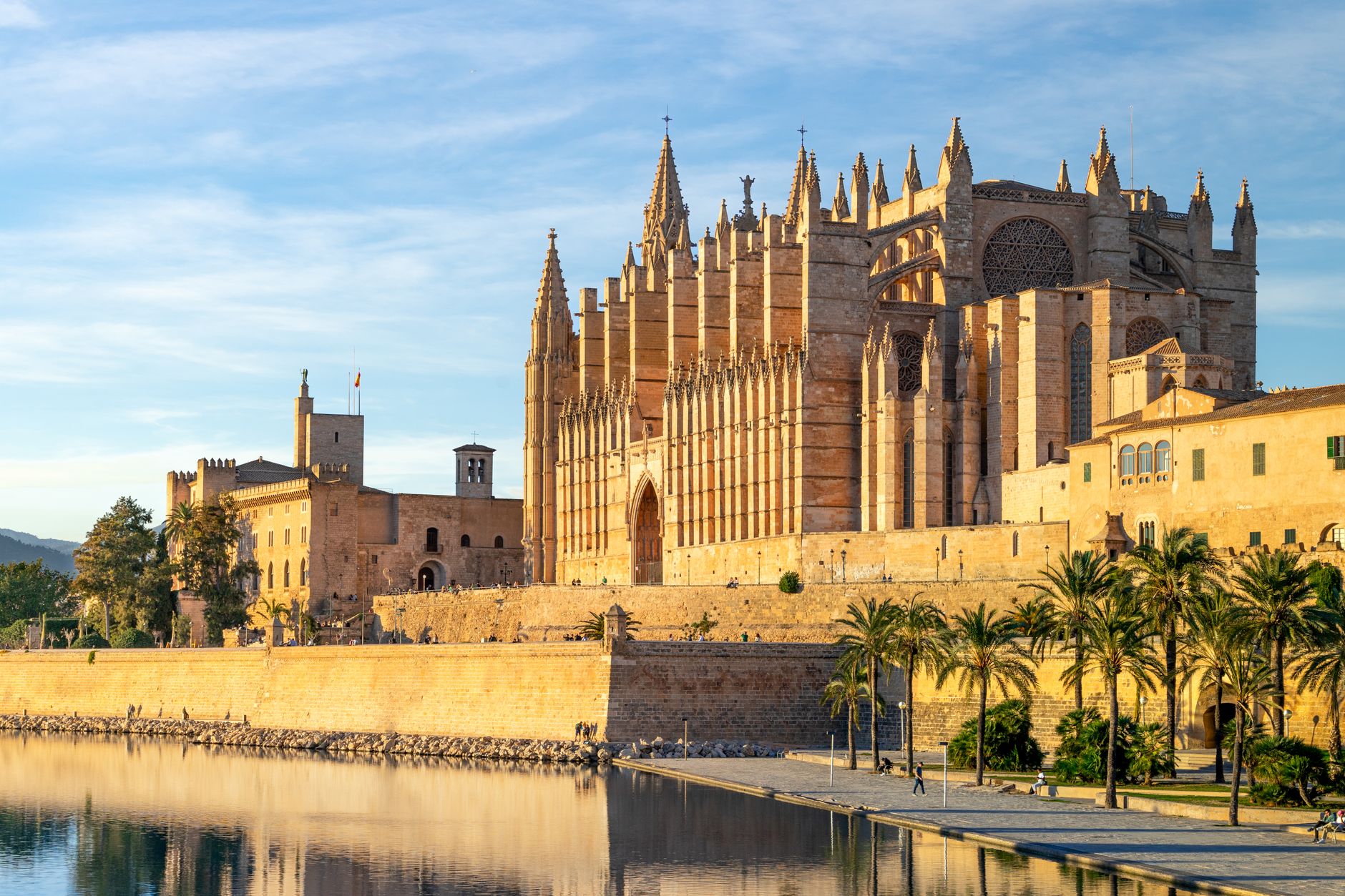
Palma de Mallorca, Spain, is mentally filed under beach destination, which is how a Gothic cathedral redesigned by Antoni Gaudí manages to operate in relative obscurity. Gaudí spent eleven years here between 1904 and 1915 — his sole work outside Catalonia — rearranging the choir, designing a baldachin canopy above the altar, and transforming how light moves through the nave. Most of the people flying into Palma for a fortnight in the sun have no idea it exists.
 Photo: Margo Evardson / Pexels
Built from cited sources · see the method · How we make our guides →
The city holds 2,000 years of habitation, and little of it is buried. Arab baths from the 10th century hide behind an unmarked door two streets from a Modernisme building whose facade is covered in dragon motifs and broken-tile mosaics. A sea wall begun in 1562 and completed in 1801 runs the length of the seafront, still structurally intact, its Renaissance stonework going amber in the afternoon light.
What gives Palma its texture is the life organized around eating. On Sundays, and increasingly any day of the week, the city stops between noon and 2pm for vermut: a glass of vermouth over ice with an orange slice, in bars whose aesthetic hasn't shifted since the 1950s. The custom predates the tourist wave; it was the post-Mass ritual before the family Sunday lunch, and it has never stopped.
This is also the centenary of Gaudí's death, and the cathedral is marking it with theatrical walks, a November symposium, and guided tours focused on his 1904–1915 interior redesign. The Paseo Marítimo reopened this spring as a fully pedestrianised 3.5-kilometre promenade, replacing traffic lanes with green space along the entire harbour front. The city is in a deliberate moment of reinvention.
Not every monument, just the ones we'd walk you past ourselves.

Where to wander, by quarter — each with its own rhythm.
Before you go
Curated from places in this city. Same price as official sites.


Prices shown are indicative — final pricing and availability are confirmed at checkout. Audiala may receive a commission from bookings made via these links.
From Roman harbor to Mediterranean crossroads, 2,000 years of empire and reinvention
The Roman consul Quintus Caecilius Metellus Balearicus landed with his legions in 123 BCE to suppress the Balearic pirates who had terrorized Mediterranean trade routes for decades. He founded two cities on the island: Pollentia in the northeast to serve shipping lanes toward Rome and Gaul, and Palma in the southwest bay, oriented toward Africa and Hispania. Palma was laid out in the Roman grid pattern — cardo and decumanus cutting through whatever Talaiotic settlement had stood there before. For this work, Metellus kept the island's name as his own surname, Balearicus, which tells you roughly how proud he was of the job.
When the Vandal king Gunderic swept through Hispania in 427, Mallorca fell almost incidentally — a useful harbor on the way to North Africa. His successor Geiseric made it something more deliberate: a base for naval raids that reached Sicily, Greece, and ultimately Rome itself, which he sacked in 455 CE. Byzantine general Belisarius ended the Vandal kingdom in 534 and the Balearics returned to Constantinople's distant orbit, early Christian basilicas appearing where Vandal damage had been. Byzantine authority dissolved quietly through the 8th century without anyone quite noticing.
Issam al-Khawlani, a commander from the Emirate of Córdoba, seized the Balearic Islands in 902 CE — reportedly sheltering from a storm in Mallorcan waters during a pilgrimage to Mecca and deciding not to leave. The city was renamed Medina Mayurqa, and over the following three centuries it became one of the western Mediterranean's busiest trading ports. The Roman grid gave way to narrow winding streets, hammams, mosques, and irrigated orchards that occupied roughly a fifth of the city's interior. The Jewish cartographers and scholars who settled here would eventually produce some of the finest navigational charts ever drawn.
In 1114, a Christian fleet of approximately 500 vessels from Pisa, Genoa, and the Catalan counties descended on Medina Mayurqa in one of the largest amphibious operations the medieval Mediterranean had yet seen. They captured the city, took thousands of prisoners, stripped it of portable wealth, and then withdrew when an Almoravid counter-force appeared on the horizon. The city was left severely damaged but still Muslim. The raid confirmed something both sides already suspected: this harbor was too valuable to leave in someone else's hands indefinitely.
Six soldiers scaled the walls of Medina Mayurqa on the last night of 1229, planted the banner of the Crown of Aragon, and ended 327 years of Muslim rule. King James I — 21 years old, already calling himself the Conqueror — had spent three months besieging the city after landing at Santa Ponça in September with 155 ships and approximately 15,000 troops. The man who led the scaling party, Arnaldo Sorell, was knighted on the spot. The great mosque was demolished within months, its site cleared for a cathedral, and the street names, language, and population changed within a generation.
Ramon Llull was born in Palma around 1232, three years after James I's conquest, to a Catalan settler family who had arrived with the conquering army. He spent his early years as a courtly troubadour, married, had children, then around age thirty experienced a series of visions that redirected everything. Teaching himself Arabic and studying logic and mathematics, he invented a philosophical system he called the Art — a combinatorial diagram-machine for proving Christian doctrine through pure reason, which Leibniz examined 400 years later as a precursor to computational logic. Three missionary journeys to North Africa followed; he died around age 83, probably after being stoned in the Algerian city of Bougie; his tomb has been in the Franciscan church in Palma since 1448.
When James I died in 1276, his will split the Crown of Aragon between his two sons — and the younger, Jaume, received something unexpected: an independent kingdom encompassing the Balearic Islands, Roussillon, Cerdanya, and the lordship of Montpellier. Palma, then called Ciutat de Mallorca, became an island capital in its own right. Jaume II commissioned Bellver Castle, rebuilt the Almudaina Palace in Gothic style, founded new churches, and turned the city into something genuinely royal. The independence lasted barely 70 years before Aragon absorbed it back.
Royal architect Pere Salvà began Bellver Castle around 1300 on a pine-forested hill 3 kilometers above the bay, building it circular — one of only a handful of Gothic castles in Europe built to this plan. A round keep connects to the main building via a flying arch; three cylindrical towers anchor the perimeter. It served as royal residence, fortress, and political prison over the following centuries, holding figures including the Enlightenment philosopher Gaspar Melchor de Jovellanos, who was imprisoned there from 1801 to 1802. The views from the battlements across the entire arc of Palma Bay explain immediately why a medieval king chose this hill.
Abraham Cresques was a Jewish cartographer working in Palma when Prince John of Aragon commissioned what would become the Catalan Atlas of 1375 — the most complete world map of the 14th century, extending from the Atlantic coast to East Asia, with Sub-Saharan gold trade routes rendered in gold ink. The map was the product of generations of Mallorcan Jewish cartographic expertise; the island's navigational knowledge had made it indispensable to Mediterranean commerce for decades. The atlas now sits in the Bibliothèque nationale de France, where it has been for 650 years. Cresques died in 1387; four years later, his community was nearly destroyed.
On August 2, 1391, a mob attacked Palma's Jewish quarter — the Call Major and Call Menor — in the same wave of anti-Jewish violence that had begun in Seville in June and swept through the entire Crown of Aragon that summer. Hundreds were killed; thousands were forcibly baptized; the quarter was ransacked. Those who converted nominally while keeping Jewish practice became known as Chuetas, marked by their family surnames for the next five centuries. Exclusion from guilds, the nobility, and the church hierarchy followed regardless of how many generations had passed since the conversion.
Guillem Sagrera, Mallorca's greatest medieval architect, began La Llotja — the Gothic merchant exchange — in 1426 and finished it in 1452. The interior is a single vaulted hall supported by six spiral columns so slender they barely read as structural. Merchants closed their deals beneath carved stone angels, the implication being that divine witnesses would keep negotiations honest. Sagrera went on to work at the Castel Nuovo in Naples; La Llotja stayed in Palma, and it remains the most refined piece of Gothic architecture on the island.
In 1521, Mallorcan peasants and craftsmen rose in the Revolt of the Germanies — a wave of insurrections against the Habsburg-backed nobility that had already exploded in Valencia. For two years they held significant parts of the island. The suppression was methodical and brutal: thousands killed or imprisoned, rural hierarchies reshuffled, resentments calcified into the social fabric. The revolt left no lasting political change but a deep scar — the memory that the island's farmers had once tried, and failed, to break the power of the landed class.
Plague arrived at the port of Sóller in 1648, carried from Valencia and Catalonia, and worked its way across the island over four years. It killed approximately 14,000 to 15,000 people out of a population of around 100,000 — roughly 9,000 of them in Palma alone. Entire villages were emptied; agricultural production collapsed; the island entered a stagnation that lasted decades. The 17th century ran concurrent miseries: plague, Berber and Ottoman piracy along the coast, and an Inquisition working through Chueta families with patient bureaucratic thoroughness.
In 1691, the Mallorcan Inquisition staged what locals came to call Sa Cremadissa — the Great Burning. Thirty-seven members of Palma's Chueta community were condemned in a single auto de fé: some burned alive, others burned in effigy, all publicly destroyed. A book titled Fe Triunfante was published immediately to cement their infamy in print and keep it circulating. The event did not end the discrimination; it formalized and broadcast it, and Chueta families could be identified by their surnames in Palma well into the 20th century.
A Bourbon fleet under the French-born general Asfeld besieged Palma on July 2, 1715 — the last battle of the War of the Spanish Succession, fought ten months after Barcelona had already fallen. Mallorca had backed the losing Habsburg side. Philip V's Decree of Nueva Planta dissolved the Gran i General Consell (founded 1249), replaced Mallorcan law with Castilian law, and made Castilian Spanish mandatory in all official transactions. In a single administrative document, the island lost institutions it had spent 466 years building.
Frédéric Chopin and the novelist George Sand arrived in Mallorca in November 1838 looking for a mild winter to ease Chopin's tuberculosis, and found instead cold, wet weather and hostile locals who feared contagion. They ended up in a vacant cell in the Valldemossa Cartuja monastery, where Chopin completed his 24 Preludes Op. 28 as rain fell on the stone roof. Sand's account of the whole miserable experience — A Winter in Majorca, published in 1842 — became the island's first piece of major international literary publicity, and remains one of the more entertaining complaints ever filed against a destination. The monastery is now a museum.
Lluís Domènech i Montaner — one of the three architects who defined Catalan Modernisme alongside Gaudí and Puig i Cadafalch — designed Palma's Gran Hotel, which opened in 1903 as the grandest hotel in Spain. The façade brought Modernisme's organic stonework and craft-workshop detail to a city just beginning to look northward, toward Europe and the possibility of tourism. Now CaixaForum Palma, a cultural center, the building repays thirty seconds of attention from the pavement even if you have no intention of going in.
Antoni Gaudí accepted an invitation from Bishop Pere Campins in 1904 to reform La Seu Cathedral — the only major commission he ever took outside Catalonia. He moved the choir from the nave to the presbytery, opening the cathedral to its full 121-meter length; designed the baldachin canopy with a crown of thorns suspended over the high altar; and rethought the building's relationship to light and color entirely. The project was unfinished and controversial. In 2026, the centenary of Gaudí's death, La Seu is hosting a year-long program that finally positions this work at the center of his legacy rather than at its margins.
When the Spanish Civil War broke out in July 1936, Mallorca's garrison joined the Nationalist side within days. A Republican amphibious force under Colonel Alberto Bayo landed at Porto Cristo in August and initially advanced inland — only for Mussolini's intervention to settle the matter: Italian aircraft and warships drove the Republicans back into the sea by September. For the rest of the war, Mallorca served as an Italian air base, its planes bombing Republican ports at Valencia and Barcelona. Hundreds of Mallorcan left-wingers were arrested and shot.
Joan Miró moved permanently to Palma in 1956, at age 63 — his mother was Mallorcan, he had visited since childhood, but it took until the mid-century for him to commit fully. His studio at Son Abrines became his base for the final 27 years of his life, the period in which he produced the large-scale works — tapestries, ceramics, outdoor sculptures — that now stand in cities from Barcelona to Chicago. In 1981 he donated his studios and archives to the city; the Fundació Pilar i Joan Miró opened formally in 1992. Those final years in Palma were arguably his most ambitious.
Son Sant Joan Airport opened in 1960, and within a decade it had reshaped Mallorca more thoroughly than any conquest since 1229. Charter flights from Germany, Britain, and Scandinavia brought millions of tourists annually to an island whose economy had been agricultural and subsistence-level within living memory. Hotels covered the coast; coastal villages became resorts almost overnight; GDP rose sharply as traditional agriculture collapsed entirely. By 2024, the Balearic Islands were receiving 18.7 million tourists a year, and Palma residents were marching in the streets with banners that read Mallorca is not for sale.
On March 1, 1983, the Statute of Autonomy of the Balearic Islands entered into force, making the archipelago a self-governing community for the first time since Philip V's 1715 decree abolished Mallorcan institutions. The Catalan-Mallorcan language — banned from public life under Franco for 40 years, and suppressed for two centuries before that — became officially co-official alongside Spanish. The date is now the Balearic public holiday, Dia de les Illes Balears. After 268 years, something resembling self-governance returned to Palma.
In 2007, Miquel Barceló — born in Felanitx, Mallorca, in 1957 — unveiled the Capella del Santíssim inside La Seu: an entire chapel covered floor to vault in multicolored ceramic, representing the miracle of the loaves and fishes through forms that read more as cave geology than religious iconography. The diocese was praised and attacked in equal measure. Whatever its theology, the chapel is one of the most arresting pieces of new religious art installed inside a medieval European building in the 21st century — and it sits within the same cathedral that Gaudí had already reworked a century before. Palma, apparently, collects these interventions.
Philosopher, Poet, Mystic · c.1232–1316
Born in Palma
Born into the merchant class of a newly conquered Christian Palma, Llull spent his first three decades as a court poet before a series of visions of the crucified Christ turned him toward theology. He went on to create one of the first systematic philosophical logic systems, wrote the first major novel in Catalan, and died — according to tradition — stoned by a mob in North Africa at 83 while attempting to convert Muslims. His tomb is in the Basilica of Sant Francesc, two minutes' walk from where he was born.
King, Conqueror · 1208–1276
Conquered Mallorca 1229; ordered La Seu built
James I landed on Mallorca with 155 ships and 15,000 men on September 10, 1229 — then 21 years old, already king of Aragon, acting on intelligence from a Catalan merchant about the island's wealth. He took the city within four months, and legend holds he vowed during a fierce storm at sea to build a great cathedral if God spared his fleet. Whether or not the storm happened, construction on La Seu began that year. James also wrote about the campaign himself, in Catalan, producing the Llibre dels Fets — the first royal autobiography in European history.
Architect · 1852–1926
Worked at La Seu cathedral 1904–1915
The Bishop of Mallorca invited Gaudí to restore La Seu in 1904, expecting something conservative. Instead Gaudí moved the medieval choir out of the nave to open the sightlines, hung a wrought-iron baldachin above the altar, and redesigned the lighting to fall dramatically onto the presbytery — all inside a Gothic cathedral built five centuries before he was born. The result was either inspired or outrageous depending on who you asked, and locals debated it fiercely. In 2026, the centenary of his death, La Seu is running a full events programme in his honor.
Painter, Sculptor · 1893–1983
Lived and worked in Palma 1956–1983
Miró first came to Mallorca as a child to visit his mother's family, and when he returned permanently in 1956 — aged 63 — it was partly to escape Barcelona and partly because the island's light suited the scale of work he wanted to make. His studio in Cala Major, Son Abrines, was designed by his friend Josep Lluís Sert; he worked there every day until the year he died. The studios are preserved exactly as he left them: paint-spattered floors, half-finished canvases, the particular quality of afternoon light he chose the building for.
Painter, Sculptor · born 1957
Born in Mallorca; created La Seu's Barceló Chapel
Born in Felanitx, 60km east of Palma, Barceló became the most internationally prominent Spanish artist of his generation — known partly for the ceramic mural covering the ceiling of the United Nations Human Rights chamber in Geneva. His most intimate work is closer to home: the Chapel of the Sacrament inside La Seu, where he spent six years creating a landscape of sea creatures, stalactites, and skulls in ceramic that covers every surface. The bishop who commissioned it died in 2003 before the chapel opened, which gives the whole thing an appropriately melancholy weight.
Where locals actually book dinner — not the tourist menus.
Small things that change how the city treats you.
The city, as it actually looks.



Yes — and for reasons most visitors miss. La Seu cathedral contains the only major Gaudí work outside Catalonia, Palma has Spain's second-richest collection of Modernist architecture after Barcelona, and a medieval old town historically split between rival quarters whose civic rivalry survived into the 20th century. It is not a beach resort that happens to have a cathedral; it is a city of 400,000 people with a genuine cultural life.
Three to five days gives you time to cover the city's main sites, explore the neighborhoods at a reasonable pace, and make at least two day trips — the Tren de Sóller through the Tramuntana mountains and Valldemossa being the most rewarding. Two days is rushed. Anything over five and you're really exploring the island rather than the city.
Bus A1 is the most practical option: it runs every 12–15 minutes, stops at Plaça d'Espanya (the main transport hub) and Passeig Mallorca, and costs about €3 by contactless card or €5 cash. Journey time is roughly 30 minutes. Taxis cost €20–30 and take 11–15 minutes. There is no metro connection to the airport.
Mid-range to expensive by Spanish standards — closer to Barcelona than to inland Andalusia. In 2026, all TIB intercity buses and trains across Mallorca are free with the Targeta Única card, which significantly cuts travel costs. The Juan March Foundation museum is free every day; La Seu costs €8–10. Accommodation in July and August runs sharply higher than spring or autumn.
April, May, and October are the best months: warm enough for the beach, cool enough to walk the old town comfortably, and clear of the summer crowds that pack La Seu and sell out the Tren de Sóller weeks in advance. July and August are hot, crowded, and expensive. Spring 2026 adds a specific reason to visit early: the Gaudí Year centenary programme at La Seu includes theatrical walks on April 23–24.
Yes. The usual urban precautions apply around busy areas: watch bags in crowds, don't leave valuables in hire cars. The old town neighborhoods including Sa Gerreria are safe at night — particularly during the Tuesday Ruta Martiana, when the streets fill with locals rather than tourists. Nothing about Palma's crime profile should give a seasoned traveler pause.
Entirely. The historic center is compact and walkable; EMT buses cover every neighborhood cheaply. For day trips, TIB intercity buses reach most of the island (free in 2026 with the Targeta Única), and the Tren de Sóller handles the Tramuntana. A car makes some remote beaches more accessible, but it is not necessary for a city-focused visit.
The Tren de Sóller — a 1912 wooden train through the Tramuntana mountains to a port town that connects by 1920s tram to the harbour — is the most memorable purely for the journey itself. For cultural depth, Valldemossa (17km, where Chopin spent the winter of 1838–39) rewards more than most expect. For genuine wilderness, the uninhabited island of Sa Dragonera, reached by a 15-minute ferry from Sant Elm, is exceptional.
3 places to discover
Saved and recently read places — kept on this device only.
Photos may have been resized or cropped.
