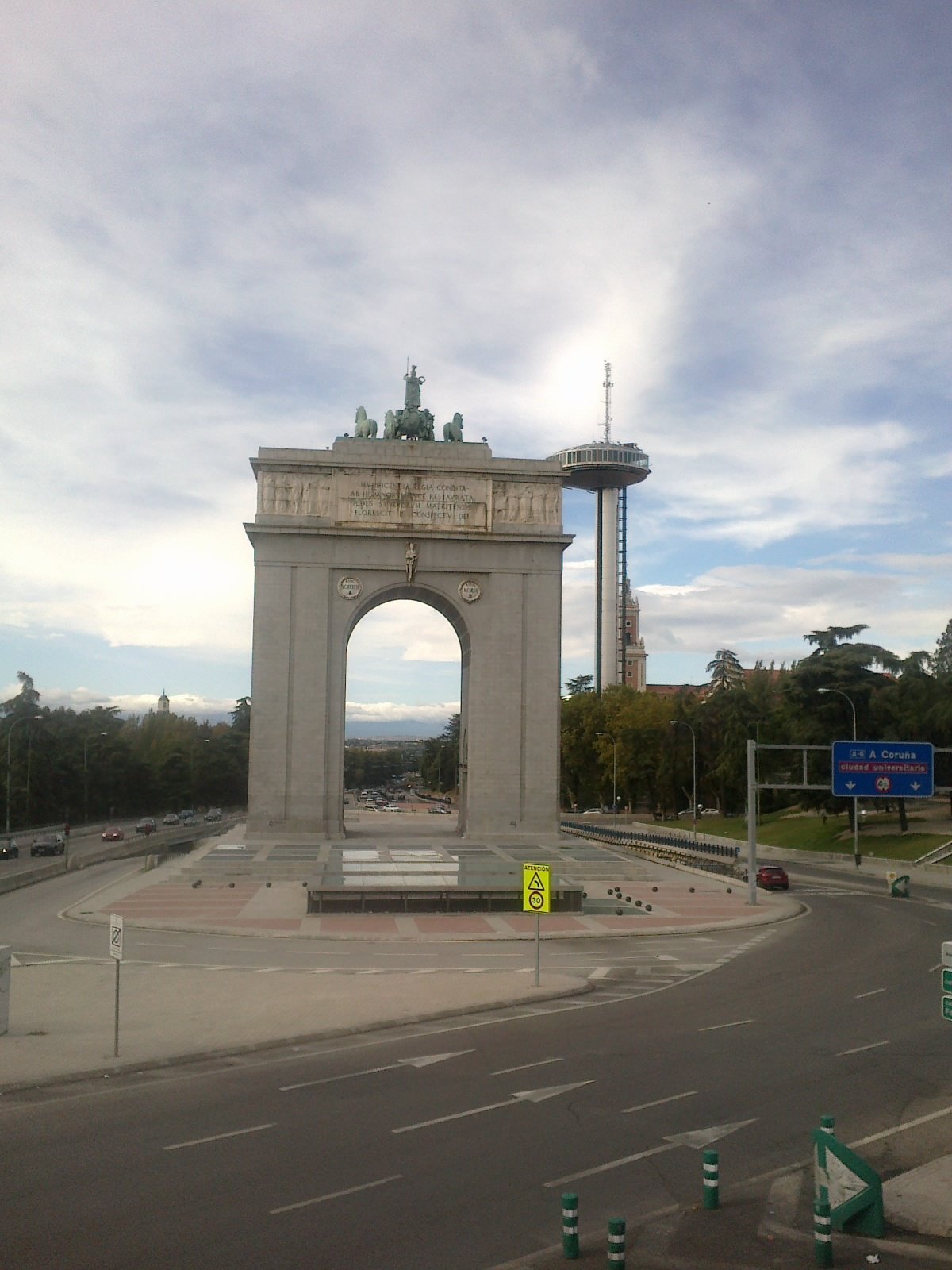
Plan and listen to Arco De La Victoria with Audiala.
Audio guide in your pocket, itinerary in your browser. Built for the way you actually visit.
Introduction
The Arco de la Victoria, also known as the Victory Arch, stands as a monumental testament to a turbulent period in Spain's history. Located in the Moncloa district of Madrid, this neoclassical arch was constructed between 1950 and 1956, commissioned by the Francoist regime to commemorate the Nationalist forces' victory in the Spanish Civil War (1936-1939) (Exploring Arco de la Victoria - Visiting Hours, Tickets, and Historical Significance in Madrid). Designed by architects Modesto López Otero and Pascual Bravo Sanfeliú, the structure stands 49 meters high and 44 meters wide, constructed from granite and limestone. The arch's design is reminiscent of ancient Roman triumphal arches and is adorned with intricate reliefs and sculptures depicting various scenes from the Spanish Civil War (Visiting Arco de la Victoria - History, Tickets, and Tips).
This comprehensive guide aims to provide visitors with essential information about the Arco de la Victoria, including its origins, architectural features, historical context, visiting hours, ticket prices, travel tips, and nearby attractions. Whether you're a history enthusiast or a casual visitor, the Arco de la Victoria offers a deep dive into Spain's complex history and architectural heritage.
Origins and Construction
The Arco de la Victoria is located in the Moncloa district of Madrid and was constructed between 1950 and 1956. Commissioned by the Francoist regime to commemorate the Nationalist forces' victory in the Spanish Civil War (1936-1939), the arch is a significant piece of Francoist architecture. Designed by architects Modesto López Otero and Pascual Bravo Sanfeliú, the structure stands 49 meters high and 44 meters wide, constructed from granite and limestone.
Architectural Features
The neoclassical design of the Arco de la Victoria is reminiscent of ancient Roman triumphal arches. It features a central archway flanked by two smaller arches, adorned with intricate reliefs and sculptures. A bronze quadriga, driven by the goddess of Victory, crowns the top of the arch, symbolizing the Nationalist forces' triumph. Sculptors Moisés de Huerta and José Ortells designed the reliefs, which depict various scenes from the Spanish Civil War.
Historical Context
The construction of the Arco de la Victoria reflects the broader context of post-Civil War Spain under General Francisco Franco's dictatorship, which lasted from 1939 until his death in 1975. The regime used monumental architecture to legitimize its rule and reinforce its ideological narrative. The arch was part of a larger urban development plan for the Moncloa district, strategically located at the city's entrance as a symbol of the regime's power.
Controversies and Criticisms
The Arco de la Victoria has been a subject of controversy due to its association with the Francoist regime. Critics argue that the arch is a painful reminder of a divisive and violent period in Spanish history. In recent years, there have been calls to remove or repurpose the arch to address the legacy of the Francoist regime. Some suggest transforming it into a memorial for the Civil War and dictatorship victims, while others advocate for its complete removal (Exploring Arco de la Victoria - Visiting Hours, Tickets, and Top Tips for Madrid’s Iconic Landmark).
Preservation and Current Status
Despite the controversies, the Arco de la Victoria remains an important historical and architectural landmark in Madrid. Maintained by the Spanish government and protected as a cultural heritage site, the arch undergoes regular maintenance and restoration work. Located near the Moncloa transport interchange, it is easily accessible to visitors and close to other significant landmarks like the Faro de Moncloa and Ciudad Universitaria.
Educational and Cultural Significance
The Arco de la Victoria serves as a valuable educational resource for understanding 20th-century Spain. It provides insight into the architectural and artistic styles of the period and the political context of its construction. The arch is often included in guided tours and educational programs exploring the Spanish Civil War and the Francoist regime. Recent efforts aim to use the arch for public history projects to foster a nuanced understanding of the past.
Visitor Information
Visiting Hours
The arch is accessible 24/7, but visiting during daylight hours is recommended to appreciate its architectural details.
Tickets
There is no entrance fee to view the arch from the outside.
Guided Tours
Available through various tour operators, these provide in-depth historical context and insights. Some popular tour operators include Madrid City Tours and Sandemans New Europe.
Nearby Attractions
The arch is near the Moncloa transport interchange, Faro de Moncloa, and Ciudad Universitaria. Other notable sites include:
- Museo de América: Offers a fascinating collection of artifacts from the Americas.
- Parque del Oeste: A beautiful park with lush greenery and scenic views.
- Temple of Debod: An ancient Egyptian temple that provides a unique historical experience.
Travel Tips
Allocate sufficient time to explore the surrounding area and consider using public transportation for easy access. Madrid is a well-connected city with various transportation options.
Special Events and Photographic Spots
Occasionally, special events and guided tours focusing on the historical significance of the Arco de la Victoria are held. Photographers will find numerous spots to capture the monument's grandeur, especially during sunrise and sunset. The arch is particularly photogenic from the nearby Plaza de la Moncloa and Parque del Oeste.
FAQ
Q: What are the visiting hours for the Arco de la Victoria? A: The arch is accessible 24/7, but it is best visited during daylight hours.
Q: How much are the tickets to visit Arco de la Victoria? A: There is no entrance fee to view the arch from the outside.
Q: Are there guided tours available? A: Yes, several tour operators offer guided tours that provide historical context and insights.
Listen to the full story in the app
The whole Arco De La Victoria,
told well.
Audio guides for 1,100+ cities across 96 countries. History, stories, and local insight — offline ready.

Verified, and shown.
Researched and written by the Audiala editorial team from historical records, architectural archives, and local expertise.
Last reviewed
Researched from Wikidata, Wikipedia & official sources · fact-checked · How we make our guides →


