An introduction.
Researched by the Audiala editorial team from historical records, architectural archives, and local expertise.
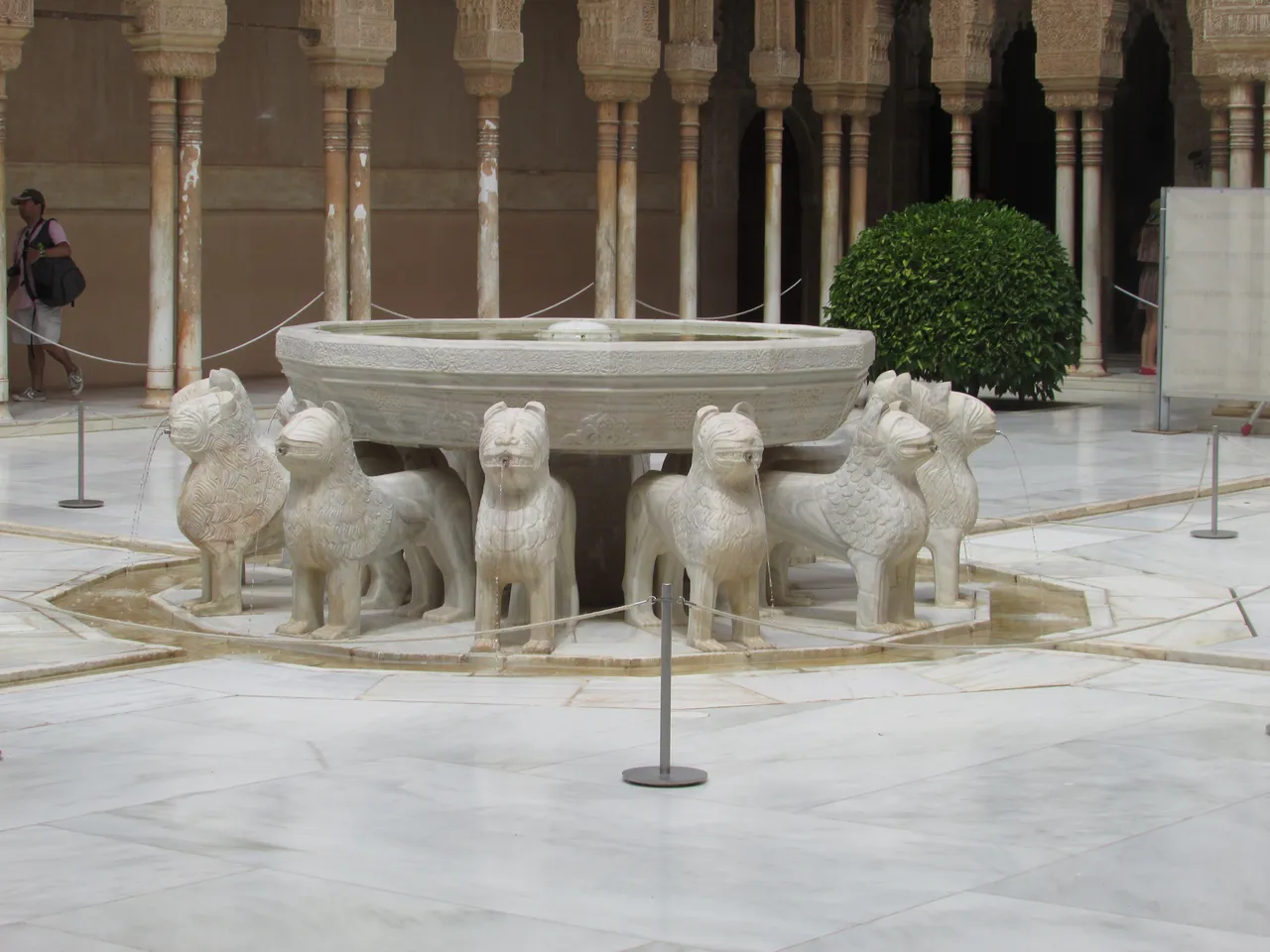
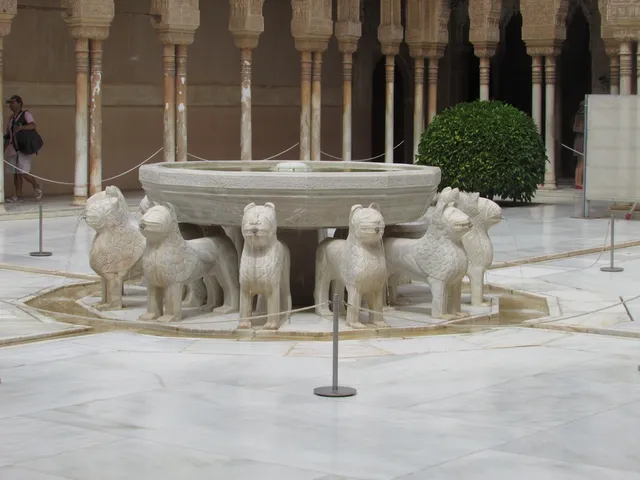
WWhy does the Löwenbrunnen in Granada, Spanien, look like a dream of perfect calm when so much about it is still argued over? In the Court of the Lions today, white Macael marble throws back the Andalusian light, slender columns cast striped shadows across the paving, and the twelve stone beasts stand around their basin as if they have always known this silence. Visit because this is the Alhambra at its most deceptive: a fountain that seems decorative until you realize it was built to make power, poetry, and water look effortless.
Most visitors arrive expecting a postcard. They get one, for a moment. Then the details start to misbehave: the lions are similar but not identical, the Arabic verses on the basin speak in a human voice, and the whole courtyard feels less like a garden retreat than a piece of political theater performed in marble and running water.
Documented evidence places the palace and fountain in the reign of Sultan Muhammad V, most likely around 1380, after he lost his throne, went into exile, and returned. That changes the mood of the place. This was not a ruler decorating his spare afternoon home; this was a ruler making his comeback look ordained.
And the fountain still works on you the way it was meant to. You walk in, lower your voice without being told, and look longer than you planned.
01 What to see.
Fuente de los Leones
The Rooms Around the Court
Take the Court Slowly
02 In pictures.


Plan and listen to Fountain De Los Leones (Alhambra) with Audiala.
Audio guide in your pocket, itinerary in your browser. Built for the way you actually visit.
Tickets & tours.
These are guided options from our partners — same price as booking direct.
Prices are indicative — final pricing and availability are confirmed at checkout. Audiala may earn a commission from bookings made through these links.
03 Visitor logistics.
The practical scaffolding for a good visit — kept short.
Getting There
The fountain sits inside the Nasrid Palaces, so your real destination is the Alhambra entrance at C/ Real de la Alhambra s/n. From central Granada, bus C30 from Plaza Isabel la Católica or C32 from the Albaicín is the cleanest move; on foot, Cuesta Gomérez from Plaza Nueva usually takes about 15-20 uphill minutes, steep enough to feel longer than the map suggests.
Opening Hours
As of 2026, the Alhambra day visit runs daily from 08:30-18:00 between October 15 and March 31, and 08:30-20:00 between April 1 and October 14; the ticket office opens at 08:00. The complex closes on January 1 and December 25, and the Löwenbrunnen follows your exact Nasrid Palaces time slot, printed on the ticket and enforced.
Time Needed
Give yourself 3 hours if you want the visit to breathe; that is the official average for the full Alhambra, and the Court of the Lions is the part people rush and then regret. A fast, focused visit can work in 1.5-2 hours, while a slower circuit with Generalife, Alcazaba, photos, and uphill terrain usually stretches to 4 hours or more.
Accessibility
Access is possible, but this is not a smooth museum floor: expect cobbles, ramps, steps, narrow rooms, and level changes all through the complex. The Alhambra provides accessible route maps, wheelchair loans at the Access Pavilion, lifts in the Palace of Charles V, and adapted toilets, but the Nasrid Palaces still move slowly and can be tight.
Cost & Tickets
As of 2026, the ticket you need is the Alhambra General day visit at €22.27, which includes the Nasrid Palaces, Partal, Alcazaba, and Generalife; children under 12 enter free but still need a ticket. Buy from the official Alhambra system, ideally well ahead, because the timed Nasrid Palaces entry is the choke point and same-day luck is unreliable.
04 Tips for visitors.
Small things that change the day.
Photo Rules
Bring a camera, not a rig. Personal photos are allowed without flash, but tripods, monopods, selfie sticks, and stabilizers are banned, so the marble basin and slender columns have to survive your admiration unaided.
Ticket Scam Watch
Granada still has a lively trade in shady last-minute Alhambra promises. If someone near the monument claims they can magic up Nasrid Palaces access after the official site is sold out, assume trouble unless it comes through the official ticket system.
Eat Downhill
Skip the tired tourist logic of eating right by the entrance unless convenience wins. For something more Granadino, head down into Realejo after your visit: Bar Candela or Ajoblanco for budget tapas, La Botillería for mid-range, or the Parador inside the grounds if you want the splurge.
Best Timing
Book the earliest Nasrid Palaces slot you can get if you want softer light on the marble and a little more room before the human tide thickens. Late morning and midday bring the heaviest foot traffic, when the courtyard's water is harder to hear over shoe soles and phone shutters.
Bag Strategy
Don't arrive with a big backpack and optimism. Bags over 40 x 40 cm are not allowed, small backpacks must be worn on the front, and free same-day lockers are available at the Access Pavilion and near Puerta del Vino.
Pair With Realejo
The smart local pairing is not another queue but a downhill walk. After the Lions, take the free-access Alhambra surroundings and drop into Realejo or Campo del Príncipe, where Granada starts sounding like itself again and your ticketed day stops feeling managed.
Where to Eat
Don't Leave Without Trying
Galeria Fotografica Ruiz Linares (1886)
cafeOrder: Coffee and a pastry while browsing the historic photography gallery — this is the real deal, a working cafe inside a 1886 photo archive on the main Alhambra approach.
Highest-rated spot on this list and genuinely local: a century-old photographer's studio that serves coffee to visitors without the tourist-trap markup. The atmosphere is Granada's past distilled into one room.
Los Aljibes Bar
local favoriteOrder: Order whatever Granada tapas specials they have on the day — look for Trevélez ham, tortilla del Sacromonte (omelette with chorizo and local ham), or any eggplant with cane honey if available.
Sits directly on the plaza in front of the Alhambra with solid reviews from actual diners. This is where locals grab a proper meal after touring, not a quick tourist sandwich.
Casa Linares, Souvenirs, Food, Drinks & Ice Creams.
quick biteOrder: Ice cream or a light meal — this is the practical stop if you've been walking the Alhambra grounds and need refreshment without leaving the immediate area.
Honest, no-frills spot that knows its job: feed tired tourists and locals alike with decent food and cold drinks. It's not fancy, but it's reliable and right where you need it.
Pizza sandwiches and go Alhambra.
quick biteOrder: A sandwich to go — grab one and eat it on a bench overlooking the Alhambra gardens rather than sitting inside. Most reviews praise the convenience and speed.
Most reviewed spot on the list because it's fast, cheap, and exactly what you need when you're on foot and hungry. No pretense, just fuel for more exploring.
Dining Tips
- check All four verified restaurants on this list sit directly on or very near the Alhambra approach road (Calle Real de la Alhambra), making them convenient stops without a long walk downhill into Granada's center.
- check If you want a fuller tapas experience with more variety, the research points to Rosario Varela, Bodegas Castañeda, and El Bar de Fede in the cathedral district downhill — these are local favorites but not in the verified data for this guide.
- check Granada's tapas culture traditionally pairs drinks with free or cheap bites; ask what's available rather than assuming a menu.
- check Moroccan mint tea at nearby tetería (tea houses) offers a lighter alternative to coffee or a full meal if you want something atmospheric and reflective after the Alhambra.
- check Market mornings in Plaza Larga (Albaicín) feature fruit stalls and neighborhood food stops, though formal food markets are not immediately adjacent to Löwenbrunnen.
Restaurant data powered by Google
05 Water, Verse, and the Performance of Rule
Across six and a half centuries, the Fountain of the Lions has kept doing the same strange job: turning hydraulic engineering into emotion. Under the Nasrids, under Christian monarchs, through Romantic meddling and modern restoration, the court remained a place where water was staged to look weightless, controlled, and slightly miraculous.
Much changed around it. The paving disappeared, gardens came and went, a second basin was added and later removed, and the monument passed from royal residence to global icon. The enduring thing is the effect: people still enter, slow down, and submit to the argument the place makes with stone, shade, and sound.
Muhammad V's Comeback in Marble
At first glance, the Fountain of the Lions looks like the serene center of an eternal palace, the sort of object people imagine simply appeared when the Alhambra was at its height. That surface story is comforting. It makes the court feel outside politics, outside fear, outside the ordinary panic of keeping a throne.
But Muhammad V had been overthrown in 1359 and forced into exile before he recovered Granada and began the palace complex of his second reign, documented between 1362 and 1391. His stake was personal. A ruler who comes back after a coup cannot merely resume; he has to prove that heaven, art, and court culture still flow through him, which is why Ibn Zamrak's verses on the basin matter so much: they do not decorate the fountain, they speak for it.
The revelation is that this court was built to make restored legitimacy feel natural. Most scholars date the fountain to the late 1370s or around 1380, when Muhammad V turned survival into style and let water perform what politics could not safely say aloud. Once you know that, you stop seeing twelve pleasant lions and start seeing a comeback staged so elegantly that six centuries later it still passes for peace.
What Changed
What Endured
Listen to the full story in the app
The whole Fountain De Los Leones (Alhambra),
told well.
Listen to sourced travel stories with local history and practical context — ready offline.
06 Frequently asked.
The questions travellers send us most about Fountain De Los Leones (Alhambra).
Is the Fountain of the Lions in the Alhambra worth visiting?
Yes, because this is the point where the Alhambra stops being a pretty shell and starts confessing what it was built to prove. Muhammad V placed the fountain here around 1380, in a court so light and pale it feels almost weightless, with 12 marble lions holding up a basin like a choir lifting a single note. Look closely: the lions are similar, but never identical.
How long do you need at the Fountain of the Lions in the Alhambra?
You only need 15 to 30 minutes for the fountain itself, but you need about 3 hours for the full Alhambra visit if you want the place to make sense. The Fountain of the Lions sits inside the Nasrid Palaces, and that timed entry controls your whole day. If you're moving fast, 1.5 to 2 hours can work; if you like to pause for light, tile, and echoes, give it 3 to 4.
How do I get to the Fountain of the Lions in the Alhambra from Granada?
From central Granada, the cleanest route is bus C30 or C32 up to the Alhambra, then walk into the Nasrid Palaces at your ticket time. If you'd rather arrive on foot, take Cuesta Gomérez from Plaza Nueva or Cuesta del Realejo from Plaza del Realejo and expect a real climb, the kind that reminds you this palace was built to rule from above. The fountain itself is inside the Court of the Lions, so you can't reach it without a Nasrid Palaces ticket slot.
What is the best time to visit the Fountain of the Lions in the Alhambra?
The best time is your earliest available Nasrid Palaces slot, or a night visit if you can get one. Early in the day, the white Macael marble catches cooler light and the court feels less crushed by traffic; at night, sound takes over and the water reads more clearly than the carving. In the 2026 schedule, day visits run 08:30 to 20:00 from April 1 to October 14 and 08:30 to 18:00 from October 15 to March 31.
Can you visit the Fountain of the Lions in the Alhambra for free?
Usually no, because the fountain is inside the Nasrid Palaces and requires the general Alhambra ticket or a night-palace ticket. As of 2026, the standard day ticket is €22.27, while children under 12 enter free but still need their own ticket, like a free seat that still has to be reserved. Sunday free entry applies to the Andalusi Monuments circuit, not to the Court of the Lions.
What should I not miss at the Fountain of the Lions in the Alhambra?
Don't stop at the fountain photo; stay for the sequence of rooms around it, especially the Hall of the Two Sisters, the Hall of the Abencerrajes, and the quieter Mirador de Daraxa. The real secret is the water system: this fountain was designed for a controlled, shallow flow rather than a dramatic jet, more whisper than spectacle. And check the basin inscription, because Ibn Zamrak's verses turn the stone into a speaking object.
Verified, and shown.
Researched and written by the Audiala editorial team from historical records, architectural archives, and local expertise.
Official visitor rules, timed entry for the Nasrid Palaces, booking guidance, transport notes, luggage limits, and visit timing.
Official 2026 opening hours, ticket prices, closure days, and visit formats.
Official history and interpretation of the Court of the Lions and its role in the palace.
Restoration history, chronology, materials, hydraulic system, and conservation context for the fountain.
Official background on the fountain, Muhammad V, Ibn Zamrak, restoration phases, and debates about the lions.
Details on the fountain's original water regulation system and restored hydraulic behavior.
English official overview of the court, architecture, and water design.
Biographical context for Muhammad V and his two reigns.
English official explanation of the fountain's spouts, poetry, and hydraulic reconstruction.
Official information on the Hall of the Muqarnas and damage from the 1590 explosion.
Supplementary description of the Hall of the Muqarnas and the 1590 blast damage.
Secondary reporting on the 1590 powder-magazine explosion and its effect on the Alhambra.
Academic material supporting the date and context of the 1590 explosion.
Scholarly debate on the lions' origin, symbolism, and restoration evidence.
Official argument for the court's historic marble paving and later garden changes.
Official research summary on paving, later planting, and restoration evidence.
Interpretive essay on the fountain's history, inscription, and debates.
Reporting on the 2007-2010 restoration of the lions and basin.
World Heritage listing, historical framing, and management concerns including tourism pressure.
General historical context on the Alhambra and 1492.
Official note on the later upper basin and 19th-century changes to the fountain.
Official material on the 19th-century spout and vegetation in the court.
Dating and interpretation of the 19th-century spout intervention.
Report on Richard Ford's 1831 graffito discovered during restoration.
Reporting on the Richard Ford inscription found on the fountain.
Official note on the 2012 reopening, paving, accessibility, and return of water.
Official English note on the restored lion and conservation work.
Official information on the 2010-2012 archaeological intervention.
Authority record used for the identity of sculptor Alonso de Mena.
Official note on the court's use as a modern national emblem.
Official day-visit product details for the Alhambra General ticket.
Official overview of day, night, and combined visit formats.
Official night-visit schedule and format for the Nasrid Palaces.
Live ticketing portal with products, warnings, current closures, and visitor rules.
Official ticket page with price and inclusion details for the general visit.
Official reservation product showing special access for ICOM/ICOMOS members.
Official city bus route serving the Alhambra from central Granada.
Official city bus route serving the Alhambra and Albaicin.
Official bus information used to check the conflicting claim about Alhambra access.
Official city transport fare page.
Local practical guide for parking prices and access estimates.
Local guide used for metro coverage and transfer context.
Supplementary metro information for access planning.
Recent user-facing evidence that La Mimbre remains open near the Alhambra.
Recent user-facing evidence for a nearby restaurant near the entrance.
Supplementary local practical information about nearby dining.
Recent food journalism used to confirm the Parador restaurant as a current dining option.
Official visitor overview with access, footwear, and planning notes.
Supplementary walking-route timing from Paseo de los Tristes.
Official information on lockers, toilets, parking, vending, rest areas, and special services.
Official accessibility notes, wheelchair loans, maps, and site limits.
Official rules on strollers, photography, footwear, and on-site behavior.
Supplementary travel source used for estimated walking times from the center.
Official planning page used for visit duration and preparation advice.
Official page showing audioguide availability status.
Academic study used for sound, night atmosphere, and sensory reading of the court.
Official description of the hall and the Abencerrages legend as tradition rather than firm fact.
Text of Irving's romantic writing used for the fountain's afterlife in travel imagination.
Official reading recommendation used for the modern storytelling afterlife of the Alhambra.
Official context for Muhammad V's patronage and broader Nasrid Granada.
Official information on the Hall of the Two Sisters and its water channel connection to the court.
Official description of the Hall of the Ajimeces.
Official description of the lookout, windows, and decorative detail.
Official information on the Hall of the Kings and its ceremonial function.
Official note on Macael marble paving works and measured surface area.
Official note on the source of the Macael marble used in restoration.
Reporting on research showing the pavilion muqarnas are not true twins.
Reporting on restoration discoveries including hidden carpentry and drawings.
Scholarly article supporting conservation findings in the Lions court.
Official page on tactile interpretation points near the Nasrid Palaces route.
Repository source used for viewpoint and architectural interpretation near the court.
Repository source used for architectural reading and view sequences in the palace.
Local news on the February 2026 restoration tender for the patio.
Local reporting on the 2026 restoration tender and budget.
Regional news on planned restoration works in 2026.
City tourism advice on sold-out tickets, scams, and alternative plans.
Local neighborhood guide used for downhill post-visit context and local vibe.
Source used for the effect of crowds on hearing the fountain's soundscape.
Local guide reflecting how the court is described in Granada visitor culture.
Local reporting used for the recurring theme of endless restoration.
Radio report on the All Blacks' haka in the Alhambra.
Local guide for nearby places often paired with an Alhambra visit.
Local safety advice used for petty theft and general visitor caution.
Supplementary dining advice and warning against poor-value food near tourist zones.
Overview of Granadan dishes used for local food suggestions.
Current menu reference for dishes served inside the Alhambra grounds.
Official note on the court appearing on a commemorative stamp.
Coverage of the illegal ticket-sales scandal history.
Radio coverage of the Alhambra ticket scandal and legal aftermath.
Official visitor behavior, bag handling, and photography rules in Spanish.
Supplementary visitor-rules summary, including conduct and restrictions.
Official rules for commercial filming, photography, and authorized use of spaces.
Official information on special visits and authorized photo sessions.
Local guide used for neighborhood eating suggestions in Realejo.
Local recommendations for tapas bars downhill from the Alhambra.
Local recommendations for coffee stops in Realejo and central Granada.
Local restaurant suggestions for mid-range meals in Granada.
Official education and interpretation programs used for living-heritage context.
Official note on the oral-history project and recorded community memory.
Official festival context showing the Alhambra as an active cultural stage.
Official history of the 1922 Cante Jondo competition in the Alhambra.
Official historical context for the 1922 cante jondo event.
Official note on modern commemorations of the 1922 competition.
Festival history and dates used to support the Alhambra's ongoing cultural role.
Supplementary overview of the Granada festival in Alhambra spaces.
Official resident-access program showing recurring civic use of the monument.
Official program details for free resident visits.
English official description of resident-focused free guided tours.
Official note on museum day programming in the Alhambra.
Official listing for museum day activities and public programming.
Official note on volunteer programs tied to the Alhambra museum.
Official museum-volunteer commemoration used for living-heritage context.
Official exhibition material on the lions' restoration and the poem in Arabic and Spanish.
Official workshop on Nasrid art, used for craft transmission and learning-by-hand.
Official educational workshops connected to Alhambra interpretation.
Official oral-history project preserving lived memories linked to the monument.
Official framing of the archive as a living repository of memory.
Official context for Irving's lasting role in the Alhambra's modern image.
Official note on the public staging of Irving's Alhambra legacy.
Official museum-guiding program showing present-day civic use and volunteer interpretation.
Official explanation of conservation methods used on the fountain.
Official discussion of restoration philosophy combining traditional craft and modern science.
Academic study used for overtourism and heritage-management context.
Official regional listing used to confirm 2025 festival dates.
Official page for the 2025 museum day program.
Official exhibition page related to the fountain's spouts.
Official exhibition page on the 1922 Cante Jondo contest.
Official interpretive page on the 1922 Cante Jondo competition.
University-linked news note confirming the 1966 dismantling date in later reporting on restoration.
Official note used to check special-access dates and free cultural programming.
Official note clarifying that some free-admission days target selected zones rather than the full Nasrid route.
Official press note about presenting new findings from the intervention.
Official note naming restoration and archaeology figures involved in the intervention.
Built from cited sources · see the method · How we make our guides →