Type 2+ letters to search all countries, cities, and places
/Ctrl KEsc
travel_explore
Type 2+ letters to search all countries, cities, and places
Press Enter to open the top result
Guggenheim
Bilbao·Spain·43° N · 2° W·Updated Apr 2026
Forged from 33,000 ultra-thin titanium sheets to rescue a dying port, this architectural landmark shifts from muted silver to liquid gold with the changing light.
How does a city of rust and river silt convince the world to trade shipyards for titanium? It’s a paradox etched into the Nervión’s banks: the Guggenheim Museum Bilbao in Bilbao, Spain, shouldn’t exist here, yet it remains the exact reason you will travel to watch industrial decay dissolve into liquid light. Step through the glass doors today, and the air shifts. Sunlight fractures across 33,000 hand-numbered titanium scales, casting a warm, metallic glow on pale Basque limestone floors, while the river’s damp breeze slips through the atrium like a slow exhale.
The architecture refuses to sit quietly. Frank Gehry’s deconstructivist curves don’t mimic a box; they mimic a ship caught mid-turn, or a school of silver fish breaking the surface. Visitors wander past a 24,000-square-meter floor plan that feels less like a traditional gallery and more like the inside of a brass instrument. You’ll catch your own reflection warping in the glass elevators, then look out to see the Zubi Zuri bridge anchoring the museum to a city that once measured its wealth in coal and steel.
Don’t mistake the shimmer for vanity. The building’s radical geometry was born from a desperate civic gamble, a calculated risk taken when Bilbao’s unemployment hovered near 20 percent and the river ran thick with chemical runoff. Today, the museum operates as a civic agora, where contemporary art, experimental performance, and neighborhood debates collide. You come for the iconic shell, but you stay to watch how a post-industrial city learned to breathe again.
Researched by the Audiala editorial team from historical records, architectural archives, and local expertise.
What to see
The Titanium Atrium
Frank Gehry didn’t just design a museum lobby when he opened this 45-meter-high void in October 1997; he dropped a 33,000-panel titanium cloud into the Nervión River valley. Each panel measures 0.38 millimeters thick—thinner than a credit card—and they overlap like armored scales, their curves calculated by CATIA aerospace software originally built for fighter jets. Walk inside during a Bilbao drizzle and the facade shifts from cold silver to dull brass, while a faint metallic tick echoes across the limestone floors as the afternoon sun warms the seams.
Gallery 104 and The Matter of Time
Richard Serra’s seven torqued weathering-steel sculptures don’t just occupy Gallery 104; they rearrange your sense of balance. The column-free chamber stretches 130 meters long and 30 meters wide, a rusted corridor that feels wider than two Olympic swimming pools laid end to end. High frequencies die inside those leaning 70-ton walls, leaving only the low thud of your pulse and the quiet scrape of shoes until you reach the far monitor, where original crane footage reveals how engineers maneuvered the steel into place.
The Descent to the Nervión River
Skip the main doors and walk down the broad staircase from Calle Iparragirre, where the rigid city grid suddenly dissolves into Gehry’s fluid waterfront. The route drops you onto the reflecting basin, past Louise Bourgeois’s iron spider and Daniel Buren’s crimson Arcos rojos arches, until you reach the riverbank where the thin titanium skin releases soft thermal clicks as the evening chill hits. You stop treating the building as a static container and realize it actually breathes.
Plan your visit
Getting There
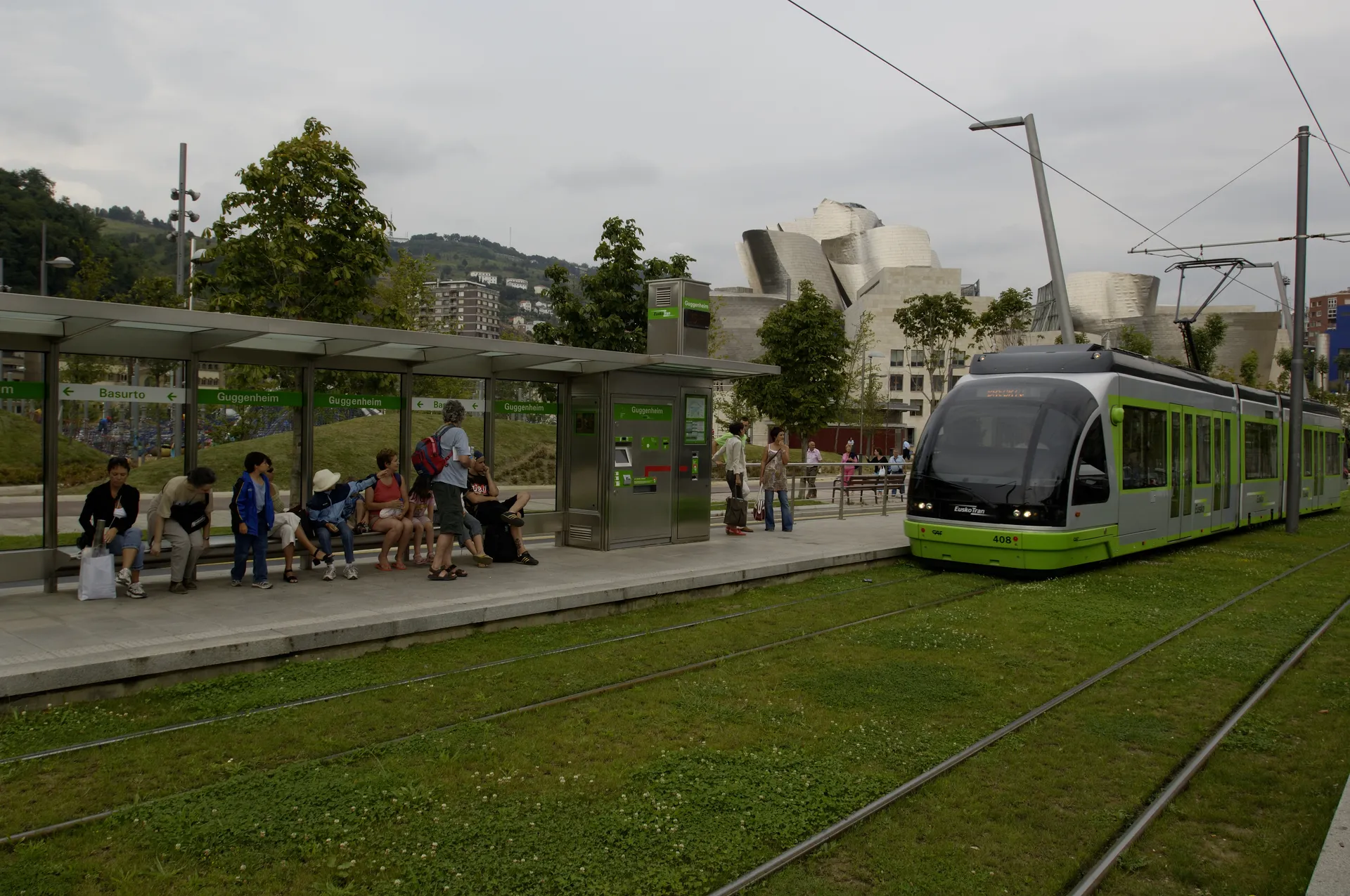
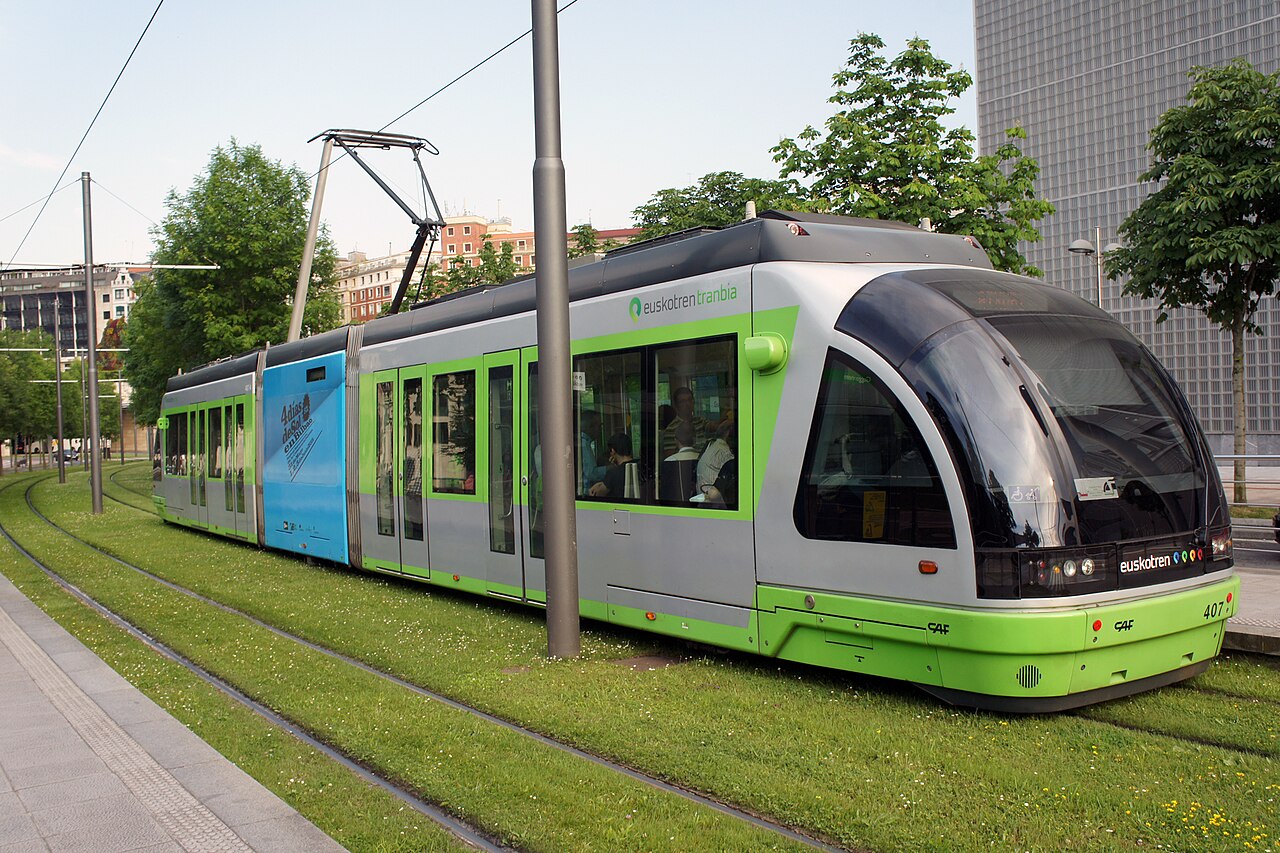
Walk 15–20 minutes from Casco Viejo along the Nervión Riverfront, or catch the Euskotren tram that drops you exactly at the doors. Skip driving. Municipal garages at Plaza Euskadi handle overflow when you insist on arriving by car.
Opening Hours
Doors unlock daily and close at 19:00, though seasonal shifts and holiday closures change yearly. Check online. As of 2026, verify the official calendar before booking, since special programming routinely alters access windows.
Time Needed
A rapid sweep of the titanium atrium and Serra’s steel corridors takes two hours flat. Stay longer. Stretch your visit to four hours if you want to study rotating exhibitions and watch light slide across 33,000 titanium scales, each thinner than a fingernail.
Accessibility
Two wheelchair-friendly entrances exist: an elevator through the main bar and a ramp along the riverside façade. Ask staff. They hand out ultra-light rest chairs, tactile sculpture models, and audio guides with subtitles on request.
Cost/Tickets
As of 2026, adult entry runs €15, roughly the price of three plates of pintxos at a neighborhood bar, while students and seniors pay half. Purchase online. Refunds never happen, so skip third-party resellers entirely.
Photo Gallery
A view of Guggenheim, Bilbao, Spain. · Mariordo (Mario Roberto Durán Ortiz)A view of Guggenheim, Bilbao, Spain. · Mariordo (Mario Roberto Durán Ortiz)A view of Guggenheim, Bilbao, Spain. · Mariordo (Mario Roberto Durán Ortiz)A view of Guggenheim, Bilbao, Spain. · Mariordo (Mario Roberto Durán Ortiz)A view of Guggenheim, Bilbao, Spain. · jacme31A view of Guggenheim, Bilbao, Spain. · Mariordo (Mario Roberto Duran Ortiz)A view of Guggenheim, Bilbao, Spain. · Andrew Nash from Vienna, Austria
History
The Titanium Wager
Before the titanium skin caught the Atlantic light, this plot of land belonged to the railway spurs and rusted cranes of Bilbao’s industrial port. By the early 1990s, deindustrialization had left the Nervión River classified as biologically dead and the surrounding neighborhoods hollowed out. The Basque government, facing a demographic and economic cliff, decided to bet its remaining political capital on a single, audacious cultural intervention. Municipal records show that local leadership actively sought a global brand to anchor the regeneration, setting the stage for an unprecedented transatlantic partnership.
The turning point
The Titanium Gamble
Most visitors assume the museum’s success was inevitable, a seamless victory of visionary architecture over industrial decline. The official narrative credits a simple partnership between New York’s Guggenheim Foundation and Basque civic leaders, with Frank Gehry simply drawing his famous curves while engineers handled the rest. The building appears to be a triumph of pure artistic intuition, smoothly translated into steel and glass.
But the engineering math never quite added up. Bilbao’s damp, salt-heavy air was practically designed to corrode exposed metal, and Gehry’s proposed cladding was thinner than a standard credit card. Initial weathering tests showed unpredictable discoloration, and the aerospace software CATIA required to calculate the structural loads had never been applied to a civilian project. When budget requests ballooned toward $145 million, local trade unions openly denounced the venture as a cultural Trojan horse that would drain public coffers.
The turning point arrived in late 1994, when Juan Ignacio Vidarte, the newly appointed managing director, made a quiet but decisive call to trust the chaos. Vidarte risked his entire professional standing by shielding Gehry from political pressure, funding the CATIA conversion, and pushing the unproven titanium panels through aggressive real-world trials. According to institutional archives, the software successfully translated Gehry’s crumpled cardboard models into precise millimeter tolerances, and the titanium didn’t corrode—it oxidized into a living, light-shifting skin that turned a perceived engineering flaw into the building’s greatest asset.
Knowing this shifts how you read the facade. The shimmering surface isn’t just a decorative flourish; it’s a scarred armor forged through political brinkmanship and untested technology. When you stand in the atrium now, you’re not just looking at a museum. You’re standing inside a high-stakes wager that paid off, watching how a city’s survival instinct was literally hammered into sheet metal.
The Foundation's Fiction
Tourists often assume the New York foundation bankrolled the project. In reality, the Consorcio Guggenheim Bilbao—funded entirely by Basque regional and municipal taxes—covered the full construction cost, a $50 million art endowment, and an ongoing $20 million annual licensing fee. The Foundation provided the brand and rotating exhibitions, but the financial and legal risk sat entirely on local shoulders.
The River's Second Life
The museum’s site selection was a deliberate act of ecological surgery. Before 1993, the Nervión River was choked by two centuries of heavy industry runoff and classified as biologically dead. The construction phase required aggressive dredging and soil remediation, effectively turning a toxic industrial corridor into a public waterfront. The building’s orientation toward the water wasn’t just aesthetic; it was a physical declaration that Bilbao’s relationship with the river had fundamentally shifted.
Tips for visitors
Photography Rules
Flash photography, tripods, and selfie sticks face strict bans inside the galleries to protect conservation conditions. Personal snapshots remain welcome, but commercial shoots require written permits and hefty fees.
Dress Code & Climate
Pack a light sweater regardless of Bilbao’s summer heat, since climate control keeps the exhibition floors consistently cool. Leave beachwear at your hotel and deposit oversized backpacks in the free coatroom before entering.
Safety & Scam Awareness
Ignore anyone selling skip-the-line passes outside the plaza, as official tickets sell exclusively online at fixed prices. Pickpockets target crowded ticket queues and river promenades during peak summer, so keep bags zipped.
Food & Drink Nearby
Skip the inflated plaza cafes and walk to La Viña de Abando on Calle Diputación for authentic baked spider crab and local txakoli. For historic elegance, Café Iruña on Plaza del Arriaga serves excellent pastries in a restored 1903 interior.
Weather & Best Light
Late autumn and winter offer thinner crowds and dramatic overcast light that makes the titanium facade shift from dull gray to copper. Bring a compact umbrella, since Bilbao’s damp Atlantic climate drops rain without warning.
Local Insight
Walk the riverside promenade at dawn to hear your footsteps echo against the limestone and catch the empty plaza around Puppy. Save your entry fee unless a specific exhibition calls, as locals treat the free exterior architecture as the real museum.
Where to Eat
local_dining
Don't Leave Without Trying
PintxosGildasPintxo de TortillaBacalao al pil pilMarmitakoKokotxas de merluza en salsa verdeTxuletaAlubias rojas de TolosaMarianitoTxakolí
Rongorri Restaurante
local favorite
Basque-Asian Fusion€€star4.7(365)
Order: The monkfish and the octopus from the tasting menu are standout dishes that showcase their incredible fusion technique.
This is a rare gem that masterfully blends local Basque ingredients with Asian flavors. The execution is flawless, making it one of the most interesting and unique dining experiences in the city.
Order: The sharing plates are the way to go; the quality of the ingredients is evident in every bite.
It’s a snug, authentic spot that feels like a true local outpost. The atmosphere is warm and the staff are incredibly well-trained, making it the perfect place for a high-quality, relaxed Basque dinner.
Order: The cacao cake is light and perfectly balanced, and their coffee—especially the flat white—is expertly prepared.
Just steps from the Guggenheim, this cozy spot feels like a home kitchen. It’s incredibly welcoming and a rare find that offers excellent gluten-free options alongside top-tier specialty coffee.
checkMost traditional restaurants shut down completely between 15:30 and 20:00/21:00; plan your meals accordingly.
checkLunch is the main meal of the day; aim to be seated between 14:00 and 15:30.
checkBreakfast is a slower, morning ritual typically enjoyed between 9:00 and 10:30.
checkLook for the 'pintxo de tortilla' as a benchmark for a bar's overall quality.
Restaurant data powered by Google
Frequently asked
Is the Guggenheim Bilbao worth visiting?
Yes, because Frank Gehry’s sweeping titanium-clad curves literally reshaped a crumbling industrial port into a global cultural capital. Watch closely. The 33,000 individually shaped 0.38 mm panels shift from dull gray to rose gold depending on the damp Basque weather.
How long do you need at the Guggenheim Bilbao?
Plan for three to four hours to walk the galleries properly and absorb the sweeping architectural volumes. The space breathes. Richard Serra’s towering weathering steel corridors dampen sound into a low hum that amplifies your own footsteps.
How do I get to the Guggenheim Bilbao from the city center?
Walk fifteen to twenty minutes from Casco Viejo along the pedestrianized Nervión River promenade to reach the main entrance. The tram drops you right outside. Bilbao’s Metro Lines 1 and 2 connect to the Zubiaur station, leaving you a short riverside stroll away.
What is the best time to visit the Guggenheim Bilbao?
Late afternoon between three and four o'clock offers the best balance of thinning crowds and golden light hitting the facade. The weather shifts. Overcast skies mute the metal to cool silver while summer sun turns it warm copper.
Can you visit the Guggenheim Bilbao for free?
The exterior plazas, reflecting pool, and landmark sculptures like Jeff Koons’ Puppy cost absolutely nothing to explore. Kids under eighteen enter free. Everyone else pays fifteen euros for gallery access, which includes a standard audio guide.
What should I not miss at the Guggenheim Bilbao?
Walk straight to Gallery 104 to experience Richard Serra’s seven towering steel corridors that force your body to recalibrate. Pause upstairs. The Flower skylight casts shifting geometric shadows across the atrium floor that change by the minute.
Sources & attribution8
Researched and written by the Audiala editorial team from historical records, architectural archives, and local expertise. Last updated April 2026.
Euskotren tranbia guggenheim geltokia — Mikel Arrazola — CC BY 3.0 ES (https://creativecommons.org/licenses/by/3.0/es/) — Source: https://commons.wikimedia.org/wiki/File:Euskotren_tranbia_guggenheim_geltokia.jpg
Bilbao 05 2012 EuskoTran 2824 — Mariordo (Mario Roberto Durán Ortiz) — CC BY-SA 3.0 (https://creativecommons.org/licenses/by-sa/3.0/) — Source: https://commons.wikimedia.org/wiki/File:Bilbao_05_2012_EuskoTran_2824.JPG
Bilbao 05 2012 EuskoTran 2823 — Mariordo (Mario Roberto Durán Ortiz) — CC BY-SA 3.0 (https://creativecommons.org/licenses/by-sa/3.0/) — Source: https://commons.wikimedia.org/wiki/File:Bilbao_05_2012_EuskoTran_2823.JPG
Bilbao 05 2012 EuskoTran 2829 — Mariordo (Mario Roberto Durán Ortiz) — CC BY-SA 3.0 (https://creativecommons.org/licenses/by-sa/3.0/) — Source: https://commons.wikimedia.org/wiki/File:Bilbao_05_2012_EuskoTran_2829.JPG
Bilbao 05 2012 EuskoTran 2822 — Mariordo (Mario Roberto Durán Ortiz) — CC BY-SA 3.0 (https://creativecommons.org/licenses/by-sa/3.0/) — Source: https://commons.wikimedia.org/wiki/File:Bilbao_05_2012_EuskoTran_2822.JPG
Bilbao - Musée de Guggenheim — jacme31 — CC BY-SA 2.0 (https://creativecommons.org/licenses/by-sa/2.0/) — Source: https://commons.wikimedia.org/wiki/File:Bilbao_-_Musée_de_Guggenheim.jpg
Bilbao 05 2012 EuskoTran 2039 — Mariordo (Mario Roberto Duran Ortiz) — CC BY-SA 3.0 (https://creativecommons.org/licenses/by-sa/3.0/) — Source: https://commons.wikimedia.org/wiki/File:Bilbao_05_2012_EuskoTran_2039.JPG
Bilbao Trams - 18 (8500252980) — Andrew Nash from Vienna, Austria — CC BY-SA 2.0 (https://creativecommons.org/licenses/by-sa/2.0/) — Source: https://commons.wikimedia.org/wiki/File:Bilbao_Trams_-_18_(8500252980).jpg
Ord TranGuggOto — Marcos Maté Luna (Ordunte en Tranvia.org) — CC BY-SA 3.0 (https://creativecommons.org/licenses/by-sa/3.0/) — Source: https://commons.wikimedia.org/wiki/File:Ord_TranGuggOto.jpg
Person walks in front of stopped tram (18783023296) — Eric Fischer — CC BY 2.0 (https://creativecommons.org/licenses/by/2.0/) — Source: https://commons.wikimedia.org/wiki/File:Person_walks_in_front_of_stopped_tram_(18783023296).jpg
Tram shelter and ticket vending machine (18783023276) — Eric Fischer — CC BY 2.0 (https://creativecommons.org/licenses/by/2.0/) — Source: https://commons.wikimedia.org/wiki/File:Tram_shelter_and_ticket_vending_machine_(18783023276).jpg
Euskotren Tranbia (Tram), Bilbao (32075487416) — Naotake Murayama from San Francisco, CA, USA — CC BY 2.0 (https://creativecommons.org/licenses/by/2.0/) — Source: https://commons.wikimedia.org/wiki/File:Euskotren_Tranbia_(Tram),_Bilbao_(32075487416).jpg
Strictly necessary cookies keep the site working. Analytics (PostHog, Google Analytics) measures how each visitor uses our pages. Marketing loads YouTube videos and walking-route maps without a tap and lets Google Analytics set advertising cookies. We never sell your data. You can change this any time from the footer.
Analytics and marketing cookies are optional and only load if you agree. Details under Customize.
Privacy
Cookie preferences
Pick what you're okay with. You can change this any time from the footer.
Strictly necessary
Always on
Sign-in, language, navigation. Always on.
Product analytics
PostHog (EU) and Google Analytics record which pages you view and how you use them, under a random identifier stored in your browser. Helps us see which pages work and which need fixing. Google's ad personalisation stays off. No selling.
Marketing
Loads YouTube videos and the walking-route maps (OpenFreeMap) without a tap; without it, they load only when you tap them. If analytics is also on, Google Analytics may set advertising cookies. Ad personalisation stays off.