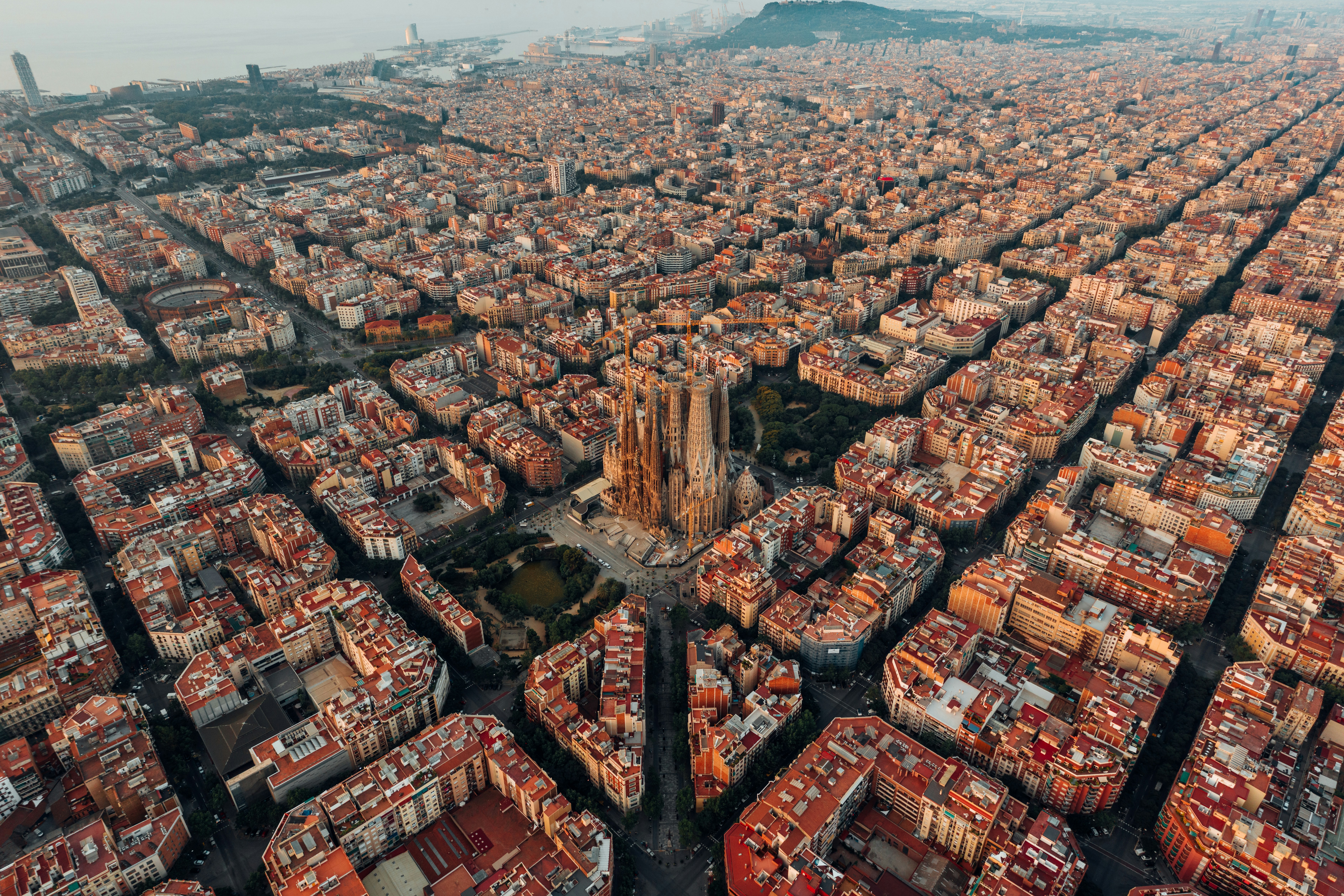
An introduction.
Researched by the Audiala editorial team from historical records, architectural archives, and local expertise.
HHow does a building that openly defies gravity, ignores right angles, and has been under construction for over 140 years manage to feel less like a monument and more like a breathing forest? Step inside the Sagrada Família in Barcelona, Spain, and the paradox resolves in stone and glass. Sunlight fractures through emerald and cobalt panes, washing the nave in an underwater glow. The nave’s ceiling soars 45 meters overhead, roughly the height of a fifteen-story apartment block. You come here because it refuses to sit quietly in the past; it demands you watch it grow.
The basilica was never meant to be a static postcard. It began as an expiatory temple, funded by the weekly coins of factory workers and shopkeepers who wanted to atone for the rapid secularization of industrial Catalonia. Every ticket sold today still pays for a single limestone block, a single steel beam, a single pane of stained glass. The architects treat your entry fee like a parishioner’s donation.
Most visitors arrive expecting a finished masterpiece frozen in 19th-century ambition. Instead, they find tower cranes suspended like metallic herons against the sky. The site hums with the steady rhythm of diamond-tipped saws and 3D printers laying down gypsum prototypes. It operates as a living workshop, scaling stone blocks wider than a London bus with millimeter precision. It is a sanctuary first, a construction site second.
01 What to see.
The Nativity Façade & Morning Light
The Passion Façade & Model Museum
The Central Crossing Acoustic Experience
02 In pictures.





Plan and listen to Sagrada Família with Audiala.
Audio guide in your pocket, itinerary in your browser. Built for the way you actually visit.
03 Visitor logistics.
The practical scaffolding for a good visit — kept short.
Getting There
Metro lines L2 and L5 drop you directly at the station, with wide stairs opening onto the main plaza. Walk 25 minutes north. Use the Nativity Façade entrance on Carrer de la Marina.
Opening Hours
As of 2026, the doors open at 09:00 on weekdays year-round, though closing shifts from 18:00 in winter to 20:00 in summer. Sundays start late. Christmas and Epiphany days restrict access to 09:00–14:00 for mass and maintenance.
Time Needed
A quick sweep of the main nave and exterior facades takes 60 to 90 minutes. Add a 30-minute buffer. A thorough exploration demands 2.5 to 3.5 hours when you climb one tower and visit the crypt.
Cost And Tickets
Baseline entry runs €26–€36 as of 2026, with tower access pushing the total toward €48. Buy online early. Children under 11 enter free with a paying adult.
Accessibility Notes
Ground-floor ramps provide full barrier-free access to the main nave and accessible restrooms near the exit. Tower elevators exist. Book accessible slots months ahead to guarantee entry.
05 Tips for visitors.
Small things that change the day.
Cover Shoulders And Knees
Security guards check attire strictly at the doors because this remains an active Catholic basilica. Pack a light scarf to avoid turning back to the nearest shop.
Leave The Tripod Home
Personal cameras work fine, but tripods and selfie sticks get flagged at security. Keep your voice low while framing shots.
Eat On Carrer Mallorca
Skip the overpriced kiosks on the plaza and walk two blocks to Carrer de Mallorca for proper tapas. Budget seafood spots sit near the intersection.
Chase The Morning Light
Book the earliest 09:00 slot to catch the eastern stained glass glowing against the Nativity Façade. Crowds swell past 11:00.
Drop Bags Beforehand
Security refuses oversized backpacks and rolling suitcases at the gates. Use the automated lockers on Carrer de Padilla, roughly a 5-minute walk north.
Where to Eat
Don't Leave Without Trying
Dining Tips
- check Lunch is best enjoyed between 12:30 PM and 1:30 PM to avoid peak crowds.
- check Dinner service typically starts no earlier than 8:00 PM; aim for 8:00 PM – 8:30 PM to avoid long waits.
- check Tipping is optional; 5%–10% is appropriate for casual/mid-range dining.
- check Always leave tips in cash, as card terminals often do not include a tipping function.
- check Check your bill for 'servicio incluido'—if it's there, no extra tip is needed.
- check Card payments are the standard, but keep small cash on hand for minor purchases or tipping.
- check Reservations are highly recommended for weekends, holidays, or rainy days.
Restaurant data powered by Google
04 A history of reinvention.
The Architect Who Let Stone Breathe
In 1882, a modest Neo-Gothic crypt broke ground on the outskirts of Barcelona’s Eixample district. The project belonged to the Spiritual Association of Devotees of St. Joseph, a lay group that wanted a church paid for by small donations rather than aristocratic patronage.
Francisco de Paula del Villar y Lozano drafted the initial plans. He envisioned a conventional revivalist structure, complete with pointed arches and flying buttresses. Within a year, budget disputes drove him away. A 31-year-old draftsman stepped into the void and decided to erase the rulebook entirely.
The Vanishing Blueprint
Most guidebooks describe the Sagrada Família as the pure, uninterrupted vision of Antoni Gaudí. Visitors assume the sweeping parabolic vaults and hyperboloid columns emerged fully formed from his sketchbooks, guided by a single master plan handed down before his death in 1926. The surface narrative suggests a straight line from genius to stone. It rarely does.
But temple records show a fractured reality. In July 1936, as the Spanish Civil War ignited, anarchist militias breached the workshop. They smashed hundreds of hanging plaster models, torched the drafting tables, and scattered surviving blueprints into ash. According to conservation archives, roughly 70 percent of Gaudí’s three-dimensional calculations vanished in a single afternoon. If the official narrative held true, the basilica should have stalled permanently.
The truth survived through Domènec Sugranyes i Gras, Gaudí’s chief disciple, who inherited the wreckage. His personal stake was absolute: either reconstruct his master’s geometry from memory and debris, or watch the project die. The turning point arrived in the winter of 1936, when Sugranyes risked militia patrols to crawl through the crypt’s rubble by flashlight, pulling charred plaster shards from beneath collapsed timber. He spent the next decade piecing them together like a fractured mosaic, manually calculating the catenary curves that would dictate the nave’s final form.
Knowing this shifts how you read the interior. You stop looking for a finished statement and start tracing a conversation across generations. The slight variations in column angles and the stark geometric contrast of the Passion Façade are no longer flaws. They are the fingerprints of survival.
The Expiatory Coinage
The Digital Chisel
Listen to the full story in the app
The whole Sagrada Família,
told well.
Audio guides for 1,100+ cities across 96 countries. History, stories, and local insight — offline ready.

06 Frequently asked.
The questions travellers send us most about Sagrada Família.
Is the Sagrada Família worth visiting?
Yes, it completely rewrites what a church can be. Gaudí replaced traditional flying buttresses with branching stone columns that distribute weight like a forest canopy, creating a nave wide enough to swallow a Boeing 737. Morning light hits the eastern stained glass and turns the air into a cold, cyan vault.
How long do you need at the Sagrada Família?
Plan for two and a half hours if you actually want to absorb the geometry instead of just snapping photos. You will spend about an hour walking through the main nave and crypt, where the temperature drops to 16°C and the stone echoes footsteps for nearly four seconds. Add another hour for the museum's reconstructed plaster models and one tower ascent.
What is the best time to visit the Sagrada Família?
Book an 8:30 AM slot in October or April to catch the light before the tour groups arrive. The low sun angle stretches the eastern stained glass colors across the floor, and the 3.8-second acoustic decay lets you hear a dropped coin ring like a bell. Summer afternoons wash out the glass with harsh glare and pack the nave with humidity.
Can you visit the Sagrada Família for free?
Only if you hold an official disability card rated at 65 percent or higher, which grants you free entry plus one companion. Everyone else must buy timed-entry tickets online, as the basilica eliminated physical ticket windows years ago. Local residents occasionally get subsidized access through parish programs, but tourists should budget at least €26.
How do I get to the Sagrada Família from Plaça Catalunya?
Walk north up Passeig de Gràcia for about 25 minutes, then cut left onto Carrer de Provença until the spires block the sky. If you prefer transit, take Metro Line L2 or L5 directly to the Sagrada Família stop, which drops you on the plaza in under ten minutes. Taxis struggle with the surrounding resident-only parking zones, so stick to the underground or your own feet.
What should I not miss at the Sagrada Família?
Stand exactly beneath the central crossing and clap your hands once to hear the vaulted branches split the sound into a distinct triplet echo. Look down at the column bases on the Nativity Façade, where Gaudí carved a sea turtle and a land tortoise to anchor the stone. The museum downstairs holds charred plaster fragments salvaged from the 1936 fire that architects still use to calculate missing vaults.
Verified, and shown.
Researched and written by the Audiala editorial team from historical records, architectural archives, and local expertise.
Construction timeline, Gaudí's 1926 death, 1936 workshop destruction, and consecration details.
Architectural significance, biographical context, and heritage status documentation.
Seasonal opening hours, metro line routing, and entrance locations.
Online-only booking policy, pricing structure, and accessibility discount rules.
Sensory light zoning, acoustic reverberation data, and interior visitor guidance.
Last reviewed
Researched from Wikidata, Wikipedia & official sources · fact-checked · How we make our guides →