Plan and listen to Casa Comalat with Audiala.
Audio guide in your pocket, itinerary in your browser. Built for the way you actually visit.
Introduction
Casa Comalat, located in the heart of Barcelona’s Eixample district, is an architectural marvel that represents a vibrant chapter in the city’s Modernist (Modernisme) movement. Designed by Salvador Valeri i Pupurull and constructed between 1906 and 1911, Casa Comalat is celebrated for its striking dual façades—one elegantly restrained in stone, the other exuberant and colorful with ceramics. Though lesser-known than Gaudí’s masterpieces, this building is a must-see for anyone interested in Barcelona’s rich architectural heritage. This detailed guide provides everything you need to know about Casa Comalat’s visiting hours, ticket information, architectural highlights, and practical travel tips for your Barcelona itinerary.
Historical Context and Significance
Casa Comalat is a quintessential example of Catalan Modernisme, a movement that swept Barcelona in the late 19th and early 20th centuries. Conceived at the height of the movement, the building was commissioned by textile industrialist Joan Comalat Aleñá, who sought to express both social status and artistic vision (bcnmagica.com). Architect Salvador Valeri i Pupurull, educated at the Barcelona School of Architecture and influenced by Antoni Gaudí, crafted Casa Comalat to reflect both functional needs and the creative exuberance of the era (barcelonaturisme.com).
Located in the Eixample district—an urban area synonymous with Modernist experimentation—Casa Comalat exemplifies the period’s fascination with organic forms, innovative materials, and the integration of decorative arts into architecture (irbarcelona.com). Its dual façades metaphorically express the duality of public and private life in early 20th-century Barcelona.
Architectural Features and Dual Façades
Main Façade (Avinguda Diagonal 442)
The primary façade presents a dignified and symmetrical stone exterior, featuring:
- Curvilinear balconies and floral stonework, echoing natural forms.
- Elaborate wrought ironwork on balconies and the entrance gate.
- A grand wooden door with intricate carvings.
- A central tower capped with green-glazed ceramics, adding vertical emphasis.
This side exudes restrained elegance, reflecting the public-facing persona of the building (es.wikipedia.org).
Rear Façade (Carrer de Còrsega 316)
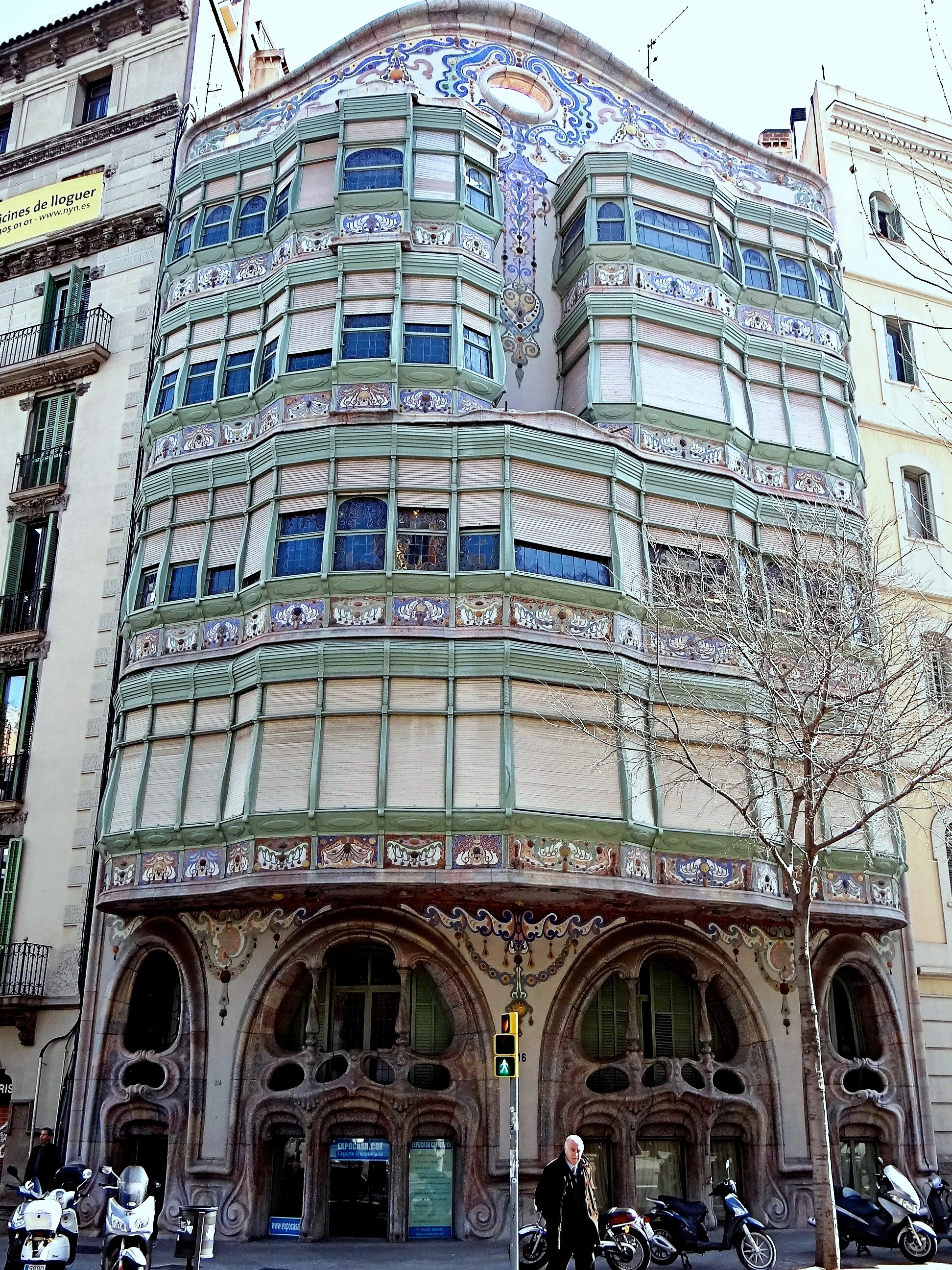
In sharp contrast, the rear façade bursts with Modernist creativity:
- Vibrant polychrome ceramics form a mosaic of color and light.
- Undulating balconies and rounded wooden galleries with green shutters.
- A whimsical turret resembling a harlequin’s hat.
- Organic and playful motifs throughout.
This façade is more expressive and private, capturing the artistic spirit of the Modernisme movement (shbarcelona.com).
Interior Highlights (Not Open to Public)
While interior access is generally not available, descriptions note:
- Richly decorated ceramic walls and ceilings.
- Stained glass windows by Rigalt i Granell.
- Artistic woodwork and curvilinear furnishings.
- Minimal alterations, preserving original Modernist craftsmanship (irbarcelona.com).
Visiting Casa Comalat: Hours, Tickets, and Access
- Interior Access: Casa Comalat is a private residence and office building; the interior is not open for public visits.
- Exterior Viewing: Both façades can be admired from the street at any time during daylight hours.
- Tickets: No tickets or reservations are required for exterior viewing.
- Guided Tours: Some specialized Modernisme walking tours may include Casa Comalat as an exterior stop. Check with local operators or Barcelona Turisme for details.
How to Get There
- Address:
- Main Façade: Avinguda Diagonal 442
- Rear Façade: Carrer de Còrsega 316, Barcelona, Spain
- Metro:
- Nearest stations: Diagonal (Lines L3, L5) and Verdaguer (Lines L4, L5), each about 10 minutes’ walk.
- Bus:
- Multiple city lines serve the area, including 6, 22, 24, 33, 34, H8, N4, N5, and V17.
- On Foot:
- Easily accessible from Passeig de Gràcia and other central locations.
Best Times and Tips for Your Visit
- Best Lighting: The rear façade is especially photogenic on sunny days from late morning to early afternoon (11:00 AM–2:00 PM).
- Climate: Visit in spring or fall (April–June, September–November) for mild weather.
- Duration: Plan for 20–30 minutes to appreciate both façades and take photos.
- Accessibility: Wide sidewalks make the site accessible for those with mobility challenges.
- Visitor Flow: Casa Comalat is less crowded than major attractions, offering a peaceful experience.
- Photography: Bring a wide-angle lens to capture sweeping curves and intricate details.
- Respect Privacy: Remain on public sidewalks and avoid disturbing residents.
Nearby Modernist Landmarks
Casa Comalat is ideally located for a Modernist walking itinerary. Notable nearby sites include:
- Casa Milà (La Pedrera): Gaudí’s architectural marvel with rooftop access.
- Casa Batlló: Renowned for its dragon-inspired roof and vibrant façade.
- Casa de les Punxes: A striking Modernist house-museum.
- Passeig de Gràcia: Lined with Modernist buildings, shops, and cafés.
Combine these for a comprehensive cultural experience.
Frequently Asked Questions (FAQ)
Q: Can I enter Casa Comalat?
A: No, the building is private and not open for interior visits.
Q: Are there official visiting hours?
A: The exterior can be viewed at any time during daylight hours; there are no set visiting hours.
Q: Do I need tickets?
A: No tickets are required to view the exterior.
Q: Are guided tours available?
A: Some Modernist-themed walking tours include Casa Comalat’s exterior. For details, check with Barcelona Turisme.
Q: Is the site wheelchair accessible?
A: Yes, sidewalks are accessible, but there are no special visitor facilities.
Q: When is the best time for photos?
A: Late morning to early afternoon on sunny days, especially for the colorful rear façade.
Summary and Practical Insights
Casa Comalat is an emblematic yet understated masterpiece of Barcelona’s Modernist era. Its dual façades—one refined and floral, the other exuberantly tiled—embody the creative dynamism of early 20th-century Catalonia. While interior visits are not permitted, the building’s exterior offers a rich visual experience and a fascinating glimpse into the city’s architectural evolution. For the best experience, combine a visit to Casa Comalat with nearby Modernist landmarks, and consult official tourism channels for any special access events or guided tours (barcelonaturisme.com; irbarcelona.com).
For curated walking tours, interactive maps, and insider tips, consider downloading the Audiala app. Stay up to date with the latest on Barcelona’s architectural treasures by following us on social media.
Listen to the full story in the app
The whole Casa Comalat,
told well.
Audio guides for 1,100+ cities across 96 countries. History, stories, and local insight — offline ready.

Verified, and shown.
Researched and written by the Audiala editorial team from historical records, architectural archives, and local expertise.
Last reviewed
Researched from Wikidata, Wikipedia & official sources · fact-checked · How we make our guides →